QueryTracker Blog

Helping Authors Find Literary Agents
Showing posts with label carolyn kaufman. Show all posts

Thursday, July 30, 2015

Best Writing Advice: Sometimes, You Just Gotta Throw Darts

I once had a good friend named Carolyn.

We met through QueryTracker, talking informally through the forum. Turned out, she worked closely with the site's captain and moderated the QT blog. One day, she invited me to write with them.

It was a huge opportunity. I thought, what a great gig. This could really pan out for me. What I didn't know was I'd be getting a dear friend and mentor in the bargain.

Carolyn was bright—no, brilliant—and funny and innovative and she had a charm about her that was far too humble to accurately portray her innumerable talents. One of those talents was giving advice. And over the years I'd turned to her quite often for guidance.

Once, I was lamenting being stuck for a topic for my upcoming spot on the blog. After a lot of sympathizing/grumbling on both our ends (because writer's block doesn't discriminate), she shared a few of her tactics for treating Topic Absentia. Then she added:

"I've also been known to flip through writers' books and just put my finger on a page and write about whatever I end up with."

As offhand a comment as that seemed at the time, it stayed with me. Frankly, it was good advice. For one thing, this nifty little trick actually worked. I've got a pretty sizeable writer's library, so every time I've resorted to this, it worked like a charm. It was an innovative way to harness the elusive muse and her inspiration.

Apart from the simplicity of the advice, there was a deeper takeaway message.

And, like just about everything else Carolyn said, it was light-hearted and poignant and brilliant, all at the same time.

Sometimes, you just gotta throw darts.

Ready, Aim...
Picking a random topic out of a writer's book is like throwing a dart. Close your eyes and pick one.

It's a stress-free way to make a decision and it pretty much takes you off the hook for it. Fate determined the choice. Now, all you had to do is make something of it.

These days, I find myself with more options than opportunities to see every single one of them through. Sometimes, it's just too hard to choose…and we waste valuable time waffling. If you've ever faced a deadline, you know how desperate lost time can feel. And what if we pick the wrong option? In a profession where doubt can do serious damage, anything that makes a decision a lot less guilt-ridden is a commodity.

In moments like these, you need to close your eyes, center your spirit, and lift a dart.

That sounds scary, I know. (And it would qualify for Jane's advice to do one scary thing every day.)

But it doesn't have to terrify you. You already know that, no matter where the dart lands, it's going to be a choice that you had already considered. It was on the table. It was something you wanted to do. And, if any one of those choices is a scary thing in and of itself, tell yourself this: you control that fear, because you had already been willing to face it.

Knowing that you have a table full of things you'd like to do doesn't mean it's easy to choose one from amongst them. Maybe you want to do all of them with equal intensity. Maybe they've divided themselves into categories like Easy, Necessary, Impressive (or Fun, Feels Like Work, Would Look Awesome in A Bio). But if you didn't think they should be done, they wouldn't be on the table in the first place. There are no bad choices.

So, feel the dart in your fingers. Weigh it. Envision its flight path. Imagine the satisfying thunk it will make when it hits home. Let fate make a decision, for once, and revel in that tiny fleeting moment of blameless freedom.

...Fire.
Then open your eyes, see what life has next in store for you, and smile because your aim is true.

You made sure of that before you even picked up that dart.


Ash Krafton is a speculative fiction writer who, despite having a Time Turner under her couch and three different sonic screwdrivers in her purse, still encounters difficulty with time management. She's the author of the urban fantasy trilogy The Books of the Demimonde as well as WORDS THAT BIND. She also writes for YA and NA audiences under the pen name AJ Krafton. THE HEARTBEAT THIEF, her Victorian dark fantasy inspired by Poe’s “The Masque of the Red Death”, is now available.

Friday, October 10, 2014

Publishing Pulse, October 10, 2014

This Week at Query Tracker
The profiles of several agents were updated this week. Please make sure you double-check every agent's website or Publisher's Marketplace page before querying.
Ready to write your own success story?
If you're a QueryTracker member (membership is free) you can view the database of more than 1200 agent and publisher profiles. Premium Members can be notified whenever an agent or publisher is added or updates their profile, in addition to receiving access to several other enviable features.
This Week in Publishing
This made me grin—and nod emphatically the entire time while reading it. A “Dear Agent” letter of a different kind.
Self-publishing or traditional publishing: know which path you want to follow before you set out, because some steps cannot be untread. Here’s an example of what agents do not want to see.

Joanna Penn shared a podcast in which she and Helen Sedwick talked about various legal issues in “Copyright, Publishing Contract Clauses, Image Use, And Avoiding Getting Sued”.
A few tips for success that all writers can use.
Writing a memoir? Here are some helpful pointers from Abigail Carter.

#WriteTip Round-Up
Try keeping a list of active verbs you can refer to when writing
Open your book with conflict. No conflict, no story
If nothing changes then the scene is either not working hard enough or could be cut.
What's worrying or annoying you right now? Write a story about it. (Change the characters, increase the danger)
Don't give two main characters names beginning with same initial and with same number of syllables (David/Derek, Rosie/Rachel)

Today in Publishing
Ever wonder what a genie would say to his therapist? I did. :)

My paranormal romance WORDS THAT BIND was released by The Wild Rose Press today. It's a bittersweet moment, really, because our dear friend and QTB legend Carolyn Kaufman isn't here to share it.

She was instrumental in the development of this book--her expertise in the field of psychology made me rethink the plot, her enthusiastic support convinced me it was a story worth writing, and her memory will forever inspire and encourage me.

This book is for her.

Have a good weekend, everyone!
I'll be at New York Comic Con, getting' my fangirl on. If you plan on attending, just yell for me when you come in. See you there!


Ash Krafton is a speculative fiction writer who, despite having a Time Turner under her couch and three different sonic screwdrivers in her purse, still encounters difficulty with time management. Visit Ash at www.ashkrafton.com for news on her urban fantasy series The Books of the Demimonde (Pink Narcissus Press). Her paranormal romance WORDS THAT BIND (The Wild Rose Press) comes out today.

Wednesday, July 16, 2014

Advice from Carolyn Kaufman, Part 4: Get Started on Another Book

I've been posting a short series based advice for aspiring authors from my friend, fellow founding QT blogger, and critique partner, Carolyn Kaufman. Previous posts can be found here: Part 1: Professionalism,  Part 2: Accepting Criticism and Part 3: Controlling your Online Image.

Carolyn passed away well before her time, but she left a rich legacy of advice for writers in her book and on her blogs, including Psychology Today and this one.

This is the third part of an interview she did for me back when her book, The Writer's Guide to Psychology, was about to come out.

What I’ve Learned: Advice for Writers Who Aspire to Publish  
Dr. Carolyn Kaufman 1973-2013 
4. Get started on another book. 
If your first idea doesn’t sell, move on to another one. The Writer’s Guide to Psychology wasn’t the first book idea I had – it was just the first one strong enough to grow into a true book. I’m extremely methodical about preparing a proposal – I spend months researching and writing, and I want to know exactly what’s going into each and every chapter – so I’m pretty committed to finding the book a home once I reach that stage. Other writers find it fairly easy to write up their ideas and send them out without doing that kind of preliminary work. When you’re working so hard on one book – writing it, editing it, promoting it – it feels like your entire world. The truth is, though, that if you want to be more than a one-hit wonder, you will eventually need to write another book. Try to get that next proposal ready before everyone forgets who you are!

Carolyn was so right. At this point in my career, the thought of only working on one thing at a time is laughable. I have two publishers and four books under contract. Three books will release int 2014 and probably four in 2015.

The good thing about being this busy is I don't really have time to fret over one single book. At one point this year, I was drafting a proposal, writing two novels (different genres) and editing another, while yet another had just been published and I was dealing with interviews and pimping the new baby to readers and reviewers.

*hands in the air while screaming on the way down the roller coaster drop*

I've been lucky in that I've always had another project in the works while I was querying, on submission, or waiting for publication. Otherwise, I'd probably be friendless and my family would hate me, too. It's hard not to fret and get paralyzed by the odds or the changing world of publishing. I've found I work best under pressure with lots of balls in the air. No time to brood.

Carolyn was an amazing time manager. She blogged all over the place, taught college classes, was a fabulous photographer, and still, she found time for friends and reached out to aspiring writers who sought guidance. She was a fabulous resource with regard to psychological issues addressed in books and for professional advice. Sadly, her website no longer exists, but you can check out some of her articles the links found at the bottom of Part 1 in this series.


***

Mary Lindsey is one of the founding members of the QT Blog. 

She writes young adult novels for Penguin USA and is the author of Shattered Souls, Fragile Spirits, and Ashes on the Waves. She also writes adult romance for Entangled Publishing as Marissa Clarke. Love Me To Death is scheduled for publication October, 2014. 

Mary is represented by Kevan Lyon of the Marsal Lyon Literary Agency and can be found the following places: Twitter, Facebook, MaryLindsey.com and MarissaClarke.com. 

Wednesday, July 9, 2014

Advice from Carolyn Kaufman, Part 3: Control Your Online Image

I've been posting a short series based advice for aspiring authors from my friend, fellow founding QT blogger, and critique partner, Carolyn Kaufman. Previous posts can be found here: Part 1: Professionalism and Part 2: Accepting Criticism

Carolyn passed away well before her time, but she left a rich legacy of advice for writers in her book and on her blogs, including Psychology Today and this one.

This is the third part of an interview she did for me back when her book, The Writer's Guide to Psychology, was about to come out.

What I’ve Learned: Advice for Writers Who Aspire to Publish  
Dr. Carolyn Kaufman 1973-2013 
3. Control your image: be conscientious about what you share online. 
This is a good general rule, but it’s doubly important when you’re trying to convince people – agents, editors, potential readers – that you’re a professional. 
Thanks to books (and films) like Fear and Loathing in Las Vegas, we all know that Hunter S. Thompson was heavily into drugs and alcohol. Unfortunately, the same image might not do much for you if you’re writing YA or MG or even a nice nonfiction book on scrapbooking. Even if you are writing edgy material, you don’t want unsavory personal choices to overshadow your work, a la Jessica Simpson or Britney Spears.

Yes! I completely agree with Carolyn. I see this all the time. I guess it's the anonymity of the internet that makes people want to over-share, but stop! Please.

Querying authors: Save the behind the curtain posts for after you land an agent or publisher or decide to publish your book yourself. Don't put the angst of the process out there for everyone to see while it's happening. To outsiders, it looks like you are a failure (which rejection of a manuscript in this business is NOT), or it makes you look like a whiner to those inside. A little bit is okay, but were an agent to Google you, and see nothing but posts about rejection letter after rejection letter and how torn up and discouraged it makes you feel, it might affect his or her stand on what to do about your manuscript. It's a tough business. It takes tough people--or at least people who can appear tough. Sad, but true.

After the fact, whine and rant away if you feel you must, but be careful. It's out there forever.

As for online persona… I go to conferences and workshops all over the country and meet readers who feel like they know me simply from online interaction. Without having met me in person, they come up and introduce themselves (sometimes by Twitter handle) knowing I'm friendly and approachable because I work hard to give out that vibe online.

I can't even tell you how many times I've wanted to rant and rail about specifics of the industry or jump into a flame war over a review of what I though was a fantastic book by an author I love, but I don't. I never do. Not because I'm scared, but because there is absolutely no benefit from it. I write commercial fiction. I'm aware that the readers of my books don't really care about my political, religious, or industry beliefs. They care about books, and dogs, and my kids and funny crap I accidentally do or say--usually involving my dog or kids. Now, other authors are in different situations, especially if their works relate to specific issues hitting the coals. I can only speak to what works for me.

When I want to jump in the middle of something flaming on a board or Twitter, I step back and think, would I do that in real life? Would I tell a group of my friends that? If so, I go for it. But it's rare.

More than that, I think long and hard about how personal I want to get online. I'm pretty open, but I don't air dirty laundry. Some people put it all out there, and if it's helpful for them personally or professionally or enhances their platform, okay. For me, its like putting a personal diary out there for strangers to read and pass around. Not for me, thanks.

Carolyn mentioned genre related to persona being a consideration. I completely agree. In real life, I cuss like a sailor (thank you, Dad). Online, I intentionally don't swear because I speak at middle and high schools and write for teens in addition to adults. I don't want a school board or teen book club to cancel an appearance because they think I'm going to go all potty-mouth on campus in front of an auditorium full of students. Teens follow and interact with me on social media, and I never ever let myself forget that. I'm an ambassador for my books, my publishers, my genres, my profession and ultimately, my brand as an author. You know… I'm that super nice woman from Texas who loves meeting new people and writes ghost stores for teens and adults.

Carolyn had a fantastic online presence. She prided herself on her accessibility to aspiring writers as a resource of psychological issues addressed in books and for professional advice. Sadly, her website no longer exists, but you can check out some of her articles the links found at the bottom of Part 1 in this series.

Stina did a great post on online behavior recently you might want to check out called, You Really Want to Avoid This.


***

Mary Lindsey is one of the founding members of the QT Blog. 

She writes young adult novels for Penguin USA and is the author of Shattered Souls, Fragile Spirits, and Ashes on the Waves. She also writes adult romance for Entangled Publishing as Marissa Clarke. Love Me To Death is scheduled for publication October, 2014. 

Mary is represented by Kevan Lyon of the Marsal Lyon Literary Agency and can be found the following places: Twitter, Facebook, MaryLindsey.com and MarissaClarke.com. 

Wednesday, July 2, 2014

Advice from Carolyn Kaufman, Part 2: Accepting Criticism

Recently, I posted the first part of this article regarding advice from my friend and critique partner, Carolyn Kaufman.

 Carolyn passed away well before her time, but she left a rich legacy of advice for writers in her book and on her blogs, including Psychology Today and this one.

 This is the second part of an interview she did for me back when her book, The Writer's Guide to Psychology, was about to come out.

What I’ve Learned: Advice for Writers Who Aspire to Publish  
Dr. Carolyn Kaufman 1973-2013 
2. Be open to honest feedback: Realize that criticism of your idea or writing isn’t criticism of you. Also realize that you are not objective about your work, and that the only way you’re going to see those flaws that are hidden from you is to rely on other people. The only way you’re going to grow as a writer is to really listen and consider what others have to say – especially when their feedback isn’t all glowing. (In fact, if all you’re getting is glowing feedback, you’re not getting honest feedback. Everybody’s work has rough edges. And if you’re not getting honest feedback, it’s because you’ve somehow sent the message that you don’t want or can’t handle honest feedback. So take a step back and decide how important publication is to you. If you’re determined to get there, you need to find a way to hear and utilize constructive criticism.)

Easier said than done. Truth can sting, but it also can make us better, which is why I loved having Carolyn as a critique partner. She told it like it was, and my manuscripts were much better for that. She lived up to her own advice and accepted criticism gracefully. More information on Carolyn and her book can be found at the bottom of Part 1.

How about you? Do you have writing buddies who give and accept honest criticism? (Feel free to give them a shout out in the comments).


***

Mary Lindsey is one of the founding members of the QT Blog. 

She writes young adult novels for Penguin USA and is the author of Shattered Souls, Fragile Spirits, and Ashes on the Waves. She also writes adult romance for Entangled Publishing as Marissa Clarke. Love Me To Death is scheduled for publication October, 2014. 

Mary is represented by Kevan Lyon of the Marsal Lyon Literary Agency and can be found the following places: Twitter, Facebook, MaryLindsey.com and MarissaClarke.com. 

Wednesday, June 18, 2014

Advice from Carolyn Kaufman, Part 1: Professionalism

It is such a joy to blog here again after several years away. My name is Mary Lindsey, and I was one of the original Querytracker bloggers, along with H.L Dyer, Suzette Saxton Fisher, Elana Johnson, and Carolyn Kaufman. 

It was a tremendous loss, not only to me, personally, but to QueryTracker community, her college students and fellow professors, her family and friends, and to aspiring and established authors when Carolyn Kaufman died unexpectedly in September 2013 of a brain aneurism.

When I mentioned to Patrick McDonald, (owner/creator/designer of QueryTracker.net) that I had come across an old interview I did for Carolyn's first book, we agreed it would be a nice tribute to Carolyn, and all the hard work she did on behalf of aspiring authors, to post some of her wisdom as a tribute. So, here we go!

Here's the first bit of advice she had for aspiring authors (second tip will be posted on July 2):

What I’ve Learned: Advice for Writers Who Aspire to Publish 
Dr. Carolyn Kaufman 1973-2013
 1. Treat everyone well at every step along the publishing path. That includes your crit buddies, agents and their assistants, editors, publicists, and anyone else you encounter along the way. How well you write is important, but I genuinely believe professionalism is nearly as important. If you’re arrogant, entitled, mean, petty, or refuse to be a team player, nobody is going to want to work with you. There’s a reason most authors’ Acknowledgements page is lengthy – they didn’t reach the finish line (of publication) alone.

It seems like such an obvious suggestion: Be professional and treat people well. And it is… until the drama begins. Bad reviews. Inflammatory blog posts or Tweets. Flame wars on forums. The online drive by nastiness can suck a writer in and under and make Carolyn's advice nearly impossible to follow.

But follow her advice.

The professional contacts and friends I've made over the years have been one of the most important aspects of my success as a writer.

Carolyn lived up to her own advice, setting an example not only as an author and expert, but as a personal friend and critique partner. I was fortunate enough to have her as a critique partner for several years, and though her critiques were often harsh, they never came across as anything other than honest and professional--like Carolyn herself. She is terribly missed by all of us at QueryTracker.

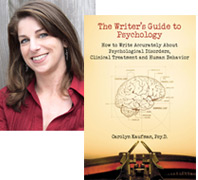
Carolyn Kaufman's bio and articles on psychology for writers can be found on the Psychology Today Blog, where she was a contributor. Her book, The Writer's Guide to Psychology: How to Write Accurately about Psychological Disorders, Clinical Treatment and Human Behavior, is available for purchase and is an excellent resource for established and aspiring writers.


***
Mary Lindsey is one of the founding members of the QT Blog. 

She writes young adult novels for Penguin USA and is the author of Shattered Souls, Fragile Spirits, and Ashes on the Waves. She also writes adult romance for Entangled Publishing as Marissa Clarke. Love Me To Death is scheduled for publication October, 2014. 

Mary is represented by Kevan Lyon of the Marsal Lyon Literary Agency and can be found the following places: Twitter, Facebook, MaryLindsey.com and MarissaClarke.com. 

Monday, July 29, 2013

Finding a Reputable Agent or Publisher

Base Image: DragonTash
I recently got an excited email from an acquaintance whose book had been accepted by a "publisher" with a terrible reputation for doing very little publishing and a great deal of stealing starry-eyed writers' hard-earned dollars. I had to give her the bad news that the publisher was not only disreputable, it was a scammer.

To keep the same thing from happening to you (or your friends), it's good to understand what makes a publisher reputable or reprehensible. Read on!

How Do I Find a Reputable Agent or Publisher?

There are a lot of ways to get published these days; Jane Friedman summarized them well in her recent objective infographic, 5 Key Book Publishing Paths. With regards to financial risk and value, a summary of her paths is:


  1. Traditional: Advance + royalties model; publisher takes on all financial and creative risk but is extremely selective about which books are chosen (e.g. Penguin)
  2. Partnership: No fee to publish, no advance; partner selective about which books are chosen (e.g. Rogue Reader)
  3. Fully Assisted: Author pays upfront free; all work is accepted (e.g. AuthorHouse). This is also sometimes referred to as vanity publishing.
  4. DIY + Distributor: Author does most work, pays service for conversion of all files into e-book, POD, or print; distribution service may take a percentage of sales and is responsible for paying you (e.g. CreateSpace)
  5. DIY Direct: Author does all work and provides retailers with completed books; retailer takes a percentage of sales (e.g. Amazon KDP)


Friedman's Key Publishing Paths Infographic
For a long time, the die-hard rule of the road was, never give money to an agent or a publisher, but the pond has gotten a lot muddier with so many available options. If you wish to self-publish or go through a “fully assisted” service like Author House, you will be paying some money to see your book published; however, if you produce a true quality product that people want and you are willing and able to do the work to promote it, you may do extremely well.

The most outspoken (and one of the most successful) self-publishing authors is J.A. Konrath, who could be called an entrepreneur. He's had so much success and made so much money that he had no problem turning down a $500K publishing deal from a mainstream publisher in 2011.

Of all the publishing approaches, the “fully assisted” (aka vanity) route is still seen by most as the worst since the service will publish anything, regardless of quality, and along the way they will push you to spend more and more money on things you don't need. As Friedman notes, “The self-pub success stories you hear about do not come from full-assist services.” So if you’re going to self-publish, take one of the DIY approaches.

If you want to go a more traditional route, however, you will either need to go through an agent or approach small publishers directly. The trick to this can be sorting the shysters from the reputable, so let’s look at some rules of thumb.

Agents

Not all resources, including some of the big-name publications and databases, put the legitimacy of the agent or agency first, but QueryTracker does. Though you should always keep your eyes open, administrator Patrick McDonald does his utmost to include only reputable agents. People frequently ask why this agent or that agent is not included, and now you know why. (Note: Sometimes there is nothing actually wrong with an agent, she may just be new enough that she has not yet built any reputation either way.)

You should never give money to an agent. If one tries to charge you for anything—from reading to editing to finding a home for your book—run.  Many less-than-upstanding “agents” make their money not from book sales, but from referring unwitting authors to editors who will charge them an arm and a leg without actually providing a quality service. In these cases, the agent gets a kickback from the editor. It’s fine for an agent to recommend more extensive editing than she is willing to do, but choose your own editor rather than accepting a referral. And if an agent takes you on, her editing assistance must be free.  It’s a conflict of interest for an agent who is also your editor to take your money.

When you find an agent or agency that interests you, always do some additional research—and that includes agents on QueryTracker, just to be safe. Two of the best resources (listed beside each QT agent’s entry) include Preditors and Editors for agents and agencies and SFWA’s Writer Beware. You can also ask what other people have heard on message boards like those in the QueryTracker Forum.

Finally, be sure to check out the agent and agency's website and (if available) blog. Reputable agents and agencies should have significant recent sales in the area you wish to publish.

Publishers

QueryTracker has a growing list of publisher listings, which include the same information on acceptance and rejection statistics that is provided for agents and agencies.

The rules of the road are very similar to those noted above for agents.  Traditional and partnership publishers should not charge you upfront fees of any kind, including those for editing. And again, always double-check the publisher’s reputation by looking for recent sales, and by visiting Writer Beware. (If you want to take a look at one active “publisher”—who keeps changing names to try to avoid its own bad reputation—that is notorious for bilking writers, look at the Writer Beware entry on SBPRA.)

Don't Forget!

In both cases, remember—a publisher makes its money from sales. It gets the big percentage (often around 90%), and you get the small one. Likewise, a literary agent makes money because she gets a percentage—usually 15% for domestic sales and 20% for foreign sales—of any money the author makes. If an agent is involved, any money you make goes from the publisher to your agent, who takes her 15% and then sends the rest along to you.

It is therefore in the interest of such reputable agents and publishers to only choose writers who can actually sell books, because the author has to start making money on the book for them to get paid!

Once your manuscript is as polished as you can possibly get it and your betas (and/or editor) can't find much to complain about, you're ready for the next step—querying. More on choosing an agent or publisher who really "gets" your work in a future post!*

Have you ever had a bad experience or a close call with an agent, agency, or publisher? Without naming names, tell us about what you learned from the experience in the comments.


Click the link to Tweet it! Share what you read today:


*I’ve gotten several questions via email recently asking me about dealing with agents, so this is the third part of a series of posts on figuring out whether you’re ready to start querying, whether you need an agent,  finding a reputable agent, and choosing someone who really “gets” your work. Of course, QueryTracker.net will help you through all of the stages, and fellow QT blogger Jane Lebak recently wrote a great post on How to Use the QueryTracker Site.


Carolyn Kaufman, PsyD's book, THE WRITER'S GUIDE TO PSYCHOLOGY: How to Write Accurately About Psychological Disorders, Clinical Treatment, and Human Behavior helps writers avoid common misconceptions and inaccuracies and "get the psych right" in their stories. You can learn more about The Writer's Guide to Psychology, check out Dr. K's blog on Psychology Today, or follow her on Facebook! 

Monday, November 12, 2012

Thesaurus Pros and Cons

When I’m writing fiction, my favorite book is the thesaurus. For years I had a well-thumbed version of Roget’s II; now I keep thesaurus.com open in the background as I edit.

If by some chance you’ve never used a thesaurus and are not familiar with the term, it’s a dictionary of synonyms and antonyms. So let's say I randomly input the word crackle; the thesaurus gives me back synonyms like crimple, crinkle, snap, sparkle, rustle, rattle, and pop.

It’s a fantastic way to find just the right word, and I use it a lot to come up with strong verbs for the verb-adverb combinations I tend to write into first drafts (e.g. walked quickly becomes strode).

But there are dangers to the thesaurus.When I was younger, I’d open my Roget’s and find a bunch of obscure words I’d never heard of next to the ones I recognized. And if I liked the way one sounded, I’d throw it into the manuscript. Which sometimes made my writing read like…well, a vocabulary test. For example, one of the synonyms I didn’t list for crackle was crepitate.

Say what?

I just had to use extirpation in my manuscript... Bad idea.
I looked it up (dictionary.com is a companion site to thesaurus.com—a good reference to keep handy to make sure you understand the nuances of a synonym), and it literally means “to make a crackling sound.” So it's a perfect synonym, right?

Probably not. Darned if I’ve ever heard that word before. Which typically means that people just don’t talk like that.

Writing the paper crackled as I balled it up works fine; writing the paper crepitated as I balled it up makes you sound like you’re getting paid to use 50c words.

Beware the 50c words! (Because you're not getting paid to use them.)

I’m kind of a thesaurus snob in that I strongly prefer Roget’s—now in a 21st-century edition—which is what thesaurus.com usually references first. Merriam-Webster’s, which was for a long time the most common online and software thesaurus, has just never done it for me. You may, of course, feel differently.

If you don’t already have a favorite, a fun thesaurus that’s worth trying is Thinkmap’s Visual Thesaurus. It’s $20 a year with a free 14-day money-back-guarantee trial. You can also try it for free without a subscription.

You type in a word and the word appears with moving synonyms (nouns are in red, adjectives are in yellow, and verbs are in green) attached to it. If you click on one of those words, new synonyms and antonyms bounce and float into place. It even has a “word suggestions” column for people who needs words that sound like or are spelled similarly to the original word.

Do you use a thesaurus? Which one is your favorite resource? Have you noticed any pitfalls I didn't mention?


Carolyn Kaufman, PsyD's book, THE WRITER'S GUIDE TO PSYCHOLOGY: How to Write Accurately About Psychological Disorders, Clinical Treatment, and Human Behavior helps writers avoid common misconceptions and inaccuracies and "get the psych right" in their stories. You can learn more about The Writer's Guide to Psychology, check out Dr. K's blog on Psychology Today, or follow her on Facebook! 

Wednesday, October 3, 2012

Using Life's Disasters to Add Authenticity to Your Writing

Not where you planned to spend your night...
Bad things – sometimes terrible things – happen to us all. While they’re happening, we’re focused on surviving them.

After you manage to do that, for better or worse, you’ve learned something new about the human condition. And if there’s one thing writers do well, it’s share how hard it is to be human.

I have this little voice inside that I call The Writer. When something really awful happens, it’s the part of me that’s yelling “Oh man, you can totally use this in your stories!” Don’t get me wrong, a lot of times panic and horror mostly overwhelm the Voice, but for me, it’s always there.

Whether you have a mouthy The Writer voice or not, after you survive the emergency, disaster, or tragedy, you’re going to have to process it. Most people do that by talking with others, but as a writer, you may also want to…well, write about it. Whether you’re journaling in the first person or incorporating your experience into a character’s journey, if you do a good job of sharing what you went through, including your struggle to find meaning in it all, that will resonate with your readers.

There's nothing like reading something that makes you think, "Wow, the author really knows what she's talking about. That's exactly what it's like!"

The loudest I ever remember my The Writer voice being was during college, when my long-term boyfriend got into a fistfight with his identical twin brother. Everyone had been drinking. My boyfriend took the keys away from his twin’s girlfriend, and his twin took offense. Hence, the fistfight.

That was the first (though certainly not the last) time in my life that I was genuinely hysterical. Most of me was freaking out, trying to decide how to intervene, but in my head The Writer starts jumping up and down and shrieking, “Wow, this hysteria thing is fascinating. You’re laughing and crying and feeling like you’re half-outside your body. We have got to remember this so we can use it in our writing!”

So now when I have an hysterical character, he or she gets to be hysterical in full the-writer-has-experienced-it Technicolor.

Another example:

A couple of weeks ago, I got out of bed, put in my contacts, and promptly started to go blind.

Over the next few hours, my surroundings appeared to be filling with more and more smoke, which nobody else could see. I changed my contacts. That didn’t work, so I got online, Googled it, and concluded I must be getting a migraine. I’ve never had one with hazy or cloudy vision before, but the magical Internet assured me that such things happen. I’d had both my eyes and my physical health checked the previous month and I’d come through with flying colors, so a migraine made the most sense.

The problem was that over the next few hours, everything became so hazy that I couldn’t see myself in the mirror, which is not normal for a migraine. ("Ocular migraines" only occur in one eye, and the blindness passes in an hour or less.) I went back on Google and (with great difficulty, at 300% magnification) searched some more. If you’re going blind and it isn’t a migraine, the warnings on the internet are dire. As in, permanent blindness. And death.

Terrified, I broke down sobbing and called my mother to take me to the ER.

Though the storyteller in me would love to give you all the gory details about my visits (plural) to the ER (I was misdiagnosed the first time I went), that isn’t really the point here. My point is that I now know all about multiple conditions that can cause sudden cloudy and blurry vision, as well as blindness. I know how the ER handles emergencies like this. (They make you read an eye chart. Which is very difficult when you are blind.) I know what kinds of medications they recommend (antibiotic eye drops if the surface of the eye is involved), what kinds of specialists you’re supposed to see (ophthalmologists if the eye is involved; neurologists if the brain is involved), what it’s like to get a CAT scan (pretty cool), what it’s like to feel like your eyeballs are on fire (very not cool), and what it’s like to get your corneas dyed so the doctor can look for abrasions. I also learned that sometimes when you go blind, everything doesn’t go black. It goes white.

And soon, unfortunately, I will learn how much all of that stuff costs.

If you’re wondering what the final diagnosis was…turns out I had managed to chemically burn both of my corneas. How did I pull that off? Over the past 15 or 20 years, I have always washed my contact lens cases in the dishwasher. I got a new dishwasher, and apparently it didn’t wash all the detergent out of my lens case. I put the lenses in the lens case, they soaked up the detergent, I put them in my eyes, and…voila, chemical burns. Interestingly, it didn’t hurt a bit. The pain came later, after I’d removed my lenses. The theory is that blinking sloughed off the burned part of the cornea over the next few hours, which eventually resulted in dead-of-night second-trip-to-the-emergency-room agony.

Fortunately, I have fully recovered from the experience (typically corneal abrasions resolve themselves in 24 - 72 hours), and I can see and read and drive (and write) again.

But now my characters can experience all of these things realistically. Likewise, your characters can experience the types of disasters you have. Sure, we had to go through something miserable to learn what we did, but since we had to go through it…we might as well figure out how to get a story out of it!**

** After we survived The Great Scorched Eyeball Incident, my mom said, “I bet you’ll at least get a blog post out of this.” She clearly knows me – and The Writer – well! 


Carolyn Kaufman, PsyD's book, THE WRITER'S GUIDE TO PSYCHOLOGY: How to Write Accurately About Psychological Disorders, Clinical Treatment, and Human Behavior helps writers avoid common misconceptions and inaccuracies and "get the psych right" in their stories. You can learn more about The Writer's Guide to Psychology, check out Dr. K's blog on Psychology Today, or follow her on Facebook! 

Wednesday, September 12, 2012

Using Personal Issues to Enhance Fiction

This is a test of your creative imagination...
There is a projective psychological test called the Thematic Apperception Test (TAT). It’s not the most empirical thing in the world, as the client essentially tells a subjective story about each of a series of (rather dated) black-and-white scenes. Therapist and client then look for recurring themes in the stories, sometimes providing surprising insight into client concerns.

When we write stories of our own, in many ways we are participating in a grand version of the TAT, exorcising relevant life themes onto the page, sometimes over and over. It’s not unusual for a particular writer’s stories to have common elements, characters, themes, and settings.

So how, someone once asked me, how do we avoid projecting our own concerns, our own personal narratives, into our stories?

Honestly, I’m not sure we should try to avoid doing so.  

From a psychological standpoint, there is often something healing in writing, and if you are continually finding the same theme on your page, that repetition compulsion (i.e. a repetitive re-enactment of a particular set of circumstances) may indicate something you (and your characters) need to work through before you’re going to be able to move on to something new. One of the beautiful things about storytelling is that you can play out various outcomes. Don’t be afraid to push your characters into uncomfortable situations. Let them wrestle with the issue or issues in their own ways. See what happens.

Another argument for allowing the same theme to recur is that it’s clearly something that has a lot of energy in your psyche. If you let it, that energy will come through and engage your readers. Especially if you’re willing to push your characters—and yourself—into literary places that are not familiar, comfortable, or safe.
Your main character is afraid of failing in school and not measuring up? Take a deep breath and let him fail. Let all those awful things that he’s (you’re) afraid of happen. How will he overcome those problems? How will those struggles affect him as a person?  

If the theme recurs later, push both your characters and yourself even harder, into even darker, scarier places. Archetypal psychology, often used in storytelling, suggests that each hero must eventually confront his greatest fears if he is to overcome them. Some of your characters may fail or even break under such pressure; they may even become villains as a result. Don’t be afraid to explore those possibilities; you may find some of your best villains down those dark passages.  But also remember that the most exciting plots and the strongest heroes are also born of such trials. It may be a rocky road, but your hero will prevail and overcome…and so will you.


Carolyn Kaufman, PsyD's book, THE WRITER'S GUIDE TO PSYCHOLOGY: How to Write Accurately About Psychological Disorders, Clinical Treatment, and Human Behavior helps writers avoid common misconceptions and inaccuracies and "get the psych right" in their stories. You can learn more about The Writer's Guide to Psychology, check out Dr. K's blog on Psychology Today, or follow her on Facebook or Google+! 

Monday, August 27, 2012

Writing Realistic Love Relationships

Credit: Spekulator
One of the challenges of writing relationships is making romantic relationships realistic. A problem I see in some fiction is that there is no reason for the characters to fall for each other or be in love—other than the fact that they're both excruciatingly hot, of course.

As in real life, your characters should be attracted to the people they're attracted to for a reason beyond the superficial. (Don’t get me wrong, some people fall into passionate but superficial relationships, but they tend to burn out quickly without the other important aspects of true love: commitment and intimacy.)

In real life, finding and getting along with your “other half” long-term is difficult. The good news when it comes to fiction is that Conflict is the engine that keeps every story going, and the love relationship between your characters is one of the most important parts of that engine.

Some questions to help you generate realistic conflicts. Try to be as specific as you can when you answer.

  • What drives you crazy in a relationship? What are your pet peeves?
  • What drives your partner (or past partners) crazy about you?
  • What kinds of life decisions and stages have created conflict in your life? That is, which things challenge your relationships? Money decisions? Family decisions? Work decisions? Something else?
  • What really stresses you out (in general)? How does this impact your relationships with others? 

In real life people choose the partners they do for all kinds of reasons, some of them noble and romantic, some of them less so.  For example, maybe they had great "chemistry" with their partner. Maybe they had a lot in common.  Maybe they need to feel needed.  Maybe they wanted to get out of their parents' house.  Maybe they were ready to settle down.  Maybe they needed someone to help them parent a child.  Regardless, there is definitely a reason other than that an author needed them together to make a particular storyline work.

Some things to think about:

  • What attracted your character to the love interest in the first place?  
  • What needs does the love interest fulfill for your hero or heroine?
  • Why is the love interest different from all the other men and women out there?

Once your characters are together, why do they stay together?  Doing couples therapy was always a fascinating endeavor for me, because couples with enormous problems would come in and complain about each other and the relationship—but still want to make it work.  They still loved each other.  And they could usually tell you why. In other words, for all of the ways they drove each other crazy, they always had a reason that they were still together.

In my stories, relationships are usually messy.  People say the wrong things, have affairs, and hurt each other—sometimes accidentally and sometimes on purpose. Ex-partners create havoc, hidden histories drive wedges, but in the end love always prevails for me.  I like to pretend to be pragmatic and sensible, but the truth is that I'm a hopeless romantic, and in my stories, love really is the greatest power of all.


Ask yourself:

  • What is the absolute worst thing each partner could do to the other? (Usually the "worst thing" varies by character.) Why is that the worst?
  • Can you work that conflict into your story?
  • Why might your characters still want or need each other in spite of this betrayal?
  • Usually things are not "like new" after a betrayal—what are the lingering effects of having survived the conflict?

I'm most drawn to fictional relationships where there is a strong, identifiable reason for an attraction at the same time there are problems (internal or external to the relationship) that are trying to tear the couple apart. For me, the attraction to each other has to be stronger than the problems, but not by much. The characters have to keep coming together the way a pair of magnets will.  They might push against each other, but inevitably, they snap together and hold on.

How about you? What are your secrets for making romantic plots and subplots work?

Carolyn Kaufman, PsyD's book, THE WRITER'S GUIDE TO PSYCHOLOGY: How to Write Accurately About Psychological Disorders, Clinical Treatment, and Human Behavior helps writers avoid common misconceptions and inaccuracies and "get the psych right" in their stories. You can learn more about The Writer's Guide to Psychology, check out Dr. K's blog on Psychology Today, or follow her on Facebook or Google+! 

Wednesday, July 18, 2012

Are You a Real Writer?


I started writing in the sixth grade, and by the seventh I was working on a novel. By the eighth, I had something solid—a real story with decent characterization and real character and plot arcs. I started thinking of myself as a writer before it ever occurred to me to wonder what that meant, and “writer” has remained a core aspect of my personality ever since.

But not everyone has that experience. In fact, I’ve met a lot of people who write who aren’t sure whether they qualify as  “real” writers.

Since I’ve been doing a lot of digging into the psychological and sociological research on writing and creativity, I decided to explore how scientists understand or “operationalize” (define) a writer.

Here’s what I learned.

At the most basic level, a writer is someone who writes regularly. This is repeated over and over in the literature, albeit in different ways: A writer is someone who shows up every day and writes. Writing is incorporated into the writer’s daily life.

That may seem obvious, but there are a lot of people out there who want to be writers but don’t do much actual writing. They plot constantly in their heads (or even on notecards or a bulletin board), but never actually do anything with the material.

I’m not sure exactly why they do that—one reason I’ve heard is that these people are afraid that if they actually start trying to write, their stuff will be awful.  And heck, let's be realistic—maybe it will! But you have to start somewhere, and as we’re discussing, you can’t be a writer if you don’t write.

Iris Murdoch once created a character who said, “I live with an absolutely continuous sense of failure. I am always defeated, always. Every book is the wreck of a personal idea.” And Gail Godwin said, “For every novel that makes it to my publisher’s desk, there are at least five or six that died on the way. And even with the ones I do finish, I think of all the ways they might have been better.”

So even successful writers struggle with that feeling that they’re not producing material that’s as good as the original idea. Nonetheless, they press forward and keep writing. And strive to keep getting better and keep growing.

Over time, according to the research, someone who continually incorporates writing into his or her life is— consciously or not—fostering the identity of a writer.


And if you don't think you write regularly enough? Then try building some dedicated writing time into your day, even if it's just journaling about ideas or possibilities. It doesn't have to be every day, and it doesn't have to be for hours at a time. Just carve out a niche of time—half an hour, maybe, every other day—during which you nurture the writer in you.

Because that’s all it takes to be a “real” writer!

Your turn: When did you start calling yourself a writer? What makes you feel like a real writer? What tips would you give to someone who wants to build on his or her writing identity?


Carolyn Kaufman, PsyD's book, THE WRITER'S GUIDE TO PSYCHOLOGY: How to Write Accurately About Psychological Disorders, Clinical Treatment, and Human Behavior helps writers avoid common misconceptions and inaccuracies and "get the psych right" in their stories. You can learn more about The Writer's Guide to Psychology, check out Dr. K's blog on Psychology Today, or follow her on Facebook or Google+! 


Have a question about psychology in your writing? Use the email address on the right-hand side of the QTB page, or visit ArchetypeWriting's Q&A page.

Wednesday, May 23, 2012

Free Internet Tools for Writers


I recently attended a conference where we discussed online tools for teachers, and that got me thinking about online tools for writers. So today we’re going to look at a few of my favorites, and I hope you all will share your own favorites in the Comments!

1. JoliPrint

I’m a little old-fashioned in that I enjoy reading things on paper rather than online. And if I find something I want to read again, I need to do more than Bookmark it – I can’t find anything in all the bookmarks I have. But it’s kind of a pain to copy and paste an article and then reformat it into a Word document, especially if there are ads built into the page.

Enter JoliPrint, a free website that clears out all but the article you want and formats it into a lovely PDF for download.

For example, I need to write a synopsis, something that I can’t say is a strength. So I pulled up Jane Lebak’s QTB piece, Taming the Dreaded Synopsis. I pasted the address for the article into JoliPrint, and voila! I have a beautifully formatted PDF to print!

You can also add JoliPrint to your blog or website (I just added it to the QTB, you should see a JoliPrint button at the end of this post) or install it in your browser toolbar. You can even have a “magazine” of your reading list delivered to your iPad, mobile, or computer.

2. PhraseExpress

We writers sometimes have to type the same thing over and over again, whether because an unwieldy phrase or name appears often in our manuscripts, or because we’re working hard on those letters to agents.

PhraseExpress is a free text expansion program that resides in your System tray. In addition to learning and correcting spelling errors in any application you use (including email programs, which I find incredibly useful), the program will expand abbreviations as you type. For example, when I use my work email program, I can’t use italics (who knows why *grumble*), so I have to use CAPS to emphasize. I always worry that my students will misread this as nastiness on my part, so I set PhraseExpress to change #notyell into “I’m not yelling, I just can’t use italics in this email program.”

You can set PhraseExpress to quickly insert your author bio (you can even have several set up), your high-concept hook, your website or blog, your contact information, your signature, and other frequently-used phrases into your email queries.

One final use: I once wrote a novel in which the first 3 letters of any character’s name would expand to the full name – it sped up my typing when I was really in the zone and writing quickly.

3. Doodle

Need to plan a time for your writing group to meet, but you can’t find a time everyone can meet? Try Doodle, a website that lets you pick potential meeting times and lets everyone weigh in on what would work for them.

4. Pinterest

I’ll say upfront that I’m a Pinterest newbie, but writers can do a lot with the site. You can save favorite quotes; create story planning and character boards filled with images of people, places, and things related to your story; and share your writing space and favorite tools. How do you use it? Feel free to share your Pinterest writing boards in the Comments!

Your Turn

What other free online tools do you use to make writing easier, more collaborative, more creative, and more fun? Let us know in the Comments!


Carolyn Kaufman, PsyD's book, THE WRITER'S GUIDE TO PSYCHOLOGY: How to Write Accurately About Psychological Disorders, Clinical Treatment, and Human Behavior helps writers avoid common misconceptions and inaccuracies and "get the psych right" in their stories. You can learn more about The Writer's Guide to Psychology, check out Dr. K's blog on Psychology Today, or follow her on Facebook or Google+! 

Monday, April 16, 2012

The Breaking Point...and Beyond

Have you ever seen the TV show nip/tuck (2003 - 2010)?  It's an unusual show, because you're watching along, and they imply that something really edgy is going to happen.  A main character is feeling kind of turned on by the super-expensive sex doll modeled after his business partner's ex-girlfriend. A plastic surgery patient character has threatened to perform her own mastectomy.

Most writers would turn away, getting their characters out just in the nick of time. Of the few writers who decided to go all the way, most of them would never show the actual event. In nip/tuck, they Go There. All the way. And they show all of it. The sex with the doll. The woman who does the mastectomy on herself with an electric carving knife in the doctors' waiting room. And then they show the fallout. These characters never get a break.

Going There is what intrigues me. Not what happens when the hero gets there in the nick of time, but when the worst the hero can possibly imagine happens. And then sometimes...that's not all. Next come a few things the hero couldn't possibly have imagined in his worst nightmares.  And then, of course, there's the fallout.  Shattered relationships. Grief. Nightmares. Depression. Post-traumatic stress disorder.  Suicidality. And the humiliation of having had all those reactions in front of other people.

Maybe it's having been on the frontlines and counseled people who have had things worse than they could ever imagine happen to them. Maybe it's just having lived through a few things in my own life.  But I Go There in my fiction. A lot.

I don't see it as torturing my characters. I see it like this: Life can really, truly be that ugly.  Human beings do horrible things to other human beings, and sometimes they even do them intentionally.  I don't pretend otherwise when I tell a story.

One of the best ways to learn about the dark side of life is to be willing to be open, and to listen. Everyone has suffered indignities, and some have suffered horrors.  But those things are invisible unless you're open and willing to other people, including the really nasty, awful bits.  Like Mary Lindsey once said to me, the people who seem the most benign are often the ones who hide the most.  Because they've had to learn to seem benign to be accepted by a world too horrified by the realities of their lives.

The same thing is true with your characters.  You have to be willing to really listen to them, and if they have to Go There, you need to be brave enough to go with them. Carl Jung talked about how we all have a dark side to our personalities (which he called the Shadow), but only a few of us are willing to confront that side and integrate it into the Self.  I've always believed that part of what makes Stephen King so great is that he faces his own Shadow and then writes about what he finds.

So how do you do that , avoid giving in to the urge to look away from the dark stuff? 

The most important word in your story is NO. Whatever your character wants or needs, the answer must always be NO. Once in a while, it may seem that the character is getting a yes, but in reality that yes must ultimately drive them farther from what they want or need. I believe strongly in the NO.  It always leads to a better story.

Have you ever seen Cool Hand Luke?  No matter how many times they drag Luke back to the chain gang, he always takes off again. He can't seem to help it. After the second time he escapes, the boss makes him dig a trench.  Then fill the trench.  Then dig the trench.  Then fill the trench. Over and over and over, until Luke finally breaks down, half dead, and begs to be allowed to stop.  But they keep pushing him. The other inmates turn away, horrified by what's left of this free spirit they all admired.

Still, later in the film, Luke escapes again, this time with another inmate.  The friend laughs, crowing that Luke's groveling was so convincing that "They didn't know you was foolin!"  And Luke says "Foolin, huh? You can't fool them about somethin like that.  They broke me."

So forget a little spilled milk, a few broken eggs. For me the real question is...what does it take to break your character, and what happens to him after he's broken?

Carolyn Kaufman, PsyD's book, THE WRITER'S GUIDE TO PSYCHOLOGY: How to Write Accurately About Psychological Disorders, Clinical Treatment, and Human Behavior helps writers avoid common misconceptions and inaccuracies and "get the psych right" in their stories. You can learn more about The Writer's Guide to Psychology, check out Dr. K's blog on Psychology Today, or follow her on Facebook or Google+!