QueryTracker Blog

Helping Authors Find Literary Agents
Showing posts with label author. Show all posts

Tuesday, July 19, 2016

Seven Questions Authors Need to Ask About Copyright

Writers beginning their journey to publication will eventually have to think about the issue of copyright protection.

When my first novel came out, the small press who published it took care of copyright registration. There wasn’t a heck of a lot for me to do. I saw the little copyright symbol in the front of my book and thought, Well, that’s one less thing for me to worry about.

However, when I self-produced my novel THE HEARTBEAT THIEF, I was on my own—so I needed to know what the details were.

New writers should be aware what copyright is and what it does so that they can make informed decisions regarding their work. Much of the information presented in this article comes from the Wikipedia page (noted as [1]) as well as Copyright.gov (noted as [2]).

Which leads me to the big looming disclaimer: I am not a lawyer. I don’t pretend to be a lawyer. This is not legal advice. If you need legal advice, consult a professional. This article is for informational purposes only. Visit copyright.gov for the laws and regulations and processes regarding this topic.

Ok, let's get to the important stuff. Here are the questions you should be asking (as well as some answers. I have nothing against cheat sheets.)

1) What is copyright?

“Copyright is a legal right created by the law of a country that grants the creator of an original work exclusive rights for its use and distribution.” [1] It protects both published and unpublished works. [2]

Basically, it states that, if you create it, you should have the rights to it. For authors, this means that your book is your book and you control the rights to it. It also means that if you plagiarize another person’s work or distribute it without their permission, you are in violation of their copyright. You cannot copyright material that belongs to someone else.

However, there are shades and degrees all sorts of nuances. For instance, through coincidence, two people may hold copyright on substantially similar ideas and still not be in violation of copyright as long as it can be determined that one did not copy from the other.

2) What does copyright protect?

“Copyright is a form of intellectual property, applicable to certain forms of creative work. Under US copyright law, legal protection attaches only to fixed representations in a tangible medium.” [1]

Creative work includes far more than literary creations but, for us authors, we are most concerned with works such as novels, stories, poems, plays, and articles. (For an in-depth answer to this question, look at this document.)

3) What does copyright NOT protect?

The Wikipedia page lists several exceptions to what copyright will protect. Copyright will not protect:
• Names of products
• Names of businesses, organizations, or groups
• Pseudonyms of individuals
• Titles of works
• Catchwords, catchphrases, mottoes, slogans, or short advertising expressions
• Listings of ingredients in recipes, labels, and formulas (although the directions may be protected by copyright)

It also doesn’t protect facts or ideas. [2]

Copyright is not the same thing as a patent or a trademark. Those distinctions are described here. 

4) How is copyright enforced?

Copyright exists the moment an author puts work in a tangible form. In other words, he prints it out. You write a book, print it out, boom. You got copyright!

Enforcing it, on the other hand, is where all the work comes in. An author must register the work with the copyright office. Doing this is easy enough: go to http://copyright.gov and fill out an application.

You send in the form either by mail or electronically (faster) and follow up with snail-mailing a print copy of your book. They mail you a certificate once the work is registered. If you then find that someone has violated your copyright, you can take legal action.

5) What does it cost?

Registering a work with the copyright office isn’t very expensive. For a single author/single work, it costs under 50$. The fee list is here.  (The costs associated with taking legal action will vary.)

6) What is a poor man’s copyright?

It is thought that if one were to print out their manuscript, seal it in an envelope, and mail it to themselves, it would protect their work in the matter of what some call “a poor man’s copyright". If left unopened, the date on the postmark should be enough proof that the work was put into tangible form by that date. Right?

Wrong. This process won’t protect the work in the event of a copyright lawsuit. All this process does is make a nice souvenir. But you already knew that copyright exists the moment you print your work out. (If not, go back and read #4.)

7) Do you need to register your copyright?

And that’s the million dollar question. The answer is: only if you want copyright laws to back up your claim should you head to court.

Will you actually need to go to court? I hope not.

It’s kind of like auto insurance. Are you definitely going to get into an accident? I hope not. But that’s why we carry insurance. It’s protection in case an if becomes a when. What stops a person from driving a car without insurance? Nothing, really, except the threat of legal ramifications since it’s the law to maintain car insurance. But no law says you need insurance to publish a book.

So…maybe it’s not like auto insurance. Maybe it’s even more confusing.

Think about you, your book, your goals as a writer…then do your own research. You already own the right to your work. Do you want the laws to protect it for you? I guess that’s the question you need to ask.

And if you want to see copyright in action, here are some articles about important copyright infringement discussions:

J.K. Rowling wins copyright infringement case

When Does a Movie Infringe a Novel's Copyright?

The Shadowhunters vs. the Dark-Hunters

Authors published by traditional or small presses most likely will have their registration handled for them, as mine had been with my first novel. Indie authors who are self-producing their work will have to register their work with the copyright office on their own.

I chose to register THE HEARTBEAT THIEF because I wanted to ensure I crossed every t and dotted every i (something that, ironically, I often fail to do when handwriting. What a weird cliché for me to use.) It was only 35$. I figured it was worth the cost of insurance. Once I had the print book formatted, I printed a proof copy and mailed it in (so, another 10$ or so).

For me, it wasn’t difficult or and it wasn’t expensive...and it’s one less thing I need to worry about.

Good thing. I don’t need to spend my time worrying about things like that. I’d rather spend my time writing my next book.


Ash Krafton is a speculative fiction writer who, despite having a Time Turner under her couch and three different sonic screwdrivers in her purse, still encounters difficulty with time management. She's the author of the urban fantasy trilogy The Books of the Demimonde as well as WORDS THAT BIND. She also writes for YA and NA audiences under the pen name AJ Krafton. THE HEARTBEAT THIEF, her Victorian dark fantasy inspired by Poe’s “The Masque of the Red Death”, is now available.

Monday, February 18, 2013

Should Authors Be Reviewers?

For every story, there is a review. Sometimes, there are many reviews. Sometimes, the reviews remain unwritten.

And that is the tragedy, isn't it? The unwritten review.

Reviews are nature's way of validating an author's efforts. Whenever a review is written, an author is assured, once more, that their work has been read. Has been processed by the mind of another person. Has been mulled about in another's thoughts.

An author is assured that, through their story, they've connected to another human being.

Does that sound melodramatic? It should…and it shouldn't.

Every author should be able to think back to a time before they decided to pick up the pen and write a book. We all start out as readers, with our own favorite authors and favorite stories. We read, we devour books by the score, and we share them with our friends. We talk about the characters we love, the villains we hate, the tales that keep us thinking about them long after we put down the book.

Remember?

If you were to write a review of a book you'd read back then, how would you write it? With all the passion of a dedicated reader, who only wants a chance to discuss the book and the way it affected you?

Or would you write it as the author you are today--with all the sensitivity of a common bond, as someone who understands the weight each word of a review can carry? How would your perspective as an author change the way you review another person's work?

Can you walk that fine line without toppling?

The Review and the Razor's Edge

On one side of the blade, you may under-evaluate a work for fear of hurting feelings or--worse yet--earning a negative review in return. What purpose would such a review serve? The writer would not be fairly reviewed if all you provide is lip-service. Readers who come across your critique may mistake it for veritable praise and expect to find those merits in the story.

On the other side, you may be tempted to find fault where there is none, to cut down another's work to elevate your own. Your immediate response to that must be I would never--! But there is a part in each of us that is absolutely identical: the writer's conceit, that piece of ego that insists that we can tell a certain story better than anyone else can. That is a part of what drives us to write--aside from the pleasure of writing, apart from the creativity and the craft we have cultivated.

The silver line of the razor's edge is often taken too lightly--or too seriously--by writers. Just like any element of writing, the review is simply another thing authors should learn to write.

We need reviews, and we need a lot of them if our books have a chance of standing out in the crowded world of publishing. We are more likely to enlist the help of fellow authors when we are able to offer our own help in return. Has anyone forgotten the sweetness of a well-earned blurb?

I didn't think so.

So. Now we come to the part when someone says…but I've never written a review! Should I be writing them?

As an author, your opinion is going to be taken seriously. Whatever you put our name on is going to become part of your brand. Although there is no magic formula to writing stellar reviews, there are some tips to keep in mind.
 
  • Read book reviews.
Part of improving our craft of writing involves reading. Just as we read books and stories to see what works and what doesn't, we should also read reviews. Reviews are everywhere (and they are a great deal cheaper than novels). Read reviews posted on book blogs, on sites like Amazon and Goodreads. My personal opinion is that, as a future author, you need to write reviews that look just as professional as your manuscripts.
 
  • Structure your reviews and give something useful and unique to the reader.
Don't just spew out your random butterfly thoughts without any sense of direction. Provide the basics--the title, the publisher, a few links--so that a reader can track down the book for their own consumption. But don't just give boilerplate reviews--add your own insights, you special flavor, your emotional reaction.
 
  • Learn when opinion and info share becomes spoiler.
Never spoil--but tease liberally. Make the reader want to seek out the book for themselves.
 
See, I don't think it's in anyone's best interest for an author to publish a lousy review. I don't mean lousy as in the book was lousy. I mean a poorly-written review.
 
Why? It doesn't serve either the reviewer or the reviewee. People will skim over and ignore a poorly-written review and, perhaps by extension, the book itself. That hurts the author. Other people will associate a poorly-written review with the person who wrote it--and may assume everything else they've written is garbage, too. That hurts you.
 
So, what are you supposed to do?
 
Think before you write. Choose your subjects wisely. Realize the power a review has for both the subject and the reviewer. Put the same effort and skill into your review as you would your own story.
 
Reviews are forever. Even if you could somehow scrape it off the Internet (ha, ha…good luck with that) you will never remove it from the mind of the author whose book you reviewed. Especially an author like me, who prints out every review she finds and keeps it in a binder.
 
Reviews can't be taken back.
 
Which is precisely the reason you should be writing them.
 
Huh?
 
There are quite a number of benefits we will enjoy by taking the time to write reviews.

Writers belong to a community. While writing is a solitary effort, reading is a group sport. We read. We share. We bond. Reviewing our peers shows we are a part of that community.

Also, reviewing raises our public profile. It's another Google hit, another blog post, another chance to be read. Reviewing for others is still promotion for ourselves.

And besides, remember that every good turn deserves another. Every writer knows how valuable time is. Reading and reviewing another's work is a sacrifice that is not soon forgotten. Reviewing is a great way to earn a favor for when you are hoping for reviews of your own work.

Still working on getting that first book published? Then cash in on the value of writing reviews while you have the time to do it--long before the deadlines begin to step on your neck, you can improve your craft, read other wonderful stories, build a platform and public profile and--hopefully!--an audience, and you can endear yourself to other writers in the community.
 
You get all that, simply for voicing your opinion…as long as you do it right.

Do I? Should You?
 
I myself am not a prolific reviewer. I admire reviewers--I admire the insight they have into a stranger's work and I admire the way they infuse their passion with opinion. I've bought books based only on reviews. I know the power that book bloggers have over the audience that trusts them.
 
I also have read a lot of lousy reviews and have no wish to write one.
 
I never paid much attention to the opinions of others until I had something of my own to receive potential reviews. Once I began to pursue publication, I tried to separate reviews into two neat little piles--consumer opinion and professional review. Even when the line between the two got blurry, one thing always remained clear--I should never, ever allow myself to write anything less than a professional review.
 
Maybe, back in the day, when I was a kid who curled up on the sofa with a book and forgot to eat lunch, I would have done it without thinking twice. I'd simply have poured out my elation and my agony and my frustrations in book reviews without a second thought. Not now. I've walked in the shoes of an author for too long. I'd think very hard about what I'd write, and imagine how I'd feel to get a review just like it.

I'm one of those that take the silver line of the razor's edge too seriously.
 
Perhaps that is the great tragedy. I don't think that the world is devastated by the absence of heaps of reviews from me. There are far worthier opinions out there than any I'd have to offer. However, there are a lot of authors who may never know how much I appreciated their characters and their stories and their worlds and, perhaps, a few of them may have been glad to hear about it from someone like me.
 
The only reviews that should remain unwritten are the poorly-written ones and the ones that make writers feel poorly. Every other review is a golden opportunity--for writers, for readers, for authors alike. I look forward to the day when I'll be able to devote more time to writing well-crafted reviews. I know I'm missing out on a fantastic opportunity but it is one of my goals as a professional writer. 
 
Do you review? Why? Or why not?


Ash Krafton is a speculative fiction writer. Visit Ash's blog at www.ash-krafton.blogspot.com for news on her urban fantasy "Bleeding Hearts: Book One of the Demimonde" (Pink Narcissus Press 2012) and the follow-up "Blood Rush" due May 2013.

Wednesday, January 30, 2013

Is Your Writing a Hobby or a Business?

A new year means a new headache for many Americans because it's the beginning of the dreaded tax season.

I use the word "dreaded" very lightly, though, because I actually enjoy doing my taxes. (Don't judge me. Statistically, I cannot be the only person to admit that.) I use tax software to organize and file my yearly taxes but, even so, it still takes a working knowledge of tax preparation to do it right.

This year, I am filing with a new occupation: a writer. Are you?

It all comes down to whether your writing is a hobby or a job. Hobby Writers file differently than Job Writers. There are benefits and downsides to each of those positions so it is very important to determine where you stand.

I do not pretend to offer professional advice: so, here is my champion disclaimer. *Ahem*

Disclaimer:
Don't take my bizarre love for filing taxes as professional advice because I am definitely not an accountant. I am still learning as a writer and, for me, this is just one more lesson.
Please refer to www.irs.gov and their publications for the rules and regulations that govern this topic and ask a real accountant for advice.
(Just remember--I write speculative fiction. I lie for a living.)
Okay, now that we've established that, I want to let you know there are a lot of things you can consider when trying to determine your own position as a Hobby Writer or a Job Writer.
Do You Operate Your "Writing Job" in a Business-Like Manner?

For several years, I've been "grooming" my activities in preparation of becoming a Job Writer. Like any business person I, as a Job Writer, should do things to promote myself and my writing. These are some of the things I did to show I wasn't scribbling only for the fun of it.
  • Joined a professional writing organization, such as Pennwriters, RWA, Pikes Peak Writers, the Maryland Writers Association, or the Science Fiction Poetry Association (to name some of my favorites.) 
  • Entered contests, either for the prize or for feedback.
  • Networked by distributing business cards, using social media, or maintaining a website or blog.
  • Kept a file of what I've sent to editors and agents--even the rejections.
  • Attended conferences, took online classes or seminars (even free ones), and read books on the craft of writing and publishing.
A Job Writer will keep records of all these things, often incurring expenses such as in the case of memberships and book purchases. A Hobby Writer may not be as interested in making substantial monetary investments or building a network.

Once you decide you are a Job Writer, you'll need to prove you can back up that claim. In the event of an audit, the IRS will look for key elements to determine your status. According to the IRS, an activity qualifies as a business if it is carried on with the reasonable expectation of earning a profit.

I pulled this from the IRS website:

In order to make this determination, taxpayers should consider the following factors:
• Does the time and effort put into the activity indicate an intention to make a profit?
• Does the taxpayer depend on income from the activity?
• If there are losses, are they due to circumstances beyond the taxpayer’s control or did they occur in the start-up phase of the business?
• Has the taxpayer changed methods of operation to improve profitability?
• Does the taxpayer or his/her advisors have the knowledge needed to carry on the activity as a successful business?
• Has the taxpayer made a profit in similar activities in the past?
• Does the activity make a profit in some years?
• Can the taxpayer expect to make a profit in the future from the appreciation of assets used in the activity?

Are You In It For The Money?

Do you write for the joy of it? Or because you want to see your work published and selling? Even if you are not yet earning royalties, you may still be a Job Writer. What it all comes down to is the time and effort you put into your writing--as well as a motive to earn a profit.

Before my novel was published, I was writing and submitting short stories and poems, while using Duotrope.com to track my submissions. Never knew it would come in handy at tax time, but it will--all because it shows nearly every submission and response I've ever sent. Likewise, my Query Tracker account is a record of all the agents I've approached. Both spreadsheets contain ample proof that I put serious time and effort into getting published.

Keeping a calendar will help, too, especially if you are big into events and activities. Mark the days and time for each activity you attend--and, while you're at it, mark off things like blog tours or days you devote to polishing your query.

Basically, keep a time card. Hobby Writers may not have an inclination to keep such records, but they provide valuable proof for Job Writers.

Do you depend on income from the activity?

I know I'm not ready to give up my day job yet, but that's not going to stop me from filing as a Job Writer. Every business starts off small and often incurs losses in the beginning--just as indicated in the next bullet point in the list. The point is, earning a living as a writer is my ultimate goal--and one day, I hope to support myself with my writing.

Losses and dry spells are to be expected, just like in any business. Besides, everyone in the publishing business starts off small. Think about that. Why would I be different?

Have you changed your methods to improve profitability?

What this basically means is: are you attempting to grow as a writer? Do you enter contests to obtain feedback? (Read more about that here) Do you take classes in person or online to improve your skills, learn new ways of promoting, or pick up new writing tips? Do you try different outlining or storytelling techniques, searching for a better method?

All of these things change the way we write and the way we attempt to get our projects noticed. If the ultimate goal is selling that novel, then those activities help you meet this requirement.

Do you have the knowledge needed to carry on the activity as a successful business?

Do not think this means you need a license or degree to be a writer. However, you do need to learn about publishing before you dive in. Lucky for you, there is a splendid place called the Query Tracker Forum, which is an excellent place to start toeing the waters. There is also a hoarde of fabulous publishing blogs and websites that help demystify the publishing process. The knowledge is out there, waiting for you.

You can also expand your knowledge through conferences, webinars, and reading newsletters from published authors. Even reading blog posts such as this one demonstrate your intent to learn more about the business of writing. (You're welcome, by the way. :D)

The last few bullet points discuss past, present, and future income.

These sound pretty straightforward to me.

I have yet to earn significant amounts from my writing, yet I have every intent to file as a writer. Why? Because I put a lot of money into my business last year--I went to conferences, I purchased tons of promotional swag, I paid for advertising, and I entered contests. What I spent far outweighed my income…and, hence, the day job comes in handy again. (Huzzah.)

If I was better informed before now, I would have filed sooner--I've been running a "writing business" for a few years now but I let my lack of reportable income keep me from filing as a Job Writer. I could have been deducting my expenses for as long as I've been a member of Query Tracker, because that was the year I decided I would pursue publication. Last year, however, the hobby officially became a job, so my own path was clear.

It's a tough decision that I had to make for my own reasons--and so must you, if you are still in the unpublished phase. You should become familiar with these IRS guidelines because you can get your "business" in order and look ahead to the future. Even if you aren't ready to declare yourself a Job Writer now, one day, you might. These points may help shape you as a professional writer and may even point you in a new direction of growth.

It's never too soon to get your business in order.


Ash Krafton is a speculative fiction writer. Visit Ash's blog at www.ash-krafton.blogspot.com for news on her urban fantasy "Bleeding Hearts: Book One of the Demimonde" (Pink Narcissus Press 2012) and the follow-up "Blood Rush" due May 2013.

Monday, January 7, 2013

Writers and Resolutions

Over the holidays, I moved my writing space to a big broad table in our living room. The table had been my grandmother's and previously kept by my brother. A few months ago he redecorated and decided he wanted it gone. For sentimental reasons, I took it home.

Not that I needed another dining room table, because I really didn't have room for it. After months of alternatively burying it under coats and moving it from spot to spot, I finally placed it in a window alcove of my living room. Success. My houseplants were happy, my Keurig carousel was happy and, best of all, my laptop was happy.

Unfortunately for me the table is once again buried--this time with piles of paper. I'm getting ready for tax time. (I just heard a collective groan!)

As I separated my receipts, I saw just how much I'd spent in 2012 to promote my novel. It never seemed like a lot as I purchased business cards here, a promo tour there, but once the receipts were added and stacked and beheld as a whole, I realized how much money I'd spent. However, that wasn't what really stunned me.

What hit me was the time I'd spent. I saw dates on emails. I saw receipts for magnets that I pass out just about everywhere I go. (I get a kick when people snap photos of them and tag me on Facebook.) I realized how many hours I spent on social networks and blogs, chatting and promoting and introducing my work to new readers.

Don't get me wrong--these are all worthy activities. These are things that authors should be doing, if we want to expand our audience.

However, I saw all the time I'd spend promoting and realized it was time away from what I loved--and that's writing.

I may be a published author now, but I've always been, first and foremost, a writer. I love seeing words on paper. The stream of thoughts that move from the brain to paper. The creation of actual stories out of images and ideas--that's what I really love to do.

While promoting gets my stories out, it does seem like I spent more time on promoting than I did on writing new ones.

Yesterday morning, I sat in my writing space, looking out over the stacks of paperwork and receipts. I did a mental tally of 2012 and remembered each activity--the blog tours, the emails, the weekend at Balticon and I thought; 2012 was a pretty good year.

Then I looked at the small pile of papers that had gotten tossed in the tax folder by accident. On top, was a stapled stack of manuscript, my WIP--a short-for-now story about wizards and gods and destruction.

A new story. It made me smile.

Yes, 2012 was a great year for sure but I decided that 2013 would be even better because I finally made my New Year's resolution…

I'd make more time for writing.

Too Much (Wasted) Time On My Hands

I took a good hard look at how I actually spent most of my "available to write" time and realized I wasn't spending all of it arranging blog tours or sending out Tweets. I can't add extra hours to the day and I can't quit the day job but I sure can trim the fat. Promoting my work didn't take time away from writing…not writing took time away from writing. There is plenty of time to spend writing if I streamlined my other activities.

I can accomplish more by I thought I'd share my own battle plans for making more time for writing.


1) Get organized…but don't re-organize

If you are like me when it comes to buried desks and tabletops, then you know the importance of organization. Straighten up, throw it out, put it away. Reducing clutter will reduce stress as well as reduce distractions. However, don't re-organize. A complete drastic change will trap you in an hours-long endeavor and then you won't have time for anything else. Don't get carried away. The key is to manage, not re-design. A little time spent cleaning up my writing space ensures I'll keep my butt in that space, doing nothing but writing.

2) Turn off the tube

I admit my biggest time distraction is the television. Usually I get side-lined by a Bollywood epic (we are talking three hours of sub-titles. Doesn't leave room for anything but staring at the screen) or a Ghosthunters International marathon. My main excuse is that I keep the TV on to keep me company while I'm home alone, letting it play while I manage the housework or work on promotional activities. Funny thing, though: as soon as the kids get home from school, I find myself lamenting peace and quiet to get some writing done. DUH! Off goes the TV, out come the words.

3) Set goals and deadlines

I am a champion time-waster (as is evident by how long it actually took me to complete this post.) I can lose entire days if I'm left to my devices and, were it not for deadlines, there are things I might never get done. My biggest weapon against procrastination is a desk calendar. Simple as that. I use a month-at-a-glance calendar and mark my tasks down. For me, it helps that I mark non-writing deadlines and meetings down, too. I know the horror of putting off an article until the last minute only to realize that I had a Boy Scout meeting the night before my article was due. Setting goals and making deadlines--even arbitrary ones--keep me moving forward instead of standing still.

4) Make a to-do list

When my children were younger, I learned a vital lesson in parent survival. Never go to the grocery store without a list. When I go into the market freestyling it, I spend money on things I want and not necessarily what I need. Inevitably I end up with less money--and less time, as well, when I have to go back for the vital groceries I forgot to buy the first time around. The list keeps me on task and reduces aimless wandering through the aisles. Eventually, I realized this was a good way to streamline my writing activities. I list out the things I want to accomplish: next week's QueryTracker article, a short story that's laying half-finished on my desk, updates to my blog or Goodreads page. Seeing those tasks on paper make them substantial, real, necessary. If I kept my to-do lists in my head, they'd flutter off like the rest of my butterfly thoughts. Besides, I like crossing things of my lists when I complete them. Each one is a victory, and you folks know the value of each victory, no matter the magnitude.


I'm Resolved! Are You?

Hopefully, I will accomplish one main goal: streamline my activities to maximize my time to write. I don't have to reduce the time I spend promoting in order to get more writing done.

As is evident by the time and effort I put into promoting my work, I view my writing as a business. Perhaps I just need to adopt the attitude that all writing time is business time. If I'm on the clock, I better get the work done.

I plan to use these tips to increase my writing time. Do you have a favorite time management tip to share? Leave a comment for the rest of us. Some of us need all the help I can we can get.


Happy New Year, QueryTrackers. Hope you find a worthy resolution of your own and wishing each of you a year of many words.


Ash Krafton is a speculative fiction writer. Visit Ash's blog at www.ash-krafton.blogspot.com for news on her urban fantasy "Bleeding Hearts: Book One of the Demimonde" (Pink Narcissus Press 2012).

Wednesday, December 19, 2012

Promotional Techniques for Authors

All authors, whether independent or traditionally published, will eventually need to turn their attention to the wide world of promotion. Even traditionally published authors have to do a lot of self-promotion, despite having the power of a big publishing house behind them. Every author, no matter who has published their work, has one goal in common: to see their hard work and beautiful books promoted from sea to sea to sea.  We all want to go global, don't we?

In the beginning of my career, I was a shy writer, the girl who wanted her promotional attempts to be as far outside her "personal space" as possible. Think: billboard, but cheaper. I wasn't ready for signings or meet-and-greets or conferences. I thought a static webpage and a blog for announcements would be enough. Thank goodness I dispelled those illusions before I got my novel published.

Because I started out writing poetry and short stories, I was able to find my way through the promotional jungle one footstep at a time. Along the way, I've learned countless ways to promote my work--and most ways cost more time than money. You can tailor your methods to suit you and your work best; you can decide if you want to hire out to save time and work or make it a DIY project that will be inexpensive but time-consuming.

That's the beauty of promotion--it's a personal endeavor that you can make work for you.

Keeping my "personal space" in mind, here are some methods I've used--without ever leaving my writing cave.
  • Social media: please don't tell me you are still putting off getting online with Facebook and Twitter. While you are at it, join Goodreads and think about Pinterest or Google+. You won't sell books hanging a For Sale sign in an empty room. Get your social media profiles polished, start collecting friends, and don't ignore them! They'll only stay interested as long as you are interesting. Still intimidated? Check out this introduction to social networking here. The more advanced crowd might consider a Twitter party and enlist a few friends to help you promote through chatter and hashtags.

  • Blog: It's not enough to blog...you have to promote it as widely as possible. I've been reading up on SEO (search engine optimization) and learned a trick to get my blog to pop up in more searches. You can too--enroll your pages in blog directories to get more exposure, then make sure you use a lot of tags to describe your content. Some directories require annual re-enrollment and each one I've used require a code be placed on the blog (known as a reciprocal link.) I invite you to scroll to the bottom of my own blog to see which ones I use--you'll find at least four different graphics. Click on them to learn more about each directory.
     Also, consider joining Triberr, which combines the power of blogging with the audience of Twitter. In short: expand your audience. You can find more information on Triberr here.
 
  • Virtual book tours: Going on an author tour can be expensive, time-consuming, and all-around terrifying. Did you know you can promote a new release by going on a virtual book tour, instead? Instead of book stores and libraries, you visit book blogs and websites. Offer bloggers a giveaway, an excerpt, or an interview--your imagination can run wild, and bloggers love free content.
     Unlike physical touring, it's pretty much free (unless you offer prizes) and not terrifying at all. However, it still is time-consuming because you need to research blogs and email each blogger--and the prep work can take several weeks. (Many of the more popular blogs require months of notice in order to get you on their schedule, so start early.) Nonetheless, it's great promotion. You can see what I did on my virtual book tour here.
 
  • Book blasts: This is kind of like a virtual book tour except it's more ad than commercial. I just participated in a book blast for my urban fantasy Bleeding Hearts. Over fifty blogs posted a boilerplate post containing my book's blurb, buy links, and cover. My photo and bio were also displayed. Of course, there was a huge giveaway.
     This is one of the few times I've paid for promotion. While it was costly, it gave me access to new blogs and new audiences. All the work was done for me--and having organized a book tour in the past, I appreciated not having to spend hours and hours emailing and organizing. The result? Check out one of the blogs who hosted my book blast--and enter the contest while you still can!
 

  • Goodreads: If you are a Goodreads author (and you really should be) you should give serious though to offering your book in a Goodreads giveaway. You spark a lot of interest in your new book just by giving one away, since most entrants also add your book to their Want to Read shelf. Consider opening your giveaway to all countries available--the international readers will appreciate it and you'll expand your potential audience. The downside is the cost of extra postage, but that's pretty much it.
    There are also several--okay, a ton--of groups on Goodreads. I belong to a number of them that have review request programs. An author will offer a set number of books to giveaway in exchange for reviews. I've gotten some great reviews this way, and it didn't cost a penny (not that you should ever have to pay for reviews.)
 
  • Swag: Okay, it costs money to get good swag but, thanks to places like Vistaprint.com or Print Runner, you've got affordable options. My favorites? Magnets and t-shirts, because everyone I know either owns a refrigerator or wears clothing. (Sometimes, they do both.) A word of warning: a brick of magnets will get you pulled out of line for a bag search in an airport, so put them in the tray to save time getting through security.
This list is far from complete but it's an excellent start for the author getting ready to promote themselves--and each of these can be accomplished without ever getting up from the computer.

What about you? Have you used a technique or an event to promote your work? Was it effective? Share your experience with us!


Ash Krafton is a speculative fiction writer who resides in the heart of the Pennsylvania coal region, where she keeps the book jacket for "Abraham Lincoln: Vampire Hunter" in a frame over her desk. Visit Ash's blog at www.ash-krafton.blogspot.com for news on her urban fantasy "Bleeding Hearts: Book One of the Demimonde" (Pink Narcissus Press 2012).

Wednesday, July 18, 2012

Are You a Real Writer?


I started writing in the sixth grade, and by the seventh I was working on a novel. By the eighth, I had something solid—a real story with decent characterization and real character and plot arcs. I started thinking of myself as a writer before it ever occurred to me to wonder what that meant, and “writer” has remained a core aspect of my personality ever since.

But not everyone has that experience. In fact, I’ve met a lot of people who write who aren’t sure whether they qualify as  “real” writers.

Since I’ve been doing a lot of digging into the psychological and sociological research on writing and creativity, I decided to explore how scientists understand or “operationalize” (define) a writer.

Here’s what I learned.

At the most basic level, a writer is someone who writes regularly. This is repeated over and over in the literature, albeit in different ways: A writer is someone who shows up every day and writes. Writing is incorporated into the writer’s daily life.

That may seem obvious, but there are a lot of people out there who want to be writers but don’t do much actual writing. They plot constantly in their heads (or even on notecards or a bulletin board), but never actually do anything with the material.

I’m not sure exactly why they do that—one reason I’ve heard is that these people are afraid that if they actually start trying to write, their stuff will be awful.  And heck, let's be realistic—maybe it will! But you have to start somewhere, and as we’re discussing, you can’t be a writer if you don’t write.

Iris Murdoch once created a character who said, “I live with an absolutely continuous sense of failure. I am always defeated, always. Every book is the wreck of a personal idea.” And Gail Godwin said, “For every novel that makes it to my publisher’s desk, there are at least five or six that died on the way. And even with the ones I do finish, I think of all the ways they might have been better.”

So even successful writers struggle with that feeling that they’re not producing material that’s as good as the original idea. Nonetheless, they press forward and keep writing. And strive to keep getting better and keep growing.

Over time, according to the research, someone who continually incorporates writing into his or her life is— consciously or not—fostering the identity of a writer.


And if you don't think you write regularly enough? Then try building some dedicated writing time into your day, even if it's just journaling about ideas or possibilities. It doesn't have to be every day, and it doesn't have to be for hours at a time. Just carve out a niche of time—half an hour, maybe, every other day—during which you nurture the writer in you.

Because that’s all it takes to be a “real” writer!

Your turn: When did you start calling yourself a writer? What makes you feel like a real writer? What tips would you give to someone who wants to build on his or her writing identity?


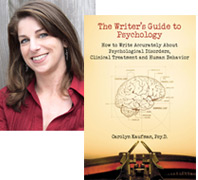
Carolyn Kaufman, PsyD's book, THE WRITER'S GUIDE TO PSYCHOLOGY: How to Write Accurately About Psychological Disorders, Clinical Treatment, and Human Behavior helps writers avoid common misconceptions and inaccuracies and "get the psych right" in their stories. You can learn more about The Writer's Guide to Psychology, check out Dr. K's blog on Psychology Today, or follow her on Facebook or Google+! 


Have a question about psychology in your writing? Use the email address on the right-hand side of the QTB page, or visit ArchetypeWriting's Q&A page.

Monday, August 29, 2011

Conflict & Characterization: Lessons from an Old Anime

(I promise that what lies below ties in to writing!)

I’m a big fan of this old-school (1972) anime called Gatchaman (and of its American translations…well, some more than others).  Author and friend Jason Hofius wrote a definitive guidebook on one of the American translations, which was called Battle of the Planets (1978), and recently he sent me an email to tell me he’s created a website on the same topic.

So I went tooling around the website, and it struck me that writers could learn a few things from his approach to the information.

Story Conflict

In the Battle of the Planets series, as in most stories, there are bad guys and there are good guys.  The bad guys are from the planet Spectra. Because Spectra is dying, the bad guys run around consuming the resources from the Peaceful Planets and generally trying to destroy the Peaceful Planets using monster mecha machines. The good guys belong to the Intergalactic Federation of Peaceful Planets, which is a very green and scientific sort of group.  The Federation’s most important answer to attacks from Spectra is the 5-person G-Force ninja team. (Please rest assured that this came long before Disney’s elite guinea pig team. The members of this G-Force are human.) 

Here’s what struck me, though. For each and every one of the series’ 85 episodes, Hofius indicates what Spectra is trying to accomplish and what the G-Force team is trying to accomplish.  You  might think this would get ridiculously redundant (for example, Spectra’s Goal: To steal a precious mineral; G-Force’s Goal: To stop the Mecha of the Week and recover the stolen mineral) but it really doesn’t because each side has numerous sub-agendas and internal conflicts (read: subplots).

Your Writing

You may know who your good guys and bad guys are overall, and what each side’s mission is in your story or novel as a whole, but do you know what the key conflict is in each scene?   If your story is moving forward properly, each scene’s conflict should be a little different as the characters react and respond to each other.  Each scene’s conflict should also advance the story as a whole.

As I edit a novel, I often find that I have several redundant scenes, usually because I am trying to make a point of some kind.  But a story is more exciting (and fun) if it doesn’t get mired in redundancies.

For example, in the novel I’m currently working on, I found three scenes meant to emphasize how bad things were for the good guys now that the bad guys had successfully invaded—the good guys had reached the point of surrendering not just physically, but also psychologically.  

My goal was to prove that things were BAD, and I did such a good job with it that I found myself depressed and a little hopeless, even though I knew the good guys would eventually prevail. There’s nothing pretty about beating a dead horse, folks, and if you insist on doing so, your readers may beat a hasty retreat. 

Though I’m not much of a chess player, the craftiness of the game has always intrigued me, and so I like to think of a story like an intense chess game between sides. One side moves; the other side has to counter that move and not only block the opponent’s goals, but also further its own.

So take another look at that story you think you’ve finished.  Is it as tight as it can be?  Do the conflicts between characters evolve and change with each and every scene?  If not, can you combine scenes or otherwise hone things down to keep your writing razor edged?
Character Guides

Back for a moment to Hofius’s website.  In addition to the great episode guides, he provides fantastic character guides.  Again, what strikes me about them is that they’re different from every other character guide I’ve ever seen for the series (and I’ve seen a bunch and even written a number of them).

Rather than focusing on the obvious—G-Force team member Mark, for example, has blue eyes and likes airplanes—Hofius tells us about the characters, referencing at least one episode for each tidbit.  That “at least one episode” is important—the show’s creators were fairly consistent in developing the characters’ abilities.

Your Writing

You may have character sheets, but have you managed to work details that define your characters into the story?  

I recently did some editing work for an aspiring novelist who’s still mastering the art of working the details into the story.  She knew a lot of important things about her main characters, for example, and she did a fantastic job of describing them, but she needed to work on slipping the information in without infodumps or blatant telling (e.g. “I am an honest sort of guy”).

One of the biggest dangers of telling (rather than showing) characterization is that your character won’t ring true to readers.  Think about it – if someone you worked with ran around telling everyone what an honorable guy he is, but you never saw him do a single honorable thing, you’d think he was a liar, wouldn’t you?  Readers will feel the same way about characters unless they get to see that honor in action.

Your turn: Is your writing as tight as it should be? Are you effectively showing conflict and characterization?

Carolyn Kaufman, PsyD's book, THE WRITER'S GUIDE TO PSYCHOLOGY: How to Write Accurately About Psychological Disorders, Clinical Treatment, and Human Behavior helps writers avoid common misconceptions and inaccuracies and "get the psych right" in their stories. You can learn more about The Writer's Guide to Psychology, check out Dr. K's blog on Psychology Today, or follow her on Facebook or Google+! (Her Gatchman site, which she linked to shamelessly in the post above, is here.)

Wednesday, May 18, 2011

Interview: From Slush Pile to Publication


Karen Sandler is our latest Querytracker.net success story with a book coming out (September, 2011). We hope you enjoy her interview. If you have any questions, I'm sure she would love to answer them.
**** 
Can you tell us about your journey from The Call to now?
Looking at my records, my first query for TANKBORN went out October 13, 2009. Before the process was over, I’d sent out 28 total. In some cases, the agents’ submission requirements allowed me to send part of the manuscript. In a very few cases after sending only a query I got requests for the partial and even the full. Two agencies that requested the full eventually made me offers of representation within days of each other in late February 2010.

I’d always thought it would be very cool to have more than one agent “fighting” over me. But I loved them both and it was difficult and sort of heartbreaking to have to choose one. Eventually I decided on Matt Bialer at Sanford J. Greenburger Associates.

Based on Matt’s notes and those of his fabulous assistant/junior agent Lindsay Ribar, I did an extensive (but not the first) re-write, with much back and forth with Matt & Lindsay. When we were all satisfied, the book went out in early April 2010. We got an offer for Italian rights in early May (seemed very unusual to sell foreign rights before a U.S. sale. Then in late August, came the offer from Lee & Low Books. TANKBORN would be one of three launch books for Lee & Low’s new YA/MG imprint, Tu Books.

Once the contract with Lee & Low was in place, there were two more extensive re-writes based on notes from my editor, Stacy Whitman. Along the way, we discussed cover art and Stacy also commissioned an artist to draw a map of Svarga, the main continent on the planet Loka where the story takes place. The map (based on a very crude one that I drew) will be included in the book. Stacy also had an expert in Indian culture read the manuscript to be sure I didn’t commit any major faux pas.
The most recent milestone for TANKBORN is that the cover was just released and I’m waiting on copyedited galleys.
What was one of the most surprising things you learned in creating your book?
I had gotten very used to writing what are called “category” or “series” romance novels. In my particular line, six books are released every month. They’re quite short (55K-60K for the ones I wrote) and the turnaround time is short as well. So I could write a book in about four months (and I know authors who write them even more quickly). I was used to writing at least two a year, with time left over for other projects. There would be one round of very light editing for my book, then later a quick read-through for typos and that was it as far as editing was concerned.
For TANKBORN, a full-length (~97K words) science fiction book, there were four rounds of very extensive re-writes. Based on my past experience of being lightly edited, I thought this meant that there was something wrong with me as a writer. Lindsay assured me that what we were going through was par for the course. I’d just never had the luxury of an editor being so focused on my book and being able to give me such thorough notes.
Was there ever a time you felt like giving up? Why didn’t you?
There have been many times when I considered giving up. Back in the late ‘90s, early 2000s when I didn’t have a sale for three years. More recently when I submitted five (yes, five) proposals to my editor at Harlequin and he turned down every one. Luckily, I’d been working on TANKBORN during that time, so I had somewhere to turn when I got discouraged.
I didn’t give up because I’ve always wanted to be a writer (at least since I was 9 years old). I identify so strongly with being a writer, it’s hard to imagine not doing it. I will always find a way to write.
What is the hardest/least favorite part of being a writer?
There are two very difficult aspects to writing, and they’re related to one another. First, I despise the waiting—to hear back from an agent, to find a publisher willing to take a chance on your book, to have to wait for reader reactions because the book doesn’t come out for a year or six months. The other aspect is that so many other people seem to control at least part of your career. Often, without an agent, you can’t get your book to a publisher. Without a publisher, you can’t get your book published. Even if it’s published, you can’t make readers fork out their money to buy it and you certainly can’t make them like it.
Nowadays, the opportunities for self-publishing have the potential for removing the “obstacles” of agents and publishers. But there’s still the issue with finding readers (or readers finding you), which is even more difficult with that mode of publishing your book.
If you could give a message to aspiring authors everywhere, what would it be?
If you truly want to see your work published, keep working at it. Don’t allow yourself to mope for longer than a day when you get a rejection. Remember, you’re only getting rejections because you’re getting your work out there. If you’re persistent and talented, you will likely reach your goal of publication.
What is your advice to new or unpublished writers? 
Improve your craft. So many editors or agents say “write the book of your heart” or “write the best book you can.” But you can’t do either one if you don’t know the basics of spelling, grammar, character development and story construction. So take classes if they’re available (there are many online). Go to writer’s conferences where you’ll not only learn your craft, you’ll have a chance to meet bestselling authors, agents and editors. Join or form a critique group. You need outside eyes to read your work.
What kinds of things are you doing to promote your books? Did you do anything before you found an agent? If so, what?
Keeping my blog, website and Twitter feed up to date. Doing school visits, book signings, attending conferences. If television or radio interview opportunities come up, I’ll be glad to do them. I’ve been doing these kinds of things for years, both while represented and not.
Is there anything you wished you had done differently?
There are individual decisions I sometimes second-guess myself on, hindsight being 20-20 and all. I always wish I was more disciplined in my writing. But everything I’ve done, right or wrong, has been a learning experience.
What are you working on now?
I just submitted a proposal for a TANKBORN sequel. I’m also working on a re-write of a paranormal YA.
Karen Sandler can be found on her website, blog, and Twitter (@karensandlerYA)

Wednesday, February 16, 2011

Your Author Photo: General Tips

Most people shy away from having their portraits taken. Why? Because we’ve had bad experiences, and end up with pictures that make us cringe (or maybe we were cringing in the photo to begin with).

©Stina Lindenblatt
As an author, you can occasionally you get away with skipping the author picture (for example, if you’re a male who writes steamy romances under a pen name), but for the most part, you’ll have to provide your publisher with a picture (of you, not your beloved pet) for promotional purposes. And you might want to include one on your website and blog so that you are real to your followers and fans.
The following pointers will help make the process less painful, and help ensure you end up with photos you’ll love:

  • See if you have a talented photographer friend who would be thrilled to take the pictures for you. The advantage of this is you already have a great relationship. You’ll end up looking relaxed in the photos, instead of looking like you’d rather be anywhere but there.
  • If you aren’t lucky enough to know someone in the above category, ask your friends for recommendations. The photos highlighted on a photographer’s website aren’t always representative of their usual work. And a great photographer will know how to make you shine. They know the tricks of the trade.

©Stina Lindenblatt

  • Weather permitted, see if the photographer can take the photos outside (or a place you feel comfortable). People tend to feel (and look) more uptight in a studio setting. The added benefit is that there are more interesting things to look at than in a studio. This, too, will help you relax.
  • Let the photographer know if there’s anything you feel self-conscious about. They may be able to pose you a certain way to overcome the problem. But remember, chances are great only you notice whatever’s bugging you.

                                                                      ©Carolyn Kaufman


  • If you see a photo, including in a magazine, of a pose you like, bring it with you to show the photographer. Most will welcome suggestions.
  • Dress comfortably and for the weather. If you’re shivering because it’s freezing out and you’re wearing a t-shirt, it’s going to affect the outcome. Sure, models might be posing in summer clothing during the winter months, but you don’t have to.


©Carolyn Kaufman
  • Keep your clothing simple and avoid bright patterns and stripes. They are too distracting. And if you’re in a group shoot (i.e. family picture), try to coordinate the clothing. Don’t have half the group in casual clothing while the other half is dressed up. And don’t have half the group in pastels while the other half is wearing dark colors. You get the general idea?


©Stina Lindenblatt

  • Bring several items of clothing or props with you. That will give you a variety of looks to choose from. And the props give you something to do with your hands.

Tomorrow, we’ll give you some tips on posing, which will help you look great in your photo.

Stina Lindenblatt writes romantic suspense and young adults novels. In her spare time, she’s a photographer and blogging addict, and can be found hanging out on her blog, Seeing Creative.


Carolyn Kaufman, PsyD's book, THE WRITER'S GUIDE TO PSYCHOLOGY: How to Write Accurately About Psychological Disorders, Clinical Treatment, and Human Behavior helps writers avoid common misconceptions and inaccuracies and "get the psych right" in their stories. You can learn more about The Writer's Guide to Psychology, check out Dr. K's blog on Psychology Today, or follow her on Facebook!

Friday, May 8, 2009

Publishing Pulse - Week of 5/4/09

First -- congratulations to both QueryTracker.net and RallyStorm.com for landing on the 2009 Writer's Digest list of 101 best websites for writers!

Upcoming Contest!

On Monday May 11th, our second agent-judged contest will open for entries. Literary agent Brendan Deneen with FinePrint Literary Management has graciously agreed to judge one-sentence pitches. You can only enter if your manuscript falls in the following genres: YA thriller, YA horror, YA fantasy, YA sci-fi, or adult thriller. Watch for a special post this weekend with details on how to enter. We are very excited to work with Mr. Deneen, and we wish you all the best of luck!

QueryTracker.net Success Stories

We have three new success stories over at QueryTracker.net. Jeannie Lin, Michael Landweber, and Lisa & Laura Roecker have all recently signed with agents they found on QueryTracker.net!

New Agents on QueryTracker.net

Doug Grad, formerly a senior editor at four major New York publishers, has recently opened his own literary agency, Doug Grad Literary.  He accepts e-mail queries; see his website for more information.

QT Blogger Carolyn Kaufman in The Writer Magazine

The June 2009 issue of The Writer just hit newsstands, and it includes a 2-page article written by QT Blogger Carolyn Kaufman: Get Your Psych Right - A psychologist describes the six most common ways writers get it wrong about her field. The article is organized into six myths, and under each one is the origin of the myth, ways that myth appears in fiction, and tips to help you get it right in your stories!  You can find The Writer in any bookstore.

Brenda Novak's Diabetes Auction

Bestselling romantic suspense author Brenda Novak is auctioning off all kinds of writerlicious goodies during her diabetes auction. You can bid on autographed novels (e.g. The Host by Stephenie Meyer), lunches with authors (e.g. Janet Evanovich, Diana Gabaldon), a professional line-edit of your entire novel, agent proposal evaluations, agent writing critiques (e.g. by Kristin Nelson), some fabulous vacations, and more! Go bid -- it's for a great cause!

For Twilight Fans

Several new books are coming out over the next few months.  First, Breaking Dawn (the last book in the series) will be re-released in a limited special edition that includes a DVD, a color poster, and more extras.  Eclipse, the trade paperback of the third book in the series, will be published in August.  In October, four Twilight Journals will be released in a collectible tin.  Finally, an illustrated movie companion book will be released to coincide with the New Moon film adaptation slated for October.

Thursday, April 2, 2009

Interview with Author Dotti Enderle


Dotti Enderle is one of the most engaging people I know. She is approachable and dang funny, which is a plus for a children's author. I met Dotti a year ago at a Romance Writers of America meeting. What struck me immediately was that Dotti doesn't write romance. Why was she there? Because writing is her job. She is active with local writers' groups because of the workshops and contacts. Dotti rolls up her sleeves and immerses in the business. She works at her craft, which is reflected in the quality and number of books to her credit.

Dotti has sold 30 books. 19 are in print. 8 more are coming out in September of 2009. Her work has been published by Random House, Flash Light Press, Pelican Publishing Company, Llewellyn, Upstart Press and ABDO Publishing Company.

The cover above is from Llewelln's New World's Magazine. More about Dotti can be found on her website.

My son's favorite book by Dotti is GRANDPA FOR SALE (Flashlight Press).


If you have children, this picture book is a must. Awards for GRANDPA FOR SALE include:

  • Storytelling World Resource Award Winner 2008
  • Teddy Children's Award Winner 2007
  • North Texas Book Festival Winner 2008
  • Arizona Grand Canyon Reader Nominee 2009-2010
  • Indiana Young Hoosier Nominee 2009-2010
  • Borders Original Voices selection, Oct. 2007
My favorite is MAN IN THE MOON, a novel published by Delacorte Press. "Set in rural Texas in 1961, one restless girl finds hope for her ailing brother and faltering family in the form of a mysterious drifter. " (quote from Dotti's website)

Dotti was gracious enough to take a break from her revisions and answer some brief questions for the Query Tracker Blog.

Because she had done a blog tour, my questions for her were basic. I'm including the links to the stops on her blog tour so you can read more about her by clicking the links following the interview.

Mary Lindsey: Thanks for agreeing to an interview for the QT Blog, Dotti. How and when did you begin writing?

Dotti Enderle: I started writing seriously in 1995. I sold lots of magazine articles, stories and poems. So that's when my "writing" career began. My career as a book author came much later and has been more enlightening. My first book was published in 2002.

ML: Please tell us about your road to publication.

DE: I landed my agent in December 1999 after a referral from a good friend. It was two years later, September 2001, that we made my first sale. That book turned into an 8-book series called Fortune Tellers Club.

ML: What is one of your favorite stories about your career so far?

DE: I think the funniest has to do with my school presentations. I read THE COTTON CANDY CATASTROPHE AT THE TEXAS STATE FAIR, then I touch on a little Texas trivial, asking the kids simple questions like, "What's the state bird? The state flower?" They call out the answers in unison. When I get to "What's the state motto?" there's always a short pause, then someone inevitably shouts, "Don't mess with Texas!" Um.no. Two years ago I did an author visit in San Antonio. When I asked about the state motto one girl yelled, "Remember the Alamo!" Only in San Antonio.

For the record, the state motto is "Friendship."

ML: What is your most recent sale?

DE: My agent is working on a contract for me right now, but since it isn't signed yet, my latest sale was for a 6-book series called The Ghost Detectors that I wrote for ABDO Publishing.

ML: What is the hardest/least favorite part of being a writer?

DE: Revising. It seems to take longer than writing the first draft.

ML: What is the most rewarding part of your job?

DE: Seeing my work in print.

ML: What is your advice to new or unpublished writers?

DE: Read! Read! Read! Both how-to books and the genre in which you wish to write. I once heard that you have to read 1000 books before you can write just one. That's so true. My biggest lesson came when I took one of my favorite books, WHEN ZACHARY BEAVER CAME TO TOWN by Kimberly Willis Holt, and dissected it. I made note of when she used description within dialogue. What strong verbs she used. How she painted a scene so we could visualize it. This was when I began to see my own writing weaknesses. I don't think a million how-to books could have taught me that.

ML: Thanks for taking the time out to answer questions, Dotti. Best of luck with your upcoming projects.
To read more about Dotti's writing process or her experiences as a writer, check out the interviews from her blog tour:


If you have questions for Dotti, feel free to post them in the comments. She will post answers in the comments section some time over the weekend.


Mary Lindsey writes paranormal fiction for children and adults. Prior to attending University of Houston Law School, she received a B.A. in English Literature with a minor in Drama.

Mary can also be found on her website.