QueryTracker Blog

Helping Authors Find Literary Agents
Showing posts with label authenticity. Show all posts

Wednesday, October 3, 2012

Using Life's Disasters to Add Authenticity to Your Writing

Not where you planned to spend your night...
Bad things – sometimes terrible things – happen to us all. While they’re happening, we’re focused on surviving them.

After you manage to do that, for better or worse, you’ve learned something new about the human condition. And if there’s one thing writers do well, it’s share how hard it is to be human.

I have this little voice inside that I call The Writer. When something really awful happens, it’s the part of me that’s yelling “Oh man, you can totally use this in your stories!” Don’t get me wrong, a lot of times panic and horror mostly overwhelm the Voice, but for me, it’s always there.

Whether you have a mouthy The Writer voice or not, after you survive the emergency, disaster, or tragedy, you’re going to have to process it. Most people do that by talking with others, but as a writer, you may also want to…well, write about it. Whether you’re journaling in the first person or incorporating your experience into a character’s journey, if you do a good job of sharing what you went through, including your struggle to find meaning in it all, that will resonate with your readers.

There's nothing like reading something that makes you think, "Wow, the author really knows what she's talking about. That's exactly what it's like!"

The loudest I ever remember my The Writer voice being was during college, when my long-term boyfriend got into a fistfight with his identical twin brother. Everyone had been drinking. My boyfriend took the keys away from his twin’s girlfriend, and his twin took offense. Hence, the fistfight.

That was the first (though certainly not the last) time in my life that I was genuinely hysterical. Most of me was freaking out, trying to decide how to intervene, but in my head The Writer starts jumping up and down and shrieking, “Wow, this hysteria thing is fascinating. You’re laughing and crying and feeling like you’re half-outside your body. We have got to remember this so we can use it in our writing!”

So now when I have an hysterical character, he or she gets to be hysterical in full the-writer-has-experienced-it Technicolor.

Another example:

A couple of weeks ago, I got out of bed, put in my contacts, and promptly started to go blind.

Over the next few hours, my surroundings appeared to be filling with more and more smoke, which nobody else could see. I changed my contacts. That didn’t work, so I got online, Googled it, and concluded I must be getting a migraine. I’ve never had one with hazy or cloudy vision before, but the magical Internet assured me that such things happen. I’d had both my eyes and my physical health checked the previous month and I’d come through with flying colors, so a migraine made the most sense.

The problem was that over the next few hours, everything became so hazy that I couldn’t see myself in the mirror, which is not normal for a migraine. ("Ocular migraines" only occur in one eye, and the blindness passes in an hour or less.) I went back on Google and (with great difficulty, at 300% magnification) searched some more. If you’re going blind and it isn’t a migraine, the warnings on the internet are dire. As in, permanent blindness. And death.

Terrified, I broke down sobbing and called my mother to take me to the ER.

Though the storyteller in me would love to give you all the gory details about my visits (plural) to the ER (I was misdiagnosed the first time I went), that isn’t really the point here. My point is that I now know all about multiple conditions that can cause sudden cloudy and blurry vision, as well as blindness. I know how the ER handles emergencies like this. (They make you read an eye chart. Which is very difficult when you are blind.) I know what kinds of medications they recommend (antibiotic eye drops if the surface of the eye is involved), what kinds of specialists you’re supposed to see (ophthalmologists if the eye is involved; neurologists if the brain is involved), what it’s like to get a CAT scan (pretty cool), what it’s like to feel like your eyeballs are on fire (very not cool), and what it’s like to get your corneas dyed so the doctor can look for abrasions. I also learned that sometimes when you go blind, everything doesn’t go black. It goes white.

And soon, unfortunately, I will learn how much all of that stuff costs.

If you’re wondering what the final diagnosis was…turns out I had managed to chemically burn both of my corneas. How did I pull that off? Over the past 15 or 20 years, I have always washed my contact lens cases in the dishwasher. I got a new dishwasher, and apparently it didn’t wash all the detergent out of my lens case. I put the lenses in the lens case, they soaked up the detergent, I put them in my eyes, and…voila, chemical burns. Interestingly, it didn’t hurt a bit. The pain came later, after I’d removed my lenses. The theory is that blinking sloughed off the burned part of the cornea over the next few hours, which eventually resulted in dead-of-night second-trip-to-the-emergency-room agony.

Fortunately, I have fully recovered from the experience (typically corneal abrasions resolve themselves in 24 - 72 hours), and I can see and read and drive (and write) again.

But now my characters can experience all of these things realistically. Likewise, your characters can experience the types of disasters you have. Sure, we had to go through something miserable to learn what we did, but since we had to go through it…we might as well figure out how to get a story out of it!**

** After we survived The Great Scorched Eyeball Incident, my mom said, “I bet you’ll at least get a blog post out of this.” She clearly knows me – and The Writer – well! 
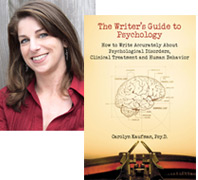


Carolyn Kaufman, PsyD's book, THE WRITER'S GUIDE TO PSYCHOLOGY: How to Write Accurately About Psychological Disorders, Clinical Treatment, and Human Behavior helps writers avoid common misconceptions and inaccuracies and "get the psych right" in their stories. You can learn more about The Writer's Guide to Psychology, check out Dr. K's blog on Psychology Today, or follow her on Facebook! 

Wednesday, July 8, 2009

Medical Fiction Questions Answered: 07/08/09

Okay, gang... the Doctor is IN! More medical fiction questions...

Disclaimer: The information provided in this post is intended for writing purposes only and does not represent medical advice. (Sorry, my lawyer-boy husband made me say that.)


First a question from Sandy:

Hi there,

Got a medical question for you. I have a guy holding a knife to my MC’s neck. As he’s threatening to kill her, he applies more pressure. Since this is my MC, I don’t want her to die or be severely injured, but I do want her to bleed a lot and think she’s dying. Is it possible for there to be a lot of blood without cutting something important like an artery or her windpipe?

Thanks very much!

Good news, Sandy! You absolutely can do this. The neck is actually quite complicated as far as anatomy goes... there are lots of blood vessels, nerves, and muscles, in addition to your windpipe and thyroid/parathyroid glands.

A cut to the neck can certainly cause severe injury or death, but there are also blood vessels that, while they could cause significant bleeding if injured, wouldn't be fatal.

For the purposes of the scenario you described, the best vessel to injure in this fashion is probably the external jugular vein. It's not deep under the skin, so it would be quite easy for your villain to injure.


So you'll probably want your villain to press the knife off to one side. As you can see from the picture, the middle is where you could injure structures like the windpipe. Also, the thyroid gland sits right in front of the windpipe at the midline. You'll also want to make sure your villain doesn't cut too deeply, or he could hit the carotid artery, which would cause your MC to rapidly bleed out.

So, go for the jugular, Sandy! *snort*

Our next question is from our resident dynamic duo, Lisa and Laura:

Ok, let me just start off by saying that you are a God-send. Laura and I were on the phone tonight discussing this question and it went something like this:

Lisa: Yeah, I don't know, let's google it.

Laura: Nothing. They don't say if this kind of pill would actually exist.

Lisa: We need to ask a doctor. How do I not have any doctor friends?

Laura: Wait! The Query Tracker blog totally has the doctor that answers questions.

Lisa: OMG - you're right. Composing e-mail now.

So, thanks in advance for any insight here.

We have a character in our book who dies from a heart attack. She has a congenital heart defect and had a surgery when she was very young, but still takes medication on a daily basis to keep things under control. Is there a medication that would prevent a heart attack if she felt the symptoms coming on? In the book we have her running from someone, went to get her medication, couldn't find it and died. Are we complete idiots? If so, feel free to inform us of that fact.

Thanks in advance for any help you can provide!
Hmmm... I have to answer this question two ways. Which seems, somehow, appropriate.

First of all, there is indeed medication that can prevent or reduce the severity of a heart attack. The most commonly referenced one would be nitroglycerin, which relaxes the blood vessels of the heart and allows more blood to reach the area that's deprived. Aspirin can also help by breaking up clots that might be blocking one of the cardiac vessels.

Which leads me into a brief discussion of what a heart attack is, exactly, in case you don't already know.

A heart attack is also called myocardial infarction. "Myocardial" means heart muscle and "infarction" means death or injury due to inadequate blood flow. So what's happening during a heart attack is for some reason the heart muscle itself is starved for blood. Part of the heart muscle may die from this, making the heart too weak to pump, or the damaged tissue may cause the heart to go into an abnormal rhythm.

There are many different congenital cardiac defects, but the vast majority of them would not be likely to put this patient at risk for a myocardial infarction. In fact, the most common cause for a young person to have a myocardial infarction (ignoring extreme familial high cholesterol or drugs such as cocaine or methamphetamine) would be one of the heart blood vessels coming off the wrong artery and delivering DEoxygenated blood to the heart muscle instead. Someone with a congenital heart problem would be LESS likely to have this problem, as they would have gone extensive heart evaluations, including 2D-echo (an ultrasound of the heart) as well as cardiac catheterizations (where they pass a camera through the blood vessels to look at them) and direct examination during her surgery.

If you want to give her a congenital heart condition that requires surgery and might give her a heart attack years later, your best bet would be a transposition of the great arteries. In that condition, the artery that usually goes to the lungs and the aorta, which usually goes to the body are switched. So the deoxygenated blood is running around in one circle and the oxygenated blood in another. The patient only survives birth if there is a hole in the heart that allows the two to mix.

The surgery to fix this involves literally cutting and switching the arteries, but depending on where the blood vessels that feed the heart are, they may end up kinking down the line.

I'm not sure that your character NEEDS to have a heart attack. Having had any sort of cardiac surgery could make her more likely to develop an abnormal heart rhythm, which can also be fatal.

Unfortunately, the medications used to treat an emergency arrhythmia are given through a vein, rather than as a pill. It takes 10 - 15 minutes to absorb a medication through the stomach. Arrythmias can also be treated with electric shock, but someone else would have to administer it.

There is a specific form of arrythmia, SVT (supraventricular tachycardia) that can sometimes be stopped by applying ice to the face or by "vagal maneuvers," such as blowing hard into their thumb (like they were trying to blow themself up like a balloon). This arrythmia can degenerate into other more serious rhythms if not corrected. (But unless she doesn't know where the freezer is, this doesn't give her much to search for either.)

I'm not sure what will work best for your story, but I hope that helps!

Big thanks to Lisa, Laura, and Sandy for sending in questions. And if you've got a medical fiction question you'd like me to answer here, please email me (hldyer at querytracker.net) with "medical question" in the subject. You'll receive a email auto-reply confirming that your question has arrived safely to my inbox.

H. L. Dyer, M.D. writes women's fiction and works as the Clinical and Academic Director for the Hospitalist Program at a pediatric teaching hospital near Chicago. In addition to all things literary, she enjoys experimental cooking and composing impromptu parodies to annoy close friends and family. Click to visit her personal blog, Trying to Do the Write Thing.

Tuesday, April 21, 2009

Do You Really Need to Write What You Know?


“Write what you know” is one of the most often heard phrases in the writing world. When I began seriously writing, my first reaction to this bit of advice was, “Oh heck no. No one is going to tell me what to write!” I didn’t want to write what I knew. That would be boring. I wanted to explore new worlds and dive into old ones.

It didn’t make any sense to me because I was hearing it very literally. I kept thinking, “Well, if writers only wrote what they knew, we’d have no fantasy or scifi or historical novels.” I mean, unless people were out there falling in love with vampires or having their home planets overrun by meat-eating aliens, it just wasn’t possible to always write what you know.

What I finally realized was that the best writers really do write what they know. Now, does that mean Stephenie Meyer has recently run into a family of vegetarian, sparkling vampires? Or that J.K. Rowling once stumbled upon a whole community of magical kids running around undetected by all the muggles somewhere in Britain? Of course not! (Well, not that I’m aware of in any case).

So how do writers write what they know? They infuse their stories with all of the emotions, knowledge, and life that they’ve experienced and use all of it to build their characters and storyworlds into incredible books that suck their readers into a new reality. I’m willing to bet that Ms. Meyer has, at some point in her life, experienced fear and loss and that total exhilaration of first love. J.K. Rowling was certainly never a magical teenage boy fighting a weird, snake-looking wizard…but she probably knows what it feels like to be terrified, excited, helpless, alone…to find friends who love you, fight for something you want, and maybe have things turn out great in the end.

To write what you know, you need to write about something you care about, something that touches you. That connection you have to your subject will come through in your work.

Novelist Kurt Vonnegut sums it up perfectly:

Find a subject you care about and which in your heart you feel others should care about. It is the genuine caring, and not your games with language, which will be the most compelling and seductive element in your style.

Agent Rachelle Gardner had a great post about writing what you know last year. In her opinion:

Write what you know means write with authenticity about thoughts, feelings, experiences of life. Be honest. Write from a deep place. Don't write from the surface. Whether you're writing about parenthood or cancer or anything else... be real.

Don't reflect what you know from other people or the media... write what you know from your own inner life.

There is a more literal approach to the “write what you know” statement as well. It really is necessary to be familiar with your genre and the world of which you are writing. There are little quirks and “rules” to every genre – what works for a romance might not always work for a thriller.

Agent Scott Eagan posted about this in his blog a few months ago. He stated:

It is crucial for you to write in the niche that you know the best. By doing so, you understand the twists and turns to that genre that others might not get. More importantly, you understand the voice that is commonly associated with that genre.

This can also be an area when a little research can come in handy. If you are writing a book set in Ancient Greece, it is necessary for you to do enough research that you really know what you are talking about. Otherwise, you will never be able to truly transport your readers into the world you are trying to describe. Mary wrote a wonderful post about how familiarity breeds authenticity. You may not be able to personally experience the day Vesuvius erupted and buried Pompeii, or what it is like to live beneath the ocean, but you can familiarize yourself enough with the pertinent details that you can convince your readers that your characters are living through those experiences.

This applies to the worlds you create yourself as well. Fantasy and science fiction writers create their own worlds, true. But there are certain rules even within the realms of fictional worlds. Maybe in your world, women have supernatural powers and men don’t. Or maybe blondes can see the future and brunettes can fly. You can make whatever rules you’d like for your universe, but you have to stick to them. And you have to have enough knowledge of that world to convince your reader that the experiences and emotions of your characters are authentic and appropriate for the world in which they live.

When you write a book, you want to suck your reader into your world – whether that world is set in the past, the present, the future, or on some other planet or reality…you need to know enough about that world, your characters, and the things they will feel and experience to draw your readers in. Using your own emotions and experiences, and your own specialized knowledge about the world you are creating, will help you craft an amazing story.

In other words, my dear writers…yes, write what you know ;-)

Michelle McLean writes YA fiction, children’s picture books, and adult non-fiction, and has been published in three Chicken Soup for the Soul books. She holds a B.S. in History and a M.A. in English. If her nose isn’t stuck in a book somewhere, you might want to check her pulse.