QueryTracker Blog

Helping Authors Find Literary Agents
Showing posts with label confidence. Show all posts

Wednesday, July 18, 2012

Are You a Real Writer?


I started writing in the sixth grade, and by the seventh I was working on a novel. By the eighth, I had something solid—a real story with decent characterization and real character and plot arcs. I started thinking of myself as a writer before it ever occurred to me to wonder what that meant, and “writer” has remained a core aspect of my personality ever since.

But not everyone has that experience. In fact, I’ve met a lot of people who write who aren’t sure whether they qualify as  “real” writers.

Since I’ve been doing a lot of digging into the psychological and sociological research on writing and creativity, I decided to explore how scientists understand or “operationalize” (define) a writer.

Here’s what I learned.

At the most basic level, a writer is someone who writes regularly. This is repeated over and over in the literature, albeit in different ways: A writer is someone who shows up every day and writes. Writing is incorporated into the writer’s daily life.

That may seem obvious, but there are a lot of people out there who want to be writers but don’t do much actual writing. They plot constantly in their heads (or even on notecards or a bulletin board), but never actually do anything with the material.

I’m not sure exactly why they do that—one reason I’ve heard is that these people are afraid that if they actually start trying to write, their stuff will be awful.  And heck, let's be realistic—maybe it will! But you have to start somewhere, and as we’re discussing, you can’t be a writer if you don’t write.

Iris Murdoch once created a character who said, “I live with an absolutely continuous sense of failure. I am always defeated, always. Every book is the wreck of a personal idea.” And Gail Godwin said, “For every novel that makes it to my publisher’s desk, there are at least five or six that died on the way. And even with the ones I do finish, I think of all the ways they might have been better.”

So even successful writers struggle with that feeling that they’re not producing material that’s as good as the original idea. Nonetheless, they press forward and keep writing. And strive to keep getting better and keep growing.

Over time, according to the research, someone who continually incorporates writing into his or her life is— consciously or notfostering the identity of a writer.


And if you don't think you write regularly enough? Then try building some dedicated writing time into your day, even if it's just journaling about ideas or possibilities. It doesn't have to be every day, and it doesn't have to be for hours at a time. Just carve out a niche of time—half an hour, maybe, every other dayduring which you nurture the writer in you.

Because that’s all it takes to be a “real” writer!

Your turn: When did you start calling yourself a writer? What makes you feel like a real writer? What tips would you give to someone who wants to build on his or her writing identity?


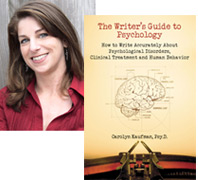
Carolyn Kaufman, PsyD's book, THE WRITER'S GUIDE TO PSYCHOLOGY: How to Write Accurately About Psychological Disorders, Clinical Treatment, and Human Behavior helps writers avoid common misconceptions and inaccuracies and "get the psych right" in their stories. You can learn more about The Writer's Guide to Psychology, check out Dr. K's blog on Psychology Today, or follow her on Facebook or Google+


Have a question about psychology in your writing? Use the email address on the right-hand side of the QTB page, or visit ArchetypeWriting's Q&A page.

Wednesday, September 21, 2011

Forgotten Networking Skill


Money. It doesn’t matter what you write, most writers dream of making money from their craft. The obvious way is to sell your articles, short stories, novels. The more you sell, the more money will land in your bank account. Simple enough. But there is another way to make money that writers often don’t think about. Public speaking. Conducting workshops, visiting schools, speaking at conferences are a great way to not only earn extra income, if you do a great job, your readership will grow.
Now obviously the organisers of major national conferences won’t invite you to be a keynote speaker if you don’t have a track record in public speaking. This is why I recommend you give this serious thought even before you land an agent or book contract. The sooner you start gaining experience the better.
The following suggestions will help you progress from being a novice speaker to becoming a pro:
·      If you’re new to public speaking—or if the idea of speaking in public leaves you scrambling for the bathroom—you might want to sign up for a public speaking workshop or Toastmasters®. If you have a group of writers in your area, you could meet once a month and have someone present on a topic of interest to the group. Rotate the speakers each month so that everyone has a chance to present. This way you get to practice your public speaking skills in a non-threatening environment.

·      If you have children in school, let their teachers know you’re a writer. Even if you don’t write kidlit, the teacher might still be thrilled to have you share your expertise with the class. But be prepared for the inevitable question: Did you write Twilight? (Or The Hunger Games?).

·      One advantage of being a member of a writing organization in your community is that you’ll hear about upcoming conferences planned for your area. The conference organisers might approach the organizations, seeking individuals interested in being presenters or moderators.

·      Be willing to speak for free. This is especially true early in your career. In this current economic turmoil, schools don’t have a lot of money to pay for author visits. In this case, check if the school will permit you time to do a book signing (if you write children’s books). The other benefit is you’ll gain experience for your CVS.

·      Consider participating in a panel discussion. This involves a moderator asking a group of experts questions on a particular topic. Panels are great for two reasons. One, the audience gets the benefit of a variety of perspectives. Two, if you’re shy, being on a panel isn’t as intimidating as speaking on your own. On the downside, battles have been known to ensue between panellists, so if confrontation isn’t your thing, stick to non-controversial topics. If you’re joining a panel created by the conference organisers, see if you can contact the other panellists and moderator ahead of time. This way you know everyone has the same expectations and there won’t be any nasty surprises. I speak from experience.

·      DO NOT heavily promote your book(s) during the presentation. It’s okay to mention the titles in your introduction. But do not mention them every other sentence (yes, some presenters actually do that). It’s annoying and won’t sell your books. People will want to check out your books if they feel you’ve done an outstanding job educating them on the planned topic. Feel free to use examples from your books, but balance things out by including examples from other authors’ books, too. The audience will respect you more for it.

·      DO NOT bring your personal problems with you when you present. We all have rough days, but the worst thing you can do is attack a member of the audience who asked you a question. Yes, I’ve heard of this happening. Not a great way to encourage people to buy your book.
Does anyone else have suggestions, based on experience as a presenter or audience member, as to how to make the experience positive for everyone? Horror stories are welcome, too.

Stina Lindenblatt writes young adult novels. In her spare time, she’s a photographer and blogging addict, and can be found hanging out on her blog, Seeing Creative 

Monday, October 18, 2010

Guest Blogger Christine Fonseca: Understanding The Imposter In Us All


Have you ever noticed that we writers tend to lack confidence in our abilities? We often feel like frauds, terrified that someone will figure out we have no actual idea how to write. We think that because we don’t outline the way someone else does, or have perfect grammar within our phrases that we are somehow flawed. We equate our rejections with failure, and the time it takes us to get an agent or sell a book as proof that we have no idea what we are doing.

In short, we feel like an imposter.

This Imposter Syndrome, as it is sometimes called, happens frequently with gifted women and creative types – and I think the cause may lie in the actual attributes of both giftedness and creative personalities.

Like gifted people, writers and other artists struggle with a level of emotional intensity that can make ordinary feelings very overwhelming. This applies to the positive feelings – joy, happiness, bliss, satisfaction – and the negative feelings – anxiety, bitterness, jealousy, and anger.

I think it’s the intensity of the feelings that, when unmanaged, can lead to a lack of confidence and self-doubt.

Let’s look at the few trends I see when my writer friends and I chat:

  • Self Esteem – A lot of us struggle in this area. We tend to measure our successes against each other, allowing the rejections to get the better of us. We forget to seek our strength inside.

At these moments, we need to remind ourselves why we write in the first place – remind ourselves of the courage it takes to not only craft a story, but put it out there and query it. It we cherish that courage and strength, we can refocus our perspective and a lot of the esteem-zappers we face day-in and day-out will melt away.

  • Praise – Yeah, we don’t get a lot of constructive praise in this business. Sure, most of us have our cheerleaders that pick us up when we are down. But they tend to offer general praise, which feels good but really does not help us when we are feeling like a fraud. What we need is specific feedback on our skills.

Objectively looking at both our strengths and the areas we can work on is a great way to combat some of the problems with lack of constructive praise. Creating an action plan that allows us to build on our strengths and work on our weaknesses is another great way to combat our lack of confidence.

  • Emotional Intensity – As I mentioned before, gifted people are not the only group prone to intense emotions. Creative, artist types are as well. This level of emotional intensity will often tip the scales, making the natural struggles with confidence that most people feel into something huge and overwhelming. At these times we will often fall into the trap of comparing ourselves with others, connecting rejection with “I’m a lousy writer.” Trust me, I know how easy it is to do this.

Instead we need to remember to be objective. Ask our CPs and other writer friends for specific feedback. Ask them to remind us about ourselves, especially when we can’t find it ourselves. We will still be intense, but that intensity can be harnessed as creative energy instead of a confidence vortex.

So what’s the bottom line here? I believe that it is the very nature of being an artist tends to lend itself to periods of waning confidence. Talking about it with friends, remembering why you write in the first place and having a realistic view of your abilities is a great way to combat these moments and let them go.

* * *

You can learn more about Christine Fonseca and emotional intensity on her website, blog, and in her book, EMOTIONAL INTENSITY IN GIFTED STUDENTS.

Monday, September 13, 2010

Succeeding as a Writer: Confidence and Determination

When I've written something and the words have just flowed, I sometimes feel like I'm looking down on the Seventh Day, basking in the warmth of my creation and proclaiming, It Is Good. I'll feel like I've captured the emotion and the angst; or the flavor, color, and texture of the world I envisioned. The characters will be as real as Real People to me. I'll feel that glow in my chest: Of course I'm a writer. This is something I was meant to do.

Now, as a psychologist, I believe it's not only okay, it's healthy to be able to say to yourself, "I did a good job on that." "I'm a good writer." You don't have to announce it to the world (in fact, you probably shouldn't!), but you're healthier if you have a secret little place inside with a nice big refrigerator to put up your accomplishments, and where you can nod and pat yourself on the back and think, I Did Good. I even have lots of professional terms to make that all sound more authoritative, like self-esteem, self-efficacy, and adequate mirroring on the Grandiose Pole. But I'm going to skip all that for right now.

If feeling good about what you'd written was as far as any of this went, all would be well. But so many of us have this urge, this drive, this need to get published. And what is that all about anyways? Few people make money publishing. It's cool, but unless you're Stephenie Meyer or JK Rowling or whoever this week's Hot Writer is, it's a passing cool that others soon forget. Getting published doesn't make you beautiful or thin or get you a Happily Ever After with whichever celebrity you drool over most.

Yet the need remains. So you sweat blood over a query and open a vein to get the synopsis right and then, hoping, praying, believing you've got something others will love, you start sending your work out to others.

Some writers start with crit buddies, some jump straight to agents and publishers; some do both simultaneously. And most soon discover that not everyone else thinks their work is so good.

According to Robert Heinlein, that's where a lot of people quit. In fact, he believed that only half the writers who actually put pen to paper (or words to screen) and finish what they start have the guts to submit to agents and publishers:

Writers...are inordinately fond of their brainchildren. They would rather see their firstborn child ravaged by wolves than suffer the pain of having a manuscript rejected. So instead they [only] read their manuscripts aloud to spouses and long-suffering friends.

But you're not satisfied to believe the friends and family who swear your work is fantastic -- you have to send your work out to people outside that little circle. And as the crits roll in and the rejections pile up, you look at your work with fresh eyes, and you realize it's miserable. It's embarrassingly horrible. You're embarrassingly horrible, and stupid besides to ever have believed someone else might be interested in the ridiculous stories you make up in your head.

Lather, rinse, repeat. Crit after crit, rejection letter after rejection letter.

Some throw in the towel right away. "The world just isn't ready for my material," they sniff, or they decide that all agents are self-important jerks who wouldn't know a good story if it ran them over. There are even websites that exist for the purpose of ranting about your rejections and throwing mud back at the agents who sent them. (Who are, by the way, human beings who are just doing their jobs as best they can. But that's another blog post.)

Other writers are worn down over weeks, months, or years of querying. Or by disapproving relatives. Or by savage critique "buddies." The rejection hurts. A lot.

But some always manage to drag themselves out of the dirt, brush themselves off, and try again. Just like they need to write, they need to keep trying to get published.

"Writing is a calling," says editor Betsy Lerner. "If the call subsides, so be it. [But] when writers say they have no choice, what they mean is: Everything in the world conspired to make me quit, but I kept going." She goes on:

Many writers have gathered their marbles and gone home for far less cause. It takes a supreme talent and fierce self-belief to write in the face of such acrimony... If the high wire is for you, if the spotlight is for you, if you believe that everyone should pay attention to you and your work, then you must stay focused. Ambivalence will never get you anywhere.

What it comes down to, I've read over and over again, is determination in the face of all that feedback, all those rejections. A willingness to learn, of course, but also determination to overcome and succeed:

** The degree of one's perseverance is the best predictor of success - Betsy Lerner

** In all manner of pursuits there's a tendency to overesimate brilliance and underestimate persistence. Talent is common. Determination is rare. -Ralph Keyes

** [The authors of the Chicken Soup books] instinctively understood that all those rejections were simply an uncomfortable part of the process that would eventually get them where they wanted to be. - literary agent Jeff Herman

** [Author of One Flew Over the Cuckoo's Nest Ken] Kesey was not even remotely the best writer in class [at the writing program at Stanford], but he was maniacally determined. - Classmate and writer Thomas McGuane

** Talent is extremely common. What is rare is the willingness to endure the life of a writer - Kurt Vonnegut, Jr.

So where do you find the determination? According to Keyes, you have to hate the idea of being ignored, of never being read, more than you hate the pain of rejection. "It is some combination of ability and ego," adds Lerner, "desire and discipline, that produces good work." She continues:

A writer's success or faltering can usually be traced to some abundance or deficit of those elements. Some of the most gifted writers I've worked with were also the most self-sabotaging. Lack of discipline, desire for fame, and depression often thwart those whose talents appear most fertile, while those who struggle with every line persevere regardless.

In many ways, learning to deal with rejection from agents and publishers is just the first step. Because when you do manage to get published, you will have to deal with critics, the bloodthirsty pirahna in the sea of your success. People who have sudden, overwhelming success, are not prepared for it. And that may topple them and keep them from producing good work going forward. So keep running that gauntlet, and be proud of your calluses and scars, because they mean you believed in yourself enough to keep going.


Carolyn Kaufman, PsyD writes fantasy, scifi, and nonfiction. She loves helping writers "get their psych right" in their stories, and her book on the same topic, THE WRITER'S GUIDE TO PSYCHOLOGY: How to Write Accurately About Psychological Disorders, Clinical Treatment, and Human Behavior is now available for pre-order. Learn more about the book at the WGTP website or ask your own psychology and fiction question here.

Monday, November 23, 2009

7 Characteristics You Need To Get Published


In honor of our swiftly-approaching one-year mark, I'm pulling out one of the QueryTracker Blog Team's first posts.  Part of what's fun about the re-post is that I can link to many of the posts we've done over the past year!

Agents and editors deal with hundreds of queries, synopses, proposals, and chapters every month. Whether you realize it or not, your approach to the process has a lot to do with whether or not your work will ever reach publication. Here are the 7 characteristics necessary to achieving your dreams!

Characteristic 1: Commitment to Growth

The first thing every real writer needs is a willingness to learn and grow. All agents or editors—no matter how busy—are interested in quality work. The first step: write the best book you can. That means you’ll probably need to brush up on grammar, syntax, sentence structure, and plotting. Don’t give someone an excuse to reject your work because you’ve either never learned or forgotten how to write in an active voice.

Research local or online writing workshops and sign up for a writing conference or two to jump start your creative juices and brush up on what it takes to become a published author. Join a critique group to help yourself develop a critical eye for grammar, sentence structure and plot in the writing of others. Then apply what you learn to your own writing. When you view writing as a life-long learning experience, you've taken the first step to becoming published.

Characteristic 2: Humility

Completing a project is an accomplishment, and one you should be proud of—just not too proud to miss places you still might be able to improve. Chances are, you did forget a comma or semicolon somewhere. Or spelled a word wrong. Or didn't tie up that loose end. Or tried to cram in too many subplots. Or something. When you share your work with critique buddies, really listen to their feedback. If an agent is kind enough to offer advice, thank him or her and then consider making the changes to your manuscript.

Characteristic 3: Self-Confidence

On the flip-side of humility is self-confidence; you’ll need both in equal measure. Not to be confused with arrogance—there is a difference! Getting published is usually an uphill battle. Everyone along the way will have an opinion about your work, and not all of those opinions will be positive! Most agents reject between 95% and 99% of all queries they see, and editors are even harder to win over.

Even after you make it through the gauntlet of agents, editors, and other decision-makers, you’ll have to face book reviewers and bloggers. You must believe in yourself enough not only to go through the whole process, but also to endure the onslaught that follows. Once you've acquired the skills of a writer, a sense of self-confidence will help you recognize that your hours of research, learning, and growing are going to pay off.

Characteristic 4: Perseverance

Once you've produced the very best story you can, built your self-confidence, and balanced it with humility, it’s time to submit. Research agents and editors and only submit to those who are a good match for your project. And don't just submit to one agent or editor. Or two. Or even ten. Keep going until you find one who loves your work!

And don't stop writing while you submit. Maybe your first book won’t make as big of a splash as you’re hoping. Maybe your second—or your fifth—novel will be the one to land that dream agent and publishing contract. Author Dan Brown published three books before he scored a worldwide bestseller with The DaVinci Code.


Characteristic 5: Professionalism


Understand that publishing is a business, and that agents and editors are trying to find books publishers—and eventually readers—will want to spend their hard-earned money to buy. That means you need to conduct yourself like a professional. While this might seem obvious, you must treat everyone you deal with, from agents’ assistants all the way up to publishing heads, with courtesy. Even if you don’t like what they’re telling you.


Never send hate mail back to agents or editors. (You might be surprised how often publishing professionals have to deal with this.) Also realize that form responses are normal — if you had to read hundreds of queries every month, you’d send them too! Don't take rejection as a personal attack—it's just business.

Characteristic 6: Patience


It takes patience to see your dream of being published come true. Not only patience to write the book—which doesn't happen in a single sitting—but patience to wait for responses from beta readers, critique groups, and then agents, editors, and publishers. Some respond immediately. Some are a little slower, but will respond eventually. And some won’t respond at all. In each case, your patience will be tried.

Characteristic 7: Luck


Before you decide that you’re doomed because you’ve never won the lottery (or even a door prize drawing), you need to know that we’re talking about the kind of luck you make for yourself. There is an old Chinese tenet, “Luck is when preparation meets opportunity.” So first, be prepared. And then cultivate your own luck. Lucky writers behave in ways that create good fortune in their lives. For example, they read agent and industry blogs (like this one!) to get a feel for what different agents like. They notice and act upon chance opportunities, follow their intuition, look for the bright side of every situation, and are certain their future is promising. Their outlook becomes a self-fulfilling prophesy, creating the perfect environment for “luck” to flourish. Remember, it only takes one positive response!

Put All Those Characteristics Together: Indomitable Spirit


Incorporating these seven traits will result in the indomitable spirit necessary to succeed in the publishing industry. What is Indomitable Spirit? It’s an attitude or state of mind in which you are impossible to frighten or defeat. Never, never, never give up on your dreams.


“People do not seem to realize that their opinion of the world is also a confession of character.” — Ralph Waldo Emerson


Elana JohnsonCarolyn Kaufman and Suzette Saxton worked together on this article!

Monday, June 29, 2009

Handling Rejection at Arm's Length


Rejection is a part of life. Sad but true. Regardless of your profession or abilities, you will come face to face with rejection and it's rarely a pleasant experience.  

Writers have it pretty bad when it comes to rejection for two reasons: 1) They are trying to sell a product that is a part of themselves--something they care about that's personal, and 2) The rejection comes in writing.  

The best advice I can give is to not take it personally. Truly, that rejection is not aimed at the writer in a spiteful or even personal way. Often, it is a form letter sent to hundreds and sometimes thousands of other writers who have queried that agent or editor.  

On several occasions, I've received a personal message from a fellow writer ranting about how mean an agent was about his/her work in a rejection letter.  When I asked the author if I could see the letter (because I've never seen a mean rejection yet and was intrigued) I discovered it was nothing more than a typical form rejection--well crafted to appear personal, but not personalized at all.  The writer was creating a slight in his/her mind that didn't exist. In one case, I was able to produce the exact same letter with identical wording that I had received in response to my own submission to that agent months earlier. 

Because I'm only one person with one person's limited experience, I want to share some other writers' views on handling rejections.  

Jeremiah Tolbert is a science fiction writer and editor for Escape Pod. I love his article, An Editor's Perspective on Rejection (Click on title to read). Mr. Tolbert addresses his approach to rejection as both a writer and an editor.  His take?  It's not personal and don't expect a rejection to be writing advice. 

Satire author Simon Haynes wrote an article on this subject called, Rejection of the Literary Kind, which should be required reading for unpublished writers seeking representation.  

Mr Haynes proposes that the road to publication can be pictured something like this:   

Mr. Haynes also addresses a recurring theme in my conversations with writer. Often, I am asked why an agent doesn't tell a writer what is wrong with the work. I know of several agents who used to do that, but had such negative responses from a few writers, they've stopped giving feedback on anything but fulls and even then, they are careful because some writers fire angry responses back. I find it hard to believe, but there are agents who have received death threats because of rejections. Sickening.  

On this subject, Mr. Haynes writes:

Of course, agents who gave honest feedback would be swamped by a tsunami of vitriol from aggrieved and hurting writers, which is why they don't do this. 

Literary agent Nathan Bransford is one of my favorite bloggers when it comes to helping a writer handle the hardships of the road to publication.  He addresses how to respond to rejections in his blog post, About Those Follow-Up Questions After a Rejection...

Mr. Bransford explains why he gives form rejections and doesn't respond to questions regarding his rejections:

I know. My standard query rejection letters are just as ambiguous and unhelpful as every other agent's (except that if you personalize your letter to me I'll personalize mine back). I know you're left hanging, that you'd like some leads, some more info... anything more than what I'm able to give you.

But I'm sorry -- my response is my response. That's it. I get 6,000-7,000 queries a year. I can't provide tips or referrals or answer further questions to even a small portion of these, or else I'd do nothing but answer queries and query questions. I have to delete follow-up questions so I can move on with my day. I mean, I can't even respond to say I'm not responding, simply because that alone would be such a huge time suck. So I just delete them.
I guess my point is this: Yes, it's difficult for a writer to be told that the novel/book/story she has delved into her heart to produce is not right for an agent's list. Even so, a writer must learn how to deal with this rejection and use it in a positive way, not take it as a personal affront. Publishing is a business. A hard one. As the old saying goes: "The only thing all published authors have in common is that the didn't give up."  

One of my books is in submission with publishers. Realistically, I will receive rejections (my agent will be receiving them as well. See? Agents get rejection letters too). How will I handle it?  The same way I handled agent rejection letters. I understand that it is not me the editor will be rejecting, but my book. Not all my books--just this one. And I've got a lot more books in me.  

I believe that in order to make it, all writers, new or established, must believe in themselves and their talent. 

Hold those rejections at arm's length and don't let them close to your heart.  

Do you have a technique/trick/tip for handling rejection? I'd love to hear about it in the comments.  

Have a beautiful week,

Mary


Mary Lindsey writes paranormal fiction for teens and adults. Prior to attending University of Houston Law school, she received a B.A. in English Literature with a minor in Drama. Mary is represented by Joan Paquette of the Erin Murphy Literary Agency.

Mary can also be found on her website or blog.

Wednesday, May 13, 2009

Author Quality: A Thirst for Knowledge

“The journey of a thousand miles begins with a single step.” ~Confucius

Today I’m going to be pontificating on a quality I believe all authors should possess—the thirst for knowledge. It’s sort of like the quest for the Holy Grail, except not quite as life-threatening. Or filled with Nazis.

In order to become a better writer, you [probably] have a few things to learn. How do you go about learning said things? The first step is acknowledging that you do not know everything. The second is to have a desire to learn more, become better. Without first accepting these two truths, you can’t move forward. So are you good? You know you’re not perfect and you’re ready to learn more?

Sweet! Onward and upward, then. I’m first going to examine a few different areas of the author’s life. There are new and exciting things to learn in each arena. If this overwhelms you, pick one and at least just get started.

1. On writing. I haven’t earned a degree in creative writing. Or English Literature. Or anything writing related. Does that mean I can’t be a successful writer? Of course not. Now, if I choose to ignore basic laws of grammar and spelling, then perhaps. If I refuse the help of others, if I won’t read and research and constantly strive to improve my craft, then yes.

There are many, many ways to learn the technical aspects of writing. I’ve read articles on “show, don’t tell”, comma rules, and a pantheon of other writing helps. I’ve attended conferences, online writing workshops and participated in critique groups. All of these things help me to become a better technical user of words.

Go forth. Learn to be a better writer.

2. On Formatting. When I sat down to write a novel, I didn’t realize the whole 1-inch margin, 12-point font, double space, single sided thing. These things came with time, with research and with discussion between fellow authors and / or reading publishing blogs. I’m not here to tell you which font to use or what these guidelines are. I’m just saying there is a “standard” way to format your documents that makes you look like a professional.

I think most of you know by now that I believe in the author being confident in themselves. If you prefer Courier, use Courier. Me? I’m a TNR girl all the way. You wanna know why? It’s the default in Word, and I’m just too darn lazy to change that. (lol)

But seriously. There are appropriate ways to format submissions, so take the time to learn what you need to know before submitting.

Climb higher. Format your perfect words perfectly.

3. On Querying. I have a whole post on researching agents and learning as much as you can about them as a person coming up so I’m not going to touch on that here. No, this is about writing the query letter and understand how publishing works.

This one actually has several steps. The first thing you need to do is understand that the querying game is a part of publishing. There’s no sense in going all ape about it. If I told you how many hoops I have to jump through to stay certified as a teacher, you’d die. (I actually pay money to print my own renewal certificate. At my own house. On my own lame copy paper. Srsly.) This is the same thing, trust me. Right now, agents accept queries. So you better know what one is. And do as much research and soul-searching as you can as you write one.

There are many fabulous spots to get your letter critiqued. There are many “formulas” and helps (one by none other than yours truly) that you can find and use. I want to say this: discover the way that works for you and do it. If you like Noah Lukeman’s formula, use it. If you like mine, use it. If you like a combination of both, do that. If you feel like pioneering a new formula, have at it (although I wouldn’t go the sequined feather route). This all goes back to believing in yourself and having confidence, something I blogged about a few weeks ago.

No matter what you do, you need to know what a query is, how to write one, and how the process works. This takes time, dedication, confidence and more time. Don’t skip over this important well of knowledge and start sending out random queries or thinking that you know a better way things should be done in the publishing industry.

I have a few more things to say, so I think I'm going to break this topic into two parts. So far in my head, I'm thinking about 4. Submissions 5.Networking and 6. Researching Agents as thirsts every author should be dying to quench. What else should I be thinking about? What do you guys think? How much work have you put into making sure your writing is spot-on? That your formatting is correct? That your query letter is as good as it can be? Do you like this "behind-the-scenes" part of being an author? Which parts DON'T you like?

I adore discussions on publishing-related things, so post your comments, concerns and / or questions!


Elana Johnson writes science fiction and fantasy for young adults. Besides a serious addiction to the Internet, she can never get enough reality TV, Dove dark or reasons to laugh. Click here to visit her blog.

Thursday, March 26, 2009

Believing in Yourself as an Author

Every author goes through a cycle of self-doubt and reflecting on why they started writing in the first place. This is especially true when you receive feedback on something you’ve penned.

Some of you have asked how you can keep your own voice, your own style, your own uniqueness in the writing when so many others have their fingerprint on it. I believe it all comes down to believing in yourself as the author.

That’s right. You. Are the author.

Does that mean the insight of others isn’t valuable? Of course not. You just have to know how to take what they’ve said and use it in your own way. How do you do this? How can you become that cat up there that is prancing through what is clear dog territory? How can you navigate the rejections, the critiques?

1. Be confident. You’ve chosen the words to tell the story. True, sometimes someone will have a better one. Change those. But you don’t have to change everything just because someone suggests it.

For example, just a few days ago, someone told me I used “walking” too much during the opening scene of my novel where two characters are walking through the park. She suggested “strolling”. Um, no. My MC doesn’t use words like “strolling”. So while that’s a fantabulous word, it wasn’t for my story. I didn’t change it.

2. Be confident. You’ve chosen the structure for your writing. True, sometimes someone will point out the awkwardness of your phrasing or the repetitive nature of your sentence structure. Pay close attention to that, modifying as you see fit. But you don’t have to change your entire style and structure because someone doesn’t like it.

For example, a while ago, one of my critmates told me it really bothered her that I never used “and” in a sentence with a list. Like this one: The presence soared in my soul, called to me, promised me no harm would come.

I know it’s grammatically incorrect. And I don’t care. It’s part of my structure. It’s part of the storytelling. It didn’t change.

3. Be confident. You’ve chosen where to start the story. True, sometimes you can’t see a better place and someone might have a better idea. Listen. Ponder. Perhaps try a rewrite. But you don’t have to start your story somewhere else just because someone wants you to.

I have several examples of this, but I'll abstain from sharing another example. Just suffice it to know that you have to have confidence in what you’ve put to paper. If you feel like your story is starting where it needs to, don’t change it.

4. Be confident. Receiving feedback on your writing can be a tough gig. Getting rejected (over and over) can deflate even the biggest of egos. My husband said something to me the other day that set me stewing. He said, “Why not you?”

Indeed, Mr. J.

That boosted my confidence back to the level it needed to be to continue down this winding path toward publication (despite the rejections and/or critiques). True, it’s a bumpy, sometimes dark and treacherous path, but I can learn what I need to learn. And you can too. When you believe in yourself, you’ll do what it takes to reach the end of the road. I firmly believe that if you put in the effort to hone your craft, you will find the confidence you need to find success.

And so I ask you, fellow QueryTracker blog readers and aspiring authors: Why not you?

Elana Johnson writes fantasy and science fiction for young adults. When she's not doing that, she's blogging, facebooking, eating out, or wishing she could do any or all of those things.

Wednesday, February 18, 2009

The Game is On--The Necessity of Persistence and a Commitment to Growth


Writing can be a discouraging business.  Less than 1 out of 100 writers who completes and queries a novel receives an offer of representation from a literary agent.  Those lucky and/or talented enough to be in that 1% are still not guaranteed the joy of seeing their book in print.  Only something like 60% of agented books sell to publishers (That includes books from established authors).

Every accomplishment starts with a decision to try.
Once the reality of the stats sets in, a writer reaches a decision point.  He must ask himself, "Do I give up and do something else, or do I learn how to play this game and stick with it?"

Now, I'm not making light of this business by referring to the process of getting published as a "game."  It is a game in that there are winners, losers and rules--lots of rules.

First of all, you must learn how to write.  Really write, not just put a story on paper.  One of the rejections I received from an agent on a full request on my first project was telling.  It said something to the effect of:

     Your story and characters are intriguing.  I was disappointed that the writing didn't live up to the premise. 

Okay.  Well, crap!  I had all my commas, semi-colons and quotation marks in the right places.  No run-ons, no sentence fragments that weren't intentional (like this one).  Gah!  I even had all the formatting correct.  So what gives?

Well, DUH!  Writing isn't grammar and punctuation.  Naturally, a writer has to be able to write correctly, but a writer has to write well.  I majored in English Literature in college, so I'm the master of the thesis paper and formulaic literary analysis.  That rejection letter brought it all into focus for me.  Writing fiction is an entirely different beast.
 
     I was disappointed that the writing didn't live up to the premise. 

Yep.  There it is again.  Those works rattle around in my head every time I sit down at my computer to write.  The fix?  I read everything I could get my hands on in the genre in which I write and paid attention to the writing itself in addition to the story.  And you know what I discovered?  The agent was right--my writing stunk!  

At this point, I vowed to get it right.  I put away that first project and its half-finished sequel and started a new, unrelated book.  I simplified my style and intensified my characterization.  I then found  a critique service through a university graduate program.  The professor critiqued my first thirty page of my first project and my new one.  She found things I do consistently in my writing that weaken it.  

I focused on the new project, which was superior to the first (Huge understatement--the first one was...well, it was a typical first novel: Overwritten and as a result, way too long).  I applied her suggestions from the first thirty pages all the way through the novel.

You have to learn the rules of the game.  And then you have to play better than anyone else.

Albert Einstein
After too many edits to count, I researched the process of querying and followed all the rules.  I was amazed at the difference between the reaction of agents to my new manuscript compared to my first one.  Night and day.  

My writing improves with every book I write.  I am so grateful to the agent who was honest with me and didn't just say, "No thanks," or, "Not for me, but another agent might feel differently."  She told me, in essence, "You have a strong story but your writing stinks.  Quit or fix it."

Imagination and talent is something we are born with, but writing skills are learned.  I'm certain that I will look back on my recent novel and think it's a total piece of garbage, but it did the trick and I got the agent.  And twenty years down the road when in a moment of complacency, I feel like my writing does live up to my premise, all I will have to do is read a the first few pages of a novel like THE GRAVEYARD BOOK by Neil Gaiman or THE SUMMER GUEST by Justin Cronin to bring me back to the reality that I will always have a long way to go.  

In the meantime, I'm going to press on and keep writing and growing.  I didn't even hesitate when I reached the point where I had to ask myself the question, "Do I give up and do something else, or do I learn how to play this game and stick with it?"  I'm in the game for keeps! 

Nothing in this world can take the place of persistence.  Talent will not; nothing is more common than unsuccessful people with talent.  Genius will not; unrewarded genius is almost a proverb.  Education will not; the world is full of educated derelicts.  Persistence and determination alone are omnipotent.

Calvin Coolidge
Hang in there everybody.  The only thing all published authors have in common is that they didn't give up.  

Mary

Mary Lindsey writes paranormal fiction for children and adults. Prior to attending University of Houston Law School, she received a B.A. in English Literature with a minor in Drama.

Mary can also be found on her website.

Wednesday, January 21, 2009

Defeating Your Inner Critic Part I - Track the Problem

A Note from Carolyn (Archetype): Many of you know that I'm the QT Blog Team's resident psychologist.  Over the next two days, I'm going to teach you to use top secret therapy techniques to defeat the Inner Critic, that nasty little voice that tells us our writing is no good and we'll never get published.

The Inner Critic can be the writer’s worst enemy. Each time we sit down to work, it feeds on our insecurities, reminds us of past failures, and criticizes everything we put down on paper.

Until now you’ve probably thought, like most people do, that the Critic’s sinister whispers should be brushed away so you can try to get back to work. But brushing them away is the worst thing you can do, because you’re not dealing with them. And that means they’ll just come back.

Imagine a room with a floor that “settled” a little too much, and now everything is tilted in toward the middle. If you drop a basketball on the floor, it will roll to the middle. You can push it back toward the wall, but as soon as it loses momentum or hits the wall, it’s going to roll right back.

Now imagine yourself sitting right in that sunken spot in the middle, and imagine ten basketballs. If they settle against you, it’s hard for you to write (they roll over your keyboard or paper, they bang into your elbows), so you have to push them. Even if it’s a really big room and the basketballs are leisurely, repeatedly pushing ten of them away is going to keep you from getting much writing done. You’d be better off dealing with the problem directly: gathering up the basketballs and getting them out of your way.

The Critic does the same thing as those basketballs. It keeps you so busy trying to ward it off that you don’t get much done.

So let’s talk about how to pick it up and get it out of your way.

Our Secret Weapon: The ABC Model

The inner Critic doesn’t just torture writers; it’s also responsible for clinical depression and anxiety. (It’s no coincidence that mood disorders are more common in writers than the general population.) But psychotherapists know just how to deal with the inner Critic; in fact, even the most vicious Critic will fall before cognitive-behavioral techniques (CBT) when they’re wielded by someone truly determined to be the victor.

So, that's what we're going to use. Our secret weapon: the ABC model.

We use a chart for our homeworks in CBT. There are 5 columns, which we’ll label A, B, C, D, and E. For right now we’re just going to worry about B, though.

A
B
C
D
             E

Exercise 1: A, B, & C


B stands for Beliefs

The first thing you’re going to do is spend some time writing down all the nasty things the Critic says to you in the B column. Even the things that seem small and silly.

Often people say, “It makes me feel bad and I want it to go away, and you want me to pay more attention to it?”

Yes, that’s exactly what I want you to do. Remember, you need to take detailed notes on what the villainous Critic is doing if you’re going to beat him (or her). Be sure to include any phrase that uses the “hot” words the Critic likes best: should, shouldn’t, must, mustn’t, have to, can’t, etc.--words that make us feel stuck because they don’t leave room for alternatives.

Once you start to pay attention, you’ll notice that the Critic knows just which things will make you feel the worst, and it repeats those things the most. Part of what makes it so virulent is it knows your deepest insecurities and fears, and those are what it uses against you. It’s successful because you’re afraid those things are really true.

Worse, it’s stealthy enough that most of the time you’re not consciously hearing what it’s saying to you.

You’ve been listening to it for so long you hardly even notice its voice. Instead, you assume that your reactions or fears are based in objective reality.

Especially because it uses insults that are hard to defend against. For example, it’s hard to argue with “You’re not creative enough” because it’s hard to define what creative enough really is.

Don’t be afraid to pull out your list and add things as they occur to you. And don’t be surprised if your list is several pages long. That means two things. First, you’re doing a good job with this, and second…well, you’re a writer. Of course you’re going to write quite a bit!


C stands for Consequences

As you work, write down any emotions you’re feeling in the C column; that is, the emotional consequences to the beliefs in column B. Some statements might make you angry, some might make you sad, some might make you anxious. Just write it all down, and don’t worry if you’re repeating the same emotions beside different kinds of Critical thoughts.


B
Beliefs/thoughts
C
What’s the Critic saying to you?
What is it trying to make you think or believe?
Your feelings as the Critic talks

Consequences
Example:Example:
I don’t know why I even bother sending out queries, I always get rejection letters. Obviously I don’t have any talent and I just look stupid to everyone who sees my work. I should just give up and admit I’m no good.Hopeless, depressed, hurt, angry, worthless


A stands for Activating Event

Now try to pinpoint when the Inner Critic bothers you most. Did you get a rejection slip? Did you see a writer on a talk show? Did you realize your writing time is coming up?  Write those things in the A column.


A
Activating event
B
Beliefs/thoughts
C
Consequences
What happened?
What’s the Critic saying to you?

What is it trying to make you think or believe?
Your feelings as the Critic talks
Example:Example:Example:
Received a rejection slipI don’t know why I even bother sending out queries, I always get rejection letters. Obviously I don’t have any talent and I just look stupid to everyone who sees my work. I should just give up and admit I’m no good.Hopeless, depressed, hurt, angry, worthless

So you’re going to be cataloging three things:

A stands for Activating Event (what happened?)
B stands for Beliefs (what you thought, what the Critic said to you)
C stands for Consequences (how you feel)

Come back tomorrow for the next step in defeating your inner critic!