QueryTracker Blog

Helping Authors Find Literary Agents
Showing posts with label disaster. Show all posts

Wednesday, June 5, 2013

Should You Use Real Life Tragedies in Your Writing?

by Rosie Genova

I didn’t grow up at the Jersey shore, but I’ve had a one-sided love affair with it my whole life, and it seemed natural to set my books there. While the seaside town in my mystery series is fictional, there are references to real places like Ocean Grove and the Seaside boardwalk to help ground the books in reality. But as I built my fictional world, I didn’t take into account another reality of shore life—hurricanes.

In October 2012, I was wrapping up the manuscript for the first book in the series, Murder and Marinara, just as Hurricane Sandy was making its way up the eastern seaboard. I hit send on October 29, only hours before I lost power for eight days. As the weather worsened, I was feeling that uneasy excitement that comes with a threatening storm. And I couldn’t help but think about how I might work a hurricane into my books. It was a perfect plot device, and my writer’s imagination teemed with fictional scenarios that involved a hurricane.

But once the wind died down,  the reality of Sandy struck with as much devastation as the storm itself. The loss of life and destruction of property in my home state were beyond expectation, and the shore communities were especially hard hit. Thousands were left homeless, businesses were destroyed, and numberless icons of the Jersey shore boardwalks and beaches were lost forever. What happened to my beloved coastline wasn’t the stuff of fiction; it was all too real.

The Seaside Heights boardwalk, its pier ripped away by Hurricane Sandy.
The wreckage of the roller coaster remained in the ocean for months.
Photo courtesy of Wikimedia Commons.
During revisions on the book, I talked with my editor about whether I should include the storm. In some ways, it seemed disingenuous not to mention such an all-encompassing event. In the end, however, we decided to leave it out. Cozy mysteries are meant to provide escape, and give readers a sense of comfort and closure when the culprit is caught and the cozy world is restored. This culprit—a  superstorm of historic proportions—had wreaked a kind of havoc that can’t be resolved in 80,000 words.

So when it came time for the cover conference, I suggested an image that specifically evoked those comforting, pre-storm memories of the Jersey shore.  The icon of the Ferris wheel reminded me of days on the boardwalk, of salt water taffy and games of chance, of long ago summers that felt never-ending. And it’s the one image on my cover that everyone remarks upon.

Ferris wheel detail from cover of 
Murder and Marinara
But these days, that Ferris wheel brings to mind another image—the now iconic picture of Seaside Height’s bent and twisted roller coaster, claimed by the ocean during the storm.

At this year’s Malice Domestic conference, I was lucky enough to meet Louise Penny, the Canadian author of the Inspector Gamache series. After exchanging cards, she praised my book’s cover art; in the next breath, she asked if I had addressed the hurricane in my story. Could anyone look at that Ferris wheel, she asked, and not think about the image of the wrecked roller coaster?

That question had me second guessing my original decision. My book’s release date also happens to be close to the one year anniversary of the storm, another reason I didn’t want to thread it into the fabric of the story.  I couldn’t appropriate as a plot device an event that had devastated so many lives. But now I realized I couldn’t ignore it, either.

And then Louise offered a suggestion that turned out to be the perfect solution:  an author’s note. At the end of my story, after the murderer is apprehended and all is well for my characters, I offer a short, simple explanation of why there is no mention of the storm.  In another book perhaps, a hurricane might figure into the story, but I remain conflicted about the intrusion of such a harsh reality into my fiction.

The 2013 Jersey shore season is already underway here. A number of our boardwalks have been repaired, and shore communities are busy with the rebuilding of homes and businesses. The wreckage of the roller coaster is gone, and a series of television commercials proclaims, “We’re stronger than the storm.”  And while that may be true, many of us in New Jersey still mourn for those pre-hurricane days, to a time when the icons of our beach towns stood for magical innocence and not senseless destruction.

Those are the times I try to evoke in my books. In my stories, none of the beach has been washed away. The boardwalk businesses are thriving, and everybody in town has a home. And that old roller coaster is still on its track, speeding through the night to the sound of the waves.

There is still much work to be done in Jersey shore communities. Please visit Restore the Shore to see how you might help.

A Jersey girl born and bred, Rosie Genova left her heart at the shore, which serves as the setting for much of her work. Her new series, the Italian Kitchen Mysteries, is informed by her deep appreciation for good food, her pride in her heritage, and her love of classic mysteries, from Nancy Drew to Miss Marple. Her debut novel, Murder and Marinara, will be released October 1. An English teacher by day and novelist by night, Rosie also writes women’s fiction as Rosemary DiBattista. She lives fifty miles from the nearest ocean  in central New Jersey, with her husband, two of her three sons, and an ill-behaved fox terrier.

Wednesday, October 3, 2012

Using Life's Disasters to Add Authenticity to Your Writing

Not where you planned to spend your night...
Bad things – sometimes terrible things – happen to us all. While they’re happening, we’re focused on surviving them.

After you manage to do that, for better or worse, you’ve learned something new about the human condition. And if there’s one thing writers do well, it’s share how hard it is to be human.

I have this little voice inside that I call The Writer. When something really awful happens, it’s the part of me that’s yelling “Oh man, you can totally use this in your stories!” Don’t get me wrong, a lot of times panic and horror mostly overwhelm the Voice, but for me, it’s always there.

Whether you have a mouthy The Writer voice or not, after you survive the emergency, disaster, or tragedy, you’re going to have to process it. Most people do that by talking with others, but as a writer, you may also want to…well, write about it. Whether you’re journaling in the first person or incorporating your experience into a character’s journey, if you do a good job of sharing what you went through, including your struggle to find meaning in it all, that will resonate with your readers.

There's nothing like reading something that makes you think, "Wow, the author really knows what she's talking about. That's exactly what it's like!"

The loudest I ever remember my The Writer voice being was during college, when my long-term boyfriend got into a fistfight with his identical twin brother. Everyone had been drinking. My boyfriend took the keys away from his twin’s girlfriend, and his twin took offense. Hence, the fistfight.

That was the first (though certainly not the last) time in my life that I was genuinely hysterical. Most of me was freaking out, trying to decide how to intervene, but in my head The Writer starts jumping up and down and shrieking, “Wow, this hysteria thing is fascinating. You’re laughing and crying and feeling like you’re half-outside your body. We have got to remember this so we can use it in our writing!”

So now when I have an hysterical character, he or she gets to be hysterical in full the-writer-has-experienced-it Technicolor.

Another example:

A couple of weeks ago, I got out of bed, put in my contacts, and promptly started to go blind.

Over the next few hours, my surroundings appeared to be filling with more and more smoke, which nobody else could see. I changed my contacts. That didn’t work, so I got online, Googled it, and concluded I must be getting a migraine. I’ve never had one with hazy or cloudy vision before, but the magical Internet assured me that such things happen. I’d had both my eyes and my physical health checked the previous month and I’d come through with flying colors, so a migraine made the most sense.

The problem was that over the next few hours, everything became so hazy that I couldn’t see myself in the mirror, which is not normal for a migraine. ("Ocular migraines" only occur in one eye, and the blindness passes in an hour or less.) I went back on Google and (with great difficulty, at 300% magnification) searched some more. If you’re going blind and it isn’t a migraine, the warnings on the internet are dire. As in, permanent blindness. And death.

Terrified, I broke down sobbing and called my mother to take me to the ER.

Though the storyteller in me would love to give you all the gory details about my visits (plural) to the ER (I was misdiagnosed the first time I went), that isn’t really the point here. My point is that I now know all about multiple conditions that can cause sudden cloudy and blurry vision, as well as blindness. I know how the ER handles emergencies like this. (They make you read an eye chart. Which is very difficult when you are blind.) I know what kinds of medications they recommend (antibiotic eye drops if the surface of the eye is involved), what kinds of specialists you’re supposed to see (ophthalmologists if the eye is involved; neurologists if the brain is involved), what it’s like to get a CAT scan (pretty cool), what it’s like to feel like your eyeballs are on fire (very not cool), and what it’s like to get your corneas dyed so the doctor can look for abrasions. I also learned that sometimes when you go blind, everything doesn’t go black. It goes white.

And soon, unfortunately, I will learn how much all of that stuff costs.

If you’re wondering what the final diagnosis was…turns out I had managed to chemically burn both of my corneas. How did I pull that off? Over the past 15 or 20 years, I have always washed my contact lens cases in the dishwasher. I got a new dishwasher, and apparently it didn’t wash all the detergent out of my lens case. I put the lenses in the lens case, they soaked up the detergent, I put them in my eyes, and…voila, chemical burns. Interestingly, it didn’t hurt a bit. The pain came later, after I’d removed my lenses. The theory is that blinking sloughed off the burned part of the cornea over the next few hours, which eventually resulted in dead-of-night second-trip-to-the-emergency-room agony.

Fortunately, I have fully recovered from the experience (typically corneal abrasions resolve themselves in 24 - 72 hours), and I can see and read and drive (and write) again.

But now my characters can experience all of these things realistically. Likewise, your characters can experience the types of disasters you have. Sure, we had to go through something miserable to learn what we did, but since we had to go through it…we might as well figure out how to get a story out of it!**

** After we survived The Great Scorched Eyeball Incident, my mom said, “I bet you’ll at least get a blog post out of this.” She clearly knows me – and The Writer – well! 


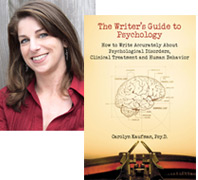
Carolyn Kaufman, PsyD's book, THE WRITER'S GUIDE TO PSYCHOLOGY: How to Write Accurately About Psychological Disorders, Clinical Treatment, and Human Behavior helps writers avoid common misconceptions and inaccuracies and "get the psych right" in their stories. You can learn more about The Writer's Guide to Psychology, check out Dr. K's blog on Psychology Today, or follow her on Facebook!