QueryTracker Blog

Helping Authors Find Literary Agents
Showing posts with label psychology. Show all posts

Wednesday, June 18, 2014

Advice from Carolyn Kaufman, Part 1: Professionalism

It is such a joy to blog here again after several years away. My name is Mary Lindsey, and I was one of the original Querytracker bloggers, along with H.L Dyer, Suzette Saxton Fisher, Elana Johnson, and Carolyn Kaufman

It was a tremendous loss, not only to me, personally, but to QueryTracker community, her college students and fellow professors, her family and friends, and to aspiring and established authors when Carolyn Kaufman died unexpectedly in September 2013 of a brain aneurism.

When I mentioned to Patrick McDonald, (owner/creator/designer of QueryTracker.net) that I had come across an old interview I did for Carolyn's first book, we agreed it would be a nice tribute to Carolyn, and all the hard work she did on behalf of aspiring authors, to post some of her wisdom as a tribute. So, here we go!

Here's the first bit of advice she had for aspiring authors (second tip will be posted on July 2):

What I’ve Learned: Advice for Writers Who Aspire to Publish 
Dr. Carolyn Kaufman 1973-2013
 1. Treat everyone well at every step along the publishing path. That includes your crit buddies, agents and their assistants, editors, publicists, and anyone else you encounter along the way. How well you write is important, but I genuinely believe professionalism is nearly as important. If you’re arrogant, entitled, mean, petty, or refuse to be a team player, nobody is going to want to work with you. There’s a reason most authors’ Acknowledgements page is lengthy – they didn’t reach the finish line (of publication) alone.

It seems like such an obvious suggestion: Be professional and treat people well. And it is… until the drama begins. Bad reviews. Inflammatory blog posts or Tweets. Flame wars on forums. The online drive by nastiness can suck a writer in and under and make Carolyn's advice nearly impossible to follow.

But follow her advice.

The professional contacts and friends I've made over the years have been one of the most important aspects of my success as a writer.

Carolyn lived up to her own advice, setting an example not only as an author and expert, but as a personal friend and critique partner. I was fortunate enough to have her as a critique partner for several years, and though her critiques were often harsh, they never came across as anything other than honest and professional--like Carolyn herself. She is terribly missed by all of us at QueryTracker.

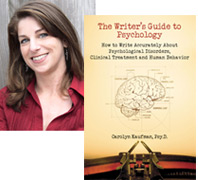
Carolyn Kaufman's bio and articles on psychology for writers can be found on the Psychology Today Blog, where she was a contributor. Her book, The Writer's Guide to Psychology: How to Write Accurately about Psychological Disorders, Clinical Treatment and Human Behavior, is available for purchase and is an excellent resource for established and aspiring writers.


***
Mary Lindsey is one of the founding members of the QT Blog. 

She writes young adult novels for Penguin USA and is the author of Shattered Souls, Fragile Spirits, and Ashes on the Waves. She also writes adult romance for Entangled Publishing as Marissa Clarke. Love Me To Death is scheduled for publication October, 2014. 

Mary is represented by Kevan Lyon of the Marsal Lyon Literary Agency and can be found the following places: Twitter, Facebook, MaryLindsey.com and MarissaClarke.com

Wednesday, June 4, 2014

Fallbacks

I'm cooked. I'm cooked because one of my children ended up in the hospital on May 6th, and after the hospital stay, doctor visits, referrals to other professionals, school meetings and a step-down program, we're still not back to normal. So how does a writer keep creating under the circumstances?

They say "writers write." I don't think it's that easy. Given that nothing is easy at the moment, I'm going to say sometimes writers don't write. But we're still writers, and this is what we're doing when life gets a whole lot knottier than we anticipated.


  • We write other things. That may mean blog posts. That may mean a novelist writes his first poems or an essayist experiments with short stories. It may mean that if your friendly local newspaper editor calls with a business profile on quick turnaround, you say, "Sure! That sounds like a co-payment right there."
  • We edit. That novel you've had hibernating for several months, or a year, or since you were eighteen? Blow the dust off it and see what you can do. Manipulating words that already exist is a whole lot easier than coming up with ideas and creating brand-new ones.
  • We end up writing anyhow while editing. You know, when you think to yourself, "Why is this scene over so quickly? We've been building up to it for ten pages, and the climax is like a paragraph." Voila: words you didn't have before
  • We read. Going on "intake mode" is just fine, and if you're worried you're not a writer if you aren't actually working on words you created, reassure yourself that writers read in different ways than non-writers. Go ahead and pick up a book or two. Or six. It's research.
  • We critique our writer-friends. Actually, in my case I discovered I'm much better at reading the piece than actually sending the friend my critique. (I'm very sorry, CB.)  But it keeps you going.
  • We stockpile. This stress right now, this experience? It may never end up in any of your work, but it's forming you as a person and therefore it's also forming you as a writer. Stress (and even tragedy) will help you form compassion and new perspectives, and those alone will help your future work.
  • We create in other ways. Ivy Reisner said on KnitSpirit that while you need to engage your spirit to write, in some ways knitting or crocheting is "pure craft." Having knit a sock all the way down to the ankle during an ER stay, I agree. You can move a hook or a needle over and over without involving your heart at a time when your heart is already working on too many other issues. So find a "pure craft" way to create: cooking or woodworking or knitting will help you be creative without taxing your creativity. 
When stressors hit, we need our fallbacks. Use them and don't feel bad. The stress won't last forever, but you'll always be a writer.


---
 Jane Lebak is the author of The Wrong Enemy. She has four kids, three cats, two books in print, and one husband. She lives in the Swamp and spends her time either writing books or shoveling snow. At Seven Angels, Four Kids, One Family, she blogs about what happens when a distracted daydreamer and a gamer geek attempt to raise four kids. If you want to make her rich and famous, please contact the riveting Roseanne Wells of the Jennifer DeChiara Literary Agency. 

Wednesday, September 12, 2012

Using Personal Issues to Enhance Fiction

This is a test of your creative imagination...
There is a projective psychological test called the Thematic Apperception Test (TAT). It’s not the most empirical thing in the world, as the client essentially tells a subjective story about each of a series of (rather dated) black-and-white scenes. Therapist and client then look for recurring themes in the stories, sometimes providing surprising insight into client concerns.

When we write stories of our own, in many ways we are participating in a grand version of the TAT, exorcising relevant life themes onto the page, sometimes over and over. It’s not unusual for a particular writer’s stories to have common elements, characters, themes, and settings.

So how, someone once asked me, how do we avoid projecting our own concerns, our own personal narratives, into our stories?

Honestly, I’m not sure we should try to avoid doing so.  

From a psychological standpoint, there is often something healing in writing, and if you are continually finding the same theme on your page, that repetition compulsion (i.e. a repetitive re-enactment of a particular set of circumstances) may indicate something you (and your characters) need to work through before you’re going to be able to move on to something new. One of the beautiful things about storytelling is that you can play out various outcomes. Don’t be afraid to push your characters into uncomfortable situations. Let them wrestle with the issue or issues in their own ways. See what happens.

Another argument for allowing the same theme to recur is that it’s clearly something that has a lot of energy in your psyche. If you let it, that energy will come through and engage your readers. Especially if you’re willing to push your characters—and yourself—into literary places that are not familiar, comfortable, or safe.
Your main character is afraid of failing in school and not measuring up? Take a deep breath and let him fail. Let all those awful things that he’s (you’re) afraid of happen. How will he overcome those problems? How will those struggles affect him as a person?  

If the theme recurs later, push both your characters and yourself even harder, into even darker, scarier places. Archetypal psychology, often used in storytelling, suggests that each hero must eventually confront his greatest fears if he is to overcome them. Some of your characters may fail or even break under such pressure; they may even become villains as a result. Don’t be afraid to explore those possibilities; you may find some of your best villains down those dark passages.  But also remember that the most exciting plots and the strongest heroes are also born of such trials. It may be a rocky road, but your hero will prevail and overcome…and so will you.


Carolyn Kaufman, PsyD's book, THE WRITER'S GUIDE TO PSYCHOLOGY: How to Write Accurately About Psychological Disorders, Clinical Treatment, and Human Behavior helps writers avoid common misconceptions and inaccuracies and "get the psych right" in their stories. You can learn more about The Writer's Guide to Psychology, check out Dr. K's blog on Psychology Today, or follow her on Facebook or Google+

Wednesday, December 21, 2011

Psychology Q&A: Dissociative Amnesia After a Trauma?

Disclaimer: The information provided in this post is intended for writing purposes only and does not represent psychological advice.

QUESTION: I am writing a novel in which I've given the main character Dissociative Amnesia. My understanding is that the condition usually develops after a stressful or traumatic event. My character has been abducted by her stalker of three years and held prisoner for several days. She is eventually shot and left for dead. She is rescued but it is discovered she has amnesia. I need the character to remember events in her past but only up to a certain age/point. My questions are:
  1. Is there a certain sequence or specific event that needs to take place in order for the condition to develop? 
  2. Is it possible for a victim of Dissociative Amnesia to lose three years worth of memory? More specifically, is it logical for my character to only remember events up to a certain age (let's say age 30), forgetting everything else beyond that (even the trauma), and believe she is age 30 when she's really age 35? 
  3. How would a doctor handle my character's condition?

ANSWER: I'll answer your questions one at a time below in more detail, but it sounds like what you actually need may not be dissociative amnesia but a dissociative fugue.

Dissociative amnesia is essentially amnesia for a particular event or set of events that are, as you note, traumatic in nature. It would be perfect if you just needed your MC to have amnesia for what happened when she is stabbed and flung from the van. A fugue is basically when someone has a dissociative split in identity, i.e. they develop amnesia for all events after a certain point (though they can make new memories) and travel away from home. During a fugue the person may (or may not) take on a new identity. When they eventually come out of the fugue (which can happen with help from therapy, or spontaneously) they may or may not remember what happened during the fugue. During a fugue, the person usually seems completely normal to others. They don't act bizarre.

1. Is there a certain sequence or specific event that needs to take place in order for the condition to develop?

Just because it may be helpful, let me quickly summarize the difference between dissociative amnesia and organic amnesia. There are 2 types of amnesia—psychological (dissociative, in which the mind is thought to split off a traumatic event to protect the psyche) and organic (physical, in which the brain is affected). A really good example of organic anterograde amnesia is in the movie Memento (or 50 First Dates). In both movies, the MC's hippocampus (the brain structure which makes new memories) is damaged beyond repair, and the character is unable to make new memories.

Then let's differentiate between dissociative amnesia and a dissociative fugue. They're essentially the same thing except that in a fugue the individual travels away from home (or wherever she normally is) and the amnesia can be more extensive. So let's say someone walks in on her partner in bed with someone else. Dissociative amnesia might be that she completely forgets walking in on them, but all other memories are the same; someone with a dissociative fugue will walk out the door, get in the car, and travel away, possibly while taking on a new identity. It seems that people with fugues are actually fleeing physically as well as psychologically from a traumatic event. Years ago actress Anne Heche went through a breakup (from Ellen DeGeneres) and went wandering in the desert claiming to be someone named Celestina. She later said she had dissociative identity disorder (multiple personality disorder), but what she was actually describing was a fugue. If you want to do a little more movie research, The Long Kiss Goodnight with Geena Davis portrays a fugue.

For either amnesia or a fugue, there has to be an event traumatic enough that the mind decides to wall it off (dissociate it) so the individual doesn't have to deal with it.

2. Is it possible for a victim of Dissociative Amnesia to lose three years worth of memory? More specifically, is it logical for my character to only remember events up to a certain age (let's say age 30), forgetting everything else beyond that (even the trauma), and believe she is age 30 when she's really age 35?

It would be rare for either someone with amnesia OR a fugue to lose 3 years prior to the traumatic event, but you could pull it off better with a fugue. You could argue that the identity the character having the fugue is taking on is that of a younger self.

The hard part about pulling off a fugue for your character may be the travel—the person has to travel. Though I suppose she could travel away from where she is living as a 35-year-old and make her way back to a "safer time," ie when she was 30.

3. How would a doctor handle my character's condition?

Who brings the character into treatment? Theoretically, if she is dissociating, she is not going to realize she has a problem.

A doctor would probably screen for organic problems (such as concussion; damage to the hippocampus, frontal lobes, and temporal lobes) as well as for drug and alcohol use and abuse (prescription and nonprescription)—for things that could cause memory problems, in other words. If nobody can find any physical cause, the character would be referred to a psychologist.

The psychologist would probably be someone who specializes in trauma (e.g. PTSD) and/or dissociative disorders. Her goal would be to help your character come to terms with the trauma that triggered the fugue. She would probably encourage your character to remember what happened, though if she's a good therapist, she definitely wouldn't hypnotize her to remember. (Hypnosis just puts you into a natural dissociative state, and makes you more suggestible. As a result, it's super easy to influence people who are hypnotized and cause them to create false memories, which certainly would not be helpful—especially if your MC ever wanted to take her stalker to court.) There would also be work on helping your MC develop coping mechanisms besides dissociation. If your therapist was someone who used EMDR (a treatment some people find helpful for PTSD), she might also use EMDR.

The therapist would also use cognitive therapy, including dealing with irrational and upsetting thoughts by changing self talk; and behavioral therapy, probably including exposure therapy of some kind. To pull those things together, the therapist would have your MC talk, and listen for ways she might be unintentionally self-sabotaging (everybody does it to some extent) due to cognitive distortions (there's a list of the ones we usually listen for at PsychCentral). Then the therapist teaches the client to think more realistically. (She doesn't whitewash things, just helps the client stop blowing things out of proportion).

Exposure therapy involves exposing oneself to the things that are associated with the traumatic event while practicing new coping and relaxation skills. You can do imaginal exposure, where the client imagines going through things again, or you could even take her back to the place the trauma happened with the therapist.

EMDR is a treatment that combines cognitive and behavioral therapies with a particular pattern of eye movement. Some people swear by it, and some people will tell you it's garbage.

If you want more detailed information on portraying these therapies, including EMDR, I go into more detail in my book, The Writer's Guide to Psychology. I also talk more about why you don't want to hypnotize someone who has a dissociative condition, and talk more about the differences between psychologists and psychiatrists.

Finally, while there are no medications for dissociative disorders, if the character is struggling with depression or PTSD symptoms, there are medications for those things.

Remember, if YOU have a psychology in fiction question you want to see answered here, use the Q&A form on the Archetype site or send an email using my QueryTracker email address to the right. (Please use Q&A in your Subject Line!).  


Carolyn Kaufman, PsyD's book, THE WRITER'S GUIDE TO PSYCHOLOGY: How to Write Accurately About Psychological Disorders, Clinical Treatment, and Human Behavior helps writers avoid common misconceptions and inaccuracies and "get the psych right" in their stories. You can learn more about The Writer's Guide to Psychology, check out Dr. K's blog on Psychology Today, or follow her on Facebook or Google+

Monday, October 3, 2011

Psychology in Fiction Q&A: Brainwashing

Disclaimer: The information provided in this post is intended for writing purposes only and does not represent psychological advice.
QUESTION: I have a character that I am writing who has a daughter but is brainwashed into believing that she isn't his daughter. How do I go about this? When people are brainwashed, or their memories are swept, how does it happen to them?
ANSWER: Hm, so your character once knew he had a daughter, but now he has been brainwashed to believe he does not, i.e. that this woman is not his daughter?

That's do-able, as memory is pliable and easily distorted.

The first technique anyone will use if they want to persuade someone is repetition -- saying the same thing over and over in a convincing way. Repetition can be very powerful.

Brainwashers also control the environment; that is, they keep the individual from exposure to people who might contradict anything the brainwasher is saying.

True brainwashing involves numerous stages, including verbal assaults on everything the individual believes about himself and his values. This usually includes simultaneous attacks on physical and emotional well-being, to create confusion, disorientation, and exhaustion. In other words, a man (or woman) is much easier to break down if you attack him on all levels, making it hard for him to think straight. Sleep deprivation and starvation are not uncommon, as are confusing, seemingly whimsical behaviors on the part of the brainwasher. That is, the brainwasher may torture the individual for no apparent reason, and then provide seeming kindnesses. Over time, this can create a sense of dependence on the brainwasher, and a deep desire to keep him or her happy. (This is called Stockholm Syndrome.)

One of the experts on brainwashing and mind control is Robert Jay Lifton, an American psychiatrist who wrote a book called Thought Reform and the Psychology of Totalism: A Study of "Brainwashing in China." In the book he identifies principles brainwashers use.

In addition to isolating the individual from others, seemingly whimsical manipulations, and assaults on the individual's sense of self and personal values, brainwashers work to convince the individual that he has committed sins to which he must confess.  These sins are, of course, behaviors from the individual's life outside the brainwasher's control, and the brainwasher offers redemption if the individual will only adopt the brainwasher's rules or doctrine.  In other words, the subject becomes so confused and overwhelmed by guilt that he's essentially floundering for a way to escape the feeling; at this point the brainwasher helpfully offers up the new ideas she wishes the individual to adopt.

Remember, if YOU have a psychology in fiction question you want to see answered here, use the Q&A form on my Archetype site or send an email using my QueryTracker email address to the right. (Please use Q&A in your Subject Line!).

Carolyn Kaufman, PsyD's book, THE WRITER'S GUIDE TO PSYCHOLOGY: How to Write Accurately About Psychological Disorders, Clinical Treatment, and Human Behavior helps writers avoid common misconceptions and inaccuracies and "get the psych right" in their stories. You can learn more about The Writer's Guide to Psychology, check out Dr. K's blog on Psychology Today, or follow her on Facebook or Google+

Monday, May 2, 2011

Psychology in Fiction Q&A: Splitting and Alter Egos

Disclaimer: The information provided in this post is intended for writing purposes only and does not represent psychological advice.

QUESTION: My MC, Andrew, exhibits many symptoms of borderline personality disorder, including splitting. With the splitting, he basically thinks of himself as a "good" Andrew and a "bad" Andrew. In his internal thought, the good part of him (who he calls Leif) talks with the bad part. At first, it's just jumbled thought, sometimes doesn't make sense, and as it progresses, it develops two distinct voices. He thinks the bad Andrew is just worthless and a street whore (he's a prostitute) and the good Andrew is who he is trying to change into, to fix his life. I don't think this is split personality or multiple personalities because they are aware of each other, and it really is like two aspects of the same thing. Does this make sense, psychologically? Is it still borderline, or is this something else?


ANSWER: It sounds like you've got the gist of splitting, which is pretty commendable, since it's a tough concept. Typically, though, adult splitting is seen as a kind of defense mechanism, so people aren't really aware that they're doing it.

Let me explain splitting a little more, just so that makes sense, and then we'll talk about what might work well for your story.

According to object relations theorists like Melanie Klein, newborns essentially believe that the world is part of the same entity as them. In other words, they can't differentiate between themselves and the world. Later, they differentiate between "me" and the world, but Mommy (or Daddy, or whomever the primary caregiver is) is seen as part of "me." Still later, the child begins to understand that "me" and Mommy are different, but they have trouble seeing "good Mommy" (who acquiesces to them and fulfills their needs) and "bad Mommy" (who says "no" or is otherwise frustrating or disappointing) as the same person. This is splitting, and it's natural around 3-4 months of age. As we get older (i.e. around 6 months of age), we learn to see "good Mommy" and "bad Mommy" as part of the same person. That's why we can love and hate someone at the same time.

This natural process is interrupted in people who have borderline personality disorder, typically due to trauma of some kind (usually abuse). As a result, these children never stop splitting other people and either idealize or devalue them. They may swing back and forth very quickly from one side to the next, but they aren't really able to simultaneously integrate the good and bad.

People with borderline personality disorder never learn to regulate their emotions, so they have extremely tumultuous, even destructive relationships with others as they frantically try to get others to help them deal with a world they feel they can’t deal with alone.

You say Andrew has other borderline tendencies, but if splitting is the primary reason you’re using the borderline diagnosis, it might be simpler to move away from that diagnosis. (Borderline personality is an extremely painful disorder for the person who has it, and they often have depression, anxiety, PTSD, and incredibly disruptive behavior patterns, and that’s a lot to try to portray!)

At the same time, you’re right, it doesn’t sound like Andrew would qualify for dissociative identity disorder (multiple personality disorder). His relationship with his alter ego, Leif, isn’t dissociative enough.

It sounds to me like Andrew has just named a normal ego state and is relating to it in a way that works for him. Which is entirely possible and probably is not in itself diagnosable.

Everyone has multiple ego states. That’s normal. For example, the “you” that goes to Thanksgiving dinner with the in-laws probably acts a little different than the “you” that goes out for a raucous evening on the town with friends. Both parts are you, but they’re different sides or facets of you.

Some people are more aware of these different ego states than others, especially if they play very diverse roles in life. That sounds like the case for Andrew.

It’s even pretty normal for people to give their ego states names, though they may think of those ego states as “the party girl” or “the writer” or whatever. People also adapt their names based on the setting they're in. For example, an Andrew might be Mr. Whomever at work, but Drew with friends and Andy to his lover. And I know people who go by their given names (e.g. James) in formal situations but by a middle name or nickname that's completely different in informal settings (e.g. Tim).

If you want or need a diagnosis for Andrew, based on the brief description you gave me, I’d probably lean toward some kind of a mood disorder, maybe dysthymia (a chronic, low-grade, but extremely wearing depression) or a major depressive disorder (which is more crippling at its worst, but tends to get better and then worse and then better again over the years). An anxiety disorder is another possibility.

For more information on borderline personality, dissociative identity disorder, mood and anxiety disorders, treatments, therapies, and character-building, check out my book on psychology for writers, The Writer's Guide to Psychology: How to Write Accurately About Psychological Disorders, Clinical Treatment and Human Behavior!

Remember, if YOU have a psychology in fiction question you want to see answered here, use the Q&A form on the Archetype site or send an email using my QueryTracker email address to the right. (Please use Q&A in your Subject Line!).  


Carolyn Kaufman, PsyD's book, THE WRITER'S GUIDE TO PSYCHOLOGY: How to Write Accurately About Psychological Disorders, Clinical Treatment, and Human Behavior helps writers avoid common misconceptions and inaccuracies and "get the psych right" in their stories. You can learn more about The Writer's Guide to Psychology, check out Dr. K's blog on Psychology Today, or follow her on Facebook!

Monday, April 18, 2011

A Necessary Fluency

A woman tells her husband she's starting a diet, and the next day he brings home two gallons of ice cream and a box of Oreo cookies.

A man calls his daughter and they talk for an hour about how bad his son (her brother) is behaving, things going on at the son's job, and what they think about how the son is raising his kids.

A woman dreads visits from her mother because her mother will look all over the house to find fault with her housekeeping, then spend the rest of the visit giving helpful "advice" about how she's spoiling her new baby. The woman has argued with her mother about that negativity, but the mother then sobs that she's only trying to help and will sulk for a week.

If you're a writer, you're going to encounter all these situations. More to the point, you're going to have to create them from whole cloth.

Therefore, and this may sound obvious, if we don't understand the basics of relationship dynamics, we cannot write realistic fiction. In fiction, character is where the rubber meets the road. And character expresses itself in relationships.

The first instance is something called a push-back reaction. Everyone does it. Why? Because we're comfortable with our loved ones just as they are. And therefore when a loved one makes a change, even a good change such as going back to college or beginning a diet and exercise program, we unconsciously make it harder for them to continue that path because we don't want the relationship to change.

The second instance is called triangulating, where two people have a relationship at the expense of a third. It keeps everyone's feelings carefully tamed but prevents any actual growth, and of course it prevents a genuine relationship between the two conspirators and the person on the third point of the triangle.

The third instance doesn't necessarily have a name, but those two clearly need to have a discussion. The problem is, whenever they fight, they fight in a way that reinforces the negative dynamic rather than addressing the actual problem (that the woman is ready for adult autonomy and her mother doesn't want to let go.)

A writer needs to become fluent in relationships. This isn't optional. The same way a writer needs to learn to manage dialogue, setting, punctuation and complex sentence structure, a writer also needs to become fluent in boundaries, push-back reactions, triangulating, and how to have an effective argument (although a lot of your story will probably have arguments of the ineffective, status-quo-reinforcing kind.)

Read self-help books. Read books about motherless daughters (Hope Edelman), about raising adopted children, about setting boundaries in relationships (Townsend and Cloud). Browse your used book store and pick up What Color Is Your Parachute even if you're not going to look for a job for ten years. Read books about basic psychology (our own Carolyn Kaufman has one of those!) and dealing with sociopaths (Martha Stout).  Read, read, read.

If you're unsure, then start with The Dance of Anger and The Dance of Intimacy by Harriet Lerner, which is where the above examples come from. Even if you don't write these specific dynamics, knowing how the human heart operates can only improve your fiction.

--
Jane Lebak is the author of The Guardian (Thomas Nelson, 1994), Seven Archangels: Annihilation (Double-Edged Publishing, 2008) and The Boys Upstairs (MuseItUp, 2010). At Seven Angels, Four Kids, One Family, she blogs about what happens when a distracted daydreamer and a gamer geek attempt to raise four children. She is represented by the inimitable Roseanne Wells of the Marianne Strong Literary Agency.

Wednesday, May 5, 2010

Handling Critiques Without Getting Defensive

When I was in high school, I had an art teacher who liked to espouse the importance of "constructive critiques."  I quickly learned to hate the term, because as far as I could tell, what it really meant was "rake the poor artist over the coals."

Though in retrospect I have no idea whether I was really being raked over the coals by someone who was emphasizing the critique over the constructive or whether I was just hypersensitive and it felt that way, I do know two things.

First, it's never easy to have your creative work critiqued.  Few things are as personal as our writing, especially our fiction. We pour our desires and dreams, fears and vulnerabilities into our characters and plot points. It's hard to share those things with others; it's even harder to have people react with anything less than mountains of praise.

Second, for better or worse, critiques from trustworthy crit buddies who genuinely want to help us improve are crucial to both our growth and our success as writers. In other words, having problems pointed out is tough, but that's the only way we're going to build a great story.  This is even more true if you hope to publish, because both agents and editors will ask you to make (often tough) revisions to polish your story into a salable state.  (And don't forget about the reviews after your book is published!  You'll need a thick skin for those!)

Before we go on to how to deal with the actual criticism, let's get the problem right out there in the open.

1. Take a good hard look at yourself -- are you getting defensive and undermining yourself?

A lot (make that A LOT) of people ask for honest and even brutal criticism, but respond defensively when they get it...no matter how it's given.  How do you know if you're doing this?  Give yourself a point for each of the following:
  • You respond to the crit buddy's comments with "But...." and explain why s/he's wrong.
  • You say (or think) "That's going to be too much work" and try to make a case for why the changes don't need to be made.
  • You decide your critique partner just doesn't understand your brilliance and declare him or her an irredeemable idiot. (Yes, you get a point for this even if you eventually decide maybe the person isn't an idiot.)
  • You get angry at the critique partner. Check this one twice if you fire back an angry email, text, or phone call.  Check it three times if you've lost critique partners this way.
  • If you've ever sent a nasty response to a literary agent for any reason following a query, just go ahead and give yourself 20 points.
  • You don't take other people's advice...ever.  (Also give yourself a point if you only take advice that tells you how to make something that's already brilliant better, eschewing advice that targets things that aren't working.)
  • You make a big deal about how bad you feel about the advice until your crit partner backpedals or tells you s/he was wrong....about any and all negatives.
  • Your crit partner/s used to give you advice that was hard to take, but now it's all vague, halfhearted, and generically positive.
The more of these you answer yes to, the more defensive you are.  Give yourself a break if you only do one or two of these once in a while -- we all feel defensive sometimes.  But the more of these you're doing on a regular basis, the more defensive you are, and the more you're probably undermining yourself, your growth, and your ability to reach your writing goals.

2. Decide -- honestly -- what you really need: praise or growth.

Some writers genuinely need praise and attention from other writers more than they want to grow as an author.  That's okay.  If what you really need is praise, then focus on communities where the feedback is mostly positive.  You probably won't grow into someone who's regularly selling your work, but that may not be what's most important to you.

Sure, publication is the brass ring, but the more people who read your work, the more you're opening yourself up to potential negativity.  Because no matter how good you are, there are always going to be people who hate your work...and are happy to tell you so.  So if what you really need is praise, focus on enjoying the writing and getting praise!

If you decide that growth is really what you want most, move on to the next point!

3. Admit to yourself how hard it is to take criticism.  (I know, it sounds like we're in AA here.)

Often, we try to sweep unpleasant feelings under the carpet to avoid dealing with them.  But experiencing them can help us deal with and get past them.  So go ahead and admit to yourself -- and your crit buddies, if you need to -- that sometimes it's hard to take even constructive criticism.  I bet they'll tell you they feel the same way!

Now that we've established the problem, let's look at how to deal with it.

1. Realize that a critique of your work is not a critique of you.

Like I said above, it can be hard not to take crits personally.  But nobody -- and that includes people like, oh,  Stephen King -- started out as a brilliant writer.  Yes, some folks (like King) have a definite head start when it comes to raw talent, but everyone needs some work to get it right.

For example, King was determined to get published from the time he was a teen.  He began sending short stories out and, like the rest of us, started racking up rejections.  He put a nail in the wall, and each time he got one, he stuck it on the nail.  Pretty soon the nail fell off the wall and he had to put up a big fat spike instead.  But when he got feedback from an editor or a mentor, he didn't feel sorry for himself or swear to give up writing -- he buckled down and figured out how to be a better writer based on that feedback.

And we all know how that turned out.

So separate critique of your work from a critique of you.

2. Even if you can't help but take critiques personally, realize that the criticism (and the bad feelings that can accompany it) won't kill you.

People who choose to pursue clinical or counseling psychology need to be aware of their own biases and the messages they're sending others verbally and nonverbally.  But when you start grad school, you're rarely as self-aware as you need to be.  So guess what happens when you get there?  That's right -- they start pointing out every little mannerism, bias, and trait.  Worse, they videotape you so they can point to the behavior and say "That is a problem."  If you can't see it, they play it over and over -- often in front of a crowd -- to force you to acknowledge the problem.

It's enough to make anyone want to crawl into a corner and curl into a fetal ball.  But you know what?  Even in such a situation, you start to realize that you can survive it.  Eventually, you realize that the fear of taking in constructive criticism is often worse than actually facing it head-on and dealing with it. Sure, you might have some mannerisms or vocal tics that need work, but that doesn't mean you're a failure as a person.

The same thing is true with writing.  You may have a lot of trouble not feeling bad when someone doesn't like your character or the twists your plot took. You may want to throw everything out the window when someone believes you need a major change to make the story work. But that doesn't mean there's something wrong with you as a person. It just means that your vision isn't coming through as clearly as you'd hoped.

Still, sometimes we need to feel the sad and frustrated feelings before we can look at things more clearly. So if you need to, go ahead and feel sorry for yourself for a day or two, but then it's important to pack up your pity party and get down to business.

Criticism can be tough to take, but you CAN take it.  And the more practice you have at taking it gracefully, the better you will get at it.  Promise!


3. Rather than getting overtly defensive, ask questions and find ways to improve clarity.

Now that you know that it's okay to experience the bad feelings -- they won't kill you -- you can have them and then move on.  One of the best ways to move on is to look at places your crit buddies see problems and find out more so you can make good changes.  Try asking questions like:
  • What made this [plot point, character motivation, etc.] confusing?  What would help me make it clearer?
  • Is this a problem you're seeing consistently through the story/novel?  What skills do I need to hone to correct that problem?  Can you recommend any resources that might help me/have helped you?
  • Could you suggest ways I might fix this problem?  Examples might help me see possibilities.
Remember, the goal in soliciting crits is to make your story better -- so follow up on anything that's unclear!

4. Keep your eye on the goal.

Remember, growth and change are usually difficult.  But if they get you closer to a treasured goal, it's all worth it!

So...what have I missed?  How do YOU deal with constructive criticism?

Monday, March 8, 2010

Psychology in Fiction Q&A: Delusional Disorders

Disclaimer: The information provided in this post is intended for writing purposes only and does not represent psychological advice.
QUESTION: I'm writing for a character I'd like to classify as having some sort of disorder, but I’m not sure what would fit with circumstances properly or how to reflect that in speech or thought patterns, and interpersonal relationships with strangers, close friends and those of the opposite sex.

The character is female, twenties, and would need to have some paranoia and believe she is on an extremely important mission. Other symptoms I could squeeze in could be hallucinations, easy to distract, or things like that. If possible I’d like to keep her thought patterns fairly logical but if no disorder fits I'm up to the challenge. I'd also like to leave the possibility open that she may not be as "disordered" as she appears.
ANSWER: Sounds to me like a delusional disorder, probably grandiose delusions with some paranoia, would be your best bet.

I'll explain better what that means in a minute, but the good news is that people with delusional disorders may seem totally normal to other people until and unless the delusion is triggered. So she might seem totally normal to people she encounters in casual day-to-day life, like the supermarket checkout person and even people she works with if their interactions are extremely shallow.

A delusion is a not-based-in-reality idea that you can't get the person to shake regardless of evidence. Many (all?) really die-hard conspiracy fanatics are delusional.

You didn't mention whether her important mission is something that could really happen. For example, if she believed that the President had tapped her as a civilian to go on some mission for the CIA, that's possible in the world as we know it. Ridiculously unlikely, of course, but possible. Possible = "nonbizarre delusion."

If she believed, by contrast, that aliens were beaming a mission into her brain using an implant they put there when they abducted her as a child (or whatever), that's not possible in the world as we know it. Impossible = "bizarre delusion."

Technically, if someone has bizarre delusions, they automatically get a schizophrenia diagnosis. For your character, it would be paranoid schizophrenia with prominent grandiose delusions.  Grandiose delusions, according to psychology's diagnostic manual, are "delusions of inflated worth, power, knowledge, identity, or special relationship to a deity or famous person."

Even with a paranoid schizophrenia diagnosis, you still wouldn't have to add a bunch of unnecessary symptoms -- the strange ideas (delusions) could be her key symptom.

Someone with a fixed delusion is going to believe they're right and others are wrong, but your character could wonder once in a while if she's losing it, as long as she always decides she isn't. Someone with a delusion is also going to see "proof" in innocuous things that others might never even see as significant. And she will definitely become aware that others think she is unwell, and that will be uncomfortable. She might even start to buy the idea that she is, but the beliefs/delusions need to persist.

I think you probably need to write her ideas and the "proof" she sees as a little over the top from time to time, so the reader wonders if she's not just mentally ill. At the same time, the evidence could be convincing to her -- and perhaps to the reader from time to time, too. You could also play with using her as an unreliable narrator. In a lot of ways that's all mental illness is -- something that keeps someone from being a reliable narrator on life as most people see it. :)

Hope that's helpful!

Remember, if YOU have a psychology in fiction question you want to see answered here, use the Q&A form on the Archetype site (note in the "extra information" area that you'd like to see the question answered on the QueryTracker Blog) or send me an email at c k a u f m a n (AT) querytracker (DOT) net. (Take out the spaces in the first word and please use Q&A in your Subject Line!).

Monday, August 10, 2009

Interview with Mystery Author Roberta Isleib


Today we are lucky enough to be joined by clinical psychologist Roberta Isleib, the author of eight mysteries published by Berkley Prime Crime--most recently ASKING FOR MURDER.

As you all know, my (Carolyn's) "thing" is helping writers get the psychology right in their stories, and I cheered all the way through Roberta's Advice Column Mysteries.  Not only are they a great read with wonderfully engaging characters, they're also the best example I've ever seen of psychology wrapped so beautifully (and accurately!) into a series. Put her novels on your Do Not Miss reading list!

Roberta's books and stories have been short-listed for Agatha, Anthony, and Macavity awards. She is the past president of National Sisters in Crime and is presently serving as the chair of the Edgar best novel committee for Mystery Writers of America.

QueryTracker Blog: How did you start writing?

ROBERTA: I’ve been a student for so many years (Ph.D in clinical psychology) that I should say I’ve always written. But I started writing articles about the psychology of golf in the mid-nineties, as a way to try to make use of the time I spent learning to play golf (too much—you can’t imagine.) Then, because I’ve always read and loved mysteries, I began a story about a neurotic professional golfer wannabe who became a murder suspect while trying to make it onto the Ladies golf tour. Hence, the Cassie Burdette golf mystery series was born.

QT: Please tell us about your road to publication.

ROBERTA: Since I knew no one in the business, I studied books on publishing like Elizabeth Lyon’s The Sell Your Novel Toolkit and Jeff Herman’s Writer’s Guide to Book Editors, Publishers, and Literary Agents.

I made huge charts of agents who had interests like mine (mystery, sports, psychology), or who had some feature in their personal background that made me think we might connect, or who had sold books with some similarity to mine. I attended mystery conventions (Bouchercon, Malice Domestic, and Left Coast Crime) and talked with people there about the publishing process. And I sent out almost thirty queries over a year with no success.

One day, I dragged myself into New York City for an International Women’s Writers Guild “Meet the Agents” panel. One hundred and fifty wannabe writers crowded the hall to hear nine agents speak about their areas of interest. Then we rushed to the front of the room to give our two minute pitches to the agent we felt most closely matched our interests. The agent I chose asked for a three-week exclusive look at my manuscript. I sent it off. Two weeks later she called with the news that a second agent had seen the manuscript on her desk, read it, and wanted to represent me. Hurray! She’s been my agent ever since. (Paige Wheeler of Folio Literary Management.)

QT: You have two ongoing series. The Golf Lover's Mystery series features Cassie Burdette and the Advice Column Mystery series features psychologist Rebecca Butterman. Could you tell us a bit about each series and what inspired you to write them?

ROBERTA: There were five books in the golf lovers’ series, all featuring Cassie Burdette and her sports psychologist sidekick. I had so much fun researching those—had the chance to play many wonderful golf courses and meet pro golfers and others in the golf world. After five books, Berkley asked to see another idea and I so I created Dr. Rebecca Butterman, clinical psychologist and advice columnist. ASKING FOR MURDER is the latest in that series, which takes place in the town next to me on the Connecticut shoreline. I find the work of a psychotherapist to be very similar to that of a detective—so this path turned out to be a natural progression!

QT: What are you working on now?

ROBERTA: I’m finishing a new standalone suspense novel with the working title “Married Seeking Married.” It goes like this: Just after hearing that her husband has left her for another woman, Mirabelle Conti finds a business card on the bulletin board in a local coffee shop: Married Seeking Married. Reacting from grief and anger, she contacts the card owner to try to understand her husband’s desertion and ends up a suspect in a suburban prostitution ring.

I will be sending it off to my agent soon and if every one of your readers crosses their fingers, maybe she’ll sell it quickly!

QT: What is the hardest/least favorite part of being a writer?

ROBERTA: The business part of writing is hard--the part I have no control over. I can produce a fabulous book, but unless the publisher really gets behind it and I have a bit of luck somewhere along the line, it's unlikely to be a commercial success. That's why I do as much as I can to promote, as long as it doesn't interfere with my writing! I want to be able to say I gave it my all without killing myself in the process.

QT: What is your favorite part about being a writer?

ROBERTA: My absolute favorite parts are seeing the books out in the world and then hearing from and meeting readers. These two things make all the agony worthwhile!

QT: Do you have a quote that motivates you?

ROBERTA: I love quotes from writers on writing. Here’s a good one that gets at the idea that you must treat this as a job, not wait for the muse to strike:

“Every morning between 9 and 12 I go to my room and sit before a piece of paper. Many times, I just sit for three hours with no ideas coming to me. But I know one thing. If an idea does come between 9 and 12 I am there ready for it.” — Flannery O'Connor

QT: What is your advice to new or unpublished writers?

ROBERTA: Okay, you asked for it!

1. MAKE A PLAN THAT INCLUDES LOTS OF LITTLE, MANAGEABLE GOALS: As I begin a book, I look ahead to the due date and figure out how many pages I’ll need to write each week in order to hand it in on time. I build in time for trips and family and time for my writers group to read and critique, and then time for me to rewrite. Then I have a page goal for each week. I write until I’ve hit the goal, sometimes even getting a little ahead. If I have an unproductive day, it just means writing a little faster later in the week to keep up.

2. HAMMER IT OUT: Get it all down, even if it's awful. You can always go back and fix things later. Anne Lamott called this “the shitty first draft”—she had it right!

3. SET YOUR SIGHTS HIGH: As a psychologist, I know the importance of having "big goals" for my subconscious to aim at. So I keep a copy of the NY Times bestseller list pasted up over my computer. Then I forget about it and work on the books word by word...

4. YOU’VE GOT TO HAVE FRIENDS: Writing can be such a lonely, discouraging business. I’ve gotten very involved with mystery organizations (Sisters in Crime and MWA,) and joined Romance Writers and Yahoo groups such as Fiction That Sells. I also have a very supportive and loyal writers group and a group blog, Jungle Red Writers. The friends I’ve met have saved my sanity and supported me endlessly along the way. I was president of national Sisters in Crime last year—a very rewarding and time-consuming experience! http://www.sistersincrime.org

5. TAKE YOUR TIME: Don’t rush off too soon to try to get your work published. This business is extremely competitive so it’s crucial to have your writing polished before sending it out. The Internet makes querying too easy—don’t press send until you’re sure the piece is the best it can be. I have lots of info on my website about agents and getting published and some of the scams writers fall for. http://www.robertaisleib.com

And meanwhile, there are lots of conferences that are attended by literary agents. It’s not a bad idea to get some face time with an agent—this personal contact could be what helps your manuscript get a serious look.

QT: Our readers are very interested in platform. What kinds of things do you do to promote your books?

ROBERTA: Right now I’m taking a little break from maniacal promotion to write. But in the past, I’ve done a lot of promoting, making use of niche markets in psychology and golf, social networking, viral marketing, book signing tours alone and with other writers, blogs and blog tours, sending out books and bookmarks, a good website…hmmm, what have I forgotten? My greatest coup was getting interviewed by Sports Illustrated about the golf mystery series in 2006.

The SI writer came to my house in Madison, CT and walked the local golf course with me (where PUTT TO DEATH was set.) A week later a pair of photographers drove out from New York and took lots of photos of me looking very fierce in the marsh where the fictional body was found. So much fun!

With promotion, you never know for sure what will work, so you’re throwing things at the wall to see what sticks. For the advice column mysteries, I consulted with Laney Becker, a very smart agent and former PR maven at my agent’s agency. She reminded me to use the advice column angle in all my publicity. So press releases were sent out in the format of an advice column and I even got Margo Howard (Ann Landers' daughter) to blurb the first book.

But I still believe the best thing a writer can do is to write an outstanding book!

Thanks so much for inviting me to stop in at Query Tracker. Hope some of this information proves to be helpful—and I’m always happy to answer questions.


Dr. Carolyn Kaufman is a clinical psychologist and professor residing in Columbus, Ohio. A published writer, she runs Archetype Writing: Psychology for Fiction Writers and an associated blog. She is often quoted by the media as an expert resource. 

Have a psychology/writing question?  Ask here (or using my email address to the right) and you may see it answered on the QueryTracker.net Blog!

Monday, March 2, 2009

Q&A with the Psychologist

Want to use psychology to give your story authenticity? As promised, I'll be answering a psychology/writing question today on the blog.  If you have a question, feel free to email me using the link at right or by using the Q&A form on archetypewriting.com.
Disclaimer: The information on this site is provided as general educational information to readers and should be not be understood as specific advice for any particular individual(s). People who are seeking help for "real-life" problems are advised to consult a local mental health professional.

On to the question! 

Q: My story is about a young girl age 17 who not only sees ghosts but communicates with them. After numerous times of her family witnessing her talking to "no one" they seek help for her. In my story the doctor recommends that she be committed for three days without visitors so that she may do an evaluation. Is that realistic? When the girl sees that her parents are going through with it she gets very upset. To calm her the doctor gives her a shot of Thorazine. Is that a proper med for this and would it continue to make her a little groggy the next day? What might be an early diagnosis for someone who claims that they see ghosts?

A: Typically people are only committed in the US if they’re a danger to themselves or someone else, or if the doctor is in a rush to get the person stabilized. Since this has been going on for some time, there wouldn’t really be any reason to commit her unless there was a crisis of some kind. For example, if the voices tell her to harm someone or herself, or she’s just at the end of her rope with the voices and doesn’t know if she can take it another second. Committing her without those reasons feels hasty to me, and maybe a little irresponsible — not to mention expensive! On top of all that, insurance probably wouldn’t agree to pay for the hospitalization unless there were an immediate crisis.

So create a crisis of some kind if you really want her in the hospital.

Thorazine is a heavy-duty drug, though it is sometimes used at lower doses for the “problem” you’re describing. These drugs are only injected if someone is acutely psychotic and extremely agitated and emergency measures have to be taken (e.g. the patient is terrified that the doctors are going to kill her). Droperidol (Dropletan, Dridol or Inapsine) is commonly used as an injectable in these cases.

I think giving her a shot of a heavy-duty anesthetic/antipsychotic is too extreme for the doctors at the hospital to do to her. They’d have to be pretty darn sure about doing something like this if they wanted to avoid the possibility of litigation (in general, not necessarily with your character).

Besides, they’d get her on an antipsychotic medication (also called neuroleptics if you want a fancy word) as soon as she got into the hospital, so there’d be no reason to give her another unless she was having acute psychotic agitation like I described above.

Normally “atypical antipsychotics” are preferred when they’re an option because they have fewer side effects. These include risperidone (Risperdal) and olanzapine (Zyprexa). Sedation is common, especially in the first couple of weeks of taking them. Essentially, doctors want to get the patient on something she’s going to be able to take for a while — these are drugs that are commonly taken for a while, though not without side effects like weight gain.

Possible initial diagnoses for someone who sees ghosts and has been seeing them for some time:

Especially in a teen, everyone would want to rule out drug and alcohol intoxication as a possible cause. I checked with Heather (Dr. Dyer), and she said they’d probably run a urine tox screen and alcohol level at least.

If she came back clean, schizophrenia is probably the most likely diagnosis, especially if she is hearing voices in addition to seeing things. However:
* If she’s had the symptoms for less than a month, a diagnosis of Brief Psychotic Disorder is likely, at least at first.
* If there was a crisis or major stressor of some kind in addition to her having symptoms for less than a month, she’d be even more likely to get this diagnosis. Doctors usually refer to this as a “brief reactive psychosis.”

Dr. Carolyn Kaufman is a clinical psychologist and professor residing in Columbus, Ohio. A published writer, she runs Archetype Writing: Psychology for Fiction Writers. Visitors will find not only articles about psychology tailored to their needs, but they can ask Dr. K their writing/psychology questions. She is often quoted by the media as an expert resource.

Tuesday, February 17, 2009

Ask the Doctors! & About Archetype

Q&A on the QueryTracker.Net blog

Some of you know by now that when I'm not writing and blogging, I'm a psychologist and a professor. And I'm not the only doctor on the QueryTracker.net blog team.  HL Dyer is a pediatric hospitalist physician in the Chicagoland area.  Just as I enjoy answering writers' questions about psychology, Heather enjoys answering writers' questions about medicine.

We decided to invite you to email us over the next week with your psychology/writing questions (those go to me, ckaufman) and your medical/writing questions (those go to hldyer).  Our email addresses are in the sidebar to your right!

Next Tuesday, February 24th, Heather will choose one or two of her favorite questions to answer here on the QT Blog, and on Tuesday, March 3rd, I'll do the same thing.  We'll be fielding some of the other questions we get on our personal sites -- links to follow!

Some tips:
* Ask specific questions. 
* If you're comfortable doing so, add some detail about why you're asking -- what's going on with your characters?  What's the scene you need information for like?

From my archives, here's an example of a good, specific question:
Could a person with schizophrenia have such a mild version that, to most, he appears completely normal except for a few "quirks" and his bad symptoms only come out in periods of high stress? Or would I be speaking of a completely different illness?
In case you're interested, the answer to this question is here.
Here's another question; here the writer included lots of character information:
How would a psychological professional respond to a woman who goaded an ex-boyfriend into hitting her? My main character is trying to work through why she is always choosing men who hurt her. The psychiatrist asks her about her first boyfriend. The character says he hit her, but only once, and she doesn't count it as because she taunted him to do it. How would a psychiatrist/psychologist respond to that?
The answer to this question is here.
About Archetype

A couple of years ago, I started to notice that writers often make mistakes or rely on clichés when they incorporate therapists, disorders, and treatments into their stories. With a little more research, I realized why.  There was no easy-to-understand, easy-to-use resource that explained disorders, diagnosis, and therapy to writers. There was also no comprehensive resource on the psychology of the writer, creativity, and good writing.

So I decided to create one.  I  named it  Archetype Writing: Psychology for Fiction Writers.

The other members of the Blog Team suggested I tell you more about my Archetype project, so today that's what I'm going to do.

Let's say, for example, that you're writing a story about a character who has bipolar disorder (aka manic depression).  Maybe that character is suicidal, and you want her to be hospitalized against her will.  The only problem?  You don't know much about bipolar disorder, how it's diagnosed, or how it's treated.  Nor do you know how the whole involuntary hospitalization process works, or how to make the doctors at the hospital sound like real shrinks.

Where to start?  Well, you could piece information together from all over the internet, or you could just visit Archetype.  After all, the Real Psychology section of Archetype includes information on all of these things. Better yet, if you can't find the details you need, or you need someone in-the-know to double-check how authentic your scene sounds, you can fill out the Q & A form  to ask specifically about your story.  (You can also check out other readers' questions and answers in the Q & A archive.) I respond by email within a few days.

The site also includes lots of articles and resources on better writing, characterization, genre writing, editing and feedback, agents and publishing, and using psychology in your fiction.  There are also worksheets and cheat sheets for writing queries, defining your character's personality, and defeating your inner critic.  I've also thrown in a few idea generators and tips on beating writer's block

I hope you'll get the chance to drop by!