QueryTracker Blog

Helping Authors Find Literary Agents
Showing posts with label villains. Show all posts

Wednesday, September 12, 2012

Using Personal Issues to Enhance Fiction

This is a test of your creative imagination...
There is a projective psychological test called the Thematic Apperception Test (TAT). It’s not the most empirical thing in the world, as the client essentially tells a subjective story about each of a series of (rather dated) black-and-white scenes. Therapist and client then look for recurring themes in the stories, sometimes providing surprising insight into client concerns.

When we write stories of our own, in many ways we are participating in a grand version of the TAT, exorcising relevant life themes onto the page, sometimes over and over. It’s not unusual for a particular writer’s stories to have common elements, characters, themes, and settings.

So how, someone once asked me, how do we avoid projecting our own concerns, our own personal narratives, into our stories?

Honestly, I’m not sure we should try to avoid doing so.  

From a psychological standpoint, there is often something healing in writing, and if you are continually finding the same theme on your page, that repetition compulsion (i.e. a repetitive re-enactment of a particular set of circumstances) may indicate something you (and your characters) need to work through before you’re going to be able to move on to something new. One of the beautiful things about storytelling is that you can play out various outcomes. Don’t be afraid to push your characters into uncomfortable situations. Let them wrestle with the issue or issues in their own ways. See what happens.

Another argument for allowing the same theme to recur is that it’s clearly something that has a lot of energy in your psyche. If you let it, that energy will come through and engage your readers. Especially if you’re willing to push your characters—and yourself—into literary places that are not familiar, comfortable, or safe.
Your main character is afraid of failing in school and not measuring up? Take a deep breath and let him fail. Let all those awful things that he’s (you’re) afraid of happen. How will he overcome those problems? How will those struggles affect him as a person?  

If the theme recurs later, push both your characters and yourself even harder, into even darker, scarier places. Archetypal psychology, often used in storytelling, suggests that each hero must eventually confront his greatest fears if he is to overcome them. Some of your characters may fail or even break under such pressure; they may even become villains as a result. Don’t be afraid to explore those possibilities; you may find some of your best villains down those dark passages.  But also remember that the most exciting plots and the strongest heroes are also born of such trials. It may be a rocky road, but your hero will prevail and overcome…and so will you.
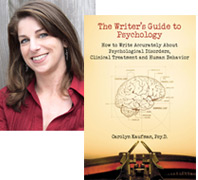

Carolyn Kaufman, PsyD's book, THE WRITER'S GUIDE TO PSYCHOLOGY: How to Write Accurately About Psychological Disorders, Clinical Treatment, and Human Behavior helps writers avoid common misconceptions and inaccuracies and "get the psych right" in their stories. You can learn more about The Writer's Guide to Psychology, check out Dr. K's blog on Psychology Today, or follow her on Facebook or Google+! 

Wednesday, June 20, 2012

3 Myths About Villains


By Angela Ackerman @angelaackerman

Characterization is a struggle for many writers, and often the most difficult role to work with is that of the villain. We know we want the reader to dislike him and root for the hero instead. We also know that he must act as a counterbalance to who our hero is inside. And we especially know that while our villain needs to be fully formed, he can’t steal the show. 

Because we’re writing the hero’s story, it can be tempting to paint the villain with as few strokes as possible. Being direct and succinct in showing who the villain is and what they want means more air time for the main character, right? Well, yes...but it also can lead to cardboard Muah-ha-ha type villains who come across as cliché. 

So how do we create a three dimensional, credible villain? And how do we make sure the reader dislikes them because of who they are, not because we tell them to? The answer lies in debunking a few emotion-related myths.

Myth #1: Villains Don’t Feel

Some writers believe that because villains cause deep suffering, they must be immune to emotion. This couldn’t be further from the truth. Villains feel. They love, lust after, fear and worry. They show determination, pride and doubt. If they didn’t, they would not have goals and desires or feel moved enough to act on them. 

Heroes and villains are more alike than it might first seem. Both act based on their Internal Landscape (what a person feels moment to moment), and they each have a unique Emotional Range (how deep those feelings run). But, what might make the hero upset may not phase the villain at all. The Emotional Range also influences their moral code. Imagine a line in the sand. The villain will cross that line and do things to achieve their goal that the hero would not. Showing the emotions of both the protagonist and antagonist is important, so always make sure they always bleed through.

Myth #2: Villains Should Only Express Negative Emotions

Again, this is false. Villains should be as rounded as any other character and therefore experience a range of positive and negative emotions throughout the story. Villains are just as capable of love, respect and sympathy as the rest of us, if it fits with their Emotional Range. Powerful, positive emotions also give the opportunity for readers to identify with the villain on a human level. Hold it, did I just say identify with? You bet! Credible villains aren’t sadists in the sense that they are driven by positive feelings just like you or I (Satisfaction, Love, Happiness, Desire, etc). Showing the villain’s root emotions (positive and negative) reveals their motivations to the reader, and promotes a deeper understanding of who they are.

Myth # 3: To Be A Villain, They Must Always Display Strength

On the outside of things, this might appear to be true. After all, the villain’s role is to chose a path and not be deterred by the hero. So while this in itself shows an inner core of strength, it is the writer’s ability to also show the villain’s weakness which will make the antagonist a fully formed, believable villain.  

How can weakness reveal strength? Simple. Each of us, hero, villain or reader, has a Wound. This wound is an experience from our past that hurt us enough that we have altered who we really are in order to protect ourselves from being hurt by it again. We have hardened ourselves in some way and actively avoid situations where the experience might repeat itself. Hollywood Screenwriter Michael Hauge refers to this as Emotional Armour. 

Wounds are powerful. The villain’s motivations will be rooted in protecting himself from the pain in his past. So, if you give readers a glimpse of his weakness, you provide a window into his personal suffering. In this way the villain shows vulnerability which will create empathy in readers. By using emotion, we help the reader understand a villain’s need or desire, but completely disagree with the path they take to satisfy it.

Obviously the hero should have center stage, but the villain has a powerful role to play, and their motivations and actions must always be credible.  Taking the time to understand who the villain is and what their Emotional Landscape looks like will pay off by providing a worthy adversary for your main character defeat. 


Angela Ackerman is one half of The Bookshelf Muse duo, and co-author of The Emotion Thesaurus: A Writer's Guide To Character Expression. This show-don't-tell brainstorming tool contains lists of body language, thoughts and visceral sensations for seventy-five emotions, ensuring writers will find the right description for any emotional moment.


Wednesday, December 22, 2010

A Case for Villains

Courtesy of shlomaster
Throughout literature, villains get a bad rap. From the outset, they're the ones everyone's rooting for to fail. To fall. To be vanquished by the hero.

And yet, villains affect the story more than any other single character in the book--heroes included.

For starters, the villain sets the tone of the story. The Dark Lord of Mordor and Darth Vader aren't going to inspire giggles and chuckles. And while the characters may enjoy some laughs when these guys aren't around, when they are, everything is dead serious. (Of course, we never actually get to meet the Dark Lord of Mordor, but the fact remains that he wasn't someone you want to mess with.) Whereas if you have a suave, witheringly sarcastic villain like Lord Vetinari from the Disc World Series, humor will be allowed. Granted, the characters will still be pushed out the door that has no floor, but Vetinari doesn't inspire quite the same depth of dread and darkness as Sauron does. (And yes, he is one of my favorite characters in the Disc World Series, Granny Weatherwax being the other, and possibly considered a villain from the wizards' and anyone else who gets in her way's standpoint.)

Next, and connected with the above, the villain sets the stakes. The hero isn't the one that determines what will be lost if he or she doesn't come through, that's the villain's job. Think of Lord Voldemort (is anyone else noticing the pattern with bad guys using Lord in their title?) and what it would have meant if Harry hadn't managed to survive their first encounter, let alone beat him sixteen years later. Or if Prince Humperdink had managed to kill Westley all the way instead of just most of the way. On one hand, the fate of the world and the lives of the muggles are at risk. On the other, the life of the world's most beautiful girl (at the moment) is what's on the line. The stakes are determined by the villain working in opposition to the hero. Which brings us to our next point.

No villain=no conflict=no plot=no point. Have you ever read a story where there really wasn't much of a conflict? Where everyone's out in golden fields picking lollipops while cute little bunnies frolic and the world has complete and utter harmony because there is no one to oppose this state of utter bliss? Yeah, me neither. For a story to work well, I think it has to have conflict. Something has to compel the reader to keep turning the page. If nothing is working against the hero(ine) of the story, there is no story. Stories need plot and plot needs conflict. Now, this isn't to say that all villains are humans. Nope. Some are vampires, some are inner vices like envy and greed, others are society or governments, some are as simple as really harsh settings. Like Siberia. (Or high school.) But something, somewhere, needs to be working in opposition to the star of the show, and that something is the villain.

My last point is that the villain defines the hero. Think about it. As bad as the bad guy is, the hero(ine) has to be that much better in order to triumph in the end. Imagine the story as a set of scales. On one side you have a bar of lead, on the other, a bar of gold. It isn't enough for the story to have the two bars balancing each other, one must tip the other for the reader to feel a sense of pay off. Back to Harry Potter. If Harry and Voldemort had been equally matched, well, they would have spent the eternities slinging unforgivable curses at each other or attempting to steal each other's wands. It was his mother's love that gave Harry the edge he needed over Voldemort. It protected him the first time Voldemort tried to kill him, and it protected him every summer when he went to stay with the Dursleys. And why was love the answer? Because it wasn't something that Voldemort had ever understood. Indeed, Dumbledore told Harry that if Voldemort had understood love, he never would have become Voldemort in the first place. (Which would have led to the no villain=no conflict=no plot=no point.) In fact, Voldemort defines Harry as the hero in a very literal way. If Voldemort hadn't heard part of the prophesy, he wouldn't have put stock into the prophesy, which means he wouldn't have gone to the trouble of hunting Harry down in the first place, thus creating his own mortal enemy. (Lesson here: if you're in the business of being bad, make sure you not only hear the prophesy of the chosen one in its entirety, but make sure you also understand what it's really saying.)

So whether your villain dresses to the nines, cackles and is mustachioed, or maybe doesn't own a stitch of clothing that isn't black, take a moment to thank them. Because without them, there is no hero and there is no story. And remember: villains need love too. ;-)