QueryTracker Blog

Helping Authors Find Literary Agents
Showing posts with label story conflict. Show all posts

Monday, August 27, 2012

Writing Realistic Love Relationships

Credit: Spekulator
One of the challenges of writing relationships is making romantic relationships realistic. A problem I see in some fiction is that there is no reason for the characters to fall for each other or be in love—other than the fact that they're both excruciatingly hot, of course.

As in real life, your characters should be attracted to the people they're attracted to for a reason beyond the superficial. (Don’t get me wrong, some people fall into passionate but superficial relationships, but they tend to burn out quickly without the other important aspects of true love: commitment and intimacy.)

In real life, finding and getting along with your “other half” long-term is difficult. The good news when it comes to fiction is that Conflict is the engine that keeps every story going, and the love relationship between your characters is one of the most important parts of that engine.

Some questions to help you generate realistic conflicts. Try to be as specific as you can when you answer.

  • What drives you crazy in a relationship? What are your pet peeves?
  • What drives your partner (or past partners) crazy about you?
  • What kinds of life decisions and stages have created conflict in your life? That is, which things challenge your relationships? Money decisions? Family decisions? Work decisions? Something else?
  • What really stresses you out (in general)? How does this impact your relationships with others? 

In real life people choose the partners they do for all kinds of reasons, some of them noble and romantic, some of them less so.  For example, maybe they had great "chemistry" with their partner. Maybe they had a lot in common.  Maybe they need to feel needed.  Maybe they wanted to get out of their parents' house.  Maybe they were ready to settle down.  Maybe they needed someone to help them parent a child.  Regardless, there is definitely a reason other than that an author needed them together to make a particular storyline work.

Some things to think about:

  • What attracted your character to the love interest in the first place?  
  • What needs does the love interest fulfill for your hero or heroine?
  • Why is the love interest different from all the other men and women out there?

Once your characters are together, why do they stay together?  Doing couples therapy was always a fascinating endeavor for me, because couples with enormous problems would come in and complain about each other and the relationship—but still want to make it work.  They still loved each other.  And they could usually tell you why. In other words, for all of the ways they drove each other crazy, they always had a reason that they were still together.

In my stories, relationships are usually messy.  People say the wrong things, have affairs, and hurt each other—sometimes accidentally and sometimes on purpose. Ex-partners create havoc, hidden histories drive wedges, but in the end love always prevails for me.  I like to pretend to be pragmatic and sensible, but the truth is that I'm a hopeless romantic, and in my stories, love really is the greatest power of all.


Ask yourself:

  • What is the absolute worst thing each partner could do to the other? (Usually the "worst thing" varies by character.) Why is that the worst?
  • Can you work that conflict into your story?
  • Why might your characters still want or need each other in spite of this betrayal?
  • Usually things are not "like new" after a betrayal—what are the lingering effects of having survived the conflict?

I'm most drawn to fictional relationships where there is a strong, identifiable reason for an attraction at the same time there are problems (internal or external to the relationship) that are trying to tear the couple apart. For me, the attraction to each other has to be stronger than the problems, but not by much. The characters have to keep coming together the way a pair of magnets will.  They might push against each other, but inevitably, they snap together and hold on.

How about you? What are your secrets for making romantic plots and subplots work?
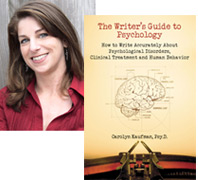
Carolyn Kaufman, PsyD's book, THE WRITER'S GUIDE TO PSYCHOLOGY: How to Write Accurately About Psychological Disorders, Clinical Treatment, and Human Behavior helps writers avoid common misconceptions and inaccuracies and "get the psych right" in their stories. You can learn more about The Writer's Guide to Psychology, check out Dr. K's blog on Psychology Today, or follow her on Facebook or Google+

Monday, August 29, 2011

Conflict & Characterization: Lessons from an Old Anime

(I promise that what lies below ties in to writing!)

I’m a big fan of this old-school (1972) anime called Gatchaman (and of its American translations…well, some more than others).  Author and friend Jason Hofius wrote a definitive guidebook on one of the American translations, which was called Battle of the Planets (1978), and recently he sent me an email to tell me he’s created a website on the same topic.

So I went tooling around the website, and it struck me that writers could learn a few things from his approach to the information.

Story Conflict

In the Battle of the Planets series, as in most stories, there are bad guys and there are good guys.  The bad guys are from the planet Spectra. Because Spectra is dying, the bad guys run around consuming the resources from the Peaceful Planets and generally trying to destroy the Peaceful Planets using monster mecha machines. The good guys belong to the Intergalactic Federation of Peaceful Planets, which is a very green and scientific sort of group.  The Federation’s most important answer to attacks from Spectra is the 5-person G-Force ninja team. (Please rest assured that this came long before Disney’s elite guinea pig team. The members of this G-Force are human.) 

Here’s what struck me, though. For each and every one of the series’ 85 episodes, Hofius indicates what Spectra is trying to accomplish and what the G-Force team is trying to accomplish.  You  might think this would get ridiculously redundant (for example, Spectra’s Goal: To steal a precious mineral; G-Force’s Goal: To stop the Mecha of the Week and recover the stolen mineral) but it really doesn’t because each side has numerous sub-agendas and internal conflicts (read: subplots).

Your Writing

You may know who your good guys and bad guys are overall, and what each side’s mission is in your story or novel as a whole, but do you know what the key conflict is in each scene?   If your story is moving forward properly, each scene’s conflict should be a little different as the characters react and respond to each other.  Each scene’s conflict should also advance the story as a whole.

As I edit a novel, I often find that I have several redundant scenes, usually because I am trying to make a point of some kind.  But a story is more exciting (and fun) if it doesn’t get mired in redundancies.

For example, in the novel I’m currently working on, I found three scenes meant to emphasize how bad things were for the good guys now that the bad guys had successfully invaded—the good guys had reached the point of surrendering not just physically, but also psychologically.  

My goal was to prove that things were BAD, and I did such a good job with it that I found myself depressed and a little hopeless, even though I knew the good guys would eventually prevail. There’s nothing pretty about beating a dead horse, folks, and if you insist on doing so, your readers may beat a hasty retreat. 

Though I’m not much of a chess player, the craftiness of the game has always intrigued me, and so I like to think of a story like an intense chess game between sides. One side moves; the other side has to counter that move and not only block the opponent’s goals, but also further its own.

So take another look at that story you think you’ve finished.  Is it as tight as it can be?  Do the conflicts between characters evolve and change with each and every scene?  If not, can you combine scenes or otherwise hone things down to keep your writing razor edged?
Character Guides

Back for a moment to Hofius’s website.  In addition to the great episode guides, he provides fantastic character guides.  Again, what strikes me about them is that they’re different from every other character guide I’ve ever seen for the series (and I’ve seen a bunch and even written a number of them).

Rather than focusing on the obvious—G-Force team member Mark, for example, has blue eyes and likes airplanes—Hofius tells us about the characters, referencing at least one episode for each tidbit.  That “at least one episode” is important—the show’s creators were fairly consistent in developing the characters’ abilities.

Your Writing

You may have character sheets, but have you managed to work details that define your characters into the story?  

I recently did some editing work for an aspiring novelist who’s still mastering the art of working the details into the story.  She knew a lot of important things about her main characters, for example, and she did a fantastic job of describing them, but she needed to work on slipping the information in without infodumps or blatant telling (e.g. “I am an honest sort of guy”).

One of the biggest dangers of telling (rather than showing) characterization is that your character won’t ring true to readers.  Think about it – if someone you worked with ran around telling everyone what an honorable guy he is, but you never saw him do a single honorable thing, you’d think he was a liar, wouldn’t you?  Readers will feel the same way about characters unless they get to see that honor in action.

Your turn: Is your writing as tight as it should be? Are you effectively showing conflict and characterization?

Carolyn Kaufman, PsyD's book, THE WRITER'S GUIDE TO PSYCHOLOGY: How to Write Accurately About Psychological Disorders, Clinical Treatment, and Human Behavior helps writers avoid common misconceptions and inaccuracies and "get the psych right" in their stories. You can learn more about The Writer's Guide to Psychology, check out Dr. K's blog on Psychology Today, or follow her on Facebook or Google+! (Her Gatchman site, which she linked to shamelessly in the post above, is here.)