Over the past year, I've had to think hard about the meaning of genre and subgenre in commercial fiction. Whether you're traditionally or self-published, understanding how your book fits onto the shelf is a really important component to success. And sometimes, the best way to really understand genre is to listen to someone who knows it inside out. So I've asked author Barbara J. Hancock to share her thoughts with us about the gothic romance genre and what it means to her. Take it away, Barbara! --S.P.
By Barbara J. Hancock
I love to play in the shadows…
Though I’ve written in several genres, there are threads throughout all the books I’ve created that tie them together. I love atmosphere and angst. And larger-than-life characters who are tortured and maybe even scarred by their past experiences. But more than that, I especially love a heroine who somehow saves the day. She may not always carry a sword or wear a uniform, but my heroines are warriors at heart no matter how vulnerable, no matter how tempest tossed.
And this is why I was immediately drawn to the call for modern gothics by the Harlequin Digital First line.
When we think of gothics, our minds conjure the iconic young girl dwarfed by the gloomy manor and intimidated by the mysterious man who may or may not be friend or foe. I read Jane Eyre when I was thirteen and I fell in love with it. I read it at twenty-two and… loved it less. Rochester was kind of pervy, wasn’t he? I read it again in my late thirties and loved it enough to have made it a yearly read. Yes. Rochester is far from perfect, but it makes me crave him even more.
Because the gothic heroine is vulnerable and even intimidated, but, in the end, she’s made of stern stuff. She faces her fears. She solves mysteries. She takes on the most complex and complicated heroes and, often on the very precipice of tragedy and failure, she saves him and herself.
Gothic romances are about the healing power of love and they’re also about characters who find and embrace their strengths when they come up against dire situations. They’re about finding beauty hidden in darkness and doubt. They’re about grabbing happily ever after even when surrounded by danger and haunted shadows. In the most determined heroine and the darkest alpha hero there are hidden places of vulnerability that are drawn to each other. The modern gothic hones in on moments that illuminate those vulnerabilities and, in the end, in spite of the ambiguity of the hero, modern gothic romances become stories that bring hero & heroine together as a team to overcome each story’s black moment.
There are some things to keep in mind when you seek to create a modern gothic romance:
Motivation: Your heroine has to have a very good reason for braving whatever it is she has to face. Think about how angry you get when you’re watching a horror movie and a character goes outside or upstairs or down to the basement. Too Stupid To Live, right? But give her a sibling or beloved pet to save and suddenly we’re torn. She’s not TSTL. She’s a devoted sister. She’s protecting the innocent. Jane Eyre was an orphan with no way of supporting herself. She had to become a governess. Even when she faced danger and the forbidden attraction to her enigmatic employer, she couldn’t easily walk away. Make sure your modern gothic heroine has reasons she can’t simply walk…or run…away.
Chills: Gothic Romance has elements of romance and mystery, but it also has elements of horror and suspense. My imagination takes me old school…Edgar Allen Poe, Oscar Wilde, Robert Louis Stevenson. Creepy, but in a gorgeous way, steeped in lush sentiment and a hint of the macabre.
Setting and Atmosphere: These should be given the importance of a character in your story. Your readers should be transported from their safe, mundane apartment to another world. While technically, these are contemporary or historical stories, they should have an element of fantasy and escapism. I’m not saying you can’t create a gothic romance with an apartment building setting. I’m just saying that maybe the apartment building should be a crumbling art deco masterpiece with few inhabits and a shadowy stranger with secrets who lives in the penthouse suite.
And that brings us to the hero…
A gothic hero is my favorite type of romance hero. He is challenge, mystery, danger, threat, allure, intrigue, and a pure sensual torture to the heroine. And that’s just in the first meeting. He will be the most complicated, dynamic and compelling person she’s ever met and whether or not that’s going to damn her or save her should definitely be buzzing in the reader’s mind from page one. An author has to walk a fine line between giving him motivation and keeping his secrets, maintaining his mystery and making it believable that the smart heroine would fall in love with him in the midst of whatever high stakes situation she faces.
Barbara J. Hancock's brand new full-length book is available as part of the Shivers Box Set by Harlequin-e. There is also a free online read on www.Harlequin.com to give readers a chance to try the line. It's called Lost in Me.
Showing posts with label romance. Show all posts
Wednesday, January 22, 2014
Monday, February 11, 2013
Losing Sight of the Target
by Stina Lindenblatt
@StinaLL
©Stina
Lindenblatt
The choice of genre that we chose to write is based on many things, but
the most important driving force is passion. You need to feel passionate about
what you write if you want your readers to experience it, too. If they feel
your passion, chances are good they’ll love your story. The downside of writing
about what makes you passionate is that it might cause you to lose sight of
your target.
When I refer to target, I’m talking about the true target audience
you’re writing for. If you write middle grade stories, you’re writing for nine
to twelve year olds. If you write young adult stories, you’re writing for
twelve to seventeen year olds. And when you write new adult stories, you’re
writing for seventeen to twenty-five year olds. Those examples are categories,
but if I were to ask you who your target audience is for your given genre (e.g.
romantic suspense, medical thrillers, cozy mysteries, etc), are you able to
identify it?
It’s important to know who your target audience is, but it goes beyond
knowing where to direct your promotional effort. Don’t get me wrong. It’s vital
that you target the right individuals if you want to see maximum sales. But
your marketing efforts might not necessarily focus on your true target
audience. Take middle grade fiction, for example. Most middle grade readers
between nine and twelve years old aren’t reading book blogs. Most aren’t
reading blogs, period. It’s the adults with the purchasing power (parents,
teachers, librarians) who read the blogs. The majority of young adult books are
bought and read by adults. That’s not to say teens aren’t reading them. They
are. But they don’t have the disposable income to buy them. They tend to borrow
books from their friends and from the library.
It’s important to know who your target audience is, but it goes beyond
knowing where to direct your marketing effort. In traditionally published
books, there are checks and balances. The publishers have determined what is
acceptable within a given category or genre. Graphic sex in young adult novels
will be edited to fit the guidelines (in other words, it won’t exist). The
stories and voice will be authentic to the true target audience. If it isn’t,
it won’t be published.
These checks and balances don’t exist in self publishing. Which means
it’s easy to write young adult books for the wrong target audience (i.e. for adults
who love YA stories instead for teens). It’s easy to lose sight of what’s
important to teens and write a non-authentic story. It’s easy to write a book
and forget who your true target is, but due to pressure from reviewers, you are
forced to re-label its genre (from YA contemporary to adult romance). It’s easy
to write a book that becomes controversial, for the wrong reasons.
Is this necessarily a bad thing? Often controversy leads to increased
sales, which can push a book into bestselling status, because readers love to
know why a particular book is controversial.
If becoming a bestselling author is the only reason you write stories,
well lucky you. But if you write stories to touch the heart of your target
audience, your true target audience, please don’t lose sight of who they are
when you write your stories. They’ll thank you for it.
Do you know who your true target audience is? Do you write for them, or
do you write the books you crave, even though you’re not part of the true
demographic (i.e. a male writing romance)? Or do you try to aim for both?
Stina
Lindenblatt @StinaLL writes young adult and new
adult novels. In her spare time, she’s a photographer and blogging addict, and
can be found hanging out on her blog.
Monday, August 27, 2012
Writing Realistic Love Relationships
![]() |
| Credit: Spekulator |
As in real life, your characters should be attracted to the people they're attracted to for a reason beyond the superficial. (Don’t get me wrong, some people fall into passionate but superficial relationships, but they tend to burn out quickly without the other important aspects of true love: commitment and intimacy.)
In real life, finding and getting along with your “other half” long-term is difficult. The good news when it comes to fiction is that Conflict is the engine that keeps every story going, and the love relationship between your characters is one of the most important parts of that engine.
Some questions to help you generate realistic conflicts. Try to be as specific as you can when you answer.
- What drives you crazy in a relationship? What are your pet peeves?
- What drives your partner (or past partners) crazy about you?
- What kinds of life decisions and stages have created conflict in your life? That is, which things challenge your relationships? Money decisions? Family decisions? Work decisions? Something else?
- What really stresses you out (in general)? How does this impact your relationships with others?
In real life people choose the partners they do for all kinds of reasons, some of them noble and romantic, some of them less so. For example, maybe they had great "chemistry" with their partner. Maybe they had a lot in common. Maybe they need to feel needed. Maybe they wanted to get out of their parents' house. Maybe they were ready to settle down. Maybe they needed someone to help them parent a child. Regardless, there is definitely a reason other than that an author needed them together to make a particular storyline work.
Some things to think about:
- What attracted your character to the love interest in the first place?
- What needs does the love interest fulfill for your hero or heroine?
- Why is the love interest different from all the other men and women out there?
Once your characters are together, why do they stay together? Doing couples therapy was always a fascinating endeavor for me, because couples with enormous problems would come in and complain about each other and the relationship—but still want to make it work. They still loved each other. And they could usually tell you why. In other words, for all of the ways they drove each other crazy, they always had a reason that they were still together.
In my stories, relationships are usually messy. People say the wrong things, have affairs, and hurt each other—sometimes accidentally and sometimes on purpose. Ex-partners create havoc, hidden histories drive wedges, but in the end love always prevails for me. I like to pretend to be pragmatic and sensible, but the truth is that I'm a hopeless romantic, and in my stories, love really is the greatest power of all.
Ask yourself:
Ask yourself:
- What is the absolute worst thing each partner could do to the other? (Usually the "worst thing" varies by character.) Why is that the worst?
- Can you work that conflict into your story?
- Why might your characters still want or need each other in spite of this betrayal?
- Usually things are not "like new" after a betrayal—what are the lingering effects of having survived the conflict?
I'm most drawn to fictional relationships where there is a strong, identifiable reason for an attraction at the same time there are problems (internal or external to the relationship) that are trying to tear the couple apart. For me, the attraction to each other has to be stronger than the problems, but not by much. The characters have to keep coming together the way a pair of magnets will. They might push against each other, but inevitably, they snap together and hold on.
How about you? What are your secrets for making romantic plots and subplots work?
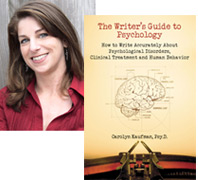
Carolyn Kaufman, PsyD's book, THE WRITER'S GUIDE TO PSYCHOLOGY: How to Write Accurately About Psychological Disorders, Clinical Treatment, and Human Behavior helps writers avoid common misconceptions and inaccuracies and "get the psych right" in their stories. You can learn more about The Writer's Guide to Psychology, check out Dr. K's blog on Psychology Today, or follow her on Facebook or Google+!
Subscribe to:
Posts (Atom)