


Recently a rude writer blew up Twitter by posting a nasty takedown of a wicked, wicked agent who somehow failed to perceive his brilliance. Her crime: he paid to pitch to her at a conference and yet she wasn't interested in his manuscript.
He retaliated via a blog post in which he called her frumpy and "pear-shaped" and all sorts of insults of equal sagacity.
Don't do this. Ever. EVER.
Why? Because there are far, far better ways of getting revenge on an agent who failed to perceive your brilliance. I mean, seriously, guys, you're writers. How can a writer be this bad at exacting revenge? Use your imagination. Come up with a revenge that sparkles with brilliance. I've compiled a few suggestions.
Are you ready? Take notes.
1) Send a "revenge query." A revenge query is a query you send within an hour of getting any rejection that leaves you feeling bitter. You send the query to an entirely different agent at an entirely different agency. You in no way mention the rejection that caused your sending of the query. (In fact, you should never mention that you've been rejected by anyone at all; let every agent think you're querying him or her first. Why begin your potential business relationship with the taint of previous failures?)
In effect, you're querying on the rebound. This achieves a few important goals. First, by spending a bit of quality time on the main QueryTracker site, you will find there are plenty of fish in the sea, and you may even find an agent who's better than the agent who rejected you. (Wait, did I say may? No, you will. As my husband muttered the first time he heard Adele's Someone Like You, "No, I want to find someone better than you." But I digress.)
Secondly, you'll cool down a bit while you're spending time researching this much-better agent, and you'll cool down even more when you're assembling your query to match this better agent's submission guidelines. Use your angry energy to attach the one-page synopsis rather than the five-page synopsis.
Third, you'll be spreading your hopes out a bit among the agenting pool rather than focusing your intensity on just one. Once you know your query is working, you should always have about ten "live' queries floating about out there, or maybe as high as fifteen. (That's in addition to any submissions you have "live" with agents.)
2) Work on your next piece, something so brilliant that no one can possibly reject it. They think you're not marketable? Well, you can show them. You can go read other books in your genre and analyze them for their marketing appeal. You can work on improving your characterization or your story structure. You can work on building your platform too. You can network with other writers and maybe find an awesome set of critique partners.
As they say, "Living well is the best revenge." I strongly suggest writing well is just as good a revenge. Think about the day that agent sees your work again on the NYT bestseller list and recognizes you as the querier he or she spurned. Imagine yourself saying, "Yeah, actually, because you rejected me, I worked on those issues I had with dialogue, and now I'm a better writer. I guess I should thank you."
What this type of revenge accomplishes is that it forms you up as a better person. You know you have literary potential, and it burns to think the agent missed it. Well, develop that potential. After all, it's much easier to snag an agent with achievement than with potential.
3) Never contact that agent again. You want revenge? This is an awesome revenge. Go ahead and write a work of scathing brilliance, something that scintillates with imagination and the lushness of the human experience. And then, when you have that glittering masterpiece in your hands, don't share it with that agent. Query other agents instead.
The whole point of a snub is silence, so don't tell the rejecting agent that you've in turn rejected him or her. Let that agent figure it out for himself when other agents are having drinks and sharing knowing looks because they all have their hands on a splendid novel while he doesn't.
--
These are the tactics a professional uses to get revenge after rejection. Rather than directing that anger outward at the agent, it's far better to direct you energy inward toward your career. Because remember, the instant you decided to query, that's the instant you became a professional with the need to behave in a professional manner.
Professionals do not write venomous blog posts about agents who declined the opportunity to represent them. Professionals do not attack an agent's appearance as though that pertains in any way to her intelligence or work ethic. Professionals do not burn their bridges by thinking everyone with a computer wants to see them having a tantrum. A high-vocabulary tantrum is still a tantrum, and readers will associate your name with someone who acts like a two-year-old.
And agents. And editors. And you yourself, eventually, when you realize how you acted and feel ashamed of yourself.
Your goal is to become a better writer and bring your stories to as many as you can. That takes discipline. That takes focus.
And yeah, sometimes it takes getting rejected and dusting yourself off, figuring out what went wrong, and making corrections.
Your professional growth never, never, never, never, never, under any circumstances, involves telling off the other professional who rejected you.
Write well. Sell well. That's the best revenge.
Showing posts with label agents. Show all posts
Showing posts with label agents. Show all posts
Tuesday, August 9, 2016


Tuesday, August 18, 2015
QUERYING IS NOT A ZERO SUM GAME
Sometimes, it’s hard to be genuinely, selflessly, happy for
someone else’s success, especially when you have been striving and failing to
meet the same goal. In the querying trenches, writers can fall prey to the
belief that getting an agent is a zero sum game. In game and economic theory,
this term refers to a situation where each participant’s gains or losses are
exactly balanced by the gains or losses of the other participants-- essentially,
if one player obtains something of value, that means another player has lost
that same item. There comes a point in every writer’s querying journey where
the virtual claps and hearty congratulations we offer our fellow writers comes
with a healthy dose of “Why not me?”
Why do we harbor this notion that when someone else gets an
agent, your chances of getting an agent necessarily decrease? Perhaps because
we know that agents reject up to 99% of queries they receive, including the
good ones that they just “didn’t connect with.” (Raise your hand if this ubiquitous
critique makes you want to scream) This is the reason we obsess over a typo in
a query that can’t be un-sent and slap our heads in frustration at “blowing my
ONE AND ONLY chance.” With that mindset, it’s no wonder that we battle with
inner jealousy when our friends hit a career milestone: We assume that their
success is not just their success, but also our loss. Conventional wisdom, also
known as Twitter, reinforces the belief that only a select few will ever
breathe the rarified air of traditional publishing. Naturally, with so many
talented writers in the world, there just can’t be room for everyone, right? So
if someone else gets a spot, that means one fewer spot for you, right?
In my opinion, this mindset is wrong and counterproductive. A
writer connects with an agent because of timing, market trends, personalities,
and a million other variables, including luck. And that’s just the first stop. An agented
writer doesn’t always get a publishing deal. Books often don’t earn back their
advances. Some writers get three book
deals and some get digital-only one book deals. There is simply no point in
equating another writer’s success with a commensurate failure on your part
because everyone succeeds differently and at different times in their life. So
if your “dream” agent picks up a new client, that new client hasn’t taken your
spot any more than your promotion or pregnancy announcement means someone else
is going to get demoted or be childless. It stinks that publishing is not always a
meritocracy but still, you’ve lost nothing by the fact of someone else’s
success. When your path to traditional
publishing seems to be a series of dead ends, don’t be tempted to buy into the
zero sum mentality and miss out on the celebrations.

Kim English - A native Floridian, Kim is the author of Coriander Jones Saves the World and the upcoming Coriander Jones On Assignment at Sabal Palm Academy. She lives in southwest Florida with her family and an ever increasing number of rescue pets.
Monday, July 29, 2013
Finding a Reputable Agent or Publisher
 |
| Base Image: DragonTash |
To keep the same thing from happening to you (or your friends), it's good to understand what makes a publisher reputable or reprehensible. Read on!
How Do I Find a Reputable Agent or Publisher?
There are a lot of ways to get published these days; Jane Friedman summarized them well in her recent objective infographic, 5 Key Book Publishing Paths. With regards to financial risk and value, a summary of her paths is:
- Traditional: Advance + royalties model; publisher takes on all financial and creative risk but is extremely selective about which books are chosen (e.g. Penguin)
- Partnership: No fee to publish, no advance; partner selective about which books are chosen (e.g. Rogue Reader)
- Fully Assisted: Author pays upfront free; all work is accepted (e.g. AuthorHouse). This is also sometimes referred to as vanity publishing.
- DIY + Distributor: Author does most work, pays service for conversion of all files into e-book, POD, or print; distribution service may take a percentage of sales and is responsible for paying you (e.g. CreateSpace)
- DIY Direct: Author does all work and provides retailers with completed books; retailer takes a percentage of sales (e.g. Amazon KDP)
 |
| Friedman's Key Publishing Paths Infographic |
The most outspoken (and one of the most successful) self-publishing authors is J.A. Konrath, who could be called an entrepreneur. He's had so much success and made so much money that he had no problem turning down a $500K publishing deal from a mainstream publisher in 2011.
Of all the publishing approaches, the “fully assisted” (aka vanity) route is still seen by most as the worst since the service will publish anything, regardless of quality, and along the way they will push you to spend more and more money on things you don't need. As Friedman notes, “The self-pub success stories you hear about do not come from full-assist services.” So if you’re going to self-publish, take one of the DIY approaches.
If you want to go a more traditional route, however, you will either need to go through an agent or approach small publishers directly. The trick to this can be sorting the shysters from the reputable, so let’s look at some rules of thumb.
Agents
Not all resources, including some of the big-name publications and databases, put the legitimacy of the agent or agency first, but QueryTracker does. Though you should always keep your eyes open, administrator Patrick McDonald does his utmost to include only reputable agents. People frequently ask why this agent or that agent is not included, and now you know why. (Note: Sometimes there is nothing actually wrong with an agent, she may just be new enough that she has not yet built any reputation either way.)
You should never give money to an agent. If one tries to charge you for anything—from reading to editing to finding a home for your book—run. Many less-than-upstanding “agents” make their money not from book sales, but from referring unwitting authors to editors who will charge them an arm and a leg without actually providing a quality service. In these cases, the agent gets a kickback from the editor. It’s fine for an agent to recommend more extensive editing than she is willing to do, but choose your own editor rather than accepting a referral. And if an agent takes you on, her editing assistance must be free. It’s a conflict of interest for an agent who is also your editor to take your money.
When you find an agent or agency that interests you, always do some additional research—and that includes agents on QueryTracker, just to be safe. Two of the best resources (listed beside each QT agent’s entry) include Preditors and Editors for agents and agencies and SFWA’s Writer Beware. You can also ask what other people have heard on message boards like those in the QueryTracker Forum.
Finally, be sure to check out the agent and agency's website and (if available) blog. Reputable agents and agencies should have significant recent sales in the area you wish to publish.
Publishers
QueryTracker has a growing list of publisher listings, which include the same information on acceptance and rejection statistics that is provided for agents and agencies.
The rules of the road are very similar to those noted above for agents. Traditional and partnership publishers should not charge you upfront fees of any kind, including those for editing. And again, always double-check the publisher’s reputation by looking for recent sales, and by visiting Writer Beware. (If you want to take a look at one active “publisher”—who keeps changing names to try to avoid its own bad reputation—that is notorious for bilking writers, look at the Writer Beware entry on SBPRA.)
Don't Forget!
In both cases, remember—a publisher makes its money from sales. It gets the big percentage (often around 90%), and you get the small one. Likewise, a literary agent makes money because she gets a percentage—usually 15% for domestic sales and 20% for foreign sales—of any money the author makes. If an agent is involved, any money you make goes from the publisher to your agent, who takes her 15% and then sends the rest along to you.
It is therefore in the interest of such reputable agents and publishers to only choose writers who can actually sell books, because the author has to start making money on the book for them to get paid!
Have you ever had a bad experience or a close call with an agent, agency, or publisher? Without naming names, tell us about what you learned from the experience in the comments.

Click the link to Tweet it! Share what you read today:
- Avoid publishing scammers by knowing how to find a reputable agent or publisher...
- Should you ever give money to an agent or publisher? Find out...
- Reputable agents and publishers choose marketable books since the book has to make $$ for them to get paid...
*I’ve gotten several questions via email recently asking me about dealing with agents, so this is the third part of a series of posts on figuring out whether you’re ready to start querying, whether you need an agent, finding a reputable agent, and choosing someone who really “gets” your work. Of course, QueryTracker.net will help you through all of the stages, and fellow QT blogger Jane Lebak recently wrote a great post on How to Use the QueryTracker Site.

Monday, July 1, 2013
Giveaways & Lessons from YA Author Elana Johnson
Update: Winners for the giveaways are posted in the 7/12/13 Publishing Pulse.
Eight hundred posts ago, on December 28, 2008, the QueryTracker Blog became a team effort for five aspiring writers. Since then, a lot has changed, both in the makeup of the QTB and in the careers of those aspiring writers. Not everyone in the original team is still writing or seeking publication, but everyone has learned from their time in the trenches. We thought it was time for a series of posts sharing where everyone started, where they are now, and what they learned along the way.
To kick things off, we asked Elana Johnson, author of the YA Possession series (Simon Pulse) to tell us about her writing and publishing journey beginning with her time with the QTB (12/2008 – 7/2010) and bringing us up to date on where she is now!
Elana has graciously agreed to do a couple of giveaways as part of her interview. There are two different prizes, which will go to two different people.
First, one of her books. If you are new to her Possession series, she will send you the first book, Possession If you are already a fan, she will send you the latest in the series, Abandon (published June 2013). If you are in the US, you will receive a hard copy of the book; if you are outside of the US, a digital copy.
Second, Elana is a query-letter expert! She teaches classes across the country and online on how to write a killer query, and she is going to critique one lucky winner's query.
Please see entry instructions at the end of this post.
Where I Started and How QT Helped Me

I spent so much time with QueryTracker, researching agents, critiquing query letters, obsessing and celebrating in the forums, and reading and writing for the QT Blog. I still refer people to QT every chance I get.
When I started writing for the QT Blog, I didn’t have a literary agent. I’d been writing seriously for about a year, and my first project had just met its death in the query trenches. I had another book I was gearing up for querying, and since I loved blogging, taking on the QT blog was something that was natural and enjoyable.
Being part of the QT team gave me the courage to step outside my comfort zone. The first thing I did was co-organize one of the first QT agent opportunities with Joanna Stampfel-Volpe. It was amazing corresponding with agents without trying to pitch them my work. This helped me realize that agents are people too.
Signing with My Agent
I blogged with QT for 11 months before I signed with my agent, Michelle Andelman. During that time, being a QT blogger helped me establish my credibility in the writing world. I’ve been asked to teach at professional conferences based on some of the posts I wrote for the QT blog, and I still have friendships and contacts that I met “way back when” I was blogging at QueryTracker.
Publication
Since then, I’ve released three books (my Possession series –3 full-length novels + 2 short stories— was just completed with the release of ABANDON this past June!), co-launched another group blog (The League of Extraordinary Writers, which is dedicated to science fiction and fantasy), and co-founded the biggest writing conference on the Internet, WriteOnCon.
My Approach to Writing: Then and Now
What has stayed the same? I still blog a couple days a week at my own blog. I’m still with Michelle, and we’re still selling books. I still teach elementary school, and I’m still squeezing writing into the 15 minutes I have before school, or my 30-minute lunch break.
The biggest difference is that now I write under a deadline. I don’t have as much time to get my work up to par—probably the most challenging thing I’ve had to endure in this publishing gig! For those who are unpublished as of yet, enjoy this time to get your craft polished. The possibilities for you are endless. Enjoy the time you have to learn, to grow, and to make mistakes. I still do all of that (it’s not like every word I write comes out golden), but I don’t have as much time to enjoy it as pre-published authors do.
I feel like I’ve come a long way in my personal confidence. When I first started at QT, I thought, “Why would anyone listen to what I have to say?” Now, I teach classes at a variety of conferences—I’ve become the expert! I’ve been working as a freelance query letter writer for a few years, and recently went out on my own in this venture. I’ve even taken my in-person-only query letter writing workshop and launched it on the Internet.
I’m also an independent publicist, something I really enjoy. I’ve always liked doing the marketing side of writing, setting up promotions and chats and giveaways for my own books. It seemed natural to take my contacts and skills and transfer them to another author’s book. I love working with authors and book bloggers in this capacity. (You can find out about my blog tours and blitzes, as well as cover reveals, here.)
Advice to Unpublished Writers
I don’t believe the unpublished should rush into publishing. Really take the time to perfect your craft, and when you do, the rewards will come. Publishing is not a race.
My best advice for those looking to promote their books is to be as active as you can in the online community. Recently, someone asked me how I met all the book bloggers I know. I honestly couldn’t answer. It’s not like there was one specific event where I met everyone. It was something that happened over the years as I read their blogs, clicked over to their cover reveals, followed them on Twitter, and emailed them about my own books. So if you’re looking to make contacts in the publishing world, you have to be willing to spend time where publishing people hang out—and the QT forum is a great place to do that!
When the original QTB team interviewed agents and authors, we often did something we called a Fast Five—five fun, quick questions. For a while the question of the day was “Courier or Times New Roman?” but we had to move on when it became clear that the industry standard had become TNR! So here is a fresh Fast Five for our alum:
Fast Five with Elana Johnson
Entering the Giveaways
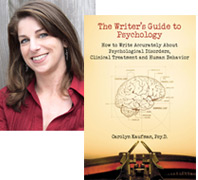 Carolyn Kaufman, PsyD's book, THE WRITER'S GUIDE TO PSYCHOLOGY: How to Write Accurately About Psychological Disorders, Clinical Treatment, and Human Behavior helps writers avoid common misconceptions and inaccuracies and "get the psych right" in their stories. You can learn more about The Writer's Guide to Psychology, check out Dr. K's blog on Psychology Today, or follow her on Facebook!
Eight hundred posts ago, on December 28, 2008, the QueryTracker Blog became a team effort for five aspiring writers. Since then, a lot has changed, both in the makeup of the QTB and in the careers of those aspiring writers. Not everyone in the original team is still writing or seeking publication, but everyone has learned from their time in the trenches. We thought it was time for a series of posts sharing where everyone started, where they are now, and what they learned along the way.
To kick things off, we asked Elana Johnson, author of the YA Possession series (Simon Pulse) to tell us about her writing and publishing journey beginning with her time with the QTB (12/2008 – 7/2010) and bringing us up to date on where she is now!
Elana has graciously agreed to do a couple of giveaways as part of her interview. There are two different prizes, which will go to two different people.
First, one of her books. If you are new to her Possession series, she will send you the first book, Possession If you are already a fan, she will send you the latest in the series, Abandon (published June 2013). If you are in the US, you will receive a hard copy of the book; if you are outside of the US, a digital copy.
Second, Elana is a query-letter expert! She teaches classes across the country and online on how to write a killer query, and she is going to critique one lucky winner's query.
Please see entry instructions at the end of this post.
Where I Started and How QT Helped Me

I spent so much time with QueryTracker, researching agents, critiquing query letters, obsessing and celebrating in the forums, and reading and writing for the QT Blog. I still refer people to QT every chance I get.
When I started writing for the QT Blog, I didn’t have a literary agent. I’d been writing seriously for about a year, and my first project had just met its death in the query trenches. I had another book I was gearing up for querying, and since I loved blogging, taking on the QT blog was something that was natural and enjoyable.
Being part of the QT team gave me the courage to step outside my comfort zone. The first thing I did was co-organize one of the first QT agent opportunities with Joanna Stampfel-Volpe. It was amazing corresponding with agents without trying to pitch them my work. This helped me realize that agents are people too.
Signing with My Agent
I blogged with QT for 11 months before I signed with my agent, Michelle Andelman. During that time, being a QT blogger helped me establish my credibility in the writing world. I’ve been asked to teach at professional conferences based on some of the posts I wrote for the QT blog, and I still have friendships and contacts that I met “way back when” I was blogging at QueryTracker.
Publication
Since then, I’ve released three books (my Possession series –3 full-length novels + 2 short stories— was just completed with the release of ABANDON this past June!), co-launched another group blog (The League of Extraordinary Writers, which is dedicated to science fiction and fantasy), and co-founded the biggest writing conference on the Internet, WriteOnCon.
My Approach to Writing: Then and Now
What has stayed the same? I still blog a couple days a week at my own blog. I’m still with Michelle, and we’re still selling books. I still teach elementary school, and I’m still squeezing writing into the 15 minutes I have before school, or my 30-minute lunch break.
The biggest difference is that now I write under a deadline. I don’t have as much time to get my work up to par—probably the most challenging thing I’ve had to endure in this publishing gig! For those who are unpublished as of yet, enjoy this time to get your craft polished. The possibilities for you are endless. Enjoy the time you have to learn, to grow, and to make mistakes. I still do all of that (it’s not like every word I write comes out golden), but I don’t have as much time to enjoy it as pre-published authors do.
I feel like I’ve come a long way in my personal confidence. When I first started at QT, I thought, “Why would anyone listen to what I have to say?” Now, I teach classes at a variety of conferences—I’ve become the expert! I’ve been working as a freelance query letter writer for a few years, and recently went out on my own in this venture. I’ve even taken my in-person-only query letter writing workshop and launched it on the Internet.
I’m also an independent publicist, something I really enjoy. I’ve always liked doing the marketing side of writing, setting up promotions and chats and giveaways for my own books. It seemed natural to take my contacts and skills and transfer them to another author’s book. I love working with authors and book bloggers in this capacity. (You can find out about my blog tours and blitzes, as well as cover reveals, here.)
Advice to Unpublished Writers
I don’t believe the unpublished should rush into publishing. Really take the time to perfect your craft, and when you do, the rewards will come. Publishing is not a race.
My best advice for those looking to promote their books is to be as active as you can in the online community. Recently, someone asked me how I met all the book bloggers I know. I honestly couldn’t answer. It’s not like there was one specific event where I met everyone. It was something that happened over the years as I read their blogs, clicked over to their cover reveals, followed them on Twitter, and emailed them about my own books. So if you’re looking to make contacts in the publishing world, you have to be willing to spend time where publishing people hang out—and the QT forum is a great place to do that!
When the original QTB team interviewed agents and authors, we often did something we called a Fast Five—five fun, quick questions. For a while the question of the day was “Courier or Times New Roman?” but we had to move on when it became clear that the industry standard had become TNR! So here is a fresh Fast Five for our alum:
Fast Five with Elana Johnson
- Mac or PC? Macs rule!
- Favorite Social Media Platform? Um, Facebook? Yeah, let’s go with Facebook.
- Writing Pet Peeve? Grammar. I always sacrifice grammar for voice and style, baby!
- Guilty Pleasure? Mini chewy sweet tarts
- Can’t Live Without? Lightning-fast Internet!
- Comment on this post and tell us something YOU have learned from being part of the QueryTracker community. This can be from the QueryTracker Blog, the main QueryTracker site, or the QueryTracker forums. By commenting, you give us permission to quote you any of the aforementioned QueryTracker sites.
- We will take comment entries through Wednesday, July 10th.
- Winners will be chosen at random and announced on Friday, July 12th in the Publishing Pulse. Please watch for this announcement, as I (Carolyn) will need the winners to contact me. I will include instructions on how to do so in that Publishing Pulse.
Carolyn Kaufman, PsyD's book, THE WRITER'S GUIDE TO PSYCHOLOGY: How to Write Accurately About Psychological Disorders, Clinical Treatment, and Human Behavior helps writers avoid common misconceptions and inaccuracies and "get the psych right" in their stories. You can learn more about The Writer's Guide to Psychology, check out Dr. K's blog on Psychology Today, or follow her on Facebook! Monday, May 6, 2013
Do I Need a Literary Agent?
I’ve gotten several questions via email recently asking me about how to go about finding good literary agents, so I’m working on a series of posts about figuring out if you need an agent, whether you’re ready to start querying, finding a reputable agent, and choosing someone who really “gets” your work. Of course, QueryTracker.net will help you through all of the stages I’m going to discuss, and fellow QT blogger Jane Lebak recently wrote a great post on How to Use the QueryTracker Site.
Do I Need a Literary Agent?
Though the role of literary agents is changing, there are at least a couple of reasons you may want one. First, they are well-connected in publishing, which means they may be able to open doors you can’t open yourself. Second, they are experts on the publishing business, including negotiating contracts.
Literary agents have traditionally been the gatekeepers between the writer and publishers. There are an awful lot of people who would like to get published, which can leave publishing houses inundated. For this reason, the biggest publishers closed their doors to unsolicited materials. Literary agents provide a screening process, weeding out all but the very best of the material that is submitted to them.
Statistics vary, but most agents say they reject between 95% and 99% of what crosses their desks. (If you’re interested in a particular agent’s statistics, QueryTracker provides detailed information on how often each agent in the database responds positively—with a request for more material, for example—vs. negatively, as is the case with a rejection.)
Agents develop relationships with publisher editors who are interested in the types of material that agent represents. So when Agent X approaches Publisher Y to say that the editor should take a look at Writer A’s manuscript, the editor is open to learning more.
As publishing experts, agents know the market well. They know what is selling, to whom, and why. They may know about markets you’ve never heard of, and they know how much editors are paying for particular types of manuscripts. They can also negotiate contracts (which include when, how, and how much the writer will be paid) and can act as a go-between with the writer and the publisher, especially if something goes wrong or the writer needs some help. [Edit: A reader notes that agents can also help negotiate foreign rights and film rights.] Usually they can negotiate better contract terms for you, both by knowing what they want removed from publishing contracts and by knowing what should be added or changed. You pay for this service by giving your agent a percentage of everything you earn (usually 15% - 20%), but particularly if the agent negotiates better terms than you could negotiate yourself, their work may proverbially pay for itself. It is in a reputable agent’s interest for you to make as much money as possible, because that's the only way they get paid!
Some agents represent a book or a series of books only; other agents represent the author. Many writers prefer to work with the latter type, as these relationships tend to be longer-term and often include help with their writerly career—improving manuscripts, trying out new ideas, and so on.
So when would you not use an agent? If you are self-publishing, you probably won't use an agent. Also, some writers decide (even if they have worked with an agent or agents in the past) that they are happier or more comfortable going it alone. They prefer to approach small publishers directly and are comfortable negotiating their own contracts (or hiring an attorney familiar with literary contracts just to review a proposed contract).
Because good agents are picky about who and what they represent, some authors get so focused on finding an agent that they forget that not all agents are equal. First, not all “literary agents” are legitimate or reputable. Second, all of us get along better with some people than others. It’s important to find someone who “gets” you and your work. I’ll be exploring these issues in upcoming posts.
Carolyn Kaufman, PsyD's book, THE WRITER'S GUIDE TO PSYCHOLOGY: How to Write Accurately About Psychological Disorders, Clinical Treatment, and Human Behavior helps writers avoid common misconceptions and inaccuracies and "get the psych right" in their stories. You can learn more about The Writer's Guide to Psychology, check out Dr. K's blog on Psychology Today, or follow her on Facebook!
 |
| Base image: DragonTash |
Though the role of literary agents is changing, there are at least a couple of reasons you may want one. First, they are well-connected in publishing, which means they may be able to open doors you can’t open yourself. Second, they are experts on the publishing business, including negotiating contracts.
Literary agents have traditionally been the gatekeepers between the writer and publishers. There are an awful lot of people who would like to get published, which can leave publishing houses inundated. For this reason, the biggest publishers closed their doors to unsolicited materials. Literary agents provide a screening process, weeding out all but the very best of the material that is submitted to them.
Statistics vary, but most agents say they reject between 95% and 99% of what crosses their desks. (If you’re interested in a particular agent’s statistics, QueryTracker provides detailed information on how often each agent in the database responds positively—with a request for more material, for example—vs. negatively, as is the case with a rejection.)
Agents develop relationships with publisher editors who are interested in the types of material that agent represents. So when Agent X approaches Publisher Y to say that the editor should take a look at Writer A’s manuscript, the editor is open to learning more.
As publishing experts, agents know the market well. They know what is selling, to whom, and why. They may know about markets you’ve never heard of, and they know how much editors are paying for particular types of manuscripts. They can also negotiate contracts (which include when, how, and how much the writer will be paid) and can act as a go-between with the writer and the publisher, especially if something goes wrong or the writer needs some help. [Edit: A reader notes that agents can also help negotiate foreign rights and film rights.] Usually they can negotiate better contract terms for you, both by knowing what they want removed from publishing contracts and by knowing what should be added or changed. You pay for this service by giving your agent a percentage of everything you earn (usually 15% - 20%), but particularly if the agent negotiates better terms than you could negotiate yourself, their work may proverbially pay for itself. It is in a reputable agent’s interest for you to make as much money as possible, because that's the only way they get paid!
Some agents represent a book or a series of books only; other agents represent the author. Many writers prefer to work with the latter type, as these relationships tend to be longer-term and often include help with their writerly career—improving manuscripts, trying out new ideas, and so on.
So when would you not use an agent? If you are self-publishing, you probably won't use an agent. Also, some writers decide (even if they have worked with an agent or agents in the past) that they are happier or more comfortable going it alone. They prefer to approach small publishers directly and are comfortable negotiating their own contracts (or hiring an attorney familiar with literary contracts just to review a proposed contract).
Because good agents are picky about who and what they represent, some authors get so focused on finding an agent that they forget that not all agents are equal. First, not all “literary agents” are legitimate or reputable. Second, all of us get along better with some people than others. It’s important to find someone who “gets” you and your work. I’ll be exploring these issues in upcoming posts.
Carolyn Kaufman, PsyD's book, THE WRITER'S GUIDE TO PSYCHOLOGY: How to Write Accurately About Psychological Disorders, Clinical Treatment, and Human Behavior helps writers avoid common misconceptions and inaccuracies and "get the psych right" in their stories. You can learn more about The Writer's Guide to Psychology, check out Dr. K's blog on Psychology Today, or follow her on Facebook! Monday, November 28, 2011
Writing: It's a Numbers Game
As a past (and future) querier, I've spent a lot of time on the Query Tracker website.
Query Tracker is a database of the most trustworthy literary agents, packed with the tools I needed to track each of my submissions to them. Query Tracker became a valuable part of my novel's road to publication and, at the height of my querying, I spent several hours a week using the website.
Assembling an agent list was the easy part. The search functions narrowed down the group of more than 1200 agents to those who were appropriate for my material. The spreadsheet showed my progress and tracked responses as they came in. The individual agent files contained contact information and links to their online dwellings.
But, after a while, those amazing features began to pale in comparison to the tab so innocently labeled "Reports and Statistics." Like many anxious writers who used Query Tracker, I quickly got sucked in to the stats of the querying game.
Numbers. Everywhere. The Query Tracker database had information on every statistic a writer could imagine. Which agent had the highest request rates. How many days until my own request should come in(ever the optimistic one.) How many lucky writers signed. How many unhappy writers marked their own queries as a "no response". Hard figures and agonizing percentages. Nail biting numbers. Knuckle crunching numbers.
Nasty thing, numbers.
Despite the pretty clear delineation between the left and right hemispheres of our brains, numbers will always want to mingle with the words crowd (much to my math-hating daughter's chagrin.) Word counts. Page counts. Royalty rates. Fun stuff. Essential stuff.
Here's some more "essential stuff" to get your mind off the agony of staring down the query stats.
We'll start at the beginning with the 10 Most Important Things every writer needs to know: while simply stated, there is a lot of down-to-earth advice here. For example, did you know that "your friends and family are not your audience"? Nope, they're not--and knowing it might help you define who your audience actually is. A list like this helps to reset ourselves, gets us to pull away from the keyboard for a moment and try to remember the reason we sat down to write in the first place.
Got blog? Then you got numbers. Here's 3 things your blog needs and 5 things it doesn't. (The comments are noteworthy.) And every blogger wants a bigger audience, right? Average bloggers will appreciate these 8 tips to grab those coveted readers while the over-achievers may prefer a heftier 19. Go big or go home, I always say.
Heck, as long as we're going big, let's go Hollywood. Here's 10 things that may decide whether your book is good enough for the big screen.
Once we're done daydreaming about cinematic fortune and fame, the blog 365 Stories In A Year will give us this more realistic list of 10 things we probably do but would never admit. On the flip side, we still have our integrity as writers—and so we'd be better off sticking to these 10 basics, which includes Wil Wheaton's Law. (If you are unsure of just how tremendously powerful a chaotic neutral overlord Wil Wheaton has become, then you seriously need to catch up. He's going to rule the world one day.)
The numbers get even more serious over at Twenty Palaces, where you can find 10 things that might be the proverbial slap you need to stay focused. However, these 10 magic ideas will inspire you with a much lighter touch. (Read it if you *heart* Voldemort as much as I do.)
Want advice from an agent instead? No problems. Rachelle Gardner has loads of great tips and she gets a perfect 10 for her 10 things theme on her blog. She's got several helpful lists on a variety of topics--have fun with them!
And Rachelle isn't the only one who's got her numbers lined up. Janet Reid lists 10 steps to diagnose your query for a particular agent. Some of us will read this and say, really? You need to spell all that out? Give us some credit! while an equal number of us will say, Now, that's what I call *clear* guidelines. Finally. Why don't all agents do it? (Don't get any ideas.)
Lastly, I'll point out a lengthy 10 secrets you might not have known about agents. There is a very poignant message in this one--if you don't have time to read the entire article right now, take the time to scroll down to the bottom of page 22 and read the last paragraph or so. It may help put querying madness into perspective.
Look at all those crazy digits floating around up there. Can writers learn anything from playing the numbers game? (Besides the apparent fact that writers seem to love the number 10.)
Maybe if we extracted all these numbers we'd realize there is no single magic formula to good writing. Sure, we can obsess over numbers and drown in the QT data explorer. We can calculate and extrapolate and postulate but, in the end, it's the actual words on the paper that matter. Word counts and page counts won't matter in the end if the heart isn't in the story. The words and the numbers must work together to produce a splendid story and it's our job to bring it all together.
Perhaps treat yourself and listen to "Hemispheres" by Rush, with an emphasis on the song The Sphere. Just as the heart and mind must unite, so must our right and left brains. Write the words but don't forget to enjoy the numbers…
And look forward to getting that single, most beautiful number: 1.
One "yes" is all it takes to win the writing game.

Ash Krafton is a speculative fiction writer who resides in the heart of the Pennsylvania coal region, where she keeps the book jacket for "Abraham Lincoln: Vampire Hunter" in a frame over her desk. Visit the Spec Fic Website at www.ashkrafton.com for updates on the release of her debut novel, Bleeding Hearts, forthcoming in early 2012 through Pink Narcissus Press.
Query Tracker is a database of the most trustworthy literary agents, packed with the tools I needed to track each of my submissions to them. Query Tracker became a valuable part of my novel's road to publication and, at the height of my querying, I spent several hours a week using the website.
Assembling an agent list was the easy part. The search functions narrowed down the group of more than 1200 agents to those who were appropriate for my material. The spreadsheet showed my progress and tracked responses as they came in. The individual agent files contained contact information and links to their online dwellings.
But, after a while, those amazing features began to pale in comparison to the tab so innocently labeled "Reports and Statistics." Like many anxious writers who used Query Tracker, I quickly got sucked in to the stats of the querying game.
Numbers. Everywhere. The Query Tracker database had information on every statistic a writer could imagine. Which agent had the highest request rates. How many days until my own request should come in(ever the optimistic one.) How many lucky writers signed. How many unhappy writers marked their own queries as a "no response". Hard figures and agonizing percentages. Nail biting numbers. Knuckle crunching numbers.
Nasty thing, numbers.

Despite the pretty clear delineation between the left and right hemispheres of our brains, numbers will always want to mingle with the words crowd (much to my math-hating daughter's chagrin.) Word counts. Page counts. Royalty rates. Fun stuff. Essential stuff.
Here's some more "essential stuff" to get your mind off the agony of staring down the query stats.
We'll start at the beginning with the 10 Most Important Things every writer needs to know: while simply stated, there is a lot of down-to-earth advice here. For example, did you know that "your friends and family are not your audience"? Nope, they're not--and knowing it might help you define who your audience actually is. A list like this helps to reset ourselves, gets us to pull away from the keyboard for a moment and try to remember the reason we sat down to write in the first place.
Got blog? Then you got numbers. Here's 3 things your blog needs and 5 things it doesn't. (The comments are noteworthy.) And every blogger wants a bigger audience, right? Average bloggers will appreciate these 8 tips to grab those coveted readers while the over-achievers may prefer a heftier 19. Go big or go home, I always say.
Heck, as long as we're going big, let's go Hollywood. Here's 10 things that may decide whether your book is good enough for the big screen.
Once we're done daydreaming about cinematic fortune and fame, the blog 365 Stories In A Year will give us this more realistic list of 10 things we probably do but would never admit. On the flip side, we still have our integrity as writers—and so we'd be better off sticking to these 10 basics, which includes Wil Wheaton's Law. (If you are unsure of just how tremendously powerful a chaotic neutral overlord Wil Wheaton has become, then you seriously need to catch up. He's going to rule the world one day.)
The numbers get even more serious over at Twenty Palaces, where you can find 10 things that might be the proverbial slap you need to stay focused. However, these 10 magic ideas will inspire you with a much lighter touch. (Read it if you *heart* Voldemort as much as I do.)
Want advice from an agent instead? No problems. Rachelle Gardner has loads of great tips and she gets a perfect 10 for her 10 things theme on her blog. She's got several helpful lists on a variety of topics--have fun with them!
And Rachelle isn't the only one who's got her numbers lined up. Janet Reid lists 10 steps to diagnose your query for a particular agent. Some of us will read this and say, really? You need to spell all that out? Give us some credit! while an equal number of us will say, Now, that's what I call *clear* guidelines. Finally. Why don't all agents do it? (Don't get any ideas.)
Lastly, I'll point out a lengthy 10 secrets you might not have known about agents. There is a very poignant message in this one--if you don't have time to read the entire article right now, take the time to scroll down to the bottom of page 22 and read the last paragraph or so. It may help put querying madness into perspective.
Look at all those crazy digits floating around up there. Can writers learn anything from playing the numbers game? (Besides the apparent fact that writers seem to love the number 10.)
Maybe if we extracted all these numbers we'd realize there is no single magic formula to good writing. Sure, we can obsess over numbers and drown in the QT data explorer. We can calculate and extrapolate and postulate but, in the end, it's the actual words on the paper that matter. Word counts and page counts won't matter in the end if the heart isn't in the story. The words and the numbers must work together to produce a splendid story and it's our job to bring it all together.
Perhaps treat yourself and listen to "Hemispheres" by Rush, with an emphasis on the song The Sphere. Just as the heart and mind must unite, so must our right and left brains. Write the words but don't forget to enjoy the numbers…
And look forward to getting that single, most beautiful number: 1.
One "yes" is all it takes to win the writing game.
Ash Krafton is a speculative fiction writer who resides in the heart of the Pennsylvania coal region, where she keeps the book jacket for "Abraham Lincoln: Vampire Hunter" in a frame over her desk. Visit the Spec Fic Website at www.ashkrafton.com for updates on the release of her debut novel, Bleeding Hearts, forthcoming in early 2012 through Pink Narcissus Press.
Monday, September 5, 2011
How to begin querying
You've written your book and edited it. You've got a sparkling query letter that's been critiqued to a high shine over at the QueryTracker forum. In anticipation of following the directions, you've got a synopsis at the ready. Now all you need to do is query some agents.
There are hundreds, and you know not to query-bomb. Where to start?
Well, let's run through how to do this, since I remember how daunting it was when I started. Login to your free account over at http://querytracker.net and let's see how this works.
Under the "agents" menu it says "Search for agents." Click there. Presumably you know your genre, so that's the best place to start. Select your genre from the pull-down menu and click to search.
I picked Women's Fiction for my search criteria and the database gave me 288 agents. Since you don't intend to query all of them today, this needs to be narrowed down a bit. Fortunately, you can narrow them down right off the bat: the ones who aren't open to queries have a red circle-slash in the information
visible on the search results. You can check the box to remove those from your search results ("only show agents who are accepting unsolicited queries") and now we're down to 222 agents.
The data displays for you how agents prefer to be queried: email? snail mail? both? Look through the list for names you recognize. You can save as many agents as you want to your list of agents to query by clicking the box in the first column. That way you can come back to them later, and the names will all be saved in one place.
Now go under "reports" and look at the "top 10 reports." You'll see the names of the ten most requesting agents, the ten most queried agents, and so on. Right now the idea is to familiarize yourself with the names. Pick an agent and click on her name to view her report.
On the first page of the agent's report is a link to the agent's website, if the agent has one. Click on that and read the website. Do you like the agent? Good. Keep that window open so you'll know how the agent prefers to be queried, but also go back to the agent's QT report, save the agent to your list, and then go to "reports and statistics."
The default report is "queries" and "all time." Click on "generate report" and see what comes up. This report tells you how many QT users have queried this particular agent and what sort of responses they've received: a full request, a partial request, a rejection, or no response. This information tells you how actively this agent is looking for clients. It also tells you whether you should expect a rejection from this agent or whether no response means no.
How is QT obtaining this information? Because when a QT user decides to query this agent, she clicks on the box to put the agent on her query list. She indicates when she queried the agent. When she gets a response, she marks it off.
Over time, with all your queries compiled on "My Query List," you'll be able to keep track of whom you queried, when you queried them, and how they responded. Moreover, your data will be compiled with everyone else's in order to detect trends. How quickly the agent responds, for example (another report) or how long it takes this particular agent to read a full submission (yet another report.)
Also, with the information on the agent's report all in one place, it's easy to find the agent's website, the agent's twitter account, the agent's Publisher's Marketplace page, what genres they represent, and in many cases, other writers have pasted the text of their form letter query into the comments so you can verify that the personal-seeming rejection letter is really their form.
Effective querying means knowing which agents you want to query and making sure you get to all of the ones on your list. Having all the information in one place was the best help in finding my own agent.
---

Jane Lebak is the author of The Guardian (Thomas Nelson, 1994), Seven Archangels: Annihilation (Double-Edged Publishing, 2008) and The Boys Upstairs (MuseItUp, 2010). At Seven Angels, Four Kids, One Family, she blogs about what happens when a distracted daydreamer and a gamer geek attempt to raise four children. She is represented by the riveting Roseanne Wells of the Marianne Strong Literary Agency.
Friday, July 29, 2011
Publishing Pulse: 7/29/2011

Ever get stumped with trying to figure out the specifics of your story? Small details that bring it to life? While the Children's Brainstorming List is specifically for kidlit writers, there's a lot of great stuff there regardless of age group or genre.
With changes to Apple's app selling rules, Kindle, Nook, and Kobo are no longer selling ebooks through iPhone and iPad apps.
And finally, with publishing going through some major upheavals, agents are considering assisting with e-publishing more and more. Agencies like the Waxman Agency, Dystel and Goderich Literary Management (and here), and now Bookends LLC are already doing it, and Agent Rachelle Gardner poses the question about whether or not agents should be publishers.
Historical romance writer Courtney Milan penned an open letter to agents and detailed why having your agent also acting as your publisher can lead to a conflict of interest. Author Bob Mayer tackles the question of can your agent be your publisher and should they?
What do you think of all these changes?

Subscribe to:
Posts (Atom)