QueryTracker Blog

Helping Authors Find Literary Agents
Showing posts with label theme. Show all posts

Wednesday, July 17, 2013

End As You Went On

With every boyfriend, I knew before the end of the first what would be the problem that broke us up. (This works both ways: I also knew before one month that my Patient Husband was The One.)  It's party intuition of course but mostly in knowing your dynamics. It never really was a surprise that so-and-so turned out to be a liar or had no sense of humor, and even when it hurt, the breakup had a sense of inevitability. What did you expect? You knew he was {fill-in-the-blank.}

Novels need to have this too, especially in their endings. Not boring or predictable endings, but we need to have a sense during the climactic fight that the parties are fighting over the right thing, and using the right tools to do so.

At the end of Return Of The Jedi, Luke and Vader have an epic lightsaber battle, both of them using The Force to try to win the battle for the other's allegiance.

Now back up a moment. How would you feel if Luke walked into the Emperor's chamber and when the Emperor tries to manipulate him with The Force, Luke pulls out his Ultimate MegaPlasmaCannon and fries him where he stands?

It's not satisfying because it comes out of nowhere. This young Jedi has spent three movies discovering and learning to manipulate The Force, and now at the climax, we have a sense that The Force needs to be involved in the story's resolution. 

It's not just a matter of tying up loose ends. That's mandatory. What I'm asking here is that whatever has been the central conflict of the story be reflected in the climax, and in a big way. If your main character has battled against a fear of heights during the book, your climax had better be taking place in a bell tower.

The story question will have returned repeatedly, and the intensity will have ramped up every time it shows itself in the plot. Since the climax is the highest-tension part of the plot, the story question needs to be at its highest pitch there as well.

The advice I normally give is that your main character has to be instrumental in solving the main problem, but I'm taking it one step further. Your main character's chief flaws have to be highlighted and overcome in the climax. Moreover, the thing your main character has desired most from the beginning of the book must be brought to bear on the final resolution.

Without that kind of resolution, your story just fizzles. In the end, we want to know not only that your character won the day, but that he won it fairly and has the dignity of a hard-earned victory.

When you infuse your central story questions into the fabric of the climax, the reader knows why those questions were worth so much effort in the first place. It's more satisfying, and the reader feels the victory along with you.

They say "Begin as you mean to go on." Well, now I'm telling you, "End as you went on." Make sure the ending is perfectly fitted to the story it caps.


---
Jane Lebak is the author of The Wrong Enemy. She has four kids, three cats, two books in print, and one husband. She lives in the Swamp and spends her time either writing books or knitting socks. At Seven Angels, Four Kids, One Family, she blogs about what happens when a distracted daydreamer and a gamer geek attempt to raise four kids. If you want to make her rich and famous, please contact the riveting Roseanne Wells of the Jennifer DeChiara Literary Agency. 

Wednesday, May 22, 2013

This is all great, but why am I reading this?

I'm critiquing a manuscript right now that's very good from a technical perspective. The writer knows her stuff, isn't making a lot of mistakes in terms of character or description, could marginally improve on some aspects, and has a firm command of sentence structure and language usage. We've had some exciting passages and characters struggling for their lives. But I have no idea why I'm reading this story.

Authors sometimes develop tunnel vision. To take a shot at an easy target (sigh) one of my critique partners asked me straight up, "What's the relationship between the main character and her mother supposed to be?" What kind of question is that? To me it was beyond obvious how the mother felt about the daughter and how the daughter felt about the mother. To me. It's not properly evoked in the manuscript, and so to everyone else, it was an unsettling bit of vagueness, and my critique partner is correct. It needs to be remedied (do you love my use of the passive voice there? Can you tell I'm reluctant to go back and edit?)

I couldn't see it myself because I knew what I meant. I suspect it's the same for the writer I'm critiquing now, and in case it's the same for you, here are some questions to ask yourself.

Is the main conflict of the story reflected in the first thirty pages? I'm not talking about jumping right in with all the juicy stuff you're rightly holding back until the proper time to reveal, but your actual story question. Let's go back to Star Wars (the first film) where our introduction to Luke shows us someone who feels oppressed by his circumstances, feels restless, feels he could do better, and is being held back by the constraints of the man serving as his father figure. We've already seen the Empire in action. Even without Lucas stopping the film to say "Wouldn't it be great if this restless, ambitious spirit could be put to use helping the Rebellion?" we feel that's the direction the story has to take.

Imagine if you just started with Luke going to town with his friends and drinking a beer, getting into a bar fight, tossing a quarter to an intergallactic beggar, repairing a broken droid he finds by the side of the road, chatting with a space trader... All the while he could be dropping hints that he's restless and his uncle is holding him back, and maybe we'd know there are Stormtroopers around. It could be exciting and well-written, but without the larger context of why any of this matters, we won't have a sense of where Luke is headed, and therefore where the story is headed.

You may think it's obvious what shape the story is going to take, or that your characters are pawns of the oppressive Evil Empire, or that your main character needs to develop self-confidence, but make sure it actually is. Go back into the text and actually highlight for yourself that the clues are there. 

You have to telegraph the main conflict of the story in your opening. Keep it understated, but include it. Your young magician is going to need to overcome his past? Fine. In the opening chapters, show a way in which that unspecified past is holding him back. 

Let's say you're reading a novel that opens with a mom and her seven-year-old child over dinner. There's no father or husband at dinner, and this appears to be their norm. Okay. Well, you can look at the cover or the category and figure out it's a romance, so probably the woman is going to meet someone and fall in love. But you're a bit directionless unless something happens during the dinner to tell us what is the obstacle to meeting someone and falling in love.

Child: "Oh, I forgot. We had a substitute for the afternoon. Mr. Miller got called out all of a sudden."
Mom: "Yeah. Probably fooling around with the school secretary."
Child: "What?"
Mom: "Nothing. Did you like the sub?"

Gee, she's bitter. Is that her past speaking? Was it the child's father who cheated, maybe her own father? Also, she doesn't mind talking right over her child's level of understanding -- was she treated with lack of respect as a child? Or is she just starved for adult conversation?

These are the tidbits we need in order to form a coherent world view within the story. We're also going to need to know how this woman fits into her society, how her situation compares to  those around her, how being single impacts her life and her child's life. Maybe it's beneficial to her to remain single because she's getting a barrel of money every month in alimony -- but show all this. Let us know what's holding her back and what's propelling her forward.

In Save The Cat! The Last Book on Screenwriting You'll Ever Need, Blake Snyder goes one further, and suggests you state the story's theme in the opening scene. We need a signpost so we know where we're headed. And yes, this works with my general aversion to opening a story with an explosion of action. We need to care, and before we can care, we need to know why we care. 

If you're on the road and you pass a sign that says Boston - 60 you have your direction, your time, your expectations. It does the same to telegraph the protagonist's hidden need and give a hint at the general problems of the world he's in. Once we know where your story is taking us, we're happy to come along for the ride.

---
Jane Lebak is the author of The Wrong Enemy. She has four kids, three cats, two books in print, and one husband. She lives in the Swamp and spends her time either writing books or knitting socks. At Seven Angels, Four Kids, One Family, she blogs about what happens when a distracted daydreamer and a gamer geek attempt to raise four kids. If you want to make her rich and famous, please contact the riveting Roseanne Wells of the Jennifer DeChiara Literary Agency. 

Wednesday, October 17, 2012

Emotion Behind Story


by Stina Lindenblatt @StinaLL
 ©Stina Lindenblatt


Story isn’t about plot. It’s about emotion. It’s the element that leaves your body tingling in fear or anticipation for what will happen next, and what readers want from the first page to the end. But how do you bring in emotion to add maximum power to your story? 

Universal Theme

Universal theme will help your readers connect to the characters and emotions in the story. These are themes that everyone can relate to, even if they can’t relate to the specific circumstances of the story.  For example, how many of you know what it feels like to have the mob kill your family? None of you, I hope. Now, what if you wrote a story about how your protagonist’s best friend tells her uncle, who happens to be the Godfather of the local crime family, that she suspects the friend is the estranged daughter of the family he’s been salivating to kill, after her father turned state evidence on his former boss? Depending on how you set up the story, you can choose to focus on the universal theme of betrayal. At one point in our lives, we’ve all experienced the feeling of being betrayed. Now we can relate to the character and the emotion of the story, even though we have never, thankfully, gone through the same experience.

Character Wounds

Another word for character wound is backstory. This is where you create the most painful past possible for your character, and let it guide your character’s actions. The type and depth of wound will be dependent on genre. The wound then plays a part in determining your character’s fears, and it is the wound and fears that make the character vulnerable. Since he doesn’t want people to know his vulnerability (especially the antagonist), he creates a persona that protects him from being hurt. For example, you could have a character who lost his parents due to an accident and is bounced around the foster care system. He ends up in the worst of homes, where the foster parents only care about the money. He’s neglected and abused. He learns not to trust adults, and because he’s bounced around so much, he learns not to develop attachments to other people. He becomes the bad-boy loner, complete with tattoos. Inside, he’s still the caring individual he was before his parents died, but he refuses to let people get close enough to discover this. That is, until he finds the right girl. 

Naturally, you would not dump this information on the first page. Write the backstory down in a separate file, and fit slivers of it into your story. Start with the small stuff, hinting of the possible wound, and as the story progresses, hit your reader with the most emotional, gut wrenching parts of your protagonist’s past. Your reader will keep turning the page, because she wants to find out what really happened X number of years ago. It’s a great way to build emotional suspense. 

Showing verses Telling

The first thing you want to avoid when writing emotion is telling.

“Go away,” he said angrily. 

In the above sentence, the writer is telling the reader that the character is angry. We don’t get to experience his anger. You can switch ‘said angrily’ for yelled, but there’s a stronger way to show emotion.

He gripped the ends of the armrests and took a long, slow breath. “Go. Away.” The two simple words, meaningless on their own, held a dangerous edge when spoken without his usual warmth. He could only hope that Lydia was smart enough to understand what he was really telling her. She was a b**** and a traitor, and he would rather spend eternity in hell than spend another minute listening to her heartbreaking lies.
 
In the first example, you learn nothing about the character. By showing the emotion through action, dialogue, inner thoughts, visceral reaction, setting (more about this in a moment), you reveal characterization. One character might scream and hurl breakable objects at the wall when he is angry. Another character might speak in a calm yet deadly tone, and reveal his anger through body language, like in the second example. Same emotion. Two different ways to show it.

Go Deep

Words are powerful, but only if you pick the right ones.  Use words in an unexpected way to add emotion to the sentence. These are typically your theme words or scene-related ones (i.e. if your scene deals with death, your power words would be related to death).  For example, ‘He watched the light bleed slowly out of day . . . . ‘ (Whispers by Dean Koontz). Notice the difference, emotion wise, between that and ‘He watched the daylight fade . . . .’ The former sentence was created to give you the shivers. Try this trick to add dimension and emotion to your setting. 

Use words to show a shift in emotion and mood in the scene. The scene could start off with words like ‘skip, sunshine, rose-scented’, but as the mood and emotion change, you weave in words like ‘trudge, stench of rotting corpses, spiraling down’. For the most impact, figure out what emotions you want to show in the scene, brainstorm verbs and nouns that best convey them, then slip them in as needed. This is a great way to add imagery to your writing. 

Study Study Study

The best way to learn how to put emotion in your story is to study your favorite novels (or short stories, if you write them). Pick ones similar to what you want to write. For example, if you want to write a tear jerker, then that’s what you should study. Rip them apart and examine how the author approached the above elements. Then apply what you learned to your WIP. I’ll be talking more about analyzing stories in an upcoming post. 

Do you make sure that your story is rich with emotion before you write the first draft and while editing?


Stina Lindenblatt @StinaLL writes young adult and new adult novels. In her spare time, she’s a photographer and blogging addict, and can be found hanging out on her blog.  
 

Wednesday, September 12, 2012

Using Personal Issues to Enhance Fiction

This is a test of your creative imagination...
There is a projective psychological test called the Thematic Apperception Test (TAT). It’s not the most empirical thing in the world, as the client essentially tells a subjective story about each of a series of (rather dated) black-and-white scenes. Therapist and client then look for recurring themes in the stories, sometimes providing surprising insight into client concerns.

When we write stories of our own, in many ways we are participating in a grand version of the TAT, exorcising relevant life themes onto the page, sometimes over and over. It’s not unusual for a particular writer’s stories to have common elements, characters, themes, and settings.

So how, someone once asked me, how do we avoid projecting our own concerns, our own personal narratives, into our stories?

Honestly, I’m not sure we should try to avoid doing so.  

From a psychological standpoint, there is often something healing in writing, and if you are continually finding the same theme on your page, that repetition compulsion (i.e. a repetitive re-enactment of a particular set of circumstances) may indicate something you (and your characters) need to work through before you’re going to be able to move on to something new. One of the beautiful things about storytelling is that you can play out various outcomes. Don’t be afraid to push your characters into uncomfortable situations. Let them wrestle with the issue or issues in their own ways. See what happens.

Another argument for allowing the same theme to recur is that it’s clearly something that has a lot of energy in your psyche. If you let it, that energy will come through and engage your readers. Especially if you’re willing to push your characters—and yourself—into literary places that are not familiar, comfortable, or safe.
Your main character is afraid of failing in school and not measuring up? Take a deep breath and let him fail. Let all those awful things that he’s (you’re) afraid of happen. How will he overcome those problems? How will those struggles affect him as a person?  

If the theme recurs later, push both your characters and yourself even harder, into even darker, scarier places. Archetypal psychology, often used in storytelling, suggests that each hero must eventually confront his greatest fears if he is to overcome them. Some of your characters may fail or even break under such pressure; they may even become villains as a result. Don’t be afraid to explore those possibilities; you may find some of your best villains down those dark passages.  But also remember that the most exciting plots and the strongest heroes are also born of such trials. It may be a rocky road, but your hero will prevail and overcome…and so will you.


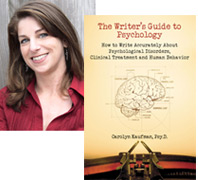
Carolyn Kaufman, PsyD's book, THE WRITER'S GUIDE TO PSYCHOLOGY: How to Write Accurately About Psychological Disorders, Clinical Treatment, and Human Behavior helps writers avoid common misconceptions and inaccuracies and "get the psych right" in their stories. You can learn more about The Writer's Guide to Psychology, check out Dr. K's blog on Psychology Today, or follow her on Facebook or Google+