QueryTracker Blog

Helping Authors Find Literary Agents
Showing posts with label writing technique. Show all posts

Monday, October 24, 2011

Spice It Up!

                                                             ©Stina Lindenblatt

Like with cooking, adding spice to your writing can transform it from okay to mouth watering. Mouth watering enough to keep your reader turning the pages. Mouth watering enough to make them eager to read your next book. Mouth watering enough to make writers wonder what your secret is for great writing. Yes, I’m taking about those impossible to pronounce words: rhetorical devices.
There are over sixty different rhetorical devices. Some you’ll be surprised to learn you already know (i.e. analogy). Here are eight, along with an example of each.  These ones (among others) are ideal for fiction, but can also be used in non-fiction.
Alliteration
The repetition of sounds at the beginning of a word.
My father knew and he taught me some before he was blown to bits in a mine explosion. There was nothing even to bury.
My bow is a rarity, crafted by my father along with a few others that I keep well hidden in the woods, carefully wrapped in waterproof covers. (Both examples were from the same page of the novel.)
Anadiplosis
The last word of a sentence is repeated at the beginning of the next sentence (or near the beginning of the next sentence).
I only have to pass a few gates to reach the scruffy field called the Meadow. Separating the Meadow from the woods, in fact enclosing all of District 12, is a high chain-link fence topped with barbed-wire loops.
Anaphora
The repetition of a word or a phrase at the beginning or three or more sentences.
It’s not that I don’t agree with him. I do. But what good is yelling about the Capitol in the middle of the woods? It doesn’t change anything. It doesn’t make things fair. It doesn’t fill our stomachs. In fact, it scares off the nearby game.
Asyndeton
When you omit the conjunction in a list of words or phrases. In the example below, the conjunction ‘and’ has been dropped from the sentence.
He lists the disasters, the droughts, the storms, the fires, the encroaching seas that swallowed up so much of the land, the brutal war for what little sustenance remained.
Epizeuxis
A repetition of a word (or phrase) for emphasis. Great for emphasizing emotions.
The crowd draws in a collective breath and then you can hear a pin drop, and I’m feeling nauseous and so desperately hoping that it’s not me, that it’s not me, that it’s not me.
Polysyndeton
The use of a conjunction between each word or phrase in a list (instead of using the conjunction between the last two words).
With both of us hunting daily, there are still nights when game has to be swapped for lard or shoelaces or wool, still nights when we go to bed with our stomachs growling.
Simile (Metaphors are also rhetorical devices)
Even so, I always take a moment to listen carefully for the hum that means the fence is live. Right now it’s silent as a stone.
Zeugma
A list in which the last word (phrase) is not like the others. (Think Sesame Street: One of these is not like the others.)
Electrified or not, the fence has been successful at keeping the flesh-eaters out of District 12. Inside the woods they roam freely, and there are added concerns like venomous snakes, rabid animals, and no real paths to follow.


If you think rhetorical devices are only for literary fiction, guess again. The above examples are from the young adult dystopian novel, The Hunger Games, by Suzanne Collins. And not only that, they’re from the first chapter. Now that’s powerful writing.
How to Use Rhetorical Devices
  • Add them when you want to place extra emphasis on something. For example, turning points in your plot or sections of heightened emotion.
  • Use them on the first page of your story to hook your reader.
  • Add them at the beginning and end of each scene to keep the reader reading.
  • Blend several together.
  • Make sure they are there for a reason. Don’t randomly insert them. If you do, you might waste an opportunity by only adding them to places of low importance.
  • Make them seamless, not obnoxious. Your reader shouldn’t notice them, unless he’s a writer who knows about rhetorical devices.
  • Because there are so many, select about fifteen to twenty that call to you, and work them into your writing as much as possible. As you become comfortable with those ones, add to your list.
  • Study your favorite stories and see how the authors used them. You might be surprise to see how often they use the various devices.
  • Add them to both your fiction and non-fiction writing.
For a complete list, and the definition for the each rhetorical device (and figure of speech), check out the About.com Tool Kit for Rhetorical Analysis.
Do you consciously use rhetorical devices in your writing?

Stina Lindenblatt writes young adult novels. In her spare time, she’s a photographer and blogging addict, and can be found hanging out on her blog, Seeing Creative 

Monday, August 29, 2011

Conflict & Characterization: Lessons from an Old Anime

(I promise that what lies below ties in to writing!)

I’m a big fan of this old-school (1972) anime called Gatchaman (and of its American translations…well, some more than others).  Author and friend Jason Hofius wrote a definitive guidebook on one of the American translations, which was called Battle of the Planets (1978), and recently he sent me an email to tell me he’s created a website on the same topic.

So I went tooling around the website, and it struck me that writers could learn a few things from his approach to the information.

Story Conflict

In the Battle of the Planets series, as in most stories, there are bad guys and there are good guys.  The bad guys are from the planet Spectra. Because Spectra is dying, the bad guys run around consuming the resources from the Peaceful Planets and generally trying to destroy the Peaceful Planets using monster mecha machines. The good guys belong to the Intergalactic Federation of Peaceful Planets, which is a very green and scientific sort of group.  The Federation’s most important answer to attacks from Spectra is the 5-person G-Force ninja team. (Please rest assured that this came long before Disney’s elite guinea pig team. The members of this G-Force are human.) 

Here’s what struck me, though. For each and every one of the series’ 85 episodes, Hofius indicates what Spectra is trying to accomplish and what the G-Force team is trying to accomplish.  You  might think this would get ridiculously redundant (for example, Spectra’s Goal: To steal a precious mineral; G-Force’s Goal: To stop the Mecha of the Week and recover the stolen mineral) but it really doesn’t because each side has numerous sub-agendas and internal conflicts (read: subplots).

Your Writing

You may know who your good guys and bad guys are overall, and what each side’s mission is in your story or novel as a whole, but do you know what the key conflict is in each scene?   If your story is moving forward properly, each scene’s conflict should be a little different as the characters react and respond to each other.  Each scene’s conflict should also advance the story as a whole.

As I edit a novel, I often find that I have several redundant scenes, usually because I am trying to make a point of some kind.  But a story is more exciting (and fun) if it doesn’t get mired in redundancies.

For example, in the novel I’m currently working on, I found three scenes meant to emphasize how bad things were for the good guys now that the bad guys had successfully invaded—the good guys had reached the point of surrendering not just physically, but also psychologically.  

My goal was to prove that things were BAD, and I did such a good job with it that I found myself depressed and a little hopeless, even though I knew the good guys would eventually prevail. There’s nothing pretty about beating a dead horse, folks, and if you insist on doing so, your readers may beat a hasty retreat. 

Though I’m not much of a chess player, the craftiness of the game has always intrigued me, and so I like to think of a story like an intense chess game between sides. One side moves; the other side has to counter that move and not only block the opponent’s goals, but also further its own.

So take another look at that story you think you’ve finished.  Is it as tight as it can be?  Do the conflicts between characters evolve and change with each and every scene?  If not, can you combine scenes or otherwise hone things down to keep your writing razor edged?
Character Guides

Back for a moment to Hofius’s website.  In addition to the great episode guides, he provides fantastic character guides.  Again, what strikes me about them is that they’re different from every other character guide I’ve ever seen for the series (and I’ve seen a bunch and even written a number of them).

Rather than focusing on the obvious—G-Force team member Mark, for example, has blue eyes and likes airplanes—Hofius tells us about the characters, referencing at least one episode for each tidbit.  That “at least one episode” is important—the show’s creators were fairly consistent in developing the characters’ abilities.

Your Writing

You may have character sheets, but have you managed to work details that define your characters into the story?  

I recently did some editing work for an aspiring novelist who’s still mastering the art of working the details into the story.  She knew a lot of important things about her main characters, for example, and she did a fantastic job of describing them, but she needed to work on slipping the information in without infodumps or blatant telling (e.g. “I am an honest sort of guy”).

One of the biggest dangers of telling (rather than showing) characterization is that your character won’t ring true to readers.  Think about it – if someone you worked with ran around telling everyone what an honorable guy he is, but you never saw him do a single honorable thing, you’d think he was a liar, wouldn’t you?  Readers will feel the same way about characters unless they get to see that honor in action.

Your turn: Is your writing as tight as it should be? Are you effectively showing conflict and characterization?

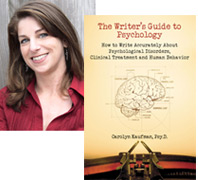
Carolyn Kaufman, PsyD's book, THE WRITER'S GUIDE TO PSYCHOLOGY: How to Write Accurately About Psychological Disorders, Clinical Treatment, and Human Behavior helps writers avoid common misconceptions and inaccuracies and "get the psych right" in their stories. You can learn more about The Writer's Guide to Psychology, check out Dr. K's blog on Psychology Today, or follow her on Facebook or Google+! (Her Gatchman site, which she linked to shamelessly in the post above, is here.)

Monday, July 11, 2011

Productive Arguing

Don't take this the wrong way, but I suggest you argue with your critics.

I've been involved in critique groups since I was twelve. I've critiqued and been critiqued; I've organized critique groups. I've been in classes that worked and classes that didn't, and it's my opinion that where critique works best is where there's a certain degree of argument on the part of the author. But it has to be the right kind of argument.

First let's cover the wrong kind, since it's easier (and funnier) and you've probably been on the receiving end. (Maybe, if you care to admit it, you've done it yourself.)

Nonproductive arguing is when someone points out a flaw in your manuscript, and you fire back with, "Okay, you may feel that way, but that's not what it's really like. I meant to do that. This wasn't a problem for anyone else, and I think it's perfectly fine."

Do that and I guarantee you two things. First that your manuscript won't improve, and secondly that you'll be beating the pavement looking for another beta-reader.

The sad fact is that just because you intended to do something (and even worked hard at it) doesn't mean it works in your manuscript. I've been on the other end of that kind of defensive critiquing, and when I realized 45 minutes of our critique session's hour were taken up with this writer defending the work rather than listening to the criticisms, I shifted to a position of "State it once and then let the writer blow steam at me." Shortly thereafter, I left the group.

But there's a productive way to argue with your critique, and it's not to defend. It's to let the work defend itself.

First, while you're receiving your critique, make sure you stay utterly quiet. You take notes, or if it's over email, you just read. You get the whole thing in without responding. (Mary has suggested putting the critique in the freezer.) You judge for yourself whether this person is working to make your piece better and if you're a good match for one another. Assuming both are true, you can then proceed to argue.

And you do that without the person in the room. You sit in front of your manuscript and you look at the changes this person wants you to make, and you ask yourself how the manuscript itself responds to this particular criticism.

Why yes, I was the woman sitting at her computer desk yelling at the marked-up manuscript, "Are you blind? Were you reading the same story I was? Because that information is in there!" But in order to do that, I had to make sure the information really was in there. Sometimes you discover mid-holler that it's not. (Oops. And then won't you be glad you didn't argue in public?)

It's the same with comments about character, setting, dialogue: listen to the criticism. Evaluate the manuscript and let the manuscript defend itself. If the manuscript can't, tackle the change, even if you don't change it in precisely the suggested fashion.

Whenever I edit for someone, I send them a caveat: that their ideal response is not to say "Yes, ma'am" and make every change I suggest. I'd much rather they say, "Jane, you are full of hooey, and if you'll look at the manuscript, you'll note the following reason why."  Or even better, "Yes, that's a problem, but I have a better way to fix it."  That way, the writer fully owns her own manuscript.

Three days ago, while responding to my agent's comments on one of my manuscripts, I started replying to one suggestion in the negative. She has a razor-sharp editorial mind. She'd pointed out an unfortunately large "expository lump" and said it needed to be broken down, and possibly moved. In my email, I started typing something like this:
Yes, I understand this is a lot of exposition, but it has to be in the manuscript by this point so the reader understands what happens on the next page. If it's moved, it would have to be earlier rather than later, and I can't think of anywhere we'd move it to. The only possible way to do it would be to put this information in the dialogue of--
That is the point at which I highlighted my entire response and deleted it. I went into the manuscript, cut the expository lump, and went back into the opening scene to put it in the mouth of that character; the character not only presented the information but also gave us a much better understanding of his personality in the process. The manuscript is improved in multiple ways, and only because I "argued" with my critic.

And in arguing, realized she was right.

Go ahead and argue. Just make sure you argue effectively.


---
Jane Lebak is the author of The Guardian (Thomas Nelson, 1994), Seven Archangels: Annihilation (Double-Edged Publishing, 2008) and The Boys Upstairs (MuseItUp, 2010). At Seven Angels, Four Kids, One Family, she blogs about what happens when a distracted daydreamer and a gamer geek attempt to raise four children. She is represented by the riveting Roseanne Wells of the Marianne Strong Literary Agency.

Monday, April 4, 2011

Writing humor

After last Friday's April Fools pulse, I was asked to blog about writing humor. But keep in mind: there's nothing more serious than writing about the techniques of humor. So…no laughing today. Sorry.

Satire is right up my alley. If you list every one of my publications, the majority of them are either satire or humor, and even my serious pieces have funny moments. I believe exercising our sense of humor makes us more human and less apt to get upset over small matters. I would never have survived the querying process without a sense of humor.

Humor in the middle of a serious novel can break up the tension and give your reader a much-needed break. Laughter helps us connect with the characters so we feel as if we're on their side. That doesn't mean villains can't use humor too. In fact, I think they should. But in general, humor makes characters and books more appealing. So we have to learn to use it well.

Humor in general arises from a surprise. When we're looking for laughs, the key is to take something familiar and frame it in an unfamiliar way, turning it on its head in the process. In order to do that, you need to know your material inside-out. For satire in particular, you need a thorough familiarity with every aspect of what you're satirizing, and then take every aspect of it and wrench it around sideways. 

Robert Darden, editor of The Wittenburg Door, rejected one of my pieces with advice that has paid off in spades ever since: keep it focused. Short humor pieces need one point, and you can build from there. (I rewrote the piece and he accepted it.) Sometimes we're trying to do too much. Neil Gaiman said that when writing Good Omens with co-author Terry Pratchett, the most shocking thing was how much hilarious material they threw away. It just didn't fit the focus. 

So let's go back to last Friday's Pulse, since it seems to have most of the elements of good satire and good parody (although that doesn't mean it was good -- only that it shares the same elements, like being written in full sentences):

The absurd: everyone announces movie deals, but would anyone really film a movie about a man designing a database? If you've been here for a while, you recognize that the "five hot women" who join his quest (database =/= quest) would be the five blogging authors in the sidebar. Then we take it over the top with a famous actor and musicians, and polish it off by saying one of the writers will have a cameo in the movie. It all sounds totally normal if you've ever read about a movie deal, but it's absurd.

Inversions: we're used to romance writers crafting stories about vampires; a vampire writing a story about romance is the reverse.

Hidden bonuses: Our artwork didn't win an award, but you wouldn't see that line unless you read the caption. Did you notice my author photo was flipped? Did you translate the Latin name of the shark?

Insider knowledge and subtlety: twisted agent names, subjects agents do blog on but wildly inverted, a new feature announced in exactly the wording Patrick normally announces them. Listen to master parodist Weird Al Yankovik: the littlest quirks of the songs he parodies will turn up in his versions, right down to holding the last note too long on "Spam." 

Irony: The "prize" for the one billionth query letter is that you get a response to your query. it's exactly the same as the "prize" for sending the 384,797th query.

Bad puns: well, those speak for themselves. I'm sure you found at least three.

A disappearing author: for satire and parody, you as the writer need to immerse yourself in the thing you're sending up so none of your own voice comes through. Become what you're satirizing. Again look to Weird Al as the master chameleon, and notice the range of voices he's able to imitate.

A point: satire should have a point, albeit subtle; parody doesn't need one. 

And finally, take it over the top.  If you have a singing query letter, follow your idea through all the way to the end. How did this start? How would it be implemented? How would the agents react? And then, how would you take a question authors frequently ask about their query letters (such as pitching a multiple-POV novel) and apply it to song?

There you have it. All the elements you need, although I have to add that a warped childhood and a decade of reading every issue of MAD Magazine  are extraordinarily helpful as well.

---
Jane Lebak is the author of The Guardian (Thomas Nelson, 1994), Seven Archangels: Annihilation (Double-Edged Publishing, 2008) and The Boys Upstairs (MuseItUp, 2010). At Seven Angels, Four Kids, One Family, she blogs about what happens when a distracted daydreamer and a gamer geek attempt to raise four children. She is represented by the unrivaled Roseanne Wells of the Marianne Strong Literary Agency.

Monday, March 14, 2011

Sequels

About six months ago, my agent and I were discussing a follow-up to the novel she had in front of her, and she said that when you write a sequel, the two books need to play into each other. They need to feel like each other, complement each other, and address the same questions. As kind of a one-off, she said that a sequel shouldn't be just 'the next book about the same character.'

I didn't realize at first what she said, but when it hit me, I was shocked. I understood then why some of my books took very well to a follow-up whereas others never got up enough steam, and I'd left them as stand-alones. By then I'd read hundreds of novels and completed an MA in English and no one had ever said it that way: a sequel needs to be more than just another book about the same characters.  

We'd discussed trilogies, of course, but trilogies divide up neatly into their own setup, intensification, and conclusion. It's different when broken up over two books. Ideally your two-book deal will have an overall arc: the first book will address the hidden need of the character, but the second book will resolve it more permanently or in a more complete form. 

More to the point, a great novel has characters with specific needs who have been put together by the author with a specific purpose in mind. If the author didn't intend to have that second book on the horizon, but sits down to write one, the novel won't work if all the central needs of the characters have been resolved.

And there lies your tightrope: your novel needs to stand alone; but in order to have a sequel, the characters need to be able to take their resolution further than they did in the first book. 

When you write a novel about a character, hold one thing in mind (told to me by author Alysse Aallyn at the 2010 Connecticut FictionFest): this should be the story about these characters' lives. Ten years from now, there won't be a better one. What you're telling now needs to be the moment these characters, at the end of their lives, will say it all changed: the pivot-point. 

Therefore you the author owe it to them to give the entire story its own harmony and its own set of central questions, no matter how many books it spans.

If not, then what you end up with is a book with another book tacked onto the end, the second book having a different feel, different scope, and an almost superimposed set of needs that should have been established (and worked on) in the first novel.

At the end, my agent told me to make sure that closing chapter points in the direction the next book will head, while still fully wrapping up that first book. The closing chapter of the first book, she told me, sells the second book.

And if the needs, the drive, and the conflict of the second book will be that dramatic a turn from the first book, possibly a sequel is not for this story. It might be time to end the story and start a new one.

---
Jane Lebak is the author of The Guardian (Thomas Nelson, 1994), Seven Archangels: Annihilation (Double-Edged Publishing, 2008) and The Boys Upstairs (MuseItUp, 2010). At Seven Angels, Four Kids, One Family, she blogs about what happens when a distracted daydreamer and a gamer geek attempt to raise four children. She is represented by Roseanne Wells of the Marianne Strong Literary Agency.