QueryTracker Blog

Helping Authors Find Literary Agents
Showing posts with label blog. Show all posts

Tuesday, June 14, 2016

Plagarism and the Indie Author

Recently I read a disturbing article about an author who’d discovered that someone had plagiarized her book, causing such substantial physical and financial distress that she eventually pursued the offender in court.

Plagiarism is not a new concept (in fact, you can revisit Carolyn's article here) but it seems to be finding a new group of easy targets: self-published books on Amazon.

If a thief tries to steal a traditionally published book, you can bet that the legal team employed by the Big House will descend like bees on a honey-stealing bear.

But self-published authors don’t necessarily have that back-up plan. And Amazon is full of self-published books, ripe for the plucking.

This isn’t an article meant to deter writers from choosing self-publishing. Many writers seeking agent representation still opt to self-publish other work not deemed generally query-able: short stories, anthologies, or poetry books...

...and, yes, novels, usually those that failed to find their footing with agents or editors. Those books aren’t automatic failures—they are just projects that didn’t get picked up. That’s not necessarily a condemnation on quality. That's why many authors pursue publication for those novels on their own.

In fact, putting forth a great self-published book can be a stepping stone to finding a dream agent because it provides an opportunity to start building an audience. An established audience is a huge enticement for an agent.

So self-publishing, when done well, isn’t the kiss of death. But it does open up an author to the plague that is plagiarism.

The vast majority of self-published novels on Amazon is romance fiction. Needless to say, those books are often the most plagiarized. (That doesn’t mean that everyone else is safe, though.) The market for romance fiction is massively huge, making it easy for a copy-cat to find a niche and sell well without being discovered. And that’s the problem—those copies have to be detected, discovered, and decried in order for Amazon to take them down.

While Amazon will take down individual offending books, so far they do not have a policy in place that will take down an author’s entire list if any of their titles are plagiarized. It’s up to authors to protect themselves when putting their products out for sale.

Here are a few things an author can do to reduce the chance your work will be plagiarized.

  • Enable your Digital Rights Management (DRM). Kindle publishers should activate this safe guard , which limits the devices upon which the book can be viewed. By doing so, you limit the ability for a person to lift your book, drop it into a word processor, and use it as their own. (There is a downside to enabling DRM, as many readers like to read between multiple devices, so do your research before making the decision that is right for your situation.)

  • Register your work with the US Copyright office. It gives you legal protection and the ability to seek damages. It doesn’t keep your work from getting stolen, but it really helps deliver the payback by giving you a case in court. (I'll be discussing Copyright Registration in an upcoming post, so stay tuned.)

  • Use websites to find your lines online. There are a few sites that scan the internet for you, such as Copyscape and Plagiarism.org using the “check for plagiarism” button. What else can you do? Author Ally E. Machate recommends using Smart Google Search to be the watchdog. Simple enter in a few random lines from your text and, if a new page pops up with those words (or very similar), you get an alert.

  • Protect your blog! May authors use their blogs to provide fresh, enticing content to keep their readers on the hook between books. Post copyright notices on your web pages and disable the right click copy function to prevent easy lifting. Use Java code as discussed in this article or look at this Java-free method tutorial. The addition of such coding helps to deter a plagiarist from lifting your blog and copy-pasting it to their own document. You can also go so far as to register your blog with the US Copyright office.

  • Watermark your images on your blog and the pages of your review copies. Adding a transparent copyright notice catty-cornered across the pages of your PDF review copies will also make it harder for pirates to throw your book up on the torrentz.

Keep this very important thing in mind: there is no way to prevent your book from getting plagiarized. Deterrence and vigilance is key.  Authors must do all that they can to post copyright notices and to make it harder for work to be swiped. Monitor the internet periodically for evidence that someone is passing your work off as their own. Obtain copyright registration so that, if you find it, you can fight it and claim your damages.

Authors put in immeasurable amounts of time and effort into creating their work. The same should go into protecting it. It’s YOUR book. Do all you can to keep it that way.


Ash Krafton is a speculative fiction writer who, despite having a Time Turner under her couch and three different sonic screwdrivers in her purse, still encounters difficulty with time management. She's the author of the urban fantasy trilogy The Books of the Demimonde as well as WORDS THAT BIND. She also writes for YA and NA audiences under the pen name AJ Krafton. THE HEARTBEAT THIEF, her Victorian dark fantasy inspired by Poe’s “The Masque of the Red Death”, is now available.

Wednesday, December 19, 2012

Promotional Techniques for Authors

All authors, whether independent or traditionally published, will eventually need to turn their attention to the wide world of promotion. Even traditionally published authors have to do a lot of self-promotion, despite having the power of a big publishing house behind them. Every author, no matter who has published their work, has one goal in common: to see their hard work and beautiful books promoted from sea to sea to sea.  We all want to go global, don't we?

In the beginning of my career, I was a shy writer, the girl who wanted her promotional attempts to be as far outside her "personal space" as possible. Think: billboard, but cheaper. I wasn't ready for signings or meet-and-greets or conferences. I thought a static webpage and a blog for announcements would be enough. Thank goodness I dispelled those illusions before I got my novel published.

Because I started out writing poetry and short stories, I was able to find my way through the promotional jungle one footstep at a time. Along the way, I've learned countless ways to promote my work--and most ways cost more time than money. You can tailor your methods to suit you and your work best; you can decide if you want to hire out to save time and work or make it a DIY project that will be inexpensive but time-consuming.

That's the beauty of promotion--it's a personal endeavor that you can make work for you.

Keeping my "personal space" in mind, here are some methods I've used--without ever leaving my writing cave.
  • Social media: please don't tell me you are still putting off getting online with Facebook and Twitter. While you are at it, join Goodreads and think about Pinterest or Google+. You won't sell books hanging a For Sale sign in an empty room. Get your social media profiles polished, start collecting friends, and don't ignore them! They'll only stay interested as long as you are interesting. Still intimidated? Check out this introduction to social networking here. The more advanced crowd might consider a Twitter party and enlist a few friends to help you promote through chatter and hashtags.

  • Blog: It's not enough to blog...you have to promote it as widely as possible. I've been reading up on SEO (search engine optimization) and learned a trick to get my blog to pop up in more searches. You can too--enroll your pages in blog directories to get more exposure, then make sure you use a lot of tags to describe your content. Some directories require annual re-enrollment and each one I've used require a code be placed on the blog (known as a reciprocal link.) I invite you to scroll to the bottom of my own blog to see which ones I use--you'll find at least four different graphics. Click on them to learn more about each directory.
     Also, consider joining Triberr, which combines the power of blogging with the audience of Twitter. In short: expand your audience. You can find more information on Triberr here.
 
  • Virtual book tours: Going on an author tour can be expensive, time-consuming, and all-around terrifying. Did you know you can promote a new release by going on a virtual book tour, instead? Instead of book stores and libraries, you visit book blogs and websites. Offer bloggers a giveaway, an excerpt, or an interview--your imagination can run wild, and bloggers love free content.
     Unlike physical touring, it's pretty much free (unless you offer prizes) and not terrifying at all. However, it still is time-consuming because you need to research blogs and email each blogger--and the prep work can take several weeks. (Many of the more popular blogs require months of notice in order to get you on their schedule, so start early.) Nonetheless, it's great promotion. You can see what I did on my virtual book tour here.
 
  • Book blasts: This is kind of like a virtual book tour except it's more ad than commercial. I just participated in a book blast for my urban fantasy Bleeding Hearts. Over fifty blogs posted a boilerplate post containing my book's blurb, buy links, and cover. My photo and bio were also displayed. Of course, there was a huge giveaway.
     This is one of the few times I've paid for promotion. While it was costly, it gave me access to new blogs and new audiences. All the work was done for me--and having organized a book tour in the past, I appreciated not having to spend hours and hours emailing and organizing. The result? Check out one of the blogs who hosted my book blast--and enter the contest while you still can!
 

  • Goodreads: If you are a Goodreads author (and you really should be) you should give serious though to offering your book in a Goodreads giveaway. You spark a lot of interest in your new book just by giving one away, since most entrants also add your book to their Want to Read shelf. Consider opening your giveaway to all countries available--the international readers will appreciate it and you'll expand your potential audience. The downside is the cost of extra postage, but that's pretty much it.
    There are also several--okay, a ton--of groups on Goodreads. I belong to a number of them that have review request programs. An author will offer a set number of books to giveaway in exchange for reviews. I've gotten some great reviews this way, and it didn't cost a penny (not that you should ever have to pay for reviews.)
 
  • Swag: Okay, it costs money to get good swag but, thanks to places like Vistaprint.com or Print Runner, you've got affordable options. My favorites? Magnets and t-shirts, because everyone I know either owns a refrigerator or wears clothing. (Sometimes, they do both.) A word of warning: a brick of magnets will get you pulled out of line for a bag search in an airport, so put them in the tray to save time getting through security.
This list is far from complete but it's an excellent start for the author getting ready to promote themselves--and each of these can be accomplished without ever getting up from the computer.

What about you? Have you used a technique or an event to promote your work? Was it effective? Share your experience with us!


Ash Krafton is a speculative fiction writer who resides in the heart of the Pennsylvania coal region, where she keeps the book jacket for "Abraham Lincoln: Vampire Hunter" in a frame over her desk. Visit Ash's blog at www.ash-krafton.blogspot.com for news on her urban fantasy "Bleeding Hearts: Book One of the Demimonde" (Pink Narcissus Press 2012).

Wednesday, August 1, 2012

Waiting on Wednesday...and Thursday...and Friday...

Your novel is complete. Your agent list is compiled. Your queries are sent.

The clock ticks. Tumbleweeds roll past your window. Your email and snail mail boxes remain empty.


So you sit. And wait.

Why are you sitting there, clicking the "send and receive" button? You have work to do!

Write your next novel. You can't pin all your hopes on one project. When your dream agent finally writes back, you want to wow them by having another book in your arsenal. Alternatively, if your current project doesn't get the response you wanted, you need to have a back up plan. Either way--keep writing!

Branch out. There are things other than novel you can be writing: poetry, short stories, articles. Anything. It will help you build a biography and it will keep your creative spark burning. You’ll also gain more practice sending out submissions (and more practice taking bad news—but don’t worry, it’ll only make you stronger.)

Work on a website. You want to have your web presence established so your future audience has a place to call home. Agents will often do a precursory search online if they are interested by your query. A website shows them you are serious about your writing and you are ready to take on a career.

Blog. Write blogs. Read blogs. Comment on blogs. You aren't just fooling around online when you do this "blog work"--you are interacting with other people and building a network. Follow some book review blogs in your genre and join the conversation. One day you'll want to do a virtual book tour...and you'll need friends to help you out. Find those friends now and help them out first by supporting their work--one day they will support yours.

Join a writers association. There is sure to be a group that fits your style. Local groups that meet at a library or a Starbucks in town once a month. State groups like Pennwriters. National groups like Romance Writers of America and Science Fiction and Fantasy Writers of America. All shapes, all sizes, all genres and focii. Join a weekend critique group. Go to a big conference and mingle with the writers and agents. Find the courage to pitch a project. It's all good exercise for any writer.

Improve your craft. Read a book on writing (I think Stephen King can help you with that). Put your manuscript through the rigors of a workbook like Donald Maass' Writing the Breakout Novel. Just because you finished a book doesn't mean you've finished growing as a writer. Get cracking on your homework.


Writing and waiting seem to go hand in hand. The submission process is 2% communicating and 98% waiting for a response--but don't waste those precious minutes waiting for cobwebs to grow on your computer.

You wanted your hobby to become a job the moment you decided to seek agent representation...so get to work. One day you'll have scant precious time between projects to do all these important and wonderful things.

Waiting time doesn't need to be wasted time.

(Photo courtesy of gunner07)


Ash Krafton is a speculative fiction writer who resides in the heart of the Pennsylvania coal region, where she keeps the book jacket for "Abraham Lincoln: Vampire Hunter" in a frame over her desk. Visit Ash's blog at www.ash-krafton.blogspot.com for news on her newly released urban fantasy "Bleeding Hearts: Book One of the Demimonde" (Pink Narcissus Press 2012).

Wednesday, February 8, 2012

Does Your Grasp Exceed Your Reach? Triberr Can Help

As a writer who is only just beginning to break into publishing, I face the same problem that most ordinary mortals do: I don't actually know that many people.

I'm not a hermit or anything. I have a day job that puts me in contact with hundreds of people each week. I know my neighbors, my kids' friends' parents, and I have a decently-sized family. But when I stop and think about potential book sales, I realize that I don't really know a lot of people and, even if I sold a book to every person I knew, it wouldn't really be an impressive number.

Now, if each of my friends told another person to buy a copy, that number might double. And if they told two people? Do the math. The Tell A Friend system would really increase the size of my potential audience.

Writers depend on extended networks to sell books. Why else would we spend so much time building our networks with online communities and writing organizations? We watch our Twitter Follower counts and our Facebook Friend numbers almost as much as we stare at our email inboxes. I'm not Jedi enough to mind-trick myself instantaneous success, though, and so I continue to look for ways to build my network and increase the size of my audience.

Then, a few weeks ago, my friend and fellow author Tricia Schneider (@triciaschneider) introduced me to Triberr.


Triberr: The Reach Multiplier

"Have you ever heard of Triberr?" she wrote. "It's basically groups of people that help each other promote our blog posts on Twitter. I have nearly a 100% increase of hits on my blog. I belong to 2 tribes and have 58 members who promote my blog posts--which means I have roughly a 56,000 reach. That's more readers, more chances for my books to be purchased."

She had my full attention. Like a lot of start-up bloggers, I've been scraping together my readership any way I could: by commenting on other blogs, by participating in blog hops, and by cross-posting my entries to my other online accounts (Facebook, Twitter, Goodreads, Red Room.) I set up as many automatically posting cross-links as possible so I can spend more time writing and less time cutting-and-pasting my blog entry's URL.

So when Tricia said she has a "reach" of 56,000 people…shoot. I needed some of that. Off to Triberr.com I went.

A Way to Share and be Shared


Tribes are groups of bloggers with similar interests who band together and combine their resources: in this case, Twitter followers and blog posts. This pool of Tweeps is calculated and called the Tribe's reach.

The Tribal Stream shows a list of your tribemates' blog posts. You simply go down the list, clicking the approve button next to the articles you want to distribute. Triberr then sends them out through your Twitter account at a rate of one post every twenty minutes.

How does this help writers? The author of the post gets his work Tweeted out to the followers of everyone in the Tribe. If the Tribe has a reach of 30,000, that's potentially 30,000 people who are going to see the Tweet of your blog's link. (I say potentially because that many people will share a number of the same people as followers.)

The person approving the posts benefits, too, by having regularly-scheduled content going out via Twitter posts. Since everyone in my Twitter Follower list isn't in my tribe, any retweets of my Tweets will expand the reach of the Tribe as well as get me extra Twitter mentions, thereby increasing my name recognition.

Content. Distribution. Twitter. What a wonderful mix for writers seeking to distribute their work.

Ease of Use

Signing up was free and easy. It did take a while to figure out that my name wasn't showing up because I'd missed a hard-to-see link (extra thank you to the oh-so-patient Laurie (@lauriej170) for her tutelage) but, once that was fixed, my account ran quite smoothly.

I also read one of the moderator's blog posts on creating a branded Twitter app and had to give it a try. In a very easy-to-follow set of instructions, Dino Dogan (@Dino_Dogan) shows you how to rig your Triberr/Twitter interface so that the Tweets appear to come from you rather than the Triberr website. This provides two benefits: it gets your name out there even more and makes the links look more original, instead of just passed along posts.

There have been drawbacks to using it, though; I've had to re-do the app twice since I started, as it likes to suddenly stop working. It's a glitchy thing but not big enough of one to make me forsake the program. Thankfully, the Triberr gods are very attentive to their website and they work tirelessly to smooth out the kinks as they come up.

Bonfires are various topics on the community message board, which range from requests for tech support to open calls for new members. Most of my questions were answered by other Triberr folk (and I found new Twitter friends, too.) Each Tribe has its own message board, too, where members can greet and chat with each other. The Tribal member page displays the names of your tribemates and makes it easy to follow them on Twitter--which is a requirement for the entire Triberr program to work.

The nicest thing is that Triberr isn't just a web program, it's a community of people who all want the same thing I do: to promote our work, to network with other bloggers, and to share the load. It's a healthy symbiotic relationship, one that definitely makes it easier to get the job done.

Does it Work?

Apart from the tiny hiccups, I have to say that, after only ten days of Triberring (my unofficial verb), I've gained a ten percent increase in Twitter followers. That's amazing for me. They are prime followers, too, since they most likely found me through my Tribes—and therefore sharing my interests.

I added a new post to my blog and saw it Tweeted out more than 25 times in six days. Guess how many Tweets my posts regularly got before I started using Triberr? Answer: only as many as I churned out myself.

While a week may not be a very long time to form an educated opinion, I'd have to say: Yeah. It looks like it's working pretty well.

I joined two established Tribes and even started my own. After a week of being on Triber, my reach has climbed to nearly 140,000. All I have to do is post to my blog and away it goes, with a little help from my friends.

Think about the potential size of that audience. Don't you need some of that?


Ash Krafton is a speculative fiction writer who resides in the heart of the Pennsylvania coal region, where she keeps the book jacket for "Abraham Lincoln: Vampire Hunter" in a frame over her desk. Visit the Spec Fic Chick website at www.ashkrafton.com for updates on the release of her debut novel, Bleeding Hearts: Book One of the Demimonde, forthcoming in March 2012 through Pink Narcissus Press.

Monday, November 28, 2011

Writing: It's a Numbers Game

As a past (and future) querier, I've spent a lot of time on the Query Tracker website.

Query Tracker is a database of the most trustworthy literary agents, packed with the tools I needed to track each of my submissions to them. Query Tracker became a valuable part of my novel's road to publication and, at the height of my querying, I spent several hours a week using the website.

Assembling an agent list was the easy part. The search functions narrowed down the group of more than 1200 agents to those who were appropriate for my material. The spreadsheet showed my progress and tracked responses as they came in. The individual agent files contained contact information and links to their online dwellings.

But, after a while, those amazing features began to pale in comparison to the tab so innocently labeled "Reports and Statistics." Like many anxious writers who used Query Tracker, I quickly got sucked in to the stats of the querying game.

Numbers. Everywhere. The Query Tracker database had information on every statistic a writer could imagine. Which agent had the highest request rates. How many days until my own request should come in(ever the optimistic one.) How many lucky writers signed. How many unhappy writers marked their own queries as a "no response". Hard figures and agonizing percentages. Nail biting numbers. Knuckle crunching numbers.

Nasty thing, numbers.

Despite the pretty clear delineation between the left and right hemispheres of our brains, numbers will always want to mingle with the words crowd (much to my math-hating daughter's chagrin.) Word counts. Page counts. Royalty rates. Fun stuff. Essential stuff.

Here's some more "essential stuff" to get your mind off the agony of staring down the query stats.

We'll start at the beginning with the 10 Most Important Things every writer needs to know: while simply stated, there is a lot of down-to-earth advice here. For example, did you know that "your friends and family are not your audience"? Nope, they're not--and knowing it might help you define who your audience actually is. A list like this helps to reset ourselves, gets us to pull away from the keyboard for a moment and try to remember the reason we sat down to write in the first place.

Got blog? Then you got numbers. Here's 3 things your blog needs and 5 things it doesn't. (The comments are noteworthy.) And every blogger wants a bigger audience, right? Average bloggers will appreciate these 8 tips to grab those coveted readers while the over-achievers may prefer a heftier 19. Go big or go home, I always say.

Heck, as long as we're going big, let's go Hollywood. Here's 10 things that may decide whether your book is good enough for the big screen.

Once we're done daydreaming about cinematic fortune and fame, the blog 365 Stories In A Year will give us this more realistic list of 10 things we probably do but would never admit. On the flip side, we still have our integrity as writers—and so we'd be better off sticking to these 10 basics, which includes Wil Wheaton's Law. (If you are unsure of just how tremendously powerful a chaotic neutral overlord Wil Wheaton has become, then you seriously need to catch up. He's going to rule the world one day.)

The numbers get even more serious over at Twenty Palaces, where you can find 10 things that might be the proverbial slap you need to stay focused. However, these 10 magic ideas will inspire you with a much lighter touch. (Read it if you *heart* Voldemort as much as I do.)

Want advice from an agent instead? No problems. Rachelle Gardner has loads of great tips and she gets a perfect 10 for her 10 things theme on her blog. She's got several helpful lists on a variety of topics--have fun with them!

And Rachelle isn't the only one who's got her numbers lined up. Janet Reid lists 10 steps to diagnose your query for a particular agent. Some of us will read this and say, really? You need to spell all that out? Give us some credit! while an equal number of us will say, Now, that's what I call *clear* guidelines. Finally. Why don't all agents do it? (Don't get any ideas.)

Lastly, I'll point out a lengthy 10 secrets you might not have known about agents. There is a very poignant message in this one--if you don't have time to read the entire article right now, take the time to scroll down to the bottom of page 22 and read the last paragraph or so. It may help put querying madness into perspective.


Look at all those crazy digits floating around up there. Can writers learn anything from playing the numbers game? (Besides the apparent fact that writers seem to love the number 10.)

Maybe if we extracted all these numbers we'd realize there is no single magic formula to good writing. Sure, we can obsess over numbers and drown in the QT data explorer. We can calculate and extrapolate and postulate but, in the end, it's the actual words on the paper that matter. Word counts and page counts won't matter in the end if the heart isn't in the story. The words and the numbers must work together to produce a splendid story and it's our job to bring it all together.

Perhaps treat yourself and listen to "Hemispheres" by Rush, with an emphasis on the song The Sphere. Just as the heart and mind must unite, so must our right and left brains. Write the words but don't forget to enjoy the numbers…

And look forward to getting that single, most beautiful number: 1.

One "yes" is all it takes to win the writing game.

Ash Krafton is a speculative fiction writer who resides in the heart of the Pennsylvania coal region, where she keeps the book jacket for "Abraham Lincoln: Vampire Hunter" in a frame over her desk. Visit the Spec Fic Website at www.ashkrafton.com for updates on the release of her debut novel, Bleeding Hearts, forthcoming in early 2012 through Pink Narcissus Press.

Monday, January 17, 2011

Should I Mention My Blog in My Query?

When should you mention your blog in a query, and when shouldn’t you? That’s today’s question:

If you have a well written blog that you work hard at, and are proud of, but the number of official “followers” is low, should you mention the blog in your bio or list it on your query? [I think mine is] funny and engaging. People who do read it seem to really enjoy it. But, I don’t have a high number of followers (at least that I know of). Or, should I mention it, but take out the follower’s box, so [an agent] can’t see how many I have? I notice some blogs don’t even list how many followers they have. I am on [Blogger.com].

Tracking Followers and Subscribers: Feedburner

Let’s start with finding out how many followers you actually have. The “Followers” widget in Blogger only shows people who have clicked “Follow” within the widget. It does not count people who have subscribed in other ways, e.g. by putting your RSS feed address directly into their preferred feedreader.

What you need to do is “burn” your feed using Feedburner, which is a free service (now owned by Google) that lets you track subscribers and post views. You can use it with Blogger, Wordpress, TypePad, and other blogging platforms. The instructions on the Feedburner site are pretty clear (just start where it says Burn a Feed Right Now!), so I won’t repost them here, though you are welcome to ask questions in the Comments if you have any trouble.

Once you’ve burned your feed and are getting subscriber results, you will need to add the number of subscribers you see in Feedburner to the number of Followers you see on your page. (You may find it reassuring that it seems to be pretty common to have, say, 3 times more subscribers through Feedburner than through the Followers widget)

Is Your Blog Related to Your Product?

Agents and editors may be interested in learning about your blog, but only if it relates to your story or book. What publishing professionals are looking for is a built-in audience that will (they hope) purchase your product (ie your book). In other words, if your blog is primarily about your life – family, friends, day-to-day activities and events – and you’re not writing a memoir or narrative nonfiction, you should leave your blog out of your query, regardless of how well it’s written. Likewise, if you have a huge blog on, say, mountain climbing, but your book has nothing to do with mountain climbing, you don’t have the built-in audience an agent or editor is looking for, and mentioning your blog will look like a non sequitur.

Many authors, however, have a blog related to their book’s topic. Granted, it’s easier to do this if your book topic is nonfiction, but expertise and a following in an area related to your novel can be useful. If you’re writing historical novels set during the Civil War and you have a strong history blog in which you regularly talk about the Civil War, that’s worth mentioning. Especially if your work on the blog gives you access to Civil War buffs who might be interested in buying your book – for example, by helping you find speaking engagements, or giving you the credentials you need to publish articles in Civil War magazines.

The whole purpose of mentioning your blog, then, is to prove what a nice big audience you bring to the table. For that reason, there’s no point to mentioning the blog unless you can also offer numbers, the higher the better. The minimum number of subscribers I’d mention is 1000, though I have seen books on platform use 10,000 as an example of a really strong number. “Strong” does depend a bit on your topic. If you have a niche market, a few thousand subscribers is good; if, however, you’re targeting a saturated market with a topic that has widespread appeal (a fantastic new diet or exercise program, for example), you’ll need significantly higher numbers (and probably some kind of professional certification or degree).

Increasing Your Followers and Subscribers

So what if you have a blog that relates to your book’s topic, but you still don’t have a lot of followers and subscribers?

I’m going to give you several tips, but I want to emphasize that this first one is the most important: You need to give the audience something they want or need with each post. If you’re a big celebrity, people won’t care what you post – Angelina Jolie could post what kind of toothpaste she uses and some people would be riveted – but the rest of us have to provide something valuable to readers.

What Would You Enjoy Reading?

Think about what kind of information you’d like to see in your feedreader. What would you find riveting? That’s the kind of material you need to produce, because even if you only post once or twice a week (with a couple days off for major holidays), you're looking at 50 to 100 posts in a year. You need a topic that you’re going to continue to be enthusiastic about for years to come if you're going to generate that many posts.

Finding (Valuable) Post Topics

If you don’t have extensive knowledge on your chosen topic, let the experts guide you. Take the time to research your posts – read books, magazines, and scholarly journals (if there are any) and newsfeeds on your topic, and then explain what you’ve learned to your readers. (Remember, emphasize how they can use that information rather than that you learned it. It’s all about your readers and what they’re getting from your blog!) Interview experts, other authors...people who can provide your readers with something they find valuable.

Impression Management: A Great-Looking Blog is Appealing

Once you’ve developed a plan for strong content, double-check that your blog looks professional – not too fussy or busy, not cluttered with things that will distract from your message (e.g. unnecessary widgets, unrelated things you like). This may seem like a small thing, but just as you make a particular impression with your physical appearance, so your blog’s appearance makes an impression. Make sure it’s a good one!

Social Networking

Now that you have 1) solid blog content that 2) intrigues you and offers you plenty of blogging possibilities and 3) a great look, it’s time to get the word out! You will want to include your blog address, along with your blog’s name and a short descriptive tagline (e.g. ours is The QueryTracker Blog: Helping Writers Become Authors) every place you can think of, including

  • Your email signature/s
  • Forum post signatures
  • Social networking sites like Facebook, Twitter, and LinkedIn
  • Business cards (Yes, you should have some. I’ll explain how to make some – or have some made – inexpensively in an upcoming post.)


If you have additional tips or places people should share their blog address, please share in the Comments section!

Carolyn Kaufman, PsyD's book, THE WRITER'S GUIDE TO PSYCHOLOGY: How to Write Accurately About Psychological Disorders, Clinical Treatment, and Human Behavior helps writers avoid common misconceptions and inaccuracies and "get the psych right" in their stories. You can learn more about The Writer's Guide to Psychology, check out Dr. K's blog on Psychology Today, or follow her on Facebook!

Wednesday, January 5, 2011

Blog Avalanche: Knowing Which Ones Are Worth Your Time

Happy New Year to everyone! Has anyone committed to try to find more time to write this year? According to one person who sent in questions for our Ask QTB extravaganza, part of what consumes writing time is  reading other folks' blogs. How do you deal, he asks, with the blog avalanche?!

Need some guidance on either (a) the best blogs to read period for LITERARY novelists (including marketing issues) or (b) guidance o how to choose the best blogs for myself. Reason? BLOG AVALANCHE. There is so much out there, I can't finish my book -- too busy reading 80 million blogs.
Since I'm a genre writer, I thought some of you might have some suggestions for great literary blogs.  If you do, please post your suggestions in the Comments!

In the meantime, let's look at what to do with all those blogs you simply have to read.  As always, I believe in a practical approach that includes understanding what you're doing and why you're doing it so you can make an educated decision on how to handle things going forward.

Just How Much Time Are You Spending, Anyhow?

If you don't already know, spend a few days (up to a week) recording just how much time you spend on other people's blogs.  Are you spending the same amount of time each day, or are you just sort of wandering through blogs to keep yourself busy? Also try to write down exactly what you're doing while you're visiting.  Are you just reading, or are you commenting, too?

Now that you know just how much time you're spending and what you're doing in that time, let's talk about why you're really reading all of those blogs.  Here are some different reasons and what you can do about them.

You're reading and commenting like a madman/madwoman because that's "what you have to do these days" to build a platform and get published. 

The reality is that there are thousands of blogs out there that you can be reading in your quest to build a network of connections. If that approach isn't exhausting you or taking away from your writing time, it can be a great way to meet and learn from other writers.

Over time, though, some people realize they're spreading themselves too thin. In psychology we talk about 3 stages of stress, and the final stage is exhaustion.  When you hit that point (or even are just struggling to keep everything in the air), you can't make quality connections, which are the ones that are going to help you most.  What to do?  Try choosing three to five blogs you will read and comment on regularly.

Now, I'm not saying you need to dump all your blogging friends, or that you shouldn't comment on other blogs.  I'm suggesting you triage.  In other words, pick three to five blogs that you a) really enjoy reading and b) believe can open doors for you if you "get in" with the blogger.  They become your focus. The other blogs are bonuses, icing on the cake.  Maybe you watch them in your feedreader but you don't read every post.  Or maybe you skim most posts but only comment every couple of weeks, when something really stands out to you.

In his book The Tipping Point, Malcolm Gladwell argues that there are three rare types of people who do the most work in spreading a "social epidemic" (like, hopefully, news about your fab book).  These are the people you want to be connecting with in your three to five main blogs.  They include "connectors," who have enormous social networks of people who will listen to them; "mavens," who are  expert communicators who are sought-after because they share helpful information; and "salesmen," who are the persuaders.

Again, I'm not saying you shouldn't have ten or even twenty blogs you like in your feedreader, blogs you comment on here and there; maybe you even have more.  But I'm a huge advocate of quality over quantity.  It's hard to pick out what's important when you're overwhelmed by background noise.  So try picking your primary targets and work hard to become a valuable resource to those bloggers.

Also -- you will probably want to set a finite amount of time you spend on the blogs each day.  Remember, you are looking for a Return on Investment [ROI], and if you're investing way more than you're getting back, you're wasting resources. An hour a day might be reasonable when you're just starting out, or when you're really ramping things up because your book is about to come out, but I'd suggest something like half an hour a day other times.  Part of the reason I suggest this is that there are other ways for you to build a platform and you should also be spending time on those.


If a formula would be helpful, try spending no more than a quarter of your writing time on reading and commenting on others' blogs.  So if you have an hour of writing time a day, you should be spending no more than ten to fifteen minutes of it on others' blogs.

You're procrastinating.

If you're spending outrageous amounts of time on blogs and not getting anything written, you may just be avoiding your writing time. We have a tendency to fill empty space with "things" to entertain us.  Writing, especially first drafts, is all about empty space -- the empty page, the empty screen.  It's much easier to go out and passively consume other people's material than it is to produce your own.  But sometimes you really do need to sit there with a blank screen and sweat blood until you're compelled to write something...anything. (And by golly, you may even write something good!)


You're socializing.

A big part of networking is socializing.  That's why we call it "social networking." But our brains can literally only handle so many stable social connections -- psychologists usually suggest a number around 150.  If you're trying to maintain strong connections with more people through blogging, blog-commenting, Facebooking, or Twitter, you may feel overloaded because you are. Your neocortex (the most highly-evolved part of your brain) can only do so much!

Some relationships are going to be stronger than others, and that's okay.  Remember, triage.  Prioritize.  Focus on people who really get you and your work, and people who can help you in your quest to build platform, or learn the craft, or provide great support when you feel like throwing in the towel, or whatever you need most.  The others will probably be there when you go back later -- in the world of internet social networking, they have to prioritize too -- remember, it's literally a limitation of the human brain!


You're afraid you'll miss something you should know.

I'm going to argue that the most important information you can glean from other writers is information on your craft.  How to write well, how to edit, how to approach agents, and so on.  But if you're trying to learn all of that from blogs, you're probably learning it in a piecemeal way.  So try investing in a few good books.  Which ones?  Well, it depends on where you're weakest.

Here are a few quick suggestions.  If you have others, please feel free to include them in the Comments!

If you need help with: Try:
Platform and Marketing  Guerilla Marketing for Writers
Editing  Make Your Words Work, Self Editing for Fiction Writers, or Writing the Breakout Novel (which also has a workbook)
Writing a (NF) Book Proposal Write the Perfect Book Proposal (probably the definitive guide), or How to Write a Book Proposal
Writing Queries The Sell Your Novel ToolkitThe Writer's Guide to Queries, Pitches, and Proposals
Ideas The Writer's Idea Book, The Writer's Partner
The Craft On Writing (probably the most-recommended book on writing out there), Bird by Bird (a classic), The Artist's Way (another classic; also has a workbook), The Forest for the Trees

Use blogs to build on the foundation of knowledge you glean from books like this.

What To Do With the Time You Free Up

The most obvious answer to this is -- write!

Another suggestion is that you spend some of your time in critique groups, giving others feedback and getting feedback on your own writing.

Because  it doesn't matter how much time you spend networking if you don't have a quality product when it's time to produce.

Beyond that, I also want to talk a little more about my remark that you can build a platform in ways other than reading and commenting on others' blogs.  You can:

  • Build a website
  • Tweet (ie use Twitter) -- you can make connections quickly because you have to keep your side of the conversation to spurts of 140 characters or less!
  • Meet other writers on Facebook
  • Blog yourself (make sure you have something to say and can keep it up!)
  • Share your expertise by speaking, teaching classes, creating YouTube videos, etc.
Do you have any additional advice on how to handle the blog avalanche?  Let us know in the comments below!


Carolyn Kaufman, PsyD is thrilled that her first book, THE WRITER'S GUIDE TO PSYCHOLOGY: How to Write Accurately About Psychological Disorders, Clinical Treatment, and Human Behavior is now available. Learn more at the WGTP website.  

Also be sure to stop by Dr. K's new blog over on Psychology Today, where she tackles things like how to write great villains, what to do when your personal issues keep showing up in your writing, and which cliche to avoid when your badass character lands in therapy.

Monday, December 21, 2009

Speed Networking At Its Best!

QueryTracker.net - Not just for queries any more.

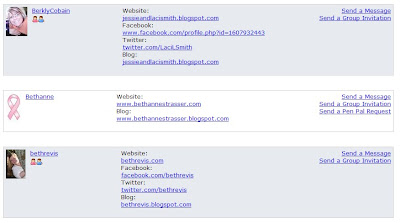
We all know that online networking is essential for writers to succeed in this modern age. So what do writers do? We haunt Facebook, Twitter, and blogs. I found myself wishing for a central listing site of WRITERS, a simple way to connect with all their sites from one single page. I wanted something that looked like this:


And then I went to the guy who could make my wish come true.


Patrick McDonald owns QueryTracker.net which, as you know, is full of writers. And so I asked: "Hey Pat, want to make my networking dreams come true?" And bless him, he consented! (The photo above shows the results!)


Now here's what you need to do join the fun:

  1. Make sure you have a membership on QueryTracker.net. It's free and easy.

  2. Update your profile (under the My Stuff tab, click Edit Profile, then click Contact Info) to include links to your Facebook*, Twitter, blog and website. (Make sure you choose to make the links visible to everyone!)

  3. Next, while still in your profile, select Genres I Write and Genres I Read, as this will help you connect with writers/readers with similar tastes. (Hint: The more genres you choose, the more people you will connect with!)


Now for the networking:
  1. Hover over the Members tab.

  2. Click on Search by Similar Likes and you are on your way!!!


Now, spread the word! More people knowing = more connections for you!

Of special note:

There is a way to keep track of who you have already connected with. When you view a QT member's links, click on Send A Penpal Request. It will change to indicate that you have connected with them.

For tips on speed networking check out Elana's post on speed blogging.

*Having a hard time learning your Facebook address? It's simple to find. While signed into Facebook, click on the PROFILE tab. Use the address that appears in your browser's window.

This is a brand new feature, so let me know if you have any questions or problems, or can think of a way to improve it. (Let's make all our networking dreams come true!) So leave a comment in this post or drop me a line: suzettesaxton@querytracker.net.


Happy networking!


Suzette Saxton writes books for tots, teens, and in-betweens. She is represented by Suzie Townsend of FinePrint Literary.

Wednesday, October 7, 2009

The Journey to Publication: Beware the Public Personal Diary


The secret diary: Most of us, especially women, had them as teens. We expressed our hopes, fears, problems and crushes in writing for various reasons. We railed against the mean girl who was our arch enemy. In some ways it was therapeutic. Sometimes the therapy came in the form power from the knowledge that we had a special secret journal of our personal life that we could choose to share if we wished or hide from the *gasp* authority figures in our lives.

Some keep diaries even as adults.

Now, I've never been a diary keeper. In fact, it never made sense to me at all. I tried as a teen because my best friend was the diary queen. She would hide her diary carefully from her family or "accidentally" leave it open to a page to indirectly pass on information. She could control how, when, and to what degree the information was disseminated because she had physical control of the diary itself.

Enter the electronic age and the blog.

As writers, we know we need to have a web presence. We are told that by other writers, agents and editors. But there is a difference in a web presence and a beneficial web presence. "Make yourself Googlable," agents tell us. Okay. Done. I start a blog. It's free, it's easy, and heck, it's even fun sometimes.

Many writers use their blogs to journal their road to publication. Any of us who are walking on the sharp rocks of that road in our bare feet know it is a hell of a tough journey. There are bloody footprints to prove it.

Here is the point of my post: Do not use your writer's blog as a private diary.

I pop onto aspiring writers' blogs all the time and large percentage of them are devoted to whining, complaining and lamenting the unfairness of the business.

Okay, Mary. It's my personal blog. I can write whatever I wish in any tone I wish.

Darn right. But writers need to be aware of the potential pitfalls.

Why do we blog? I think that is the first question to be asked. Specifically, What is the purpose of this particular blog? Who is the audience right now? Who will be reading it in the future?

My diary-loving friend would tell me how when she was famous, she was going to publish her diaries for lots of money. Again, she was physically controlling the information in that diary hidden in the bottom of her closet under her box of summer camp photographs.

In blogging, we lose control of the information the minute we hit "publish." There is a reason the button says that. "Publish" means to make known generally, and boy, do we. So many times on twitter I've seen people say something like, "How to alienate the children's publishing industry," or "How to never get published," followed by a link to the post of a poor writer who has lost control on her/his blog and gone off on a career-impacting rant.

Yes, we can set the permissions on our blog to a very narrow audience, rendering it private, but if we, as writers, are using the blog to increase our web presence or establish platform, that is not practical.

Keep the nastiness private. I have a crit partners who have endured endless rants about the difficulty of this business along with my insecurities all laid out for examination. I would never put these tirades up on my writer's blog. But to remain stable, most of us need to vent occasionally.

My advice is to never write anything on your writer's blog you do not want read by your agent, publisher, spouse, child or fan. If your career takes off, your unpleasant post could be more wide-read than you ever intended. Think long-range.

Do not give tallies of the number of queries sent/rejected/accepted. This never works as planned. If I'm an agent and you have queried me, I might google your name if I like the letter or pages. What if I go to your site and see you have received zillions of rejections and very few requests? Naturally, it's up for interpretation, but it might backfire.

What if you have ranted about how unfair and crappy a certain agent was with her form rejection? I work for a different agency, but we share office space (this is common) and talk every day. I like her. So much for the full request I was going to send you.

There is nothing wrong with opening your diary about the hardships of publication as long as you keep in mind the person you least want to read it probably will. Don't rant and don't give out your rejection count. I know of several cases where agents have told writers they requested material based on their sites or online presence (I'm one). I also am aware of a couple of cases in which an agent said that she found the presentation of the writer's blog offensive and unprofessional and were not going to pursue representation for that reason.

Now, I don't mean you have to be serious and stuffy and only blog about writing. Your website can handle that part. Quite the contrary. A blog is where you let your personality show. I'm not much of a blogger by anyone's standards. I blog mostly about writing and my road to publication, but on the rare occasion when I post, I try to make it fun for myself. The posts where I am "me" are the ones that get the most hits. I've blogged about singing out loud in a Waffle House and getting caught at the country club in my pajamas. It lets my online friends get to know me as a woman and not just as a writer. It doesn't mean I don't get discouraged and have posts that reflect that, I just refrain from ranting, venting or giving out information that will come back to bite me someday (My ever-tolerant crit group receives the full force of all of that).

One last parting bit of advice from someone who needs advice herself: Refrain from mentioning anyone by name in a negative light. Most folks are aware of this, but I'm a total technotard and found this out a year into my writing career *blush*: There is a thing called "Google Alert." If a person has it on their name (as I do now), she will receive an alert every time her name is published online. I get dozens of alerts a day, most of them not about me, but some are. Agents/writers/editors use these. Your private diary can now broadcast with pinpoint accuracy to the people you are talking about.

Be yourself on your blog, but remain professional. Use care. Be aware of the image you want to project and keep in mind that every person with a computer holds the key to your private diary.

Have a fantastic week.

Mary


Monday, July 20, 2009

Social Networking: Showmanship

In previous posts, I discussed Blog Readers and Social Networking Basics. For this post, I want to share one of my own personal tips for those of you hoping to cultivate an online relationship with publishing professionals.

In the current social networking climate, many agents and editors are more available to aspiring authors than ever. You can interact with these publishing peeps through their blogs or websites, on Facebook and Twitter, through online chats with live Q & A.

That means you have an unbelievable opportunity to make connections and create a positive foundation for a professional relationship. But it also means you need to be careful that your online actions are working FOR you rather than against you.

Let's consider an agent blog scenario as an example. Commenting on an agent blog gives you a chance to get yourself onto her radar. Many agents say that they peek at the blogs of folks who follow or comment. So you'll want to make sure your blog, website, or whatever is entertaining and professional.

Certainly that's a good start, but I'd like to take things a step further and recommend a little showmanship.

If you read through the comments on most agent blogs, you'll find they generally fall into five categories:

1. Simple comments, such as "Great info! Thanks!" or "Thanks for posting this." These sorts of comments will certainly not harm you, but they won't go too far towards making you stick out as someone the agent wants to know more about.

2. Kiss-up comments. The long, ingratiating (and often self-deprecating) paragraphs extolling the virtues of not only the post, but also the agent, the agent's friends and relations, the remarkable job her kindergarten teacher must have done, etc. These comments are dangerous, in my opinion. Flattery doesn't really get you everywhere and can seriously backfire, either by annoying the agent in question or by making your "I'm not worthy!" point so clearly that the agent agrees with you.

3. Practically Spam comments.
You know the ones... not really intended to contribute to the conversation, but to post a link to drive traffic to the commentator's blog or website. This sort of comment seems like shameless self-promotion and is likely to work against you, unless the link you're including is meaningfully related to the agent's post, and you explain how in your comment (e.g. Interesting take on social networking. I think Twitter has some drawbacks, though, as I was discussing on my blog last week.")

4. Frustrated writer rant comments.
Getting published isn't easy, and writers as a whole are extraordinarily sensitive souls who are very personally attached to their work. It can be an incredibly frustrating process, and you may feel the need to vent. Never, ever, no... NEVER EVER do that in public, especially not on an industry professional's blog or website. 'nuff said.

5. Thoughtful, entertaining comments
that add to the discussion. Ah! The sweet spot.
Number 5 is where you want to be. Which brings us to "Showmanship."

I personally am very active online. I comment on agent and editor blogs, I tweet with them. But I don't do it constantly. I employ a technique I call the "George Costanza."

If you're a Seinfeld fan, you're probably familiar with the episode where Jerry tells George about showmanship.

George had made a great suggestion at a work meeting, but then followed it up with a bad joke and ended up feeling foolish.

GEORGE: I had 'em, Jerry. They loved me.

JERRY: And then?

GEORGE: I lost them. I can usually come up with one good comment during a meeting but by the end it's buried under a pile of gaffs and bad puns.

JERRY: Showmanship, George. When you hit that high note, you say goodnight and walk off.

So, here are my personal recommendations:

1. Take your time.

2. Comment sparingly, only when you have something important/thoughtful/entertaining to say.

3. Proofread your comment or tweet before posting it.


Hit that high note, and leave them wanting more. ;)


H. L. Dyer, M.D. writes women's fiction and works as the Clinical and Academic Director for the Hospitalist Program at a pediatric teaching hospital near Chicago. In addition to all things literary, she enjoys experimental cooking and composing impromptu parodies to annoy close friends and family. Click to visit her personal blog, Trying to Do the Write Thing.

Tuesday, May 12, 2009

Query a Tune Winner!

Okay, QT's- I have reviewed the wonderful entries to the Query a Tune Contest. I have forced friends and family members to obsess over them as well.

It was VERY difficult to choose a winner. In case you have not yet read all the entries, I submit the following facts in evidence:

The honorable mentions:

JPM didn't query a specific project, but gave us a lovely parody about the query process in general


To the tune of “Copa Cabana” by Barry Manilow:

Her name was Lola, she was an agent
With yellow cushions on her chair and many manuscripts over there
She would make sales and writers moola
And while she was looking for a star, she got my query from afar
Across five states or more, she wanted chapters 1 through 4
His writing was so fun, but could she take on yet another?
And yet she asked for more!

It was the query, query I sent her
A great idea put in the letter
It was the query, query I sent her
Format and action had caused a strong reaction
To my query….she fell in love


Kat Harris shared her amazing video of a song she wrote and performed...


Windsong's entry intrigued me, as I wasn't sure whether it was a frog who made the promise, or that the prospects of obtaining a frog were promising.

There was no moon
No roses
No wine
No shooting star
To show you were mine

Chorus:

Just an emerald necklace
And the promise of a frog
Just an emerald necklace
Emerald necklace and a song

When I looked at you
White feathers
A beak
Surely a jest
For birds cannot speak

I had no promise
Of your heart
Just the
Word of a frog

Chorus

Now I see you
Bird outside
Girl in
In the game of my life
I'm going to win

Chorus (repeat twice)


I loved the images and language in this one from Nisa

The following is to the tune of "The Riddle" from the musical The Scarlet Pimpernel and depicts my novel "Power's Touch". -

See the dreams pass before her eyes
See the youth stripped clean with the lies
Angels speak no words
In a land so cursed

Just trace a portrait of darkness
You'll have an image of yourself
Betray the night
Gain a sense of right

Oh we all can taste bitter-sweet scars
Like moonlight spilling 'cross falling stars
I need more
One thing that is sure

The power, glitter, they lead us
In a dance trapping away trust
We cast our lot
And with luck it will pay off

And I am sorely disappointed that the video associated with this entry from Janet Lane never made it online. It sounds like AWESOME performance.

It's to the tune of "Chapel of Love" recorded by the Dixie Cups in 1964.
I had three women singing, a la the Dixie Cups, with two men as back-up for the "whoa, whoa, whoa's."

GYPSY TO THE CHAPEL ... to "Chapel of Love" by Dixie Cups, 1964. New lyrics by Janet Lane

CHORUS
Goin' to the chapel
And we're gonna get married
Goin' to the chapel
And we're gonna get married
Chose to be a Gypsy
And we're gonna get married
Goin' to the Chapel of Love

Fall is here
(Whoa, whoa, whoa)
Time for bliss
(Whoa, whoa, whoa)
Break the tile
(Whoa, whoa, whoa)
And then we'll kiss
But Big John says, "Something's amiss!"
And my Gypsy King is headed to jail! So now we're ...

CHORUS:
Goin' to the gallows
And we'll never get married
Goin' to the gallows
And we'll never get married
Lookin' for the chalice
And that naughty monk's secrets
Lookin' for the chalice, and LOVE!

Two days left
(Whoa, whoa, whoa)
A big surprise
(Whoa, whoa, whoa)
My Gypsy King
(Whoa, whoa, whoa)
Told me lies!
That surly knight is always right
And the chalice is finally in our hands!

CHORUS
And now I found a true lover
But we'll never get married
Found a true lover
But we'll never get married
I'm half Gypsy
Will I ever get married?
Lookin' for the Chapel of Love.
(Yeah, yeah yeah yeah)
Lookin' for the Chapel of Love
(Yeah, ONE MORE TIME!)

(Slow, with full harmony): Lookin' for the Chapel of ... Loooooove!
(Baritone): Whoa, YEAH!


But for sheer entertainment value (plus extra marks for bravery and enthusiasm), the winning entry:


Angels, Demons, and Beauty Queens*
* With Michael Jackson clawed hands swaying back and forth to the tune of “Thriller.”
(Lots of wolf howls)
It’s close to mid-night and Linny’s on a very scary plane
Out of her body, she sees a sight that makes her want to faint
She wants to run, but Elvis imp-er-sonators take the plane
She starts to scream, but Lycra stares her right between the eyes
She’s mortified!

Cause it’s a thriller, a real bone chiller
Agents jump to read it, oww
And publishers scream for it, yoww
It’s a diller, a real thriller yarn
But my query really sucks
I’ll have to rip it up
Toooonight!!!!
(Jackson howl)

Back on the airplane, Mary melts the bomb with laser beams
Annette raises a dead man and wonders if her powers are a dream
They want to run, but the FBI believes they’re double agents,
They strategize, but an evil demon stalks them from the skies
They’re terrified!

Cause it’s a thriller, a real bone chiller
Agents please, please read it!
And publishers scream for it(in a good way)
Cause it’s a thriller, a real genuine chiller
I want to win that book cause’
I need another, another, another hook!!
Tooonightttt!!!!
(Jackson howl)

by Taryn L. Hook


So, congratulations, Taryn! You've won a copy of Agent Demystified by Authoress of Miss Snark's First Victim.


So watch your email for instructions!

And seriously, all the entries were beyond awesome. I was blown away by your amazing creativity and willingness to take risks. I loved them all. BIG thanks to everyone who "pitched" in.

You guys rock. Literally.

H. L. Dyer, M.D. writes women's fiction and works as the Clinical and Academic Director for the Hospitalist Program at a pediatric teaching hospital near Chicago. In addition to all things literary, she enjoys experimental cooking and composing impromptu parodies to annoy close friends and family. Click to visit her personal blog, Trying to Do the Write Thing.