QueryTracker Blog

Helping Authors Find Literary Agents
Showing posts with label publishing journey. Show all posts

Tuesday, March 28, 2017

What is Success in Publishing?

Sometimes it's easy to define a win. A promotion, a perfect score, winning the spelling bee. All of these things can be measured and quantified. And in many careers, certain benchmarks tell you if your trajectory is up, down or lateral.

But not so in publishing. As I thought of a topic for the blog, I perused the forums and thought about my critique group meeting last week. It struck me that we ask each other for input and endlessly fret about rewrites and editing and because we are all seeking success in our writing careers. But success in a publishing career is really in the eye of the beholder. In one of my favorite movies, Caddyshack, another golfer asks Chevy Chase's character how he measures himself, since he doesn't bother to keep score. Chase responds, "By height."

There is a lesson in the quip. If you keep score based on number of books written, or number of national awards received, or sales, you will almost always feel you've failed. It can make you crazy to compare yourself to another writer. The odds are stacked against any of us being as prolific and lauded as Joyce Carol Oates or selling as many books as Stephen King.  Most of us will never quit our day jobs. Many of us will not be agented. Even those who are agented may not get a publishing contract. If we do, maybe it is with a small press and not a large one. Meanwhile, a semi-illiterate reality star gets a ghostwriter and a book deal and goes on a national book signing tour. Success? Well sure, depending on how you measure it.

Defining a win, I think, requires us to stop looking outward. There is always a golfer with a better score. There will always be a writer who has something we don't. So define for yourself what your "win" is going to be. Start with writing a great story. Then add the other ingredients to your own taste and your own score card.

I'm curious how you're measuring your careers. Is it completing a series, getting an agent, or getting your self published book out into the world? Or something else? Or do you write for the joy of it and not bother with the business side? Let's talk success.


Kim English - is the author of the Coriander Jones series and the award winning picture book 'A Home for Kayla.' Her latest picture book, 'Rolly and Mac' will be released in 2016. Her website is Kim-English.com. She is represented by Gina Panettieri.

Wednesday, October 1, 2014

Sitting on the Fence


It’s that time of year when I look over my balcony railing and compare my lawn, with its patchy areas of green and brown (thank you big snow storm two weeks ago) to my neighbor’s rich green grass. Yes, in this case, the grass is always greener…

But what about in publishing? When you’re querying, you long for the moment when you get The Call. You long to be on the other side of the fence. You’re positive it’s better than where you’re standing. And maybe it is.

And maybe it isn’t.

Regardless of which side of the fence you’re on, here is a list of things you can expect or should try to accomplish:

Rejections (you get them no matter which side of the fence you stand on…even if you’re a bestselling author)

Feedback/reviews that make you want to OD on chocolate and wine

Feedback/reviews that you want to plaster all over your office—for inspiration

Fans (even if they’re just your beta readers)

Waiting. Waiting. Waiting.

More waiting.

Workshops…because you should always keep learning

Try something new

Challenge yourself to do better with each project

Read books within your genre

Read books outside of your genre

Waiting. Waiting. Waiting.

Connect with new friends on various social media sites

Find a support system among writers/authors who are at a similar place to you

Compare notes to others who are in the same place as you (whether that be writing your first manuscript, querying, on submission with editors, getting ready to launch your debut book, getting ready to launch your tenth book)

Do your best not to compare your journey to someone else

Fail at not comparing your journey to someone else

Read a book and decide you should quit writing because you will never be that good

Read a book and aspire to write like that

Learn more about the realities of publishing

Remind yourself of the realities of publishing every day

Complain to your friends…just don’t complain where the whole world (i.e. agents, editors, readers) can read your complaints, especially if you’re complaining about someone specific

And finally…

No matter where you are on the journey, take time to enjoy it.


Stina Lindenblatt @StinaLL writes New Adult novels. In her spare time, she’s a photographer and can be found at her blog/website.  She is represented by Marisa Corvisiero, and finds it weird talking about herself in third person. Her debut New Adult contemporary romance TELL ME WHEN and LET ME KNOW (Carina Press, HQN) are now available.


Monday, May 6, 2013

Do I Need a Literary Agent?

I’ve gotten several questions via email recently asking me about how to go about finding good literary agents, so I’m working on a series of posts about figuring out if you need an agent, whether you’re ready to start querying, finding a reputable agent, and choosing someone who really “gets” your work. Of course, QueryTracker.net will help you through all of the stages I’m going to discuss, and fellow QT blogger Jane Lebak recently wrote a great post on How to Use the QueryTracker Site.

Base image: DragonTash
Do I Need a Literary Agent?

Though the role of literary agents is changing, there are at least a couple of reasons you may want one. First, they are well-connected in publishing, which means they may be able to open doors you can’t open yourself. Second, they are experts on the publishing business, including negotiating contracts.

Literary agents have traditionally been the gatekeepers between the writer and publishers. There are an awful lot of people who would like to get published, which can leave publishing houses inundated.  For this reason, the biggest publishers closed their doors to unsolicited materials. Literary agents provide a screening process, weeding out all but the very best of the material that is submitted to them.

Statistics vary, but most agents say they reject between 95% and 99% of what crosses their desks. (If you’re interested in a particular agent’s statistics, QueryTracker provides detailed information on how often each agent in the database responds positively—with a request for more material, for example—vs. negatively, as is the case with a rejection.)

Agents develop relationships with publisher editors who are interested in the types of material that agent represents. So when Agent X approaches Publisher Y to say that the editor should take a look at Writer A’s manuscript, the editor is open to learning more.

As publishing experts, agents know the market well. They know what is selling, to whom, and why. They may know about markets you’ve never heard of, and they know how much editors are paying for particular types of manuscripts. They can also negotiate contracts (which include when, how, and how much the writer will be paid) and can act as a go-between with the writer and the publisher, especially if something goes wrong or the writer needs some help. [Edit: A reader notes that agents can also help negotiate foreign rights and film rights.] Usually they can negotiate better contract terms for you, both by knowing what they want removed from publishing contracts and by knowing what should be added or changed. You pay for this service by giving your agent a percentage of everything you earn (usually 15% - 20%), but particularly if the agent negotiates better terms than you could negotiate yourself, their work may proverbially pay for itself. It is in a reputable agent’s interest for you to make as much money as possible, because that's the only way they get paid!

Some agents represent a book or a series of books only; other agents represent the author. Many writers prefer to work with the latter type, as these relationships tend to be longer-term and often  include help with their writerly career—improving manuscripts, trying out new ideas, and so on.

So when would you not use an agent? If you are self-publishing, you probably won't use an agent. Also, some writers decide (even if they have worked with an agent or agents in the past) that they are happier or more comfortable going it alone.  They prefer to approach small publishers directly and are comfortable negotiating their own contracts (or hiring an attorney familiar with literary contracts just to review a proposed contract).

Because good agents are picky about who and what they represent, some authors get so focused on finding an agent that they forget that not all agents are equal. First, not all “literary agents” are legitimate or reputable. Second, all of us get along better with some people than others. It’s important to find someone who “gets” you and your work. I’ll be exploring these issues in upcoming posts.


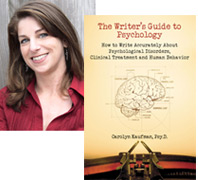
Carolyn Kaufman, PsyD's book, THE WRITER'S GUIDE TO PSYCHOLOGY: How to Write Accurately About Psychological Disorders, Clinical Treatment, and Human Behavior helps writers avoid common misconceptions and inaccuracies and "get the psych right" in their stories. You can learn more about The Writer's Guide to Psychology, check out Dr. K's blog on Psychology Today, or follow her on Facebook

Monday, June 11, 2012

Never, Never Give Up: Writing and Winston Churchill

Courtesy of mitchlaw
Taking a word, a thought, a picture and spinning them into a story is hard.


Refining that story into something wonderful is even harder.


Being able to share it with other people, most of whom you will never meet or know, is harder still.


Continuing up the path, no matter what setbacks occur along the way, is perhaps the hardest of all.


It's times like these that I think back to Winston Churchill. The quotes I'm about to share have nothing and everything to do with writing--with getting up one time more than you've been knocked down.


“Courage is what it takes to stand up and speak; courage is also what it takes to sit down and listen.”


We write because we have something to say. That something can be meant to entertain, to enlighten, to bring laughter or tears, or a myriad of other things besides. Most often, if you peel back the words to expose the meaning, you find bits and pieces of the author's heart scattered across the pages.

A story can be a deeply personal thing, while at the same time, it is something that wants to be shared. Something that needs to be shared.

So stand up and say something.

Like a coin, there is another side to standing up and speaking, and that is to sit down and listen.

It isn't easy to have your work critiqued or to receive an editorial letter that's more red than anything else. It isn't easy to look at those shards of your heart embedded within the words and realize that they're only a rough approximation of what you really meant to say.

It takes courage, humility, and patience to be willing to learn--first how to see the flaws in our writing, and then how to fix them. Over and over and over again.

And that is what we must do if we wish to be great.


Then comes the time when we learn that all that hard work to get the story as perfect as we can on our own is only the first of many steps.

Each step is another chance to be rejected. To learn that your best isn't quite good enough. Yet.

It isn't failure if you keep striving. If you keep learning. If you never give up.

It doesn't matter how many rejections you get from agents, editors, or readers. If you have something to say and the will to keep learning and honing your craft, you will succeed. You may not be a breakout success in terms of how others look at it. It may take a lot longer than you thought it would. You may have to readjust your expectations from time to time, but you will make it.


This goes twofold. Don't give in to the doubts and worries that will beset you along the way. And don't give in when it gets hard to find your audience. There have been a lot of things posted recently on the Internet about less than scrupulous behavior some authors (both trade and self-published) and other industry professionals have engaged in.

Don't do it.

No matter how much you want your book to succeed and be liked, never sacrifice your integrity to get there. It's just not worth it.


In writing, be honest to the story. Understand the message of your story--both in your mind and how it actually comes across in paper. Be deliberate and mean what you say. This is why beta readers and editors are so crucial. The story is alive and playing inside our heads. We know what we mean, but our meaning doesn't always come across as clear as we think.

That's what revisions are for.

Before you're published, it's a good idea to sit down and figure out exactly how you're going to approach reviews. There will be people who will love your work. There will also be people who hate your work. How are you going to handle them?

In general, it's a good idea to leave the reviews to the readers and move on to your next book. There have been a few authors who successfully manage to engage the reviewer by commenting on their blog or their review, but doing this well can be a difficult balancing act. Whatever you do, be kind, be courteous, and be professional. If you need to vent, do it offline with trusted friends and family. We're only human, and some things we encounter along the way will hurt. It's okay to hurt, but it's never okay to do the hurting.

And lastly, one of my favorite quotes of all:


This writing gig is hard. It's filled with ups and downs that swoop in out of nowhere, leaving us reeling--both with delight and discouragement.

Choose to look forward instead of needling yourself over past mistakes and disappointments. Your writing will improve--if you are working at it--with each book you write. Some will be easier to write. Some will be better than others. And some will be more popular while others will be less so.

Keep looking forward. Keep going. So long as you have something to say, keep saying it. And eventually--eventually--you will get there. Querying doesn't last forever. The sting of obscurity or unfavorable reviews doesn't last for always. The edits for each book eventually ends. Writer's block can be overcome.

And the story you have inside of you will one day be told.

But only if you never, never, give up.


Danyelle Leafty| @danyelleleafty writes YA and MG fantasy. She is the author of The Fairy Godmother Dilemma series (CatspellFirespellApplespell, and Frogspell), and can be found on her blog. She can also be found on Wattpad.


Wednesday, May 18, 2011

Interview: From Slush Pile to Publication


Karen Sandler is our latest Querytracker.net success story with a book coming out (September, 2011). We hope you enjoy her interview. If you have any questions, I'm sure she would love to answer them.
**** 
Can you tell us about your journey from The Call to now?
Looking at my records, my first query for TANKBORN went out October 13, 2009. Before the process was over, I’d sent out 28 total. In some cases, the agents’ submission requirements allowed me to send part of the manuscript. In a very few cases after sending only a query I got requests for the partial and even the full. Two agencies that requested the full eventually made me offers of representation within days of each other in late February 2010.

I’d always thought it would be very cool to have more than one agent “fighting” over me. But I loved them both and it was difficult and sort of heartbreaking to have to choose one. Eventually I decided on Matt Bialer at Sanford J. Greenburger Associates.

Based on Matt’s notes and those of his fabulous assistant/junior agent Lindsay Ribar, I did an extensive (but not the first) re-write, with much back and forth with Matt & Lindsay. When we were all satisfied, the book went out in early April 2010. We got an offer for Italian rights in early May (seemed very unusual to sell foreign rights before a U.S. sale. Then in late August, came the offer from Lee & Low Books. TANKBORN would be one of three launch books for Lee & Low’s new YA/MG imprint, Tu Books.

Once the contract with Lee & Low was in place, there were two more extensive re-writes based on notes from my editor, Stacy Whitman. Along the way, we discussed cover art and Stacy also commissioned an artist to draw a map of Svarga, the main continent on the planet Loka where the story takes place. The map (based on a very crude one that I drew) will be included in the book. Stacy also had an expert in Indian culture read the manuscript to be sure I didn’t commit any major faux pas.
The most recent milestone for TANKBORN is that the cover was just released and I’m waiting on copyedited galleys.
What was one of the most surprising things you learned in creating your book?
I had gotten very used to writing what are called “category” or “series” romance novels. In my particular line, six books are released every month. They’re quite short (55K-60K for the ones I wrote) and the turnaround time is short as well. So I could write a book in about four months (and I know authors who write them even more quickly). I was used to writing at least two a year, with time left over for other projects. There would be one round of very light editing for my book, then later a quick read-through for typos and that was it as far as editing was concerned.
For TANKBORN, a full-length (~97K words) science fiction book, there were four rounds of very extensive re-writes. Based on my past experience of being lightly edited, I thought this meant that there was something wrong with me as a writer. Lindsay assured me that what we were going through was par for the course. I’d just never had the luxury of an editor being so focused on my book and being able to give me such thorough notes.
Was there ever a time you felt like giving up? Why didn’t you?
There have been many times when I considered giving up. Back in the late ‘90s, early 2000s when I didn’t have a sale for three years. More recently when I submitted five (yes, five) proposals to my editor at Harlequin and he turned down every one. Luckily, I’d been working on TANKBORN during that time, so I had somewhere to turn when I got discouraged.
I didn’t give up because I’ve always wanted to be a writer (at least since I was 9 years old). I identify so strongly with being a writer, it’s hard to imagine not doing it. I will always find a way to write.
What is the hardest/least favorite part of being a writer?
There are two very difficult aspects to writing, and they’re related to one another. First, I despise the waiting—to hear back from an agent, to find a publisher willing to take a chance on your book, to have to wait for reader reactions because the book doesn’t come out for a year or six months. The other aspect is that so many other people seem to control at least part of your career. Often, without an agent, you can’t get your book to a publisher. Without a publisher, you can’t get your book published. Even if it’s published, you can’t make readers fork out their money to buy it and you certainly can’t make them like it.
Nowadays, the opportunities for self-publishing have the potential for removing the “obstacles” of agents and publishers. But there’s still the issue with finding readers (or readers finding you), which is even more difficult with that mode of publishing your book.
If you could give a message to aspiring authors everywhere, what would it be?
If you truly want to see your work published, keep working at it. Don’t allow yourself to mope for longer than a day when you get a rejection. Remember, you’re only getting rejections because you’re getting your work out there. If you’re persistent and talented, you will likely reach your goal of publication.
What is your advice to new or unpublished writers? 
Improve your craft. So many editors or agents say “write the book of your heart” or “write the best book you can.” But you can’t do either one if you don’t know the basics of spelling, grammar, character development and story construction. So take classes if they’re available (there are many online). Go to writer’s conferences where you’ll not only learn your craft, you’ll have a chance to meet bestselling authors, agents and editors. Join or form a critique group. You need outside eyes to read your work.
What kinds of things are you doing to promote your books? Did you do anything before you found an agent? If so, what?
Keeping my blog, website and Twitter feed up to date. Doing school visits, book signings, attending conferences. If television or radio interview opportunities come up, I’ll be glad to do them. I’ve been doing these kinds of things for years, both while represented and not.
Is there anything you wished you had done differently?
There are individual decisions I sometimes second-guess myself on, hindsight being 20-20 and all. I always wish I was more disciplined in my writing. But everything I’ve done, right or wrong, has been a learning experience.
What are you working on now?
I just submitted a proposal for a TANKBORN sequel. I’m also working on a re-write of a paranormal YA.
Karen Sandler can be found on her website, blog, and Twitter (@karensandlerYA)

Monday, February 28, 2011

MURDER YOUR DARLINGS: an interview


Last month, John Murphy, one of Querytracker.net’s success stories, saw the release of his first novel, MURDER YOUR DARLINGS. We’re thrilled to have him here to talk about his pathway to publication. Also, make sure you check out the side link for an upcoming agent contest. It starts this Thursday and is for adult fiction.
###
In August 2009, you landed John Talbot as your agent and he sold your mystery novel, Murder Your Darlings, to an imprint of Penguin. The book came out in January. Can you tell us about your journey from The Call to now?
It has been a perilous journey, fraught with danger in exotic locales!
Just kidding. It has been surprisingly simple—almost uneventful. The editing process with my darling editor was a piece of cake. I was asked for some ideas for the book cover, and I was thrilled with the cover that Penguin came up with. Frankly, the hardest part was the copy-editing stage, where I was called to “defend” a number of historical references. (Fortunately, I had done my homework and that went down fairly easily as well.) As a matter of fact, the greatest challenge presented itself when the book was released—how can I let people know about it? I’m still working on that one.

What was one of the most surprising things you learned in creating your book?
Two surprising things: We hear a lot these days that editors don’t have time to edit and publicists only have time for the most successful authors. That was not my experience with MURDER YOUR DARLINGS. Both my editor and publicist have been surprisingly generous with their time and very open minded about my suggestions.

Was there ever a time you felt like giving up? Why didn’t you?
Yes, every day I felt like giving up. And I still do. As everyone who reads this knows, getting published is foolhardy. It’s brutal on the psyche. But, aside from the day to day doubts, my “darkest hour” was right before my agent John Talbot called. I had thought I had a slam dunk of a book, but after sending out nearly 60 query letters and getting no action, I figured I must be wrong. Fortunately, right when I was truly about to throw in the towel, I got the call. Sometimes it’s just a matter of sending out letter after letter after letter, and hoping it clicks with someone who understands.

What is the hardest/least favorite part of being a writer?
The worst part is the carpal tunnel injuries from signing all those hefty paychecks. Will they never stop pouring in?
Huh? Wha? Oh, OK, I’m awake again. Fell asleep there for a minute… The hardest part of being a writer, for me, is finding the time to write. I have a busy full-time job, six-year-old twins, and a house in need of constant repair. I need to learn how to write in my sleep. That would be really helpful.

If you could give a message to aspiring authors everywhere, what would it be?
Two things: If you’re really serious about being a writer, then get serious about writing. Don’t wait for the muse to whisper in your ear. Treat it like a job. Punch in and do your work.
Second, forget about writing what you know. Instead, write what you want to read. What kind of story do you wish somebody would publish? Write that. There’s somebody else out there who’s waiting for the same story to be on the bookshelf.

What is your advice to new or unpublished writers? 
Take it seriously (even if you’re writing something frivolous) and, if you’re serious, keep at it. Oh, and be hard on yourself when you wear your editing hat. Also, don’t take others’ advice without a grain of salt.

What kinds of things are you doing to promote your books? Did you do anything before you found an agent? If so, what?
I’m learning that word of mouth is the best form of promotion. And writing a good book is the best thing you can do to create word of mouth. That said, I’ve written several guest posts on other people’s blogs, and that’s been very positive and rewarding.

Is there anything you wished you had done differently?
I wish I had used a pseudonym, such as “James Patterson.”

What are you working on now?
The second book in the Algonquin Round Table Mystery Series. In this one, a second-rate painter commits suicide, and Dorothy Parker enlists the aid of Harry Houdini to find out why. Shenanigans and séances ensue. Should be lots of fun.

Now for the big question, how do you find to write with two young, twin girls and a full-time job?
With great difficulty.

More can be found about John and MURDER YOUR DARLINGS on his website.

Once again, congratulations, John!

Monday, July 5, 2010

Who Do You Write For?

As a pre-published author, you can write for yourself. Well, that’s not really true, because I’m sure you’re considering your target audience, but you choose your topic, your genre, whatever you want.

Literary agent Michael Bourret blogged about the pre-published author a few weeks ago. I read his post and found myself agreeing more and more, until at the end I was nodding and thinking, “He nailed it.”

Just a small snippet: “The time before you’re published is the most important part of an author’s career.”

If you haven’t read the article, you should. He goes on to say that sometimes after an author has published a book, they’re not creatively free. And at the end, he advises to enjoy this pre-published part of the journey too.

So that’s my advice today also. If you’re not under a deadline, writing a book your publisher wants you to write, if you’re sitting down and struggling through your MS, if you get to make every single choice, then enjoy that.

Enjoy the creative freedom you have. Enjoy the process. Enjoy today. And remember that your journey is your own, and it’s impossible to compare it to anyone else’s.

What do you think? Are you enjoying your creative freedom at this stage of the game? If not, how can you start doing that? And if you’re a published author, do you agree with Mr. Bourret?

Oh, and don’t forget that our contest with literary agent Suzie Townsend opens tomorrow! It’ll be open for 24 hours, and the entries are limitless! Click here for all the details.

Photobucket