


Recently a rude writer blew up Twitter by posting a nasty takedown of a wicked, wicked agent who somehow failed to perceive his brilliance. Her crime: he paid to pitch to her at a conference and yet she wasn't interested in his manuscript.
He retaliated via a blog post in which he called her frumpy and "pear-shaped" and all sorts of insults of equal sagacity.
Don't do this. Ever. EVER.
Why? Because there are far, far better ways of getting revenge on an agent who failed to perceive your brilliance. I mean, seriously, guys, you're writers. How can a writer be this bad at exacting revenge? Use your imagination. Come up with a revenge that sparkles with brilliance. I've compiled a few suggestions.
Are you ready? Take notes.
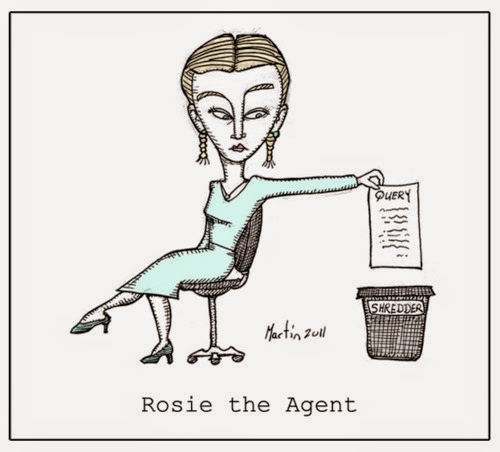
1) Send a "revenge query." A revenge query is a query you send within an hour of getting any rejection that leaves you feeling bitter. You send the query to an entirely different agent at an entirely different agency. You in no way mention the rejection that caused your sending of the query. (In fact, you should never mention that you've been rejected by anyone at all; let every agent think you're querying him or her first. Why begin your potential business relationship with the taint of previous failures?)
In effect, you're querying on the rebound. This achieves a few important goals. First, by spending a bit of quality time on the main QueryTracker site, you will find there are plenty of fish in the sea, and you may even find an agent who's better than the agent who rejected you. (Wait, did I say may? No, you will. As my husband muttered the first time he heard Adele's Someone Like You, "No, I want to find someone better than you." But I digress.)
Secondly, you'll cool down a bit while you're spending time researching this much-better agent, and you'll cool down even more when you're assembling your query to match this better agent's submission guidelines. Use your angry energy to attach the one-page synopsis rather than the five-page synopsis.
Third, you'll be spreading your hopes out a bit among the agenting pool rather than focusing your intensity on just one. Once you know your query is working, you should always have about ten "live' queries floating about out there, or maybe as high as fifteen. (That's in addition to any submissions you have "live" with agents.)
2) Work on your next piece, something so brilliant that no one can possibly reject it. They think you're not marketable? Well, you can show them. You can go read other books in your genre and analyze them for their marketing appeal. You can work on improving your characterization or your story structure. You can work on building your platform too. You can network with other writers and maybe find an awesome set of critique partners.
As they say, "Living well is the best revenge." I strongly suggest writing well is just as good a revenge. Think about the day that agent sees your work again on the NYT bestseller list and recognizes you as the querier he or she spurned. Imagine yourself saying, "Yeah, actually, because you rejected me, I worked on those issues I had with dialogue, and now I'm a better writer. I guess I should thank you."
What this type of revenge accomplishes is that it forms you up as a better person. You know you have literary potential, and it burns to think the agent missed it. Well, develop that potential. After all, it's much easier to snag an agent with achievement than with potential.
3) Never contact that agent again. You want revenge? This is an awesome revenge. Go ahead and write a work of scathing brilliance, something that scintillates with imagination and the lushness of the human experience. And then, when you have that glittering masterpiece in your hands, don't share it with that agent. Query other agents instead.
The whole point of a snub is silence, so don't tell the rejecting agent that you've in turn rejected him or her. Let that agent figure it out for himself when other agents are having drinks and sharing knowing looks because they all have their hands on a splendid novel while he doesn't.
--
These are the tactics a professional uses to get revenge after rejection. Rather than directing that anger outward at the agent, it's far better to direct you energy inward toward your career. Because remember, the instant you decided to query, that's the instant you became a professional with the need to behave in a professional manner.
Professionals do not write venomous blog posts about agents who declined the opportunity to represent them. Professionals do not attack an agent's appearance as though that pertains in any way to her intelligence or work ethic. Professionals do not burn their bridges by thinking everyone with a computer wants to see them having a tantrum. A high-vocabulary tantrum is still a tantrum, and readers will associate your name with someone who acts like a two-year-old.
And agents. And editors. And you yourself, eventually, when you realize how you acted and feel ashamed of yourself.
Your goal is to become a better writer and bring your stories to as many as you can. That takes discipline. That takes focus.
And yeah, sometimes it takes getting rejected and dusting yourself off, figuring out what went wrong, and making corrections.
Your professional growth never, never, never, never, never, under any circumstances, involves telling off the other professional who rejected you.
Write well. Sell well. That's the best revenge.
Showing posts with label rejection. Show all posts
Showing posts with label rejection. Show all posts
Tuesday, August 9, 2016


Tuesday, December 15, 2015
When should I give up?
Over on the QueryTracker forums, someone has asked us when is it time to give up. What happens if you've got a manuscript you love and the agents just don't love it the same way you do? How many queries do you send and get rejected (or get nothing but silence) before you stand down? How many times can you hear an agent say, "I love this, but I just don't know any editors who would take it"?
I'm kind of an expert on that, so I wanted to weigh in.
Giving up sounds really fatalistic. We're in the business of communicating, so let's change that wording. Giving up implies there was winning and losing instead of the whole spectrum of successes and fallings-short that encompass the drive toward publication. I'd say it's more like "standing down" than giving up. If it happens, it happens, but you're no longer tense and expectant, no longer swimming against the current.
Being sick of the querying process is a sign that you need to stand down for a while in order to protect your emotional and mental health. Publication is grueling and it's a long haul. If you were training for a marathon, you wouldn't run on a sprained ankle; you'd rest and give yourself time to recover before lacing up the sneakers again. This is the same thing. As soon as you start hating the process, or before if you can catch yourself, cut yourself off. Stand down. Lower your weapon. Let any queries still out there come back, but don't send any more.
Why? Because you'll make yourself bitter. Think about a guy who's asked four people to the prom and been rejected each time. He starts going lower down his list of prioirities because all he wants is "a date," not a particular person's company, and probably starts showing it in the way he asks. Then when he's turned down (because he's asking indiscriminately, or because he's asking with an eye toward the coming rejection) he becomes bitter and says dating sucks. Don't let yourself get to that point. You don't need a date to the prom, and you don't need an agent.
When you're getting regular feedback along the lines of, "I love this, but I can't sell it," that might be time to consider that you're not writing blockbusters, and publishers are looking for blockbusters. They need money, and their first two questions are whether the book will pull them out of a debt hole and whether the book is safe enough not to lose money. The agent is looking at your book to evaluate whether it's similar enough to something popular that it won't lose money and different enough to stand out, that way the publishers she approaches will feel comfortable looking at the book.
In other words, your book could be amazing, but editors "aren't sure they can break it out in a big way." (Ask me how many times I heard that rejection.) And maybe, "I love it, but it's kind of different." (Ditto.) And here's my favorite: "This would be a great second novel, but not a debut."
That's my favorite for two reasons. My sarcastic side says that's the editor or agent sticking a bookmark in you. They don't care to nurture your talent or give you a chance, but on the other hand, they don't want you to go to someone else. So they tell you to just, you know, spend another couple hundred hours writing something else in the hopes that maybe they'll take both books.
The other side of me says, "Second novels are how careers are made." You'll only have one debut, but having a string of solid follow-up novels is how you develop a following and end up with checks to deposit every year for the rest of your life.
So when should you stand down on querying your manuscript?
1) The minute you start to feel bitter, give your querying a vacation.
2) If you're hearing a lot of the same feedback, examine your novel and decide whether it's accurate.
3) If you keep being told this is a great second novel, rejoice, for you have it in you to turn out many solid novels that will keep your fans happy.
And your alternatives once you stand down?
1) Give it a rest and try again when you have your energy back. (Speaking for myself, though, I have gone to a permanent stand-down.)
2) Look into small publishers that aren't as intent on earning a billion dollars right out of the gate. They may well love your solid novel that "isn't a debut."
3) Read up on indie publishing, where you can nurture your back list so that when you do write a blockbuster that would make a billion dollars, you have the option of querying again, and the blockbuster will feed sales of the prior books.
Never give up on writing itself. Your stories are still there. Give them daylight, and let them breathe.
If you push when you're feeling bitter, the bitterness may transfer to your writing itself, and that will choke your stories. Please don't let that happen.
And finally, never give up on yourself. YOU are not the problem here. YOU are not "not good enough." You just didn't create a product they thought would sell. That's not a statement of your worth.
Keep writing. Put down the queries and take a break -- stand down if you must -- but always keep writing.
I'm kind of an expert on that, so I wanted to weigh in.
Giving up sounds really fatalistic. We're in the business of communicating, so let's change that wording. Giving up implies there was winning and losing instead of the whole spectrum of successes and fallings-short that encompass the drive toward publication. I'd say it's more like "standing down" than giving up. If it happens, it happens, but you're no longer tense and expectant, no longer swimming against the current.
Being sick of the querying process is a sign that you need to stand down for a while in order to protect your emotional and mental health. Publication is grueling and it's a long haul. If you were training for a marathon, you wouldn't run on a sprained ankle; you'd rest and give yourself time to recover before lacing up the sneakers again. This is the same thing. As soon as you start hating the process, or before if you can catch yourself, cut yourself off. Stand down. Lower your weapon. Let any queries still out there come back, but don't send any more.
Why? Because you'll make yourself bitter. Think about a guy who's asked four people to the prom and been rejected each time. He starts going lower down his list of prioirities because all he wants is "a date," not a particular person's company, and probably starts showing it in the way he asks. Then when he's turned down (because he's asking indiscriminately, or because he's asking with an eye toward the coming rejection) he becomes bitter and says dating sucks. Don't let yourself get to that point. You don't need a date to the prom, and you don't need an agent.
When you're getting regular feedback along the lines of, "I love this, but I can't sell it," that might be time to consider that you're not writing blockbusters, and publishers are looking for blockbusters. They need money, and their first two questions are whether the book will pull them out of a debt hole and whether the book is safe enough not to lose money. The agent is looking at your book to evaluate whether it's similar enough to something popular that it won't lose money and different enough to stand out, that way the publishers she approaches will feel comfortable looking at the book.
In other words, your book could be amazing, but editors "aren't sure they can break it out in a big way." (Ask me how many times I heard that rejection.) And maybe, "I love it, but it's kind of different." (Ditto.) And here's my favorite: "This would be a great second novel, but not a debut."
That's my favorite for two reasons. My sarcastic side says that's the editor or agent sticking a bookmark in you. They don't care to nurture your talent or give you a chance, but on the other hand, they don't want you to go to someone else. So they tell you to just, you know, spend another couple hundred hours writing something else in the hopes that maybe they'll take both books.
The other side of me says, "Second novels are how careers are made." You'll only have one debut, but having a string of solid follow-up novels is how you develop a following and end up with checks to deposit every year for the rest of your life.
So when should you stand down on querying your manuscript?
1) The minute you start to feel bitter, give your querying a vacation.
2) If you're hearing a lot of the same feedback, examine your novel and decide whether it's accurate.
3) If you keep being told this is a great second novel, rejoice, for you have it in you to turn out many solid novels that will keep your fans happy.
And your alternatives once you stand down?
1) Give it a rest and try again when you have your energy back. (Speaking for myself, though, I have gone to a permanent stand-down.)
2) Look into small publishers that aren't as intent on earning a billion dollars right out of the gate. They may well love your solid novel that "isn't a debut."
3) Read up on indie publishing, where you can nurture your back list so that when you do write a blockbuster that would make a billion dollars, you have the option of querying again, and the blockbuster will feed sales of the prior books.
Never give up on writing itself. Your stories are still there. Give them daylight, and let them breathe.
If you push when you're feeling bitter, the bitterness may transfer to your writing itself, and that will choke your stories. Please don't let that happen.
And finally, never give up on yourself. YOU are not the problem here. YOU are not "not good enough." You just didn't create a product they thought would sell. That's not a statement of your worth.
Keep writing. Put down the queries and take a break -- stand down if you must -- but always keep writing.
Monday, March 30, 2015
The 5 Essential Steps to Getting a Literary Agent (Guest Post)
We've spent the month discussing different aspects of the querying process and writing query letters. It's really been a lot to take in! However, I want to leave you all with a message of hope, simplicity, and achievability--querying can a tough process, but it's not an impossible one.
Here is a guest post by Peter Hogenkamp, who wanted to share his thoughts on getting a literary agent. Only five simple steps--and it all starts with a query letter...

Now, by virtue of the fact that you are reading this blog on QueryTracker, I suspect you all have received similar e-mails and realize that this was no big deal. But it was a big deal to me at the time, and it is still something I remember fondly. I had sent this--my very first--query to Writers House (I am sure you all know what Writers House is) and gotten a request for a partial. Things fell apart from there, of course--the I regret to inform you e-mail followed shortly--but it was the first step of the 5 Essential Steps to Getting a Literary Agent.
Step 1) Getting Your First Rejection.
Why, you ask, is this the first step? Well, consider the number of talented writers I know who have never received a rejection. The obvious reason is that none of them have ever sent a query letter in the first place. And why haven't they? The list is long--too much work, such a small chance of success, and not wanting to be slapped in the face top the list--but the reason doesn't really matter. If you are going to be a successful, agented and traditionally published author, you have got to put yourself out there--again and again--and in so doing you will be rewarded with rejections, apathy, criticism, (Sounds great, huh?) and the occasional positive response. Cherish the positive responses. Enjoying the small successes is the best way to keep on going.

Step 2) Getting Your First Partial Request.
A request for a partial is not a guarantee you are going to be the next James Patterson or Daniel Silva, but it isn't a bad thing either: Someone (likely an intern or an agent's assistant) Somewhere (likely in NYC or San Francisco) thinks you can write. It is a validation of what you have known deep down all along. It is not a good thing: It is a great thing. But let's take a step back for a second, and do some math. Yes, yes, I know, they said there would be no math, but it is simple stuff and it makes my point. You sent out 10 queries and received 5 requests: What can you glean from this? You did a good job writing your query letter. On the other hand, if you sent out 20 queries and received just the 1 request, your query letter isn't any good. Revise it. (Here is the link to the QueryTracker Forum, where you can get great advice on how to improve your query.)

Step 3) Getting Your First Submission Request
After reviewing your partial, 10 agents have requested your full manuscript (this is what is called a submission request) but you get nothing but form rejections, lack of enthusiasm and, in many cases, nothing, in response. The fault here lies in your manuscript. I am not saying that your manuscript isn't any good, I am saying that it isn't good enough... yet. Getting an agent is a hard thing to do: Take a look at the acceptance rates on QueryTracker (and don't even consider the querying process without having QueryTracker on your Favorites list.) Many agents sign only one or two writers a year, some less than that. And many of the writers they sign come from referrals, not the slush pile. I am not saying you can't do it: my agent found me in the slush pile, and if I can do it, so can you. But you have to learn from the failures along the way. Kabitzing about how unfair the process is--or how arbitrary, or how frustrating--gets you nowhere. Asking yourself how you can improve is the correct approach. Go back to the comments you may have received; what are the agents telling you? Where is the weakness in your manuscript? Are your characters well-developed? Is your dialogue genuine? Is your prose tight? This is where you become a better writer: Don't waste the opportunity. Stop querying agents until you have fixed the problems with your manuscript; there are only so many agents who represent your genre. Stop querying. Start revising. Then query again. I say this from experience--this is the exact approach that worked for me in the end.

Step 4) Getting Your First Revision Request
You may see this referred to as a Revise and Resubmit, but be careful: agents are very savvy about how they manage a writers expectations. You may need to read between the lines of their comments to realize you have received a revision request. What do I mean? Take my case. I worked very hard on revising my manuscript after it was rejected two dozen or so times at the submission level. I was fortunate to receive a lot of comments with the rejections, both good and bad, but let me tell you something: It is the bad comments you should be paying attention to. It is something you can work on. One agent told me: You write well, and I like the premise, but the main character isn't strong enough. That, my friends, was a revision request by my way of looking at it. So, that's what I did: I spent several months making the characters stronger and I sent it back to her with a carefully worded letter explaining that I had addressed the weaknesses of the manuscript and would she be interested in taking another look? (The key here is to be professional and polite.) In fact, I sent my revised manuscript to all the agents who had taken the time to make some comments (don't bother with the ones who sent form rejects or who didn't respond at all--they have no interest) and to the one agent who had specifically asked for a revise and resubmit. The agents who made comments were interested enough to spend some of their valuable time to help you: You owe it to them and to yourself to give them another shot. But only after you have worked hard to address the shortcomings in the manuscript.

Step 5) Getting Your First Offer of Representation
Interestingly enough, the one agent who had specifically requested the R/R never even responded to my letter. Even when the offers started coming in and I let her know that I had several offers of representation, she simply said she was 'no longer interested.' (I wrote her back to thank her for help, by the way.) Her lack of interest didn't phase me, however, because I had received an offer. What to do in this case, when I still had another ten or so submissions out there? You want to let the agents know you have received an offer. They will either bow out (and save themselves some time) or expedite the reading of your manuscript in case they want to make an offer. I ended up with six offers in the next few weeks. (But just so we are clear, these six offers represented five years of querying, ten years of writing two different manuscripts, two writers conferences, and several laps of the earth trying to hike away my angst.) It can be done: You can get an agent through the querying process but it can only be done with a lot of hard work. Their are no shortcuts, no head starts, no tricks or gimmicks.
Just five steps.
Peter Hogenkamp is a physician and author living in Rutland, Vermont. Peter's writing credits include ABSOLUTION, the first book of The Jesuit thriller series; THE LAZARUS MANUSCRIPT, a stand-alone medical thriller; and The Intern, a serialized novel based loosely on Peter's internship, published bi-weekly on #Wattpad. Peter can be found on his Author Website as well as his personal blog, PeterHogenkampWrites, where he writes about most anything. Peter is the founder and editor of Prose&Cons; a frequent contributor and reviewer at ReadWave; the founder and moderator of groups on Facebook (The Library), Google+ (Fiction Writers Anonymous); and a Beta-reader at StoryShelter. Peter tweets--against the wishes of his wife and four children--at @phogenkampvt and @theprosecons. He can be reached at peter@peterhogenkamp.com or through his literary agent (Liz Kracht of Kimberely Cameron & Associates) at liz@kimberleycameron.com.
 |
| Author Peter Hogenkamp |
Monday, May 20, 2013
Rejection: #1 Cause of Writers' Neurosis
Rejection.
It's a cruel beast, one that strikes through the heart of even the most stalwart person. Writers must be gluttons for punishment because our profession, by nature, is fraught with rejection. I've been asking for it myself for years now, as I've queried agents and editors and publishers while submitting my non-novel stuff around to everyone who'll read it. I've heard "no" more times than I can count.
And it never gets easier, not even when the no's are accompanied by apologies and compliments and offers to try again with something new. Even the form rejects hurt, making us think--what, I'm not good enough to reject personally? And how about the ones that say this is good but it doesn't fit my list/this issue/our publication? It's still a no. And it bugs us.
All these no's make it hideously easy for writers to doubt themselves. I used to wonder sometimes why I hadn't developed a complex. I wonder today if, in fact, I have.
Like most working writers (I hope so, at least) I have an email compulsion. I need to check and re-check and re-check often, hoping for a return on a query or a submission. I even developed a sort of separation anxiety since my day job is a twelve-hour shift without Internet. It had become so difficult to endure the day job-email blackout that I got a data plan on my phone. (And then I got a new phone because it was too hard to read mail on my Crackberry. Go figure.)
One day, my way out of work, I downloaded my mail to find new messages. Yay! I had that tiny thrill of happy-happy that momentarily satisfies my email compulsion. Even better when I saw two emails from a journal I'd submitted to back in October.
Of course, doubt strangled my excitement and the first thing I thought was, Oh great. Rejections. And sure enough, the first one was a form rejection. Boo.
Why bother checking the other right now? I thought. After all, it wasn't like the other had a subject that read BUT THIS ONE WE LOVED! Being a sadist, however, I decided to read it and get it over with, so at the first stop light, I hit retrieve. By the time the light changed, I'd noticed it was still downloading.
Fantastic, I thought. So much for painlessly ripping off that Band-Aid. The connection was murderously slow. Figures. This rejection was really going to make me work for it. I canceled the download and started over as I headed over the mountain. Fifteen minutes later, though, it was still only half downloaded.
What the heck? Curiosity consumed me. I pulled over onto the side of the road and checked the file size of the rejection. Eight MB. Ok. I checked the other one. Thirty-two hundred. Ooooo-kay. Which could mean…maybe not a rejection after all. I couldn't do anything about it, being in a low signal area, so I stowed my phone in my purse and resumed my drive home.
Here's where the whole I-think-I-have-a-complex comes in. I instantly began to doubt it could be good news. But I didn't have just any old doubt. Oh, no. This was Writer's Doubt to the nth degree.
Over the course of the next ten minutes, I went through a series of stages of doubt that ranged from maybe it's a form rejection and a copy of their newsletter to maybe it's a rejection and a copy of their submission guidelines with a warning to follow them next time. By the time I got home, I'd reached the confidence-crippling final stage of it's got to be a list of reasons why they're rejecting it accompanied by a wav. file of all the editors chanting YOU SUCK! YOU SUCK!
It took a while to get up the nerve to turn on my laptop and actually read the message. My heart was in my throat and my anxiety was so palpable the dog hid under the table and whined.
Stupid doubt. My poetry submission had been accepted and the email contained the contract.
Whew. Talk about dodging a bullet. I chuckled and sank bonelessly onto the couch, promising myself that, next time, I won't doubt myself to the point of neurosis.
But eh, who am I kidding? I may write fiction but I can't kid myself into believing that fantasy.

Ash Krafton is a speculative fiction writer who, despite having a Time Turner under her couch and three different sonic screwdrivers in her purse, still encounters difficulty with time management. Visit Ash's blog at www.ash-krafton.blogspot.com for news on her urban fantasy series The Books of the Demimonde (Pink Narcissus Press). Book Two "Blood Rush" was released May 2013. Currently, her urban fantasy novella "Stranger at the Hell Gate" (The Wild Rose Press) is available on Amazon's KDP Select.
It's a cruel beast, one that strikes through the heart of even the most stalwart person. Writers must be gluttons for punishment because our profession, by nature, is fraught with rejection. I've been asking for it myself for years now, as I've queried agents and editors and publishers while submitting my non-novel stuff around to everyone who'll read it. I've heard "no" more times than I can count.
And it never gets easier, not even when the no's are accompanied by apologies and compliments and offers to try again with something new. Even the form rejects hurt, making us think--what, I'm not good enough to reject personally? And how about the ones that say this is good but it doesn't fit my list/this issue/our publication? It's still a no. And it bugs us.
All these no's make it hideously easy for writers to doubt themselves. I used to wonder sometimes why I hadn't developed a complex. I wonder today if, in fact, I have.
Like most working writers (I hope so, at least) I have an email compulsion. I need to check and re-check and re-check often, hoping for a return on a query or a submission. I even developed a sort of separation anxiety since my day job is a twelve-hour shift without Internet. It had become so difficult to endure the day job-email blackout that I got a data plan on my phone. (And then I got a new phone because it was too hard to read mail on my Crackberry. Go figure.)
One day, my way out of work, I downloaded my mail to find new messages. Yay! I had that tiny thrill of happy-happy that momentarily satisfies my email compulsion. Even better when I saw two emails from a journal I'd submitted to back in October.
Of course, doubt strangled my excitement and the first thing I thought was, Oh great. Rejections. And sure enough, the first one was a form rejection. Boo.
Why bother checking the other right now? I thought. After all, it wasn't like the other had a subject that read BUT THIS ONE WE LOVED! Being a sadist, however, I decided to read it and get it over with, so at the first stop light, I hit retrieve. By the time the light changed, I'd noticed it was still downloading.
Fantastic, I thought. So much for painlessly ripping off that Band-Aid. The connection was murderously slow. Figures. This rejection was really going to make me work for it. I canceled the download and started over as I headed over the mountain. Fifteen minutes later, though, it was still only half downloaded.
What the heck? Curiosity consumed me. I pulled over onto the side of the road and checked the file size of the rejection. Eight MB. Ok. I checked the other one. Thirty-two hundred. Ooooo-kay. Which could mean…maybe not a rejection after all. I couldn't do anything about it, being in a low signal area, so I stowed my phone in my purse and resumed my drive home.
Here's where the whole I-think-I-have-a-complex comes in. I instantly began to doubt it could be good news. But I didn't have just any old doubt. Oh, no. This was Writer's Doubt to the nth degree.
Over the course of the next ten minutes, I went through a series of stages of doubt that ranged from maybe it's a form rejection and a copy of their newsletter to maybe it's a rejection and a copy of their submission guidelines with a warning to follow them next time. By the time I got home, I'd reached the confidence-crippling final stage of it's got to be a list of reasons why they're rejecting it accompanied by a wav. file of all the editors chanting YOU SUCK! YOU SUCK!
It took a while to get up the nerve to turn on my laptop and actually read the message. My heart was in my throat and my anxiety was so palpable the dog hid under the table and whined.
Stupid doubt. My poetry submission had been accepted and the email contained the contract.
Whew. Talk about dodging a bullet. I chuckled and sank bonelessly onto the couch, promising myself that, next time, I won't doubt myself to the point of neurosis.
But eh, who am I kidding? I may write fiction but I can't kid myself into believing that fantasy.

Ash Krafton is a speculative fiction writer who, despite having a Time Turner under her couch and three different sonic screwdrivers in her purse, still encounters difficulty with time management. Visit Ash's blog at www.ash-krafton.blogspot.com for news on her urban fantasy series The Books of the Demimonde (Pink Narcissus Press). Book Two "Blood Rush" was released May 2013. Currently, her urban fantasy novella "Stranger at the Hell Gate" (The Wild Rose Press) is available on Amazon's KDP Select.
Friday, March 22, 2013
Publishing Pulse: Friday, March 22, 2013
 This Week at Query Tracker
The profiles of several agents were updated this week. Please make sure you double-check every agent's website or Publisher's Marketplace page before querying.
Ready to write your own success
story?
If you're a QueryTracker member
(membership is free) you can view the database of more than 1200 agent and
publisher profiles. Premium Members can
be notified whenever an agent or publisher is added or updates their
profile, in addition to receiving access to several other enviable features.
The Twitter Feeds
Victoria Marini @LitAgentMarini
anyone interested in writing YA must read this: http://www.yahighway.com/p/publishing-road-map.html …
Porter Anderson @Porter_Anderson MT
@mickrooney7777:
Five publishing industry trends writers should be aware of from @JaneFriedman
http://fb.me/I3uJBP3N
@WriterUnboxed
GalleyCat @GalleyCat Dust off your resume. Publishing
jobs at @AAknopf,
@globepequot,
@hallmarkcards
+ more: http://mbist.ro/WUbiHv
Jane Friedman @JaneFriedman Excellent overview of today's book publishing
landscape & power shift to authors: http://ow.ly/jfo0u
by @evanhughes
@wired
EBook News
First off,
the research is in. Pixels have not yet made paper obsolete: bookshop browsing is still vital
for publishing.
Additionally,
Digital Book World has reported on the apparent slowing of ebook growth.
But, don't
fret, ebooks. There's hope for you, yet.
If you aren't on a dial-up connection and you need a smile, see this post on the emotional rollercoaster of publishing. (Confession: an appearance from the Ninth Doctor cinched a spot for the post in this week's Pulse.)
Margaret
Eckel offers a writer's perspective on
publishing trends over at the Book Machine blog.
Variety is
the spice of life...it's also a key element in making a living as a writer. See
what Rachelle Gardner has to say about it.
Grab that pile of rejection letters you can't seem to throw away and have a little fun: play rejection letter bingo, compliments of Writer's Digest.

Ash Krafton is a speculative fiction writer who, despite having a Time Turner under her couch and three different sonic screwdrivers in her purse, still encounters difficulty with time management. Visit Ash's blog at www.ash-krafton.blogspot.com for news on her urban fantasy "Bleeding Hearts: Book One of the Demimonde" (Pink Narcissus Press 2012) and the follow-up "Blood Rush" due May 2013.
Wednesday, March 20, 2013
Five ways to keep up your motivation
A lot of the QueryTracker success stories involve writers whose book was rejected about a hundred times before they landed an agent. Miss Snark told queriers to plan on querying a hundred agents. Think about it. Think about ninety-nine rejections.
But don't reach for the bourbon right away. You need a game plan. You need to know how to stay motivated.
1) Don't get married to any agent's profile, twitter feed, or blog. A lot of agents sound chatty and personable on their blogs, and that's probably because they're chatty and personable. That doesn't mean they love you. Up until the moment an agent offers representation, assume your affection for your "dream agent" is entirely unrequited and one-sided.
You may feel connected because the agent has created a connection with many people online. Get too attached and it's going to burn like the dickens if the agent sends you a form rejection. (Not that it eases the pain to get a rejection beginning with "I love this book! But alas...") Moreover, being "married" to an agent in your mind will keep you from really looking at others. Monogamy is laudable, but not at this stage of the game.
2) Respond to rejections by sending more queries. Have your next ten queries in mind while you're sending the first batch of ten. When a rejection comes in, roll your eyes, square your shoulders, and send the next query or two. If you have a concrete plan for responding to rejection, you'll find it's easier to handle.
3) Incorporate rejection into your goals. Back in 2005 when I decided I was sick of being a failed writer, I set the goal of getting either ten acceptances or 100 rejections for the year. This covered everything: poems, essays, short stories, magazine articles, novels, even advertorial writing. To do this, I'd need to get two rejections a week, and doing that meant I had to submit two to three queries per week.
When you've got that many balls in the air, it's difficult to get too worked up about any particular rejection. For one thing, you don't have the time to wallow -- because if you wallow, you're not going to hit your short-term goal. And in a perverse way, rejections get you closer to the overall goal. "Ooh, only 46 to go!"
In order to achieve something this broad, you probably need to branch out. But the interesting thing is that while doing this, you're going to start wracking up some literary credits, which then make it easier to get more acceptances.
4) Change your own attitude. You wouldn't be getting rejections if you weren't actively pursuing your goal. In this age of no response means no, I found it helpful to respond (in my head) to actual rejection letters with "Oh, good -- this means I'm alive."
5) And most importantly: write your next piece. (Unrelated. Not a sequel.) Working on another novel will inevitably create in you a sense of love that dwarfs any feelings you have for the one still out there. Oh, you'll still love it, but if you're neck-deep in Manuscript B, a rejection of Manuscript A is going to have the same effect as a friend from high school mentioning your crush who dumped you three years ago. Yeah, that was great, but look at the one I'm with now.
You know may be a long slog; prepare yourself.
One final note: when I was doing my year of 100 rejections/10 acceptances, an established freelancer said to me, "How do you celebrate your successes?" I shrugged. She shook her head. "Do something," she said, "no matter how small." So I instituted my "acceptance routine" of eating one frozen fun-size Snickers and dancing with my Kiddos in the kitchen to the Happy Dance Of Joy.
It's silly, but just as it helped to have a routine for dealing with rejection, it also helped to have one for acceptance. I therefore pass along her suggestion: celebrate your successes. Partial requests, full requests, R&Rs, hand-written rejections that begin with "I can't represent this, but let me tell you how it changed my life," referrals to other agents, and even "I would really like to see your next piece."
Fortify yourself. You're on your way.
---
 Jane Lebak is the author of The Wrong Enemy. She has four kids, three cats, two books in print, and one husband. She lives in the Swamp and spends her time either writing books or ejecting stink bugs from the house. At Seven Angels, Four Kids, One Family, she blogs about what happens when a distracted daydreamer and a gamer geek attempt to raise four kids. If you want to make her rich and famous, please contact the riveting Roseanne Wells of the Jennifer DeChiara Literary Agency.
But don't reach for the bourbon right away. You need a game plan. You need to know how to stay motivated.
1) Don't get married to any agent's profile, twitter feed, or blog. A lot of agents sound chatty and personable on their blogs, and that's probably because they're chatty and personable. That doesn't mean they love you. Up until the moment an agent offers representation, assume your affection for your "dream agent" is entirely unrequited and one-sided.
You may feel connected because the agent has created a connection with many people online. Get too attached and it's going to burn like the dickens if the agent sends you a form rejection. (Not that it eases the pain to get a rejection beginning with "I love this book! But alas...") Moreover, being "married" to an agent in your mind will keep you from really looking at others. Monogamy is laudable, but not at this stage of the game.
2) Respond to rejections by sending more queries. Have your next ten queries in mind while you're sending the first batch of ten. When a rejection comes in, roll your eyes, square your shoulders, and send the next query or two. If you have a concrete plan for responding to rejection, you'll find it's easier to handle.
3) Incorporate rejection into your goals. Back in 2005 when I decided I was sick of being a failed writer, I set the goal of getting either ten acceptances or 100 rejections for the year. This covered everything: poems, essays, short stories, magazine articles, novels, even advertorial writing. To do this, I'd need to get two rejections a week, and doing that meant I had to submit two to three queries per week.
When you've got that many balls in the air, it's difficult to get too worked up about any particular rejection. For one thing, you don't have the time to wallow -- because if you wallow, you're not going to hit your short-term goal. And in a perverse way, rejections get you closer to the overall goal. "Ooh, only 46 to go!"
In order to achieve something this broad, you probably need to branch out. But the interesting thing is that while doing this, you're going to start wracking up some literary credits, which then make it easier to get more acceptances.
4) Change your own attitude. You wouldn't be getting rejections if you weren't actively pursuing your goal. In this age of no response means no, I found it helpful to respond (in my head) to actual rejection letters with "Oh, good -- this means I'm alive."
5) And most importantly: write your next piece. (Unrelated. Not a sequel.) Working on another novel will inevitably create in you a sense of love that dwarfs any feelings you have for the one still out there. Oh, you'll still love it, but if you're neck-deep in Manuscript B, a rejection of Manuscript A is going to have the same effect as a friend from high school mentioning your crush who dumped you three years ago. Yeah, that was great, but look at the one I'm with now.
You know may be a long slog; prepare yourself.
One final note: when I was doing my year of 100 rejections/10 acceptances, an established freelancer said to me, "How do you celebrate your successes?" I shrugged. She shook her head. "Do something," she said, "no matter how small." So I instituted my "acceptance routine" of eating one frozen fun-size Snickers and dancing with my Kiddos in the kitchen to the Happy Dance Of Joy.
It's silly, but just as it helped to have a routine for dealing with rejection, it also helped to have one for acceptance. I therefore pass along her suggestion: celebrate your successes. Partial requests, full requests, R&Rs, hand-written rejections that begin with "I can't represent this, but let me tell you how it changed my life," referrals to other agents, and even "I would really like to see your next piece."
Fortify yourself. You're on your way.
---

Wednesday, November 30, 2011
What SYTYCD Taught Me About Writing

I’m going share a secret. I’m a huge fan of So You Think You Can Dance Canada. Here are a few tips I gained from watching it that can benefit writers.
Don’t be afraid to mix up genres and try new ones:
During his audition, Denys Drozdyuk (season three) wowed the judges by not only performing the Paso Doble on his own (something unheard of since it’s a partner dance), he combined it with a touch of contemporary dance. The result landed him a spot in the top twenty-two. He went on to win the competition.
All twenty-two dancers selected for the show had to learn and perform dance styles they had never studied before (contemporary, jazz, ballroom, hip hop, Latin dance). The dancers only had a few days to learn the routine, yet all did an amazing job.
As writers, we should push ourselves to try (or at least read) different genres, and see how aspects of them might combine to produce something more exciting. You might even develop a new trend. Isn’t that what we all want? To be on top of a trend instead of racing behind it (the latter which is never recommended).
Warning: Please try to limit the number of genres in one story. A paranormal thriller mystery romance literary novel will scare off most agents and editors. There is such thing as overkill.
Bring out the emotion:
Bring out the emotion:
At the end of each performance, the dance partners listened—sweat dripping down their faces, hearts pounding from the gruelling routine and nerves—as the judges critique the dance. Often the dancers were told to dig deep and bring out the raw emotion, which will take them to the next level. Those who managed to do that went far in the competition. There were a few routines that left the judges in tears, because of the emotional connection they felt with the dancer and the performance.
Same deal with writers. In order for the reader to connect with our characters, we need to dig deep and bring our characters’ emotions to life on the page. It’s not easy at times, but it’s essential if we want to get to the next level: gaining an agent or landing a book contract.
You owned that dance:
You owned that dance:
Each dancer had his or her own style (e.g. wild, kooky, etc). The successful dancers applied it to their routines and the judges took notice. This style made those dancers memorable. Very important during the competition.
Okay, writers. I have only one word for you: Voice!
Don’t give up because you were rejected:
Don’t give up because you were rejected:
Tara-Jean Popowich auditioned for the first season of the show but never made it into the top twenty. She went home and did everything she could to become a better dancer. Her hard work and determination paid off. Not only did she make it into the show for season two, she won the position of Canada’s favorite dancer.
Like dancers, writers have to deal with rejections. It’s part of the package. But instead of bemoaning the unfairness of it all, take the rejection and use it to make your writing and/or story better. Maybe you need a critique group (or a different one). Maybe you need to enrol in a writing class to hone your skill. Do whatever it takes to push your writing to the next level.
Embrace the critique:
Embrace the critique:
Winner Denys Drozdyuk (season three) couldn’t have said it better on the final show when he told the judges that praise is great, but the critiques were what had made him a better dancer. What more can I say?
It was amazing watching the show and seeing how much dance has in common with writing fiction. Both require determination, passion, skill, and the ability to tell a story. Do you have all of these requirements? Is there something you need to work on to turn your rejections into a reason to celebrate?

Stina Lindenblatt writes young adult novels. In her spare time, she’s a photographer and blogging addict, and can be found hanging out on her blog, Seeing Creative.
Wednesday, November 9, 2011
Treating the Pain of Rejection

You can't get a handful of rejections and stop submitting—that's not how publishing works. This is a game with more than a handful of players. Every great book has a best-fit publisher for it but you can't skim the pool and expect to net it with just a handful of attempts.
We have to accept the facts: most of us are going to have to make several submissions and face several rejections before we get the acceptance that our book deserves. Those rejections are going to hurt.
The treatment isn't easy, either. Over-the-counter analgesics provide little relief and self-medicating with alcohol only causes hangovers and the need for intense revisions later on. What's a poor writer to do?
The Treatment
The only way writers can avoid rejection is to avoid submitting work. Considering that abstinence is a pretty harsh therapy, I suggest you do the exact opposite: submit everything, submit often, submit everywhere. Kind of a hair-of-the-dog approach.
It's my homeopathic remedy to the rejection blues…keep submitting and eventually the sting of rejection goes away.
The principle of similars (or "like cures like") is a central homeopathic principle. The principle states that a disease can be cured by a substance that produces similar symptoms in healthy people.
Never mind that many studies have suggested that homeopathy is no more effective than placebo. But think about it: placebos that work prove that mind over matter works. Positive thinking works.
That's serious medicine for all writers.
Frequent exposure to rejection helps us build a tolerance. We develop thicker skins. Now, I am not suggesting we put out faulty work, poor writing, or sub-prime manuscripts for the sole purpose of amassing rejections. Our goal is acceptance, remember? Once you run out of agents on your list…then what?
Luckily, we can submit our work to places other than agents or editors.
Contests: A Litmus Test Before Submitting to Agents
Contests: A Litmus Test Before Submitting to Agents
When I finished my first novel, I wanted a litmus test before I started flinging it at agents. I wanted to toe the waters of publishing before of plunging in. I wanted to feel my way cautiously through the dark instead of bumbling through it.
Fortunately, I came across an article that described an author's journey to publication that suggested entering contests. I vowed to enter every contest I could for an entire year--but the practice proved so useful I never stopped.
Upsides to entering: Contests have judges who rate your work, as well as cool things like winners and prizes and glory. Remember—not everyone wins and most entrants end up with a contest-sized rejection.
However, the rejection is often of the personal variety. Look for contests that will return a score sheet (many post the score sheet on-line beforehand so you can see what you're going to get.) My favorite contests are those that encourage judges to leave comments. (I once got a twenty-five page entry back, line-edited. Thank you, free copy editor, because you saved me five dollars a page. *smiley*)
Contests also provided great feedback. When I first started entering contests, I had zero access to a writer’s critique group and an equally round number of beta-readers. The judges became my circle of well-meaning peers. Thanks to the feedback, I made some excellent revisions. (I also learned to ignore a lot of personal opinion, just like in a real group. That's part of building your immunity to rejection syndrome.)
Downsides? Sorry, but there are a few. Entry fees, first and foremost. For instance, some romance manuscript contests can cost anywhere from ten to fifty bucks a pop. Romance writers who belong to Romance Writers of America can often enter RWA contests for a discount; many writer group-sponsored contests offer similar discounts to their members. Despite the discounts, though, the fees add up.
Not winning is a downside, too, but here is where the homeopathy comes in. These contest-sized rejections can be crushing, especially if the judges shred your entry. Your resolve to be a writer has to be stronger than those negative forces. Most contests require their judges to provide ENCOURAGING feedback but there are judges who are simply not going to jive with your pages. You may unwittingly get a lot of practice not taking rejection personally.
My advice is to do it one score sheet at a time. If a loss was so massively rejectional, put it down and come back to it when you're ready. Even the worst scores might come back with helpful suggestions and you may find something helpful once you've prepared yourself.
Keep in mind that these kinds of "rejections" cannot hurt you. They don't ruin your chances of getting your best work in front of a coveted agent or editor. In fact, they do the opposite: contest feedback may point out a flaw you missed, a spot of slow pacing, an opening that doesn't work the way you thought.
Most contests deal with opening pages or a first chapter—the same partial that an agent or editor would see. If a contest helps you improve those pages, it also improves your chances of being read further, thereby reducing the probability of a rejection.
So, in a nutshell: like cures like. See? It's all quite scientific.
I can handle rejection a lot better now than I did back when I first started to submit my work. I can handle judge's comments better, too, because after entering dozens of contests, I've had enough feedback to know what works, what doesn't, and what is subjective commenting vs. objective feedback.
My first book has since been accepted for publication but there will be other books and other rejections to come. Also, my book will eventually be reviewed…and I know it's a chance for a whole new round of subjective comments. My experiences have made me stronger and more capable of handling adversity. I won't say I'm immune to the pain of rejection but, these days, it'll take a lot more than a "no" to cause a setback for me.
After all, if a thing doesn't kill you, it can only make you stronger, right?
And that's pretty much homeopathy.

Ash Krafton is a speculative fiction writer who resides in the heart of the Pennsylvania coal region, where she keeps the book jacket for "Abraham Lincoln: Vampire Hunter" in a frame over her desk. Visit the Spec Fic Website at www.ashkrafton.com for updates on the release of her debut novel, Bleeding Hearts, forthcoming in early 2012 through Pink Narcissus Press.
Wednesday, August 3, 2011
Fear, Rejection, & Writer's Block: Guest Post by Gene Perret

More than most, Gene appreciates how important it is for a writer to be able to handle fear, rejection, and writer's block, and over time he's developed a system for starting and finishing great projects. Now he's sharing that system with you in a new book: WRITE YOUR BOOK NOW! A Proven System to Start and FINISH the Book You've Always Wanted to Write.
I have to tell you -- I'm pretty excited about this book. Even though I was lucky enough to see an electronic ARC, I rushed over to Amazon to order a hard copy for my library. As you'll see below, Gene is both upbeat and practical as a coach -- you'll want a copy, too!
Shakespeare once wrote, “Doubts are traitors and make us lose the good we oft might win by fearing to attempt.” It’s one of the best definitions I’ve ever read for the phenomenon we call “writer’s block.” Fear, or doubt as Shakespeare put it, generates writer’s block. We fear that we won’t be able to write what we want to write as well as we want to write it. We fear that even if we do write it, no worthwhile agent or publisher would be interested in it. We fret that even if we did sell and publish our work, none of the readers would like it. Basically, we allow ourselves to be creatively paralyzed by a fear of rejection. We lose “the good we might win by fearing to attempt.”
Writers must realize that rejection is as much a part of writing as the space bar on your keyboard. To be productive we must accept, rather than fear rejection. Certainly a negative response is usually not pleasant, but neither is it catastrophic. It simply is.
One of my writing colleagues claimed that we writers were the only people so self-involved that we named an affliction after ourselves – writer’s block. He said, “Imagine that you’re taking a cross country trip. You fight the crowds and the security inconveniences at the airport. You sit in a cramped airline seat for four or five hours, you arrive at your destination, struggle to get your luggage from the conveyor belt, haul it outside, hail a cab, load the luggage into the vehicle, sit in the back seat, and say to the driver, ‘Take me to the Hilton.’ The driver then turns to you and says, ‘Gee, I’m sorry, Pal, but I’ve got cab-drivers block.’ You’d clobber him with your briefcase.”
There’s no such thing as cab-driver’s block, or plumber’s block, or librarian’s block. There’s only writer’s block because we’re the ones who sometimes begin our task afraid that it will be rejected.
Notice that most of the apprehensions we have concern events in the future. When the manuscript is completed it may not be as superb as we would prefer. Publishers may not want it. Readers may not like it. Why are we deciding now whether the book that is not even written has been written well or poorly? Why are we making management decisions for publishers about a manuscript that they don’t have so they can’t decide about? Why are we assuming what our readers will like before they have anything to read? Forget those fears-to-come. Write your manuscript now and deal with probably mythical roadblocks if and when they occur.
The word “rejection” does have a decidedly negative connotation. That “Thank you, but no thank you” letter or e-mail is unpleasant. It’s disappointing. It’s demoralizing. It’s depressing. It’s all of those and more. At least in our minds and emotions, it is. However, let’s analyze some of the myths about rejection and perhaps diminish the power of its sting.
First, you’ll always have to deal with it. That may not sound very encouraging, but if you as a writer are prepared for a percentage of refusals, they won’t come as a shock. If you’re ready for them they won’t be nearly as unpleasant, disappointing, demoralizing, depressing, or whatever.
Second, turn-downs are not necessarily a condemnation of your writing, your talent, or your potential. As a television producer I once had to audition performers for a single role in a single episode of our sitcom. Agents sent in 20 actors. The math is fairly obvious – one girl would get the role, 19 would not. That doesn’t mean that 19 of the actors were incompetent. It simply indicated that one performer would be hired and 19 would not. In fact, our staff debated for several hours over which performer to hire – many were that good.
There are countless reasons why publishers may refuse your submission. Their schedule is full, their budget is exhausted, they have a similar book in the works, your idea may conflict with the publisher’s established authors, it may be wrong for this specific publisher, publisher may not agree with your concept, they may feel their company is not suited to handle this type of book, or they may just hate the book. Most of those reasons (except for that last one) have nothing to do with your work, or your writing ability.
Third, a rejection is not personal. As they said frequently in “The Godfather,” it’s strictly business.
Fourth, a rejection can often turn into a blessing. Refer back to the case I cited above with the 20 performers all vying for one job. The following year, I produced another sitcom and needed a performer to appear regularly on the show. One of the “rejectees” was hired. Rather than getting a paycheck for one show, she received a salary for several years on the new show.
It can work that way for writers, too. One publisher rejected a proposal of mine, but suggested another book that he would like me to write. I had already written this book but had abandoned it because it had been rejected by several publishers. Now I got a sale through a rejection. Not only did I sell the book, but I didn’t even have to write it. It was already written. Is that not a blessing?
Fifth, no rejection can stop you from producing new writing, and you shouldn’t allow it to. Give yourself a few hours or even days of self-pity (and maybe even calling certain publishers or editors nasty names), but then get back to the keyboard and turn out more solid writing.
I liked the positive way that one writer handled rejection. At a party I overheard him discussing the negotiations for a book of his. He said, “We’re still working things out. I’m demanding a $200,000 advance, and the publisher is refusing to read my manuscript.”
That’s the positive approach we all should adopt.
# # #
Thanks again to Gene for his wonderful advice! If you'd like to check out the next leg of Gene's blog tour, he'll be appearing on Susan Perry's Psychology Today blog Creating in Flow tomorrow!
Friday, June 10, 2011
Publishing Pulse: 6/10/2011

Summer is rapidly approaching, which means the publishing industry slows down and some agents close their doors to queries. Make sure you check the agent’s website before submitting during the next few months to make sure your query won’t be automatically deleted. Also plan to wait longer than usual to hear back from an agent.
Querying
If you’re new to querying, or will be jumping into the querying ring for the first time at some point, you’ll want to read author (and former literary agent) Nathan Bransford’s post on rejections.
Agent Jessica Faust explained why it’s important that an agent is passionate about your book when she offers representation.
Realities of Publishing
Realities of Publishing
You’ve landed an agent and she sells your book on auction to a major publisher. Check out author Kirsten Hubbard’s post on the realities of being a midlist, debut author.
Industry News
Although bidders are emerging to buy Borders, the company announced this week that up to fifty-one additional stores may need to be closed in the next few weeks.
Conference News
Conference News
If you’re a writer of thrillers, ThrillFest is the place you’ll want to be next month. It takes place July 6-9 in New York City. Just days after the sold out Romance of America national conference ends.
If you’re going to pitching at an upcoming conference, check out these pitching tips.
Have a great weekend everyone!

Wednesday, January 19, 2011
Celebrating Rejection
 |
| Courtesy of pdufour |
This is one of the things that makes pursuing a career in writing so difficult. Because, you see, the rejections don't end once an agent agrees to represent you. Publishers will likely end up rejecting you at some point, as will some of the audience. In truth, rejections will happen your entire career, because there is no possible way to be everything to everyone.
And that's all right.
But today, I'd like to celebrate the thousands of rejections we'll all receive in life. From the agent, to the editor, to the reviewers, and even sometimes from those that we love and hold the closest.
But why celebrate something that can be so painful? Something that we sometimes even come to believe for a time? Because rejection is proof that you're not just existing--you're living.
If you never dreamed, never tried, you would never put yourself out there. You would never spend hours and hours writing and rewriting and fixing and polishing and doing it all over again, if you didn't have something important to say. You wouldn't spend time learning how to craft a query letter, write up a synopsis, come up with a tagline and keep working on it until you got it right if you didn't believe in what you were doing.
And you wouldn't then send out those queries, those manuscripts, knowing full well that most of them will come back with a rejection attached if you wanted to live quietly in a safe and sheltered world.
Because by daring to dream, by taking that risk, by opening yourself up for rejection, you are living. And it takes courage to live, to try, to fail, and to succeed. Those rejections cluttering up the dark corners of your inbox are a testament that you have thrown off safe and secure, that you've stepped out of the black and white into a world filled with color and possibility.
And that is something very much worth celebrating.

Wednesday, December 29, 2010
Pathway to Becoming a Bestselling Author

Now that the New Year is rapidly approaching, it’s a perfect time to discuss writing goals for 2011. What you want to accomplish next year may be dependent on where you are on the above pathway to becoming a bestselling novelist (or one with a loyal and growing fan base).
Newbie Writer
So you want to write a novel (or have already started one). Congratulations! The first thing you need to figure out is WHY you want to be a writer. Is it because you want to be the next Stephen King or J.K. Rowling? If so, quit now. You’re doing it for the wrong reasons. But if you want to be a writer because you hope to write stories that might one day be published and make a difference in someone’s life or entertain your readers, then welcome to the club. But before you join us, there’re some things you need to do:
- Read Read Read in the genre you want to write. If you woke up this morning and decided to become a YA writer, then you’ve got a lot of homework ahead of you. Same deal if you want to write a medical thriller and have never read one before. Of course, in this case, you might want to consider attending medical school first (or law school if you want to write a legal thriller).
- Read outside your genre. You might get some brilliant ideas for your story. Plus, you might discover a genre you never thought about writing before.
- Study nonfiction books on writing.
- Read blogs. A lot of writers are delighted to share their knowledge and writing tips in bite-sized pieces. This makes it easier for you to remember the pointers when writing and editing your novel.
- Analyze the writing of your favorite authors and see how it can improve your writing.
- Join a critique group or find some knowledgeable beta readers.
- Learn to research. Most novels require research, even if it’s just to make sure your characters aren’t stereotypes.
- Attend conferences. They’re a great learning and networking experience.
Querying Writer
You’ve written your novel and done numerous revisions based on feedback from your critique partners and beta readers. You’ve polished your novel until it shines, and have given it some much needed distance. Now you’re ready to query.
- Learn how to write a query and how not to write one. Many queries are rejected because writers did those things that irritate agents and editors the most. Don’t be one of these writers.
- Research agents. Don’t waste your time and theirs by querying the wrong agents.
- Write a query and have it critted by your critique group and by people who don’t know the story. And don’t forget to make sure it has voice. If it doesn’t, the agent might think your novel lacks voice, too. (Hint: It needs to be in the same voice as in your novel. Believe it or not, this mistake does happen.)
- If you’re just getting form rejections, go back and redo the previous three points.If agents are rejecting requested materials, figure out why. IF you’re lucky, they might give you a hint. For example, if an agent mentions the characterization wasn’t as strong as she would like, now’s the time to study some books on characterization.
- Start working on a new project. I can’t stress this one enough.
- Consider trying out a different genre. Maybe you aren’t cut out to write legal thrillers, but discover you can write a kickass romantic suspense.
Agented Writer
Congratulations, you’re getting closer to your goal of publication, but you’re not there yet. When you consider how many agents represent your genre and how many editors are looking for it, well, the odds aren’t great in your favor of your book being sold.
- Keep reading books in and out of your genre.
- Continue to develop your craft. Just because you’re agented, it doesn’t mean you can stop learning and challenging yourself to do better.
- Start working on a new project so if your current book doesn’t sell, you’ll have something new for your agent.
- If your manuscript is only collecting rejections, study the reasons behind them. Unlike agents, many editors do provide some feedback as to why they rejected the book. See this as an opportunity to improve that area of your writing (if that was the reason for the rejections), especially if they’re consistent. Remember, your goal is to be a professional one day (i.e. make money from your stories). And professionals (physicians, accountants, lawyers) are always learning. It never stops. Which brings me to the next point.
Published Author
Wow, you did it. You’ve made it to a place a lot of writers dream about. Of course, you still have a lot of work to do. You have to promote the book (which I’m not going to go into here) and write a new one. But just because yours is published doesn’t mean you can stop challenging yourself and pushing your writing to the next level. Keep studying those books on writing and attend conferences. Unless you’re an award winning author (I’m talking the major literary awards), you probably still have room to grow. Don’t be the foolish author who assumes he knows everything.
Bestselling Author
Okay, I know no bestselling authors are reading this, but hopefully you keep this advice in mind if you ever get to this point. Your fans might be forgiving, but that can only take you so far. If you start to ignore the rules, it might not necessarily work in your favor (though sometimes it can). How many of you have stopped reading books by your favorite author because the writing just isn’t there anymore? The writer has become lazy. Once your fans drop you, you have to work even harder to get them back—if you ever can. That’s why I consider the pathway to being a bestseller (or a much admired author) a two-way circle. It is possible to move backwards and not just forwards. Also, your first published novel might have been a bestseller, but it was mostly because of hype. Your next novel might not do as well if readers where disappointed with the last one.
Remember, no matter where you are on the pathway, you should never stop learning and challenging yourself to do better. Your readers will thank you for it. So where are you on the pathway, and what are you planning to do next year to help you meet your goal of being published (or keep being published)?
(Note: Because of the limitations of my graphics program, this graph is slightly misleading. Only under very rare instances could a newbie writer skip the querying step and go straight to being a bestselling author. And a writer’s first book might be a bestseller (i.e. they skipped the part about developing a fan base over a period of several books), but I couldn’t show that in my graph. Also, you might be published by a small pressed before landing an agent for your next book.)

Stina Lindenblatt writes romantic suspense and young adults novels. In her spare time, she’s a photographer and blogging addict, and can be found hanging out on her blog, Seeing Creative.
Subscribe to:
Posts (Atom)