QueryTracker Blog

Helping Authors Find Literary Agents
Showing posts with label statistics. Show all posts

Monday, August 12, 2013

How Novelrank Works, And Why We Care

I am a nerd. I am the kind of nerd who enjoys doing her own taxes, and who spent twelve years trading geeky derivatives on Wall Street. So buckle your seatbelts, kiddies, and nerd out with me for a minute, 'kay?

For years now authors have been obsessing over their Amazon ranking numbers as a sort of hobby. But an Amazon ranking, aside from supplying fodder for your next psychiatry appointment, doesn't tell you what you really need to know: how many books have you sold at Amazon? Since the ranking is proprietary, without 3rd party help it's little better than a measure of your popularity, emotional stability and self worth. (I'm kidding. Sort of.)

Enter Novelrank.com. This 3rd party website helps authors track their Amazon.com sales. To use it, you must submit your book's Amazon page to the Novelrank database. An author should do this just as soon as the book has an Amazon ranking. (Hit the big blue Track Your Book button, and paste in the Amazon URL.)

When your book has been entered into the database, Novelrank starts watching your rank for you. Not only does it save this information, but it does something even more useful. (Quick Disclaimer: I have reverse engineered this understanding of how a service like Novelrank could be built, but it is entirely possible that the site actually works in a different way. Nevertheless, thinking through this algorithm helps authors understand how sales vs. rankings are related. So bear with me.)

While a ranking doesn't tell you how many copies your book is selling, a close look at your ranking relative to books nearby does. Suppose your book is currently ranked 12,345. And then suppose you snuck a peek to see which books were ranked 12,344 and 12,346. An hour later, you checked those three books again. If they are still ranked tightly together, then it's a safe bet that none of them sold a copy since the last time you looked. Books which don't make a sale should float around together, drifting up and down on the waves in a group, like so many pieces of driftwood.

But if your book (or one of its neighbors) sells a copy, then that book would vault out of its standing with the others, and find new neighbors at a lower (better) ranking, right? And then a website like Novelrank could watch your target book in relation to its new neighbors. Lather, rinse, repeat.

For accurate results, more than two book "neighbors" would have to be watched, of course. But you get the general idea. The result is a way of accurately estimating how many sales your book has made at Amazon, and when. Novelrank keeps track of your book's sales and stores it. You can graph your sales over time, for American sales and also at international Amazon sites. Since many traditional publishers don't update their authors' sales terribly often, this can be valuable.

Other tools for monitoring your books progress in the world include Amazon's Author Central and Random House's author portal. (More on those in a later post!)
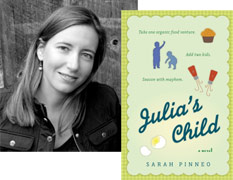

Sarah Pinneo
 
is a novelist, food writer and book publicity specialist. Her most recent book is Julia’s Child. Follow her on twitter at @SarahPinneo.

Monday, November 28, 2011

Writing: It's a Numbers Game

As a past (and future) querier, I've spent a lot of time on the Query Tracker website.

Query Tracker is a database of the most trustworthy literary agents, packed with the tools I needed to track each of my submissions to them. Query Tracker became a valuable part of my novel's road to publication and, at the height of my querying, I spent several hours a week using the website.

Assembling an agent list was the easy part. The search functions narrowed down the group of more than 1200 agents to those who were appropriate for my material. The spreadsheet showed my progress and tracked responses as they came in. The individual agent files contained contact information and links to their online dwellings.

But, after a while, those amazing features began to pale in comparison to the tab so innocently labeled "Reports and Statistics." Like many anxious writers who used Query Tracker, I quickly got sucked in to the stats of the querying game.

Numbers. Everywhere. The Query Tracker database had information on every statistic a writer could imagine. Which agent had the highest request rates. How many days until my own request should come in(ever the optimistic one.) How many lucky writers signed. How many unhappy writers marked their own queries as a "no response". Hard figures and agonizing percentages. Nail biting numbers. Knuckle crunching numbers.

Nasty thing, numbers.

Despite the pretty clear delineation between the left and right hemispheres of our brains, numbers will always want to mingle with the words crowd (much to my math-hating daughter's chagrin.) Word counts. Page counts. Royalty rates. Fun stuff. Essential stuff.

Here's some more "essential stuff" to get your mind off the agony of staring down the query stats.

We'll start at the beginning with the 10 Most Important Things every writer needs to know: while simply stated, there is a lot of down-to-earth advice here. For example, did you know that "your friends and family are not your audience"? Nope, they're not--and knowing it might help you define who your audience actually is. A list like this helps to reset ourselves, gets us to pull away from the keyboard for a moment and try to remember the reason we sat down to write in the first place.

Got blog? Then you got numbers. Here's 3 things your blog needs and 5 things it doesn't. (The comments are noteworthy.) And every blogger wants a bigger audience, right? Average bloggers will appreciate these 8 tips to grab those coveted readers while the over-achievers may prefer a heftier 19. Go big or go home, I always say.

Heck, as long as we're going big, let's go Hollywood. Here's 10 things that may decide whether your book is good enough for the big screen.

Once we're done daydreaming about cinematic fortune and fame, the blog 365 Stories In A Year will give us this more realistic list of 10 things we probably do but would never admit. On the flip side, we still have our integrity as writers—and so we'd be better off sticking to these 10 basics, which includes Wil Wheaton's Law. (If you are unsure of just how tremendously powerful a chaotic neutral overlord Wil Wheaton has become, then you seriously need to catch up. He's going to rule the world one day.)

The numbers get even more serious over at Twenty Palaces, where you can find 10 things that might be the proverbial slap you need to stay focused. However, these 10 magic ideas will inspire you with a much lighter touch. (Read it if you *heart* Voldemort as much as I do.)

Want advice from an agent instead? No problems. Rachelle Gardner has loads of great tips and she gets a perfect 10 for her 10 things theme on her blog. She's got several helpful lists on a variety of topics--have fun with them!

And Rachelle isn't the only one who's got her numbers lined up. Janet Reid lists 10 steps to diagnose your query for a particular agent. Some of us will read this and say, really? You need to spell all that out? Give us some credit! while an equal number of us will say, Now, that's what I call *clear* guidelines. Finally. Why don't all agents do it? (Don't get any ideas.)

Lastly, I'll point out a lengthy 10 secrets you might not have known about agents. There is a very poignant message in this one--if you don't have time to read the entire article right now, take the time to scroll down to the bottom of page 22 and read the last paragraph or so. It may help put querying madness into perspective.


Look at all those crazy digits floating around up there. Can writers learn anything from playing the numbers game? (Besides the apparent fact that writers seem to love the number 10.)

Maybe if we extracted all these numbers we'd realize there is no single magic formula to good writing. Sure, we can obsess over numbers and drown in the QT data explorer. We can calculate and extrapolate and postulate but, in the end, it's the actual words on the paper that matter. Word counts and page counts won't matter in the end if the heart isn't in the story. The words and the numbers must work together to produce a splendid story and it's our job to bring it all together.

Perhaps treat yourself and listen to "Hemispheres" by Rush, with an emphasis on the song The Sphere. Just as the heart and mind must unite, so must our right and left brains. Write the words but don't forget to enjoy the numbers…

And look forward to getting that single, most beautiful number: 1.

One "yes" is all it takes to win the writing game.

Ash Krafton is a speculative fiction writer who resides in the heart of the Pennsylvania coal region, where she keeps the book jacket for "Abraham Lincoln: Vampire Hunter" in a frame over her desk. Visit the Spec Fic Website at www.ashkrafton.com for updates on the release of her debut novel, Bleeding Hearts, forthcoming in early 2012 through Pink Narcissus Press.