If I were to stereotype, I'd say it's something that every author who writes speculative fiction is intimately familiar with. And yet, it's a tool that all authors--regardless of genre--can make good use of in deepening their stories and bringing them to life.
World building, in it's most basic form, is the process by which an author takes the story as it is in his or her mind and carefully reconstructs it on the page.
In speculative fiction, it involves creating a new world from the ground up. In other genres, especially in contemporary settings, it involves catching the world and pinning it in strategic places in the story.
So what's involved in a world? There are three main components to any world:
Language
For any people in any world to live together, they have to be able to communicate with each other. How this is done--both verbally and nonverbally--will depend on the people and their world view. What's important to this people? What do they value? Have disdain for? Fear? What sounds do they make, and why? How formal or informal is the language, and in which situations?
Having a basic understanding of the people's language will enable both the author and the reader to have a better understanding of the world and the characters that populate it.
Culture
Culture covers a wide range of things: architecture, morals, values, laws, dress, grooming, fashion, foods, expressions, governments, religion, customs, art, daily life, etc. A person's culture helps to shape who they are. How they see the world. And how they react in certain situations.
Having a basic understanding of the people's culture can help the reader connect with the characters better, and can also present all kinds of opportunities for conflict.
Geography
How the world is shaped and formed will have a huge impact on who populates what areas, if they are to be populated at all, and how they must adapt in order to survive and flourish. Geography will also shape a culture and language as people integrate it into their daily lives.
During the world building process, it's highly likely that you will have more built than you may ever use--and that's okay. More than okay, actually, because the more world building that makes if from your mind to the story, the more real and vibrant your world will feel to the reader. (Caveat, like everything else, there is a balance. All world building and no story makes for a very dull time.)
Once the basics are down--even in a contemporary setting--it's all a matter of details. Of allowing the world to intrude upon the characters, to help shape who they are and who they will become. It will inform potential conflicts in the story, and deepen the sense of history of the tale.
Some great resources I've used for my own world building include: allowing my muse (a.k.a. my subconscious) to run wild, Patricia C. Wrede's world building questions, and Holly Lisle's world building series that (for now) includes language and culture.
What about you? Any good world building resources out there?
Danyelle Leafty (@danyelleleafty)writes MG and YA fantasy. In her spare time, she collects dragons, talking frogs, and fairy godmothers. She can be found discussing the art of turning one's characters into various animals, painting with words, and the best ways to avoid getting eaten by dragons on herblog.
For a college professor like me, plagiarism is always a concern. But problems aren’t limited to the classroom. Every writer needs to be wary—both so you don’t accidentally plagiarize someone else, and to guard your own work against plagiarism.
The internet has made it so easy to copy and paste material into one’s notes—or even right into one’s manuscript—that many people do exactly that, either forgetting that they lifted the material or assuming no one will ever figure out they didn’t do the writing themselves. Others assume that if they change a few words here and there that they’ll never be caught. And sadly, the fact that it’s so easy to copy leads some people to assume that it must be okay.
Take former Harvard student and William Morris Agency client Kaavya Viswanathan, for example, who signed a two-book contract with Little, Brown and Company for an alleged $500,000 advance. Within a few weeks of the book’s release, readers were finding passages that had clearly been lifted from Megan McCafferty’s Sloppy Firsts and Second Helpings, Meg Cabot’s The Princess Diaries, Sophie Kinsella’s Can You Keep a Secret?, Tanuja Desai Hidier’s Born Confused, and even Salman Rushdie’s Haroun and the Sea of Stories.
McCafferty’s Sloppy Firsts: Though I used to see him sometimes at Hope's house, Marcus and I had never, ever acknowledged each other's existence before. So I froze, not knowing whether I should (a) laugh (b) say something (c) ignore him and keep on walking ... 'Uh, yeah. Ha. Ha. Ha.' ... I turned around and saw that Marcus was smiling at me.
Viswanathan’s novel: Though I had been to school with him for the last three years, Sean Whalen and I had never acknowledged each other's existence before. I froze, unsure of (a) what he was talking about and (b) what I was supposed to do about it ... 'Ha, yeah. Uh, ha. Ha.' ... I looked up and saw that Sean was grinning at me.
As soon as the first accusations were made, Little, Brown released a statement from Viswanathan saying
I wasn't aware of how much I may have internalized Ms. McCafferty's words. I am a huge fan of her work and can honestly say that any phrasing similarities between her works and mine were completely unintentional and unconscious.
The publisher of McCafferty’s novels shot back,
We find both the responses of Little, Brown and their author Kaavya Viswanathan deeply troubling and disingenuous. Ms. Viswanathan's claim that similarities in her phrasing were 'unconscious' or 'unintentional' is suspect. We have documented more than forty passages … that contain identical language and/or common scene or dialogue structure from Megan McCafferty's first two books. This … is nothing less than an act of literary identity theft ... it is inconceivable that this was…youthful innocence or an unconscious or unintentional act.
And Viswanathan isn’t the only one who’s plagiarized and been caught.
It is said that their [black-footed ferrets'] closest relations are European ferrets and Siberian polecats. Researchers theorize that polecats crossed the land bridge that once linked Siberia and Alaska, to establish the New World population.
The passage is almost indistinguishable from the one Paul Tolme wrote in the summer of 2005 for Defenders Magazine:
Their [black-footed ferrets'] closest relatives are European ferrets and Siberian polecats. Researchers theorize polecats crossed the land bridge that once linked Siberia and Alaska to establish the New World population.
Signet, who published Edwards’ book, argued first that many of the sources were so old that they were fair use, but later decided to review each of Edwards’ books in search of plagiarism. According to the Wikipedia entry on Edwards, “In April 2008, Signet stopped publishing Edwards' books ‘due to irreconcilable editorial differences.’ In an interview, Edwards said that she did not know she was supposed to credit sources, and her husband stated that Edwards gained ideas from her reference works but did not ‘lift passages’.”
If these sorts of things are a concern for published authors, imagine how often this must happen among unpublished writers. That means you need to be extra vigilant as an unpublished writer.
First, you must know exactly what plagiarism is so you never do it yourself. According to plagiarism.org:
All of the following are considered plagiarism:
* turning in someone else's work as your own
* copying words or ideas from someone else without giving credit
* failing to put a quotation in quotation marks
* giving incorrect information about the source of a quotation
* changing words but copying the sentence structure of a source without giving credit
* copying so many words or ideas from a source that it makes up the majority of your work, whether you give credit or not (see our section on "fair use" rules)
Most cases of plagiarism can be avoided, however, by citing sources. Simply acknowledging that certain material has been borrowed, and providing your audience with the information necessary to find that source, is usually enough to prevent plagiarism.
Second, you must choose your critiquing partners carefully. If someone takes your work and puts it in front of an agent or publisher first, what will that do to your chances of ever getting published yourself? We’ve heard stories about people trusting a critique partner with their material—from queries to nonfiction proposals to novels—only to hear from a third party that they’ve been plagiarized. In other words, a reader who sees both your work and your crit partner’s “work” realizes that your crit partner is stealing your material! And in some mind-blowing situations, plagiarists have even sent their plagiarized material to the person they stole from for critique!
Like Viswanathan and Edwards, many if not most plagiarists swear they’ve done nothing wrong. Because they changed some words here and there or integrated your materials into their own work, they may argue that it’s all original. In fact, little may be original — plagiarists often steal from multiple sources.
In the book Man for Himself, psychologist Erich Fromm calls people like this “exploitative characters.”
Such people will tend not to produce ideas but to steal them. This may be done directly in the form of plagiarism or more subtly by repeating in different phraseology the ideas voiced by others and insisting that they are new and their own… Things which they can take away from others always seem better to them than anything they can produce themselves… Because they want to use and exploit people, they ‘love’ those who, explicitly or implicitly, are promising objects of exploitation, and get ‘fed up’ with persons whom they have squeezed out.
We’re not suggesting you become paranoid and avoid critique partners. Crit partners are invaluable, both to help you improve your manuscript and to help you improve as a writer. But it’s a good idea to pay attention to anything that makes you feel uncomfortable or violated.
A few clues that you’re dealing with an exploitative character:
* Fromm says, “They often make ‘biting’ remarks about others…[and they display] suspicion and cynicism, envy and jealousy. Since they are satisfied only with things they can take away from others, they tend to overrate what others have and underrate what is theirs.” In other words, look out for people who often gossip about others in a negative way, or who rave about how they’re going to write something “as good as [your story]” or whatever this week’s Big Novel is.
* Be wary of someone who’s absolutely paranoid that someone else is going to plagiarize them. People often fear others doing to them what they’re doing to others.
* This is a big one: Beware of people who are copycats in other areas of their lives. If they’re constantly regurgitating other people’s opinions as if they’re original thoughts, or if they jump on the bandwagon to try to get a little glory from other people’s new and fabulous ideas, beware.
* So is this: Exploitative characters will often come right out and say they’re using people, groups, or ideas, or plan to use them. They may boast that they’re only doing something because of what they can get from it. If you hear these things on a regular basis, run for your life (and your manuscript’s!).
Some other ideas to help you stay safe:
* Get referrals to critique partners from writers you trust.
* Ask other people in your writing community about a potential critique partner to see if anyone has caveats.
* Try sharing a few chapters at a time with someone rather than sending them your full manuscript. Then wait for a while before sending more and listen for anything that makes you uneasy.
* And always, always trust your gut.
Dr. Carolyn Kaufman is a clinical psychologist and professor residing in Columbus, Ohio. A published writer, she runs Archetype Writing: Psychology for Fiction Writers and an associated blog. She is often quoted by the media as an expert resource.
Have a psychology/writing question? Send it to me (using my email address to the right) and you may see it answered on the QueryTracker.net Blog!
So now you know how to use some of the great Google tools. Want to know how to do a super specialized search? These tricks are so advanced that even advanced researchers use them less than 5% of the time. But they unleash a huge amount of power. They're what make you a full Google ninja!
Here are two of my favorites:
Phrase Search
Erich Fromm is one of my favorite philosopher/psychologists. He wrote this fantastic paper called "On Disobedience," in which he explains why disobeying authority is sometimes the truest form of doing what is right. If you Google erich fromm on disobedience (I'm too lazy to capitalize sometimes, and Google doesn't care) you get a list of sites that list, quote, or talk about the paper. But say that's not what I want. I want to see if the paper itself is online.
The trick is to put quote around a short phrase from the paper itself exactly, including any punctuation. (Personally, I try to avoid using punctuation, but if there is any, you must use it exactly.) Now, I'm geeky enough to know the first couple of lines of the paper by heart, so I put a phrase in quotes beside my original search. Now my search query looks like this:
Now I'm only getting sources that include that exact phrase. Unfortunately, it's a quotable quote, so what I ended up with is a bunch of websites that sell bad term papers to students.
So I need to pick a more obscure phrase from the paper. I get out the handy-dandy book that contains the paper and search
But that's still not good enough. So I'm going to pick an even more obscure phrase that's less likely to be someone's quotable quote. So I pick something that really captures the style of Fromm's writing but isn't likely to be quoted anywhere but in the actual article:
"my conviction and my judgment, if authentically mine, are part of me"
Now I have three results, including a web-based copy of the article. Ta-da! You can read it here.
Excluding Terms
From time to time I Google my name. (Come on, admit it, you do it too.) My excuse is that sometimes when I work with journalists, they don't tell me they're using a quote I gave them. And sometimes Google Alerts don't catch those articles when they're posted online. So I Google myself in search of them so I can print them for my expert portfolio.
Until the internet age, I thought I had a unique name. Turns out there are other people out there named Carolyn Kaufman. (Humph.)
If you search my name, my information pops up to the top (ha! take that, other Carolyn Kaufmans!), but it turns out that there's also a Carolyn Kaufman who's a former professor and the CEO of a corporation, another who's an RN, and another in Orange County who says she has "Indigo Children" -- kids who have special powers to see the future. (Holy oh noes. What will this do to my professional credibility?) There are a few others out there, too, mostly Twitter and Facebook links and marriage announcements. There's a Carolyn J. Kaufman (not me), a Carolyn C. Kaufman (not me), and a Carolyn A. Kaufman (also not me). Which leaves me a lot to sort through.
So the first thing I'm going to do is make my name into a phrase search to exclude any results with middle initials, because I don't usually use mine: "carolyn kaufman"
Then I'm going to start excluding phrases. In other words, I'm going to tell Google not to give me search results if they include this term or word. So to remove all the Indigo Children listings, I type a minus sign in front of the word I want to avoid:
"carolyn kaufman" -indigo
Fantastic, now all the Indigo Children listings are gone, but let's say I want to exclude all those other CKs I mentioned, too? Well, I just keep excluding terms:
"carolyn kaufman" -indigo -ceo -rn
That search leaves me with a Google search page that includes only one listing that isn't about me. I'm pretty happy with that. But let's say you're even picker. So I note that the other CK in the list of my results is from California, so I just add that to my list of exclusions:
"carolyn kaufman" -indigo -ceo -rn -ca
And so on. I can also make things more specific by including my unique credentials. For example, I have a doctorate in clinical psychology, a Psy.D., so I can add that (note that I am adding it, not excluding it, so there is no minus before the psyd):
"carolyn kaufman" psyd -indigo -ceo -rn -ca
Ooh, now we're really getting somewhere.
If you're name-searching someone, you should also use common variations of their name. If you're looking for a Dave, for example, also try searching with the name David. If you're searching for a John, also try Jonathan, Johnny, and Jon.
Congratulations, you are now a Google Search Ninja!
Dr. Carolyn Kaufman is a clinical psychologist and professor residing in Columbus, Ohio. A published writer, she runs Archetype Writing: Psychology for Fiction Writers and an associated blog. She is often quoted by the media as an expert resource.
Have a psychology/writing question? Send it to me (using my email address to the right) and you may see it answered on the QueryTracker.net Blog!
I am a Google ninja. I can find darn near anything (or anyone) on Google, because I know how to use all its secret tools. And it has a lot of secret tools. Journalists I’ve worked with sometimes call or email me asking me to help them find something on the internet. I'm just that good. (And totally modest about it, too.)
I'm going to do a short series today and tomorrow to teach you how to use the same mad ninja skillz.
Today we're going to look at basic searches and Google search tools. Tomorrow we're going to look at my favorite advanced search tools.
One little caveat: It can be scary to realize just how much information about you is available on the internet. You are not anonymous online. If someone really knows what they're doing, they can track down all kinds of free information about you by using just your email address or just your name. We'll look at name searches tomorrow -- you may find them especially useful if you have a detective in your story.
Google Basics
Most people know how to conduct a basic Google search. You type a word or words into the Google Search box and go. You can even type your query in the form of a question.
So let’s say I want to learn more about plagiarism. I just type plagiarism, and I get results like Plagiarism.org, which explains what it is and how to avoid it; the Wikipedia entry; and the Purdue OWL, which is the college’s writing help center.
Maybe I want to learn about anti-plagiarism software, which compares a paper's contents to a huge database of written material. I change my query to anti-plagiarism software.
Basic Built-In Google Tools
Did you know you can use Google as a calculator? A dictionary? A spellchecker? Here's how.
Calculator: Simply type the equation into the Google search box, and Google will give you an answer.
For example, 5*9= or 6/3=
Dictionary: Type define and the word you want to define, and you will get back a list of definitions.
For example, define anorexia
Spellchecker: Just type the word you have in mind, and if you're close, Google will respond with "Did you mean: (correct spelling)?"
Built-In Google Search Tools
If you want to search for a term and its synonyms, use the tilde sign (~) before your search term.
Example: ~anorexia pulls up information not only on anorexia, but also on eating disorders.
If you want to find web pages that have content similar to the site you're on, type related:followed by the web address.
Example: related:blogger.com pulls up alternate blogging systems, including WordPress and LiveJournal.
If you want to search within a particular site, use [search term] site:[site]
Once you've got these tricks down, come back tomorrow for the truly advanced tricks, the ones that will help you find anything (and anyone)....
Dr. Carolyn Kaufman is a clinical psychologist and professor residing in Columbus, Ohio. A published writer, she runs Archetype Writing: Psychology for Fiction Writers and an associated blog. She is often quoted by the media as an expert resource.
Have a psychology/writing question? Send it to me (using my email address to the right) and you may see it answered on the QueryTracker.net Blog!
The inspiration for this blog post came when a quote from Willy Wonka popped into my head and seemed to fit my quest for publication.
"There's a hundred billion people in this world, and only five of them will find golden tickets [representation as a debut author]. Even if you had a sack full of money, you probably wouldn't find one. And after this contest [process] is over, you'll be no different from the billions of others who didn't find one."
"But I am different. I want it more than any of them."
The more I recalled from that film, the more appropriate it seemed. So, here's what I've learned about publishing from Willy Wonka:
1. You should never, ever doubt what nobody is sure of. If there's one refrain everyone and their brother is singing, it's that publishing is subjective. Rejections are expected, even for eventual best-sellers. A particular genre or topic or plot device may be unanimously declared cliché, or overdone, and yet opinions can change in a split-second based on fresh execution. So, all you can hope to do is keep writing what you love, and hoping someone else comes along who loves it as much a s you do.
2. Rude demands and entitlement issues will send you down the garbage chute. There have been a lot of posts about this on agent/industry blogs. From moonrat's unproductive lunch, to odd or hostile letters sent to Jennifer Jackson, Colleen Lindsay, Jonathan Lyons and even intern Jodi Meadows... the one clear fact is that these author reactions did not help them get published. Take home point? Be a good egg.
3. In here, all of my dreams become realities, and some of my realities become dreams. I am often surprised at how often control becomes a fundamental point of focus. Part of what I enjoy about writing-- the reason I find it therapeutic-- is that I finally have complete control over something. My characters, their world, and what happens to them depends entirely on what I decide. That is a heady feeling. Interestingly enough, once the writing is finished the next step (if publishing is the goal) means putting yourself in a situation where you have very little control. I think that's why so many authors get frustrated riding the query-go-round and alternately cling to rules and/or declare them arbitrary and unreasonable.
4. There is no life I know to compare with pure imagination. Opening yourself to other people is the only way to share something wonderful you've created. It also means they might disrespect or destroy it. Be ready to filter your chocolate river.
5. A little boy's got to have something in this world to hope for. I struggle with this one a bit personally. I realize rejections are expected. I know thick skin is a publishing industry prerequisite. I know I haven't queried enough to make any assumptions about my chances to be published, but reading the odds can be pretty discouraging. But stories are meant to be shared, so I'll keep a healthy dose of optimism on hand.
6. One is Enough for Anyone. Moonrat once made a lovely post in celebration of the Little Novel That Could. What is striking about this story to me is that sometimes, one champion makes all the difference for a project. Certainly, in order to get a book published, a lot of different people need to believe it can be successful. But sometimes just one person... if it's the right person for the right project... can make them believe.
7. What Are You At, Getting Terribly Fat? I participate in several online writers groups where people share their query letters for critique, and I'm surprised at the number of intelligent, otherwise well-informed folks who seem to be unaware of appropriate lengths for novels. Colleen Lindsay of FinePrint posted a great breakdown of wordcounts by genre a while back.
And finally:
8. Don't let a golden ticket make the chocolate taste terrible. As much as any aspiring author wants to be recognized and published, the publishing process should not be allowed to spoil the experience of writing. It's easy to get swept into the madness of query letters, synopses, and pitchcraft. And I've spent my fair share of time agonizing over query blurb wording (many can testify to that), but it is important, I think, to remember why we started writing in the first place.
Kate on ktliterary posted a while back about Josie Bloss's plans for a tattoo to celebrate the release of her novel Band Geek Love, and asked what other aspiring authors would do to celebrate publication. I think I might sing "Golden Ticket" at the top of my lungs:
I never thought my life could be Anything but catastrophe But suddenly I begin to see A bit of good luck for me. Cuz I've got a golden ticket I've got a golden twinkle in my eye. I never had a chance to shine Never a happy song to sing But suddenly half the world is mine what an amazing thing!
Cuz I've got a golden ticket I've got a golden chance to make my way And with a golden ticket It's a golden day.
The first article in this series on social networking covered blog readers. This second post will address basic info on the major social networking sites.
Now, if you're already tweeting and hurling sheep at your Facebook friends, you may be well-acquainted with social networking sites. My next post on this topic will cover ways to maximize the benefits of your online presence.
But for now, we're going to start with the basics, because none of us want to end up in this situation:
For those of you who think "Twitter" has something to do with woodland creatures falling in love, here's a quick rundown. I've linked each heading to my own profile, so you can see what they look like.
Facebook: www.facebook.com Facebook is a social networking site that allows you to create a profile, upload photos, post links, and add "friends". This site requires accurate personal information (If they discover a profile for a fictional character, business or pet, they'll delete it) and therefore gives the added bonus of looking up the girl you went to summer camp with and your third grade crush.
How does this help with your writing career? You can use Facebook to post links to your personal blog, and keep your contacts in the loop regarding your writing projects. You can network through groups for writers and fans for your genre, and-- if you've established a following-- you might just get a group of your own "fans." Many, many people of all ages use Facebook, so it's a great place to make connections with potential readers.
Downsides: A recent scandal erupted when it became known that Facebook had altered their user agreement (without notifying users) to language that essentially gave Facebook rights in perpetuity to any content used on their site. Meaning they had rights to photos, notes, text, etc. if it had been posted to a user's profile. They have since backed off on the language and are rewording, but it would still be ill-advised to post any original content there. Post links back to your personal blog or website where you are guaranteed full rights to your content. Also, Facebook's silly side (Superpoke, pieces of flair, etc.) can be a lot of fun, but be careful about maintaining your professional image.
Myspace: www.myspace.com Myspace is similar to Facebook, but in my experience is geared towards a younger audience. If you are a YA or MG author, get thee a Myspace page. Unlike Facebook, Myspace allows pages for fictional characters, so if your contemporary character wants to get online, this would be a good place. You can customize your profile-- even blog there, if you like.
How will this help with your writing career? Like Facebook, Myspace allows you to add users as "friends". Unlike Facebook, default settings allow you to view profiles of people you aren't already connected to, so that can provide an easy way to increase your online connections. It's also easy with the customizable profile to add things like book trailers directly to your profile for easy viewing.
Downsides: Since a public profile means anyone can find you, that includes smarmy dudes looking for someone to complete their threesome and the like. Twitter: www.twitter.com Lately cyberspace is all a-Twitter. Everybody and their agent is Twitter-pated. So what is Twitter, anyway? Twitter is a "microblog" site, where users post personal updates, links, etc, but are limited to 140 characters per posting. You can "follow" other users who interest you, and other users can choose to follow you.
How does this help your writing career? As opposed to Facebook and Myspace, which require you a user to approve you as a "friend," Twitter allows you to follow any user you like (unless their profile is private). As a result, agents and editors who may not be thrilled if you try to "friend" them on Facebook, generally don't mind unknown Twitter followers. Many agents maintain Twitter accounts and following publishing professional can often get you the inside scoop on timely topics. In addition, you can follow QueryTracker there, too, for breaking news on new and updated agents on QueryTracker.net.
Downsides: Although agents might not be following you (even though you're following them), most of them still check their @ messages (if you're new to Twitter, an @-message is a post starting with @[username]). Which means you still need to be careful of the impression you're making if you respond to an agent's tweets. The casual nature of Twitter can be a bit misleading. Like always, you should keep your professional reputation in mind and avoid tweeting anything you wouldn't want a prospective agent or editor to read.
Rallystorm: www.rallystorm.com Suz did a great job of discussing Rallystorm on Monday. Check out her post, if you haven't already. Linked In: www.linkedin.com Linked In is a professional networking site. Keyword here is professional. While agent opinions vary regarding friend requests from aspiring authors on sites like Facebook and Myspace, Linked In is one place where the connections are generally professional in nature. In other words, if you are working with an agent or editor, it's perfectly appropriate to ask them to add you to their Linked In network. But Linked In is absolutely not a place for cold networking with publishing professionals.
How will this help your writing career? You probably won't find Linked In to be all that helpful at the Seeking-Representation stage. But it can be a great networking tool once you're officially part of the publishing industry. Linked In adds a person's whole network of connections with them. So, you'll see your personal contacts, but also your contacts' contacts.
Downsides: Not that useful for an aspiring-to-be-agented author.
Goodreads: www.goodreads.com Goodreads is a fun way to connect with your friends over books. You can post books you've read, books you've loved, books you're reading right now, and what books you can't wait to read next. You can compare your thoughts with your friends and snoop through their lists to find new great things to read.
How does this help your writing career? Anything that exposes you to more good books can only help your writing. Anything that connects you to people who love to read, is good for your platform. And one day, folks might be posting about your book there.
Downsides: Although you can peruse your friends' lists of contacts, Goodreads is mostly directed towards people you are already connected to.
There are plenty of other sites where you can connect online, from chatboards to music sites like Imeem.com. Any connection you can make online, helps build a pool of folks who might be interested in your book later. So get out there and start networking... just don't forget to keep writing while you're at it.
Some of you know by now that when I'm not writing and blogging, I'm a psychologist and a professor. And I'm not the only doctor on the QueryTracker.net blog team. HL Dyer is a pediatric hospitalist physician in the Chicagoland area. Just as I enjoy answering writers' questions about psychology, Heather enjoys answering writers' questions about medicine.
We decided to invite you to email us over the next week with your psychology/writing questions (those go to me, ckaufman) and your medical/writing questions (those go to hldyer). Our email addresses are in the sidebar to your right!
Next Tuesday, February 24th, Heather will choose one or two of her favorite questions to answer here on the QT Blog, and on Tuesday, March 3rd, I'll do the same thing. We'll be fielding some of the other questions we get on our personal sites -- links to follow!
Some tips:
* Ask specific questions.
* If you're comfortable doing so, add some detail about why you're asking -- what's going on with your characters? What's the scene you need information for like?
From my archives, here's an example of a good, specific question:
Could a person with schizophrenia have such a mild version that, to most, he appears completely normal except for a few "quirks" and his bad symptoms only come out in periods of high stress? Or would I be speaking of a completely different illness?
In case you're interested, the answer to this question is here.
Here's another question; here the writer included lots of character information:
How would a psychological professional respond to a woman who goaded an ex-boyfriend into hitting her? My main character is trying to work through why she is always choosing men who hurt her. The psychiatrist asks her about her first boyfriend. The character says he hit her, but only once, and she doesn't count it as because she taunted him to do it. How would a psychiatrist/psychologist respond to that?
A couple of years ago, I started to notice that writers often make mistakes or rely on clichés when they incorporate therapists, disorders, and treatments into their stories. With a little more research, I realized why. There was no easy-to-understand, easy-to-use resource that explained disorders, diagnosis, and therapy to writers. There was also no comprehensive resource on the psychology of the writer, creativity, and good writing.
The other members of the Blog Team suggested I tell you more about my Archetype project, so today that's what I'm going to do.
Let's say, for example, that you're writing a story about a character who has bipolar disorder (aka manic depression). Maybe that character is suicidal, and you want her to be hospitalized against her will. The only problem? You don't know much about bipolar disorder, how it's diagnosed, or how it's treated. Nor do you know how the whole involuntary hospitalization process works, or how to make the doctors at the hospital sound like real shrinks.
Where to start? Well, you could piece information together from all over the internet, or you could just visit Archetype. After all, the Real Psychology section of Archetype includes information on all of these things. Better yet, if you can't find the details you need, or you need someone in-the-know to double-check how authentic your scene sounds, you can fill out the Q & A form to ask specifically about your story. (You can also check out other readers' questions and answers in the Q & A archive.) I respond by email within a few days.
Okay, QT's, it's time to check out another QueryTracker.net feature.
Since I'm on a premium feature kick after last week's post, I thought I'd discuss one of my favorite premium features: the Genre Agent Report.
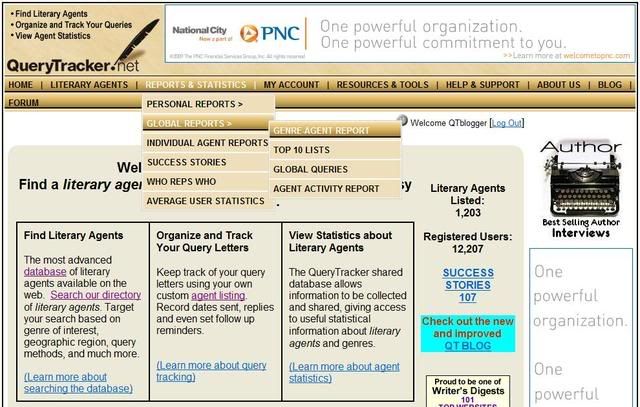
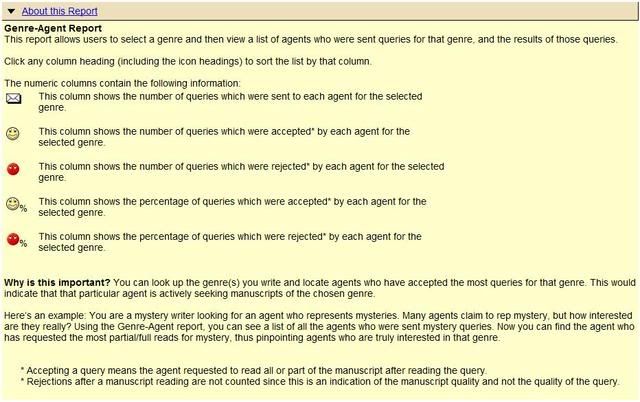
At the top of the selection box for the Genre Agent Report is a tab you can click for more information about the report. If you don't have a premium account, you'll be able to see a sample report on this page.
That's right... this report lets you see the acceptance rates of agents FOR YOUR GENRE and compare that to other agents. This not only allows you to identify agents who are truly interested in your genre of manuscript, but can also help with the ambiguous "commercial fiction" category.
When an agent lists just "commercial fiction," does that mean they are only interested in mainstream fiction? Or in sub-genres that can fall under the "Commercial Fiction" heading?
Well, you can use this feature to find out.
Here's how to create your own Genre-Agent Report:
Just select your genre from the dropdown menu...
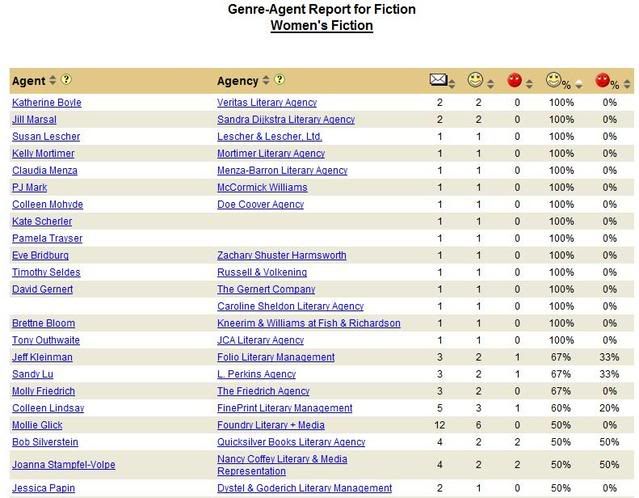
Click "submit" to generate your report. You can then sort the list. The acceptance percentage column (the smiley face with the % sign) will probably be the most useful to sort by.
You can now easily see the acceptance rates for each agent, as well as how many queries they received in your genre (to give you some perspective as to how significant the rates are.)
The list also gives you direct links back to the agents' profiles, providing an easy way to add prospective agents to your query list.
The sample list above includes Jeff Kleinman from Folio. Mr. Kleinman's profile does not list women's fiction as a genre he represents, and yet of 3 queries he's received for women's fiction project, he request more material on 2 of them. That suggests to me that this agent includes women's fiction under the commercial fiction umbrella, and so I can add him to my query list (even though his listing would not have come up through a search for women's fiction agents).
I needed a whole post just to go over the basic tracking features, but today I get to talk about the Premium features for tracking queries.
If you need a refresher on how to access your query (and submission) tracking reports, check out my previous post.
And now for the good stuff!
In the same dropdown menu where you can choose the basic QueryTracker reports, you'll see a few reports marked with a (P), showing that those reports are only available to premium members.
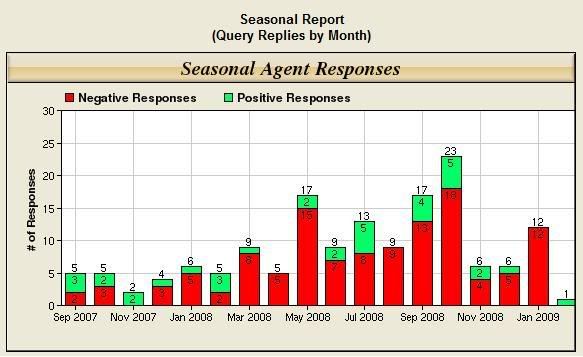
The premium reports allow you to break down an agent's responses by season, both overall AND by a specific genre. Once you click "Generate Report," you'll see a chart like this:
This graph will tell you how many replies an agent made in each month, as well as how many were positive or negative. For instance, on the graph above, we see that Ms. Jessica Faust replied to thirteen QT user queries in July of 2008 and five of those were positive responses (i.e. requests for partials/fulls, etc.) whereas in January of 2009 she replied to twelve QT user queries (all negative replies).
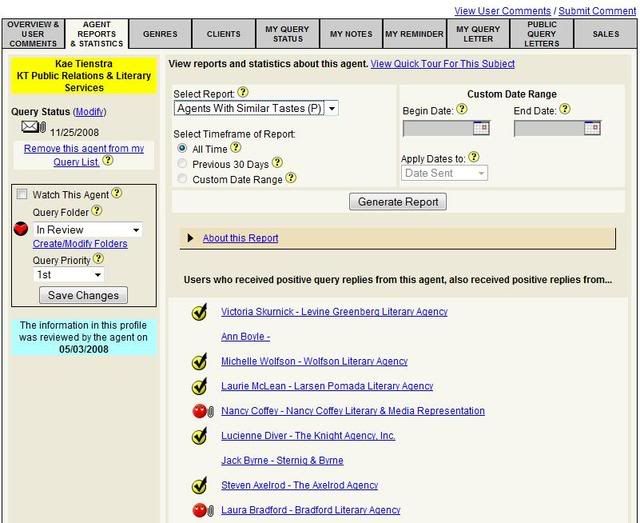
Now, perhaps one of the most useful reports available (especially when you are generating your query list) is the Agents With Similar Tastes report. You'll find it in the same dropdown list as the other reports we've mentioned.
This report will generate a list of other agents listed on QueryTracker.net who gave positive responses to the same projects as the agent you're reviewing. So, for example, I received a partial request from agent Kae Tienstra. If I generate a Similar Tastes report, I'll get a list of agents who requested material on other QT users' manuscripts Kae was interested in. I can then review those listings to determine other literary agents who might be a good match for my project.
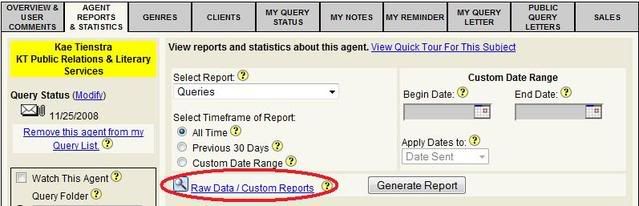
The QT symbols appear next to the agents' names, so you can see at a glance what your status is with each agent. If you like access to as much data as possible, then you will love the final report I'm going to discuss. You'll see a link to it underneath the dropdown menu on the basic Query report.
The Raw Data Report basically allows you to see all the query information available from QT users for that agent. You can review it in a huge, enlightening clump of query results, or you can sort it by genre, wordcount, query date, etc. You can also filter the data to show only a specific date range, or wordcount, etc.
In the data report below, I have filtered the data to only show replies received from this agent during August of 2008, when I received my partial request.
The Raw Data report is phenomenally helpful in judging when to expect a reply. Despite their demigod appearance to many aspiring authors, agents are people with their own busy lives. And even if you're a relative newbie to publishing, you've probably already noticed how slowly this process moves. So, at times, listed response times can be a smidge... optimistic.
Like the minutes on a football clock don't show exactly how much longer before the game finishes, the response times listed on agent websites don't always represent how long a reply will take. And of course, queries and replies DO occasionally get lost in transit, so the Raw Data report can help you know when to assume your query has gone AWOL. If the Raw Data report shows that other QT users who queried around the same time have not heard a reply, it's a safe bet that the agent's response time is currently longer than stated.
Seriously... how awesome is that?
And speaking of awesome, during last week's suggestion session, a few of our loyal blog readers mentioned their interest in hearing from industry professionals. Well, wish granted!
On Wednesday, here on the QueryTracker.net blog, we'll be featuring an interview with Angie Lofthouse.
Angie Lofthouse is a stay-home mom of six children. Her fiction has appeared in NFG, AlienSkin, Amazing Journeys, The Sword Review, Dragons, Knights and Angels, Irreantum, and Unparalleled Journeys. She is also an editor for Mindflights Magazine. She lives in a little canyon in the foothills of the Wasatch Mountains with her family of writers, artists, singers, composers, illustrators and musicians.


 Danyelle Leafty (@danyelleleafty) writes MG and YA fantasy. In her spare time, she collects dragons, talking frogs, and fairy godmothers. She can be found discussing the art of turning one's characters into various animals, painting with words, and the best ways to avoid getting eaten by dragons on her blog.


 , psychologist Erich Fromm calls people like this “exploitative characters.”