QueryTracker Blog

Helping Authors Find Literary Agents

Friday, November 11, 2011

Publishing Pulse 11/11/2011


Around the Internet

Rachelle Gardner educates authors about Book Piracy...and what you can do about it.

In keeping with writerly concerns, Rachelle also explains how Amazon's new Kindle lending library impacts authors.

Write It Sideways challenges you: Can you really call yourself a Writer?

Finally, for the bloggers among you, ProBlogger offers this post on 10 Writing Mistakes That Will Guarantee Your Blog's Failure (and probably any other writing you do, too--they're good tips).

Google+ for Writerly Networking?

So I'm curious about whether you use Google + and what you think of it as a writerly networking tool?

Here's what my experience has been like: I got an early Google+ invite and created a circle I called Writerly Folks. Then I put myself out there as a writer and added other writers and waited to see what would happen.

Well, I've reached the point where people all over the world are adding me to their circles, often ten or twelve (or more) a day. I add them all to my Writerly Folks circle and then post writerly sorts of posts in that stream from time to time. I do get some +1s and comments, but I'm not sure overall if it's any more effective than Facebook. I also have no way of knowing whether most of these folks are in fact writerly folks.

So I'm quite curious about others' experiences.  Please feel free to share in the comments!


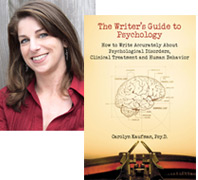
Carolyn Kaufman, PsyD's book, THE WRITER'S GUIDE TO PSYCHOLOGY: How to Write Accurately About Psychological Disorders, Clinical Treatment, and Human Behavior helps writers avoid common misconceptions and inaccuracies and "get the psych right" in their stories. You can learn more about The Writer's Guide to Psychology, check out Dr. K's blog on Psychology Today, or follow her on Facebook or Google+! 

Wednesday, November 9, 2011

Treating the Pain of Rejection

By Ash Krafton | @AshKrafton

You can't get a handful of rejections and stop submitting—that's not how publishing works. This is a game with more than a handful of players. Every great book has a best-fit publisher for it but you can't skim the pool and expect to net it with just a handful of attempts.

We have to accept the facts: most of us are going to have to make several submissions and face several rejections before we get the acceptance that our book deserves. Those rejections are going to hurt. 

The treatment isn't easy, either. Over-the-counter analgesics provide little relief and self-medicating with alcohol only causes hangovers and the need for intense revisions later on. What's a poor writer to do?

The Treatment

The only way writers can avoid rejection is to avoid submitting work. Considering that abstinence is a pretty harsh therapy, I suggest you do the exact opposite: submit everything, submit often, submit everywhere. Kind of a hair-of-the-dog approach.

It's my homeopathic remedy to the rejection blues…keep submitting and eventually the sting of rejection goes away. 

The principle of similars (or "like cures like") is a central homeopathic principle. The principle states that a disease can be cured by a substance that produces similar symptoms in healthy people.

Never mind that many studies have suggested that homeopathy is no more effective than placebo. But think about it: placebos that work prove that mind over matter works. Positive thinking works.

That's serious medicine for all writers.

Frequent exposure to rejection helps us build a tolerance. We develop thicker skins. Now, I am not suggesting we put out faulty work, poor writing, or sub-prime manuscripts for the sole purpose of amassing rejections. Our goal is acceptance, remember? Once you run out of agents on your list…then what?

Luckily, we can submit our work to places other than agents or editors.

Contests: A Litmus Test Before Submitting to Agents

When I finished my first novel, I wanted a litmus test before I started flinging it at agents. I wanted to toe the waters of publishing before of plunging in. I wanted to feel my way cautiously through the dark instead of bumbling through it. 

Fortunately, I came across an article that described an author's journey to publication that suggested entering contests. I vowed to enter every contest I could for an entire year--but the practice proved so useful I never stopped.

Upsides to entering: Contests have judges who rate your work, as well as cool things like winners and prizes and glory. Remember—not everyone wins and most entrants end up with a contest-sized rejection.

However, the rejection is often of the personal variety. Look for contests that will return a score sheet (many post the score sheet on-line beforehand so you can see what you're going to get.) My favorite contests are those that encourage judges to leave comments. (I once got a twenty-five page entry back, line-edited. Thank you, free copy editor, because you saved me five dollars a page. *smiley*)

Contests also provided great feedback. When I first started entering contests, I had zero access to a writer’s critique group and an equally round number of beta-readers. The judges became my circle of well-meaning peers. Thanks to the feedback, I made some excellent revisions. (I also learned to ignore a lot of personal opinion, just like in a real group. That's part of building your immunity to rejection syndrome.)

Downsides? Sorry, but there are a few. Entry fees, first and foremost. For instance, some romance manuscript contests can cost anywhere from ten to fifty bucks a pop. Romance writers who belong to Romance Writers of America can often enter RWA contests for a discount; many writer group-sponsored contests offer similar discounts to their members. Despite the discounts, though, the fees add up.

Not winning is a downside, too, but here is where the homeopathy comes in. These contest-sized rejections can be crushing, especially if the judges shred your entry. Your resolve to be a writer has to be stronger than those negative forces. Most contests require their judges to provide ENCOURAGING feedback but there are judges who are simply not going to jive with your pages. You may unwittingly get a lot of practice not taking rejection personally.

My advice is to do it one score sheet at a time. If a loss was so massively rejectional, put it down and come back to it when you're ready. Even the worst scores might come back with helpful suggestions and you may find something helpful once you've prepared yourself. 

Keep in mind that these kinds of "rejections" cannot hurt you. They don't ruin your chances of getting your best work in front of a coveted agent or editor. In fact, they do the opposite: contest feedback may point out a flaw you missed, a spot of slow pacing, an opening that doesn't work the way you thought. 

Most contests deal with opening pages or a first chapter—the same partial that an agent or editor would see. If a contest helps you improve those pages, it also improves your chances of being read further, thereby reducing the probability of a rejection. 

So, in a nutshell: like cures like. See? It's all quite scientific.

I can handle rejection a lot better now than I did back when I first started to submit my work. I can handle judge's comments better, too, because after entering dozens of contests, I've had enough feedback to know what works, what doesn't, and what is subjective commenting vs. objective feedback.

My first book has since been accepted for publication but there will be other books and other rejections to come. Also, my book will eventually be reviewed…and I know it's a chance for a whole new round of subjective comments. My experiences have made me stronger and more capable of handling adversity. I won't say I'm immune to the pain of rejection but, these days, it'll take a lot more than a "no" to cause a setback for me.

After all, if a thing doesn't kill you, it can only make you stronger, right?

And that's pretty much homeopathy.

Salut.


Ash Krafton is a speculative fiction writer who resides in the heart of the Pennsylvania coal region, where she keeps the book jacket for "Abraham Lincoln: Vampire Hunter" in a frame over her desk. Visit the Spec Fic Website at www.ashkrafton.com for updates on the release of her debut novel, Bleeding Hearts, forthcoming in early 2012 through Pink Narcissus Press.

Monday, November 7, 2011

Why should I care?

 Back in college I took a close-reading class, and since then I haven't viewed prose in quite the same way. The right single word can propel a poem to greatness -- or as Mark Twain said, the right word versus the wrong word is the same as the difference between lightning and a lightning bug. 

At the Muse Online Conference last month, I taught a query-writing class. Students posted their queries for critique, and a few times I found myself rearranging their sentences without knowing why. This is fine for my own work, but a student is going to want a reason, or at least a reason more than "It just works better this way, trust me."

This is a generic example of something I saw in the queries, and I want you to sit up because you're about to learn some verbal sleight of hand.

The original query would say something like this:
Jane thought her worst problem was going to be writing next week's QueryTracker blog entry until the day she discovered she was a Hedger, one of only seven women who could destroy the Earth.

Okay, we've got stakes and a person and maybe a shred of personality, but do you notice what's missing? An emotional reaction. Time and again, I'd rearrange that kind of sentence to something more like this:

Jane thought her worst problem was going to be writing next week's QueryTracker blog entry until the day she discovered the existence of the Hedgers, seven women who could destroy the world. And she is one of them.

Now why would you do that?, you're asking me. And I realized after a while that until we know the meaning of the made-up word, we don't know why we should care.

Let's boil it right down to its simplest: Look at the following two examples:

  • Fritz died last night. He was my puppy. 
  • Fritz was my puppy. He died last night.


In the first example, you the reader delay feeling anything until you know to what degree you should care about Fritz's death. You can't wail, "Oh, how awful! Who was Fritz?" so you need my verbal cue to indicate whether you should be devastated for me, whether you should shrug, or whether you should laugh out loud and say that was a long time coming. 

In the second example, I telegraphed the expected reaction by establishing the relationship between me and Fritz, and you can backfill with your own understanding of what it means to own a puppy. Then when I tell you he died, you know what degree of response is appropriate.  

Now replace "puppy" with "my neighbor's ex husband" or "the guy who shot my parents." See how giving you the information up-front changes your reaction? As readers and listeners, we guard our emotions until we know how we're expected to respond.

Also, we need to know why we're going to care. In the following circumstances, think about how differently you'd listen to a series of instructions on how to deliver a baby:
  • reading them on my weblog
  • attending a class for certification as an EMT
  • hearing them from the 9-1-1 operator

As a writer, you need to slip in the necessary information first, and then follow up with the cause for emotion.

Mind you, those initial examples about Jane discovering her powers -- they're awful and you wouldn't want them in your query anyhow. In your final draft, you'd do something more like, "While clearing her grandmother's papers out of the attic, Jane discovers a crumbling journal describing the seven women --Hedgers -- who can destroy the earth. Oh, geez -- maybe Grandma's mind was failing three decades before the Alzheimer's took her. But then Grandma's journal describes the birthmark that will appear on the wrist of the seventh Hedger. The birthmark Jane was born with ten years after the date on that entry."

Your query is short compared to your book. It would be short even as the setup of a short story. Two hundred fifty words: hit your reader hard. Tell us first why we need to care about the impending revelation, and then give us the revelation. Tell us the importance of what your MC is going to discover before she discovers it. 

Agents are receiving a hundred queries a day, and while it's a fair bet that they recognize terms like vampire, mermaid and demon, it gets tougher when you're inventing your own paranormal elements. Tell me that your main character is a Hedger or a Silter, and without excitement I say, "Okay, what's that?" Tell me that your main character cancels out entropy and occasionally clusters (totally by accident) all the oxygen at one end of a room, and now I'm saying, "Tell me more."

Remember that "Tell me more!" is the reaction you want to get to your query. The query's only purpose is to get the agent to say "There had better be pages pasted into this email," and the purpose of those pages is to get the agent to hate the subway tunnel that prevents her from sending an email demanding the rest of that manuscript right this minute. The prelude to "Tell me more" is showing me why I'm about to care.


---

Jane Lebak is the author of The Guardian (Thomas Nelson, 1994), Seven Archangels: Annihilation (Double-Edged Publishing, 2008) and The Boys Upstairs (MuseItUp, 2010). At Seven Angels, Four Kids, One Family, she blogs about what happens when a distracted daydreamer and a gamer geek attempt to raise four children. She is represented by the riveting Roseanne Wells of the Marianne Strong Literary Agency.

Friday, November 4, 2011

The Publishing Pulse: November 4th, 2011

Success Stories:

Joyce Tremel
Congratulations to Amy Sue Nathan for the recent sale her novel. Amy entered a QT contest last year, which lead to her landing her agent Jason Yarn.
Here is the excerpt from Publishers Marketplace:

Amy Sue Nathan's THE GLASS WIVES, a portrait of the effects of divorce and death on the modern family unit where a woman is compelled to live with her ex-husband's widow (who originally broke up their marriage) and her baby in order to save the home she loves, all while dealing with the scandal which erupts in their suburban paradise, to Brenda Copeland at St. Martin's, by Jason Yarn at Paradigm.
Around the Internet
Jane Friedman pointed out that self-published authors have great power, but are they taking responsibility for it?
Harper Collins is set to buy Christian Publish Thomas Nelson.
Agent Natalie Lakosil provided tips to help you market your novel. Remember, don’t wait until the last second and think spamming will win you sales. It won’t.
Agent Janet Reid presented a big query no-no. She also answered the age old question: do fiction writers need a platform?

Have a great weekend everyone!

Stina Lindenblatt writes young adult novels. In her spare time, she’s a photographer and blogging addict, and can be found hanging out on her blog, Seeing Creative.  

Wednesday, November 2, 2011

Common Grammatical Mishaps

Courtesy of lusi


For me, grammar has always been more of an instinctive thing, and it wasn't something I was even aware of until I started studying French in middle school. Up until that point, my concrete knowledge of grammar consisted of knowing what nouns and verbs were.

Then I started writing seriously. And that was when I got my first inkling of how little I knew.

Fortunately, grammatical know-how is something that can only improve and deepen with time and study.

I've complied a list of handy online resources that detail and explain common grammatical mistakes and questions:

From Easy Writer: a list (and examples) of 20 of the most common error patterns among US college students. The site also has a section detailing different styles of documenting your sources.

The Purdue Online Writing Lab (or OWL) is another excellent resource. It has a list of exercises that include grammar, punctuation, spelling, and sentence structure among others. They also come with a handy answer key. OWL also offers an APA and MLA formatting guide.

Another awesome resource is Grammar Girl. She offers a wide range of grammar tips with easy to read (I have a short attention span when it comes to reading technical stuff) explanations. For example, the difference between affect and effect.

Despite taking advanced and honors language classes, I escaped the joys of learning how to properly diagram a sentence in school. A joy that I'm working on learning how to do now. Here's a great site that explains how to diagram a sentence.

What's the point in learning how to diagram sentences? Is it necessary?

Probably not, but the point of grammar is to provide a framework that allows us to clearly explain our thoughts. My reasoning is that the more I understand how this works, the better I'll be able to convey my meaning.

My last fail-safe is my good friend Google. When I have a question--lie or lay? To hyphen or not--I type it in the search engine. If I'm trying to figure out whether or not to hyphenate a word (for some reason, I can't keep the hyphenation rules in my head), I type the words into the search engine and see what it brings up. Through this, I've discovered that some words are hyphenated if they come before the noun, but not hyphenated if they come after. Who knew? (Not me. :p) This also works great for words I'm misspelling, so I can't find them in my laptop's dictionary. O:)

What about you? Do you have any good grammar resources?


 Danyelle Leafty (@danyelleleafty) writes MG and YA fantasy. In her spare time, she collects dragons, talking frogs, and fairy godmothers. She can be found discussing the art of turning one's characters into various animals, painting with words, and the best ways to avoid getting eaten by dragons on her blog.

Monday, October 31, 2011

Your Hero's Dark Side: Looking into the Abyss

People’s fascination with Halloween fascinates me. Why do we get so excited about a day that focuses on spooks, scares, and monsters?

Maybe because that creepy stuff calls to the dark side that resides in each of us.

Psychologist Carl Jung argued that everyone has a dark, repressed side, which he called the Shadow. More modern theorists claim that this Shadow is a reservoir for creativity. And when I look at the overwhelming popularity of a writer like Stephen King, I believe it.

A King fan myself, I am fascinated by the way the author doesn’t just graze elbows with the Dark Side – he plunges head-first into the scariest situations he can think of.

And his fans are riveted.

One of the things I like about King is that his heroes are not knights in tarnished – let alone shining – armor. They are flawed human beings, most of whom fall prey to their own dark sides. King realizes that, as Nietzsche claimed, “When you look into the abyss, the abyss also looks into you.” In other words, one cannot interact with or fight monsters without awakening the monster that lies within. Like calls to like.

Perhaps realizing that humankind is vulnerable to that dark side, Nietzsche also exhorted, “Whoever fights monsters should see to it that in the process he does not become a monster."

Years ago, someone else once gave me the same advice in different words. He said, “When we fight evil, we must take care not to become the very thing we hate.”

Let me give you an example.

Not quite two weeks ago, a man in Zanesville, Ohio released 56 exotic animals from their cages and then committed suicide. Unfortunately, because it’s very hard to safely re-capture such animals, 49 of those animals were killed. Many people were outraged, and the authorities dealing with the situation began receiving death threats.

Stop and think about this for a moment, folks. These people are threatening to kill people (and sometimes they do kill people) because they disagree with the authorities killing (animals). In other words, in their hatred, these “activists” are becoming the very monsters they claim to be fighting. Their hatred has consumed their reason.

So on this Halloween, think about your Shadow, and your main character's Shadow. What does your main character hate and fear more than anything? What is he willing to do to exterminate the hated and feared thing? How can you make his interactions with the hated thing taint him? In other words, each time your character looks into the abyss, how can the abyss claim a little more of him?


Carolyn Kaufman, PsyD's book, THE WRITER'S GUIDE TO PSYCHOLOGY: How to Write Accurately About Psychological Disorders, Clinical Treatment, and Human Behavior helps writers avoid common misconceptions and inaccuracies and "get the psych right" in their stories. You can learn more about The Writer's Guide to Psychology, check out Dr. K's blog on Psychology Today, or follow her on Facebook or Google+! 

Friday, October 28, 2011

Publishing Pulse for October 2, 2011

New At QueryTracker:

Congratulations to our newest success stories, Dawn Kurtagich and S.E. Sinkhorn! 

We've added two new agent to the database: Molly Reese of Einstein Thompson Agency, and Hannah Bowman of Liza Dawson Associates. Over thirty agent profiles were updated this week, so please, we beg you: before querying, make sure you check the agent's most recent guidelines. 

Publishing News:

Several agents enjoyed a Twitter conversation under the hashtag #OfferOfRep. The question: if a writer receives an offer of representation, should s/he notify agents who only have the query but no other material? The answer: some agents want to know and others don't. (If an agent has requested your manuscript, by the way, there is no question: you notify everyone with your manuscript the same day you receive an offer of representation.)

Amazon.com earnings were lower than anticipated this quarter. Amazon spokesmen weren't worried, though. They attributed the fluctuation to heavy purchases of Kindles and anticipate making it up in ebooks over the long term.

Kobo Books has announced that it will create a publishing arm of its ebook business.

Simon & Schuster, Random House and Hachette Books all give authors access to their sales data.

Around the Blogosphere:

Victoria Crispin aggregated all the stories about the implosion of Aspen Mountain Press. If you read nothing else this week, please read that and head editor Celina Summers' account.

Jessica Faust of Bookends Literary discussed the importance of genre and classifying your novel.

Publishers Weekly talks about bad book covers.

Literary Quote of the Week:
"My life has a superb cast, but I can't figure out the plot."

Thanks for reading, and until next week, keep those queries flying!

---

Jane Lebak is the author of The Guardian (Thomas Nelson, 1994), Seven Archangels: Annihilation (Double-Edged Publishing, 2008) and The Boys Upstairs (MuseItUp, 2010). At Seven Angels, Four Kids, One Family, she blogs about what happens when a distracted daydreamer and a gamer geek attempt to raise four children. She is represented by the riveting Roseanne Wells of the Marianne Strong Literary Agency.