QueryTracker Blog

Helping Authors Find Literary Agents
Showing posts with label grammar. Show all posts

Monday, September 17, 2012

Online Writing Resources

Courtesy of fangol
I've never been very good at reading books on writing. I'm not sure why, but I have a hard time making it through them. There are a few that were definitely worth reading: Self-Editing for Fiction Writers, Save the Cat, The Chicago Manual of Style, The Emotion Thesaurus, and Spunk and Bite (a livelier and interesting take on Strunk and White's Elements of Style). Bird by Bird is another I haven't gotten around to yet, but have heard nothing but good things about. And, of course, I would love a complete set of The Oxford English Dictionary. (I am a word geek and proud. :p)

But even though I have a hard time sitting down with writing books, I have a few online resources that I would have a hard time doing without.

For pesky grammar questions, I head straight to Grammar Girl or the Purdue Online Writing Lab. I also google my writing question--especially if it deals with whether or not to hyphenate words or if it's a word I know but can't remember how to spell. Edittorrent is also an awesome grammatical resource.

If I'm looking for links to industry news, I check here on Fridays for the Publishing Pulse. Stina Lindenblatt's Friday round up is especially awesome as is Cynsations. I also check out Porter Anderson's Writing on the Ether every Thursday and The Passive Voice every day. Kris Rusch's Thursday posts are also excellent if you're interested in writing contracts. Twitter chats can also be especially useful--like #yalitchat, #mglitchat, #kidlitchat, etc. (Full disclosure, I'm a co-founder of #mglitchat.)

For writing tips, I enjoy author Patricia C. Wrede's blog, The Secret Story Lair (focuses on analyzing episodic serial fiction, and David Farland's Daily Kick. The Writing Excuses podcasts are also excellent, as is The Bookshelf Muse.

What about you? What are some of your favorite online writing resources?

Danyelle Leafty| @danyelleleafty writes YA and MG fantasy. She is the author of The Fairy Godmother Dilemma series (Catspell, Firespell, Applespell, and Frogspell), and Slippers of Pearl, and can be found on her blog. She can also be found on Wattpad.


Monday, June 25, 2012

Using Dialogue Tags and Punctuation Properly

Dialogue can be tough, but for a lot of writers, tagging and punctuating it correctly is even harder. Here are some of the most common errors I see, and how to correct them.

Dialogue Tags

You should use a dialogue tag anytime it’s not completely clear who is speaking. 

A dialogue tag lets the reader know who’s speaking. He said and she said are the most common dialogue tags, though if it’s not completely clear who’s speaking when you use he said or she said, it’s time to use your characters’ names. Let’s pretend for the example below that we’ve just started a new scene:

 “Sorry I’m late,” June said.
 “Where were you?” David said.
  “I just ran by the grocery store on the way home.”

In this example, we tag both June’s dialogue and David’s dialogue with their names. That way everyone knows which characters are involved in the scene. In the third sentence, we skipped the dialogue tag completely, because it’s unnecessary. We know that June and David are the only people involved in this conversation, so once June starts speaking again, we don’t have to tag her dialogue.

However, you may not be able to go more than a few lines without some kind of indication of who’s speaking. If you do, the reader will start to get confused.

For example, if we pick up where we stopped with June and David’s conversation:

        “I just ran by the grocery store on the way home.”
        “I wish you’d called to let me know you were going to be late. I was starting to worry about you.”
         “I had my phone on.”

By that third line, “I had my phone on,” we  may want to add a sentence tag back in (“I had my phone on,” she said), both to keep the reader from getting lost and to break the dialogue up a bit.

If someone new has several lines to say, and it’s probably not going to be entirely clear who’s speaking until you reach the ___ said  tag, then you should insert the dialogue tag after the first sentence of his or her speech, like this:

“I’m sorry I’m late,” she said.  “I lost track of the time.”

Said

As I mentioned above, said is the most common dialogue tag, because it disappears for the reader. In other words, as readers, we’re so used to seeing it that we don’t really notice it while we’re reading. This keeps it from feeling redundant, even if it’s used frequently.

You should use other tags—like shouted, screamed, bellowed, sobbed, sang, blurted, whispered, wailed—sparingly. These stand out in a big way, and can be very distracting for the reader, particularly when your writing is peppered with them.  You may feel like you need to use such strong verbs regularly to show your characters’ emotions, but you’re usually better off adding a brief sentence that shows the character’s body language or actions instead.

Rather than saying,

“I’m sorry I’m late,” she said regretfully.

or even

“I’m sorry I’m late,” she murmured.

in many cases you may be better off showing the character doing an action. This helps bring the scene to life for the reader.

“I’m sorry I’m late,” she said. She shuffled her feet, avoiding his eyes.

Sometimes you don’t even need the “she said” part:

“I’m sorry I’m late.” She shuffled her feet, avoiding his eyes.

Note, however, that in the example above there should be a period at the end of the line of dialogue, not a comma, the way there is when the dialogue is followed with _____ said. A lot of writers try to follow dialogue with a comma and then an action, but you can’t speak an action. For example:

Wrong: “Not even one,” she offered him a halfhearted shrug.
Right: “Not even one.” She offered him a halfhearted shrug.
Wrong: She offered him a halfhearted shrug, “Guess I got lucky.”
Right: She offered him a halfhearted shrug. “Guess I got lucky.”

You can also include information on what’s happening before or during the dialogue. As I noted earlier, this breaks up the dialogue and can make it feel more natural, since most people don’t speak super-fast without taking pauses. For example:

The man gripped her elbow, steadying her.  “Let me help you,” he said.  “You’re covered in blood.  Is it yours?”

Finally, you can put the dialogue tag in front of the dialogue, though this is a less conventional approach, so it should be used with care. For example:

The two women eyed each other. Then Abbey said, “Are you trying to trick me?"


Finally, if someone is, for example, asking a question, you should always use a proper question mark at the end of the line of dialogue, and then add your ____ said as if you had used a comma (ie, with a lowercase he said or she said rather than a capitalized He said or She said).

For example:


Wrong: “You have to send anyone else to the hospital?” She said.
Right: “You have to send anyone else to the hospital?” she said.


And to pull together several principles we’ve discussed:

        “Hey,” he said.
        “You have to send anyone else to the hospital?” she said.
        He nodded, checking off several adjectives in the mental status area of the intake form.“Three others.”
        “Delusions of influence?”
         “Well, I don’t know that the girl who thought she could disappear would count as a delusion of influence, but the others…yeah, they kind of fit that category.”  He tapped the tip of his pen on the table.  “How about you? Did you have to send anyone to the hospital?”
         “Not even one.”  She offered him a halfhearted shrug. “Guess I got lucky.”


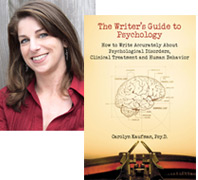
Carolyn Kaufman, PsyD's book, THE WRITER'S GUIDE TO PSYCHOLOGY: How to Write Accurately About Psychological Disorders, Clinical Treatment, and Human Behavior helps writers avoid common misconceptions and inaccuracies and "get the psych right" in their stories. You can learn more about The Writer's Guide to Psychology, check out Dr. K's blog on Psychology Today, or follow her on Facebook or Google+! 

Wednesday, November 2, 2011

Common Grammatical Mishaps

Courtesy of lusi


For me, grammar has always been more of an instinctive thing, and it wasn't something I was even aware of until I started studying French in middle school. Up until that point, my concrete knowledge of grammar consisted of knowing what nouns and verbs were.

Then I started writing seriously. And that was when I got my first inkling of how little I knew.

Fortunately, grammatical know-how is something that can only improve and deepen with time and study.

I've complied a list of handy online resources that detail and explain common grammatical mistakes and questions:

From Easy Writer: a list (and examples) of 20 of the most common error patterns among US college students. The site also has a section detailing different styles of documenting your sources.

The Purdue Online Writing Lab (or OWL) is another excellent resource. It has a list of exercises that include grammar, punctuation, spelling, and sentence structure among others. They also come with a handy answer key. OWL also offers an APA and MLA formatting guide.

Another awesome resource is Grammar Girl. She offers a wide range of grammar tips with easy to read (I have a short attention span when it comes to reading technical stuff) explanations. For example, the difference between affect and effect.

Despite taking advanced and honors language classes, I escaped the joys of learning how to properly diagram a sentence in school. A joy that I'm working on learning how to do now. Here's a great site that explains how to diagram a sentence.

What's the point in learning how to diagram sentences? Is it necessary?

Probably not, but the point of grammar is to provide a framework that allows us to clearly explain our thoughts. My reasoning is that the more I understand how this works, the better I'll be able to convey my meaning.

My last fail-safe is my good friend Google. When I have a question--lie or lay? To hyphen or not--I type it in the search engine. If I'm trying to figure out whether or not to hyphenate a word (for some reason, I can't keep the hyphenation rules in my head), I type the words into the search engine and see what it brings up. Through this, I've discovered that some words are hyphenated if they come before the noun, but not hyphenated if they come after. Who knew? (Not me. :p) This also works great for words I'm misspelling, so I can't find them in my laptop's dictionary. O:)

What about you? Do you have any good grammar resources?


 Danyelle Leafty (@danyelleleafty) writes MG and YA fantasy. In her spare time, she collects dragons, talking frogs, and fairy godmothers. She can be found discussing the art of turning one's characters into various animals, painting with words, and the best ways to avoid getting eaten by dragons on her blog.

Monday, September 26, 2011

Tensed Up

Courtesy of penywise
Two of the "writing rules" most newer writers hear about right off the bat are 1) kill all or most of your 'to be' verbs, and 2) helping verbs are bad.

Like any other of the various rules, these things are meant to be helpful, but should be taken worth a grain of salt. While they are good things to keep in mind in general, they don't apply to *all* situations.

Tenses, for example.

The use of helping verbs--the dreaded had--or 'to be' verbs, when dealing with tense, are necessary. (And here is where I'd caution that writers pay special attention to the tense they're using. If a writer finds themselves mostly in the past perfect tense, it might be a good idea to re-evaluate the structure of the story.)

Most people know the three different tenses by name: past, present, future, but there are subgroups for each. It's a good idea to be aware of these, especially in terms of how a writer is using them in their manuscripts and for their story structure.

Past Tense--the tense in which things have already happened.

Simple Past: I wrote a book.
Past Progressive: I was writing a book.
Past Perfect: I had written a book.

Why is it so important to be able to distinguish between the three subgroups above? For me, it's a matter of temporal accuracy. Most novels are written in the past--the simple past. But sometimes things are still happening, even though they're in the past tense, or sometimes a character is discussing something that goes into the past past, or the past perfect.

When I'm beta reading and come across something that happened in the past perfect, but is written in the simple past, I'm often thrown out of the story trying to figure out *when* the action is happening. Using the correct tense keeps the words invisible so the reader can follow and understand the story.

The good news is that these three subgroups follow the same pattern across the tenses.

Present Tense--the tense in which things are happening now.

Simple Present: I write a book.
Present Progressive: I am writing a book.
Present Perfect: I have written a book.

Future Tense--the tense in which things are going to happen.

Simple Future: I will write a book.
Future Progressive: I will be writing a book.
Future Perfect: I will have written a book.

Resources for Further Study


Progressive tenses--an overview of how to form them
Guide on when to use progressive tenses
An overview of the tenses by Purdue's Owl Online Writing Lab--fabulous resource for all things grammar.

Danyelle Leafty (@danyelleleafty) writes MG and YA fantasy. In her spare time, she collects dragons, talking frogs, and fairy godmothers. She can be found discussing the art of turning one's characters into various animals, painting with words, and the best ways to avoid getting eaten by dragons on her blog. Her serial novel THE FAIRY GODMOTHER DILEMMA can be found here. The first 12 chapters of THE FAIRY GODMOTHER DILEMMA are available here.

Monday, September 19, 2011

The Grammar Hokey Pokey

You put the comma in…
You take the comma out… 
You put the comma in
And you shake your fists about…

We’re always looking for a way to stand out from the crowd. Our voice. Our stories. Our hooks. Our platforms. Those are all good ways. But…grammar? Grammar is non-negotiable. You don’t want to stand out by re-writing the rules. I mean, you wouldn’t type your query or synopsis in txt spk (lol) or ALL CAPS, would you? Louder is not better. It’s just annoying.

Bad grammar is annoying, too. Learn the rules. Improve your craft. Be a master of language. That’s a much better way to stand out.

I assume everyone will spell check and knows the difference between your and you’re (and, goodness help us, yore.) But what about the trickier things like that versus which? Or…

dun dun duhnnnnnn

Commas.

That’s right. Commas. Those tiny twists of pure evil. Those little hooks that snag up our sentences and send us sprawling.

I hate ‘em, myself.

But, alas, being a writer means we need to remain objective when it comes to proper punctuation. Love them or hate them, the laws of grammar must be obeyed.

I Put The Commas In

In an effort to improve my craft, I often take online courses through Pennwriters, my writers’ organization. One particular class focused on scene and sequence but I got a bonus lesson—commas.

Commas do one of two things, my instructor said. They either set off or separate. She then went on to discuss clauses and all these other things my English teachers tried in vain to teach me. I studied, I evaluated my writing, and I saw what I’d been doing wrong: I had a tendency to place commas where they didn’t belong.

Thus, lesson learned, I opened my 106,000-word manuscript and fixed every comma gone wrong.

I Took the Commas Out

Satisfied with my new mastery of commas, I made a solemn vow to abuse commas no more and sent out a submission to a publisher. The rejection was shocking. There's quite a few simple grammar errors in your synopsis -- missing commas mostly -- and if they're in your query it makes me think they'll also be in your novel. I'm afraid that over 100'000 words it's the sort of thing that would send an Editor a bit batty.

What? Were they kidding me? I was so incensed I almost organized a cage match between that slush reader and my instructor. Instead, however, I settled for some teeth grinding and adding the publisher to my ignore list. I’d let those editors retain their questionable sanity and I’d stay far away from people who were obviously heavy comma abuse addicts. The last thing I should have done was respond with an angry retort or, worse yet, lecture on proper punctuation. Not all junkies come clean. I was too new to comma sobriety to hang out with people exhibiting at-risk behaviors.

And I Shake My Fists About

As writers, we have a duty to learn the rules of the craft. Sometimes the rules are slippery and seem to change at the whim of whoever is in charge. For example, I once got editor’s notes back on a short story only to find he added in a bunch of terrible commas. I could have fought the madness…but I was in a rather lenient mood. I just accepted the track changed and did a little *head desk* thing.

It’s his magazine, I reminded myself. He can put commas wherever he pleases. At least he didn’t blame any type of mental illness on me.

Maybe we have to bend a little and play by their rules if it comes down to having a contract or not. Regardless. We still need to learn all we can. Our reputations and our first impressions may depend on it.

I recently came across the comma topic on the QueryTracker.net Forum. One of our QTs gave a beautiful summation of comma usage. (The post is a must read. Thanks, Tabris!)

Could commas be explained so simply? And were there actually other Elements of Style nerds out there? At least I now know where all that previous publisher hate came from. They weren’t comma abuse junkies--they’re just European. (Explains their comma-awkwardness.)

Tabris also went a long way to confirm everything my Pennwriters instructor told us. It helped heal the wound left behind by that publisher’s rejection. (Hey, those things sting.)

Good luck, writers, on your own grammatical gauntlets and your word dances and your quests for good craft. Be true to the rules and obey the laws of punctuation. Do not, as William Sabin writes in THE COMMA, Excerpt from The Gregg Reference Manual, sprinkle commas down upon your writing like confectioners’ sugar upon a cake. Go forth and inflict comma trauma no more.

You do the Grammar Hokey Pokey
and revise another round—
That’s what it’s all about.


Ash Krafton is a speculative fiction writer who resides in the heart of the Pennsylvania coal region, where she keeps the book jacket for "Abraham Lincoln: Vampire Hunter" in a frame over her desk. Visit the Spec Fic Website at www.ashkrafton.com for updates on the release of her debut novel, Bleeding Hearts, forthcoming in early 2012 through Pink Narcissus Press.

Monday, October 25, 2010

Tuning Up Your Mechanics

A good story is like a well-tuned car.  When everything works well, you can just get in and enjoy the ride.  When your headlights don't work, the muffler has fallen off, and your trunk is being held closed with a bungee cord, the problems are all you can think about.

Here are some tips to help your readers enjoy the ride rather than worying about the springs sticking out of the seats.

1. Mechanics

You’d never take your car on the road if the tires were full of holes. So don’t send out your manuscript without perfect mechanics: grammar, punctuation, and spelling.

I see a lot of writers who expect their crit buddies or beta readers to fix their mechanics, but those writers are cheating themselves. They’re never going to get an in-depth critique that will help them make their story better. Nobody worries about critiquing plot, characterization, or dialogue when they’re reading work by someone who misuses every other homonym.

If you’re not good at grammar, that’s okay.  Take a class at your local community college or buy/borrow some reference books.  Strunk &White's The Elements of Style  and The Chicago Manual of Style are great resources to rely on until great grammar and punctuation becomes second nature to you.

2. Tightening

When a reader says you need to tighten your writing, she means you need to remove clunky, extraneous words and phrases.  Often they're hard to see until you know what to look for, but they rattle around like loose screws.  Here are some tips to help you find and get rid of them.

a. Use strong verbs rather than adjectives and adverbs.
Example: She flung the door open is better than She pushed the door open forcefully.

b. Remove redundancies.
Example: “What were you thinking, you idiot?” he said irritably tells us that the person is angry twice — once through dialogue and once through a verbal tag. Just stick with the dialogue and cut the verbal tag completely.

c. Say everything as efficiently as possible. Pretend that you’re being charged for every word you use. Don’t you want to make sure you’re getting your money’s worth?
Example: He walked right up to her, so close they were nearly touching, trying to intimidate her with his size becomes He moved closer, using his size to intimidate her.

d. Avoid cliches.  We often use cliches because they so often fit.  "Prim and proper" or "tall, dark, and handsome" may very well fit your characters.  The problem is, they fit a lot of other people's, too, and since you want your story to stand out from the rest, you need to make your descriptions unique.
Example:  It was raining cats and dogs becomes It was raining, huge warm droplets that pattered on the blacktop like thousands of tiny feet.

3. A Fresh Coat of Paint: Being Unique

When you go to buy a car, you want the most mechanically sound car you can find, but if you're like most people, you also care how it looks.  You can really make your writing stand out if you can find unique ways to say things.  Don't be afraid to indulge in a little wordplay, trying out unusual turns of phrase or comparisons.

a. Indulge in the sensory details.  For each scene, you need to close your eyes and imagine how the situation smells, tastes, sounds, looks, and feels.  You probably won't describe each sense in most scenes, but knowing will help you choose the most relevant and striking details.
Example: Like soft, dark wings, his voice folded around me. I was at once enveloped by warmth and aware of coldness at the base of my neck. Legs stretched out in front of him, feet braced apart, he was watching me.

b. Use metaphors and similes.  Don't be afraid to compare something to something else, directly or indirectly, as long as you do it in your own words.
Example: A traffic light flashed by; the wire that had once held it aloft eddied across the road in a black tangle. Green and red and gold chips were spattered across the asphalt like misplaced casino currency.

Want to learn more?  A few books that have really helped me get better at editing my work include

* Write Tight
* Revision and Self-Editing
* Self-Editing for Fiction Writers: How to Edit Yourself Into Print
* Make Your Words Work: Proven Techniques for Effective Writing


Carolyn Kaufman, PsyD writes fantasy, scifi, and nonfiction. She loves helping writers "get their psych right" in their stories, and her book on the same topic, THE WRITER'S GUIDE TO PSYCHOLOGY: How to Write Accurately About Psychological Disorders, Clinical Treatment, and Human Behavior is now available for pre-order. Learn more about the book at the WGTP website or ask your own psychology and fiction question here.