QueryTracker Blog

Helping Authors Find Literary Agents

Monday, February 9, 2009

QueryTracker.net Premium Reports

Okay, QT's...

Three weeks ago, I posted regarding the ways you can track your literary agent queries with QueryTracker.net.

I needed a whole post just to go over the basic tracking features, but today I get to talk about the Premium features for tracking queries.

If you need a refresher on how to access your query (and submission) tracking reports, check out my previous post.

And now for the good stuff!

In the same dropdown menu where you can choose the basic QueryTracker reports, you'll see a few reports marked with a (P), showing that those reports are only available to premium members.


The premium reports allow you to break down an agent's responses by season, both overall AND by a specific genre. Once you click "Generate Report," you'll see a chart like this:
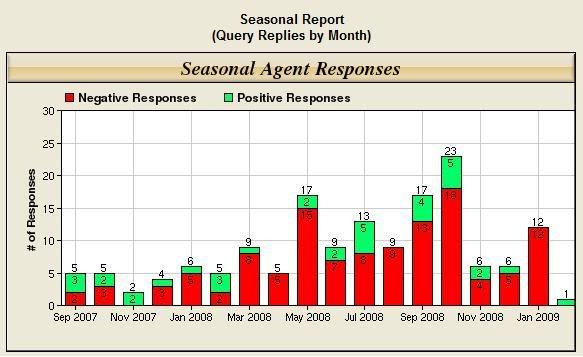
This graph will tell you how many replies an agent made in each month, as well as how many were positive or negative. For instance, on the graph above, we see that Ms. Jessica Faust replied to thirteen QT user queries in July of 2008 and five of those were positive responses (i.e. requests for partials/fulls, etc.) whereas in January of 2009 she replied to twelve QT user queries (all negative replies).

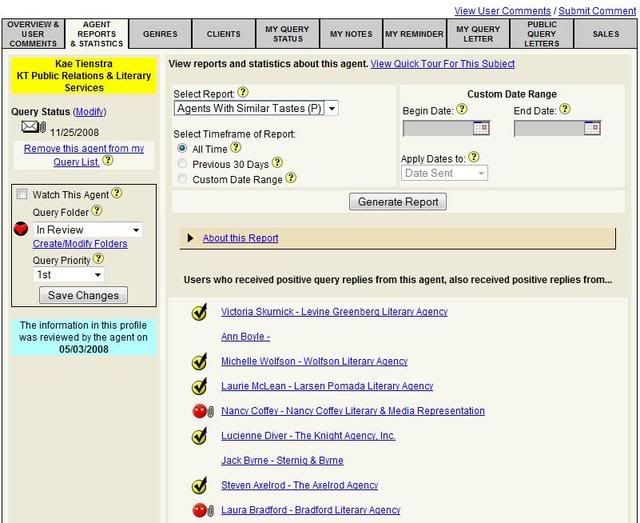
Now, perhaps one of the most useful reports available (especially when you are generating your query list) is the Agents With Similar Tastes report. You'll find it in the same dropdown list as the other reports we've mentioned.

This report will generate a list of other agents listed on QueryTracker.net who gave positive responses to the same projects as the agent you're reviewing. So, for example, I received a partial request from agent Kae Tienstra. If I generate a Similar Tastes report, I'll get a list of agents who requested material on other QT users' manuscripts Kae was interested in. I can then review those listings to determine other literary agents who might be a good match for my project.

The QT symbols appear next to the agents' names, so you can see at a glance what your status is with each agent.
If you like access to as much data as possible, then you will love the final report I'm going to discuss. You'll see a link to it underneath the dropdown menu on the basic Query report.
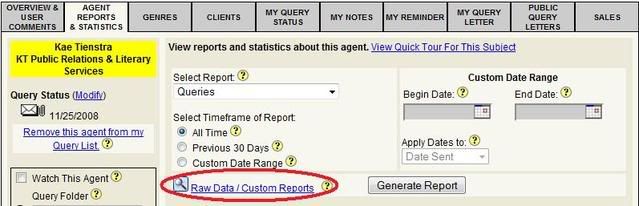

The Raw Data Report basically allows you to see all the query information available from QT users for that agent. You can review it in a huge, enlightening clump of query results, or you can sort it by genre, wordcount, query date, etc. You can also filter the data to show only a specific date range, or wordcount, etc.

In the data report below, I have filtered the data to only show replies received from this agent during August of 2008, when I received my partial request.


The Raw Data report is phenomenally helpful in judging when to expect a reply. Despite their demigod appearance to many aspiring authors, agents are people with their own busy lives. And even if you're a relative newbie to publishing, you've probably already noticed how slowly this process moves. So, at times, listed response times can be a smidge... optimistic.

Like the minutes on a football clock don't show exactly how much longer before the game finishes, the response times listed on agent websites don't always represent how long a reply will take. And of course, queries and replies DO occasionally get lost in transit, so the Raw Data report can help you know when to assume your query has gone AWOL. If the Raw Data report shows that other QT users who queried around the same time have not heard a reply, it's a safe bet that the agent's response time is currently longer than stated.

Seriously... how awesome is that?


And speaking of awesome, during last week's suggestion session, a few of our loyal blog readers mentioned their interest in hearing from industry professionals. Well, wish granted!

On Wednesday, here on the QueryTracker.net blog, we'll be featuring an interview with Angie Lofthouse.

From her blog:

Angie Lofthouse is a stay-home mom of six children. Her fiction has appeared in NFG, AlienSkin, Amazing Journeys, The Sword Review, Dragons, Knights and Angels, Irreantum, and Unparalleled Journeys. She is also an editor for Mindflights Magazine. She lives in a little canyon in the foothills of the Wasatch Mountains with her family of writers, artists, singers, composers, illustrators and musicians.


Don't miss it!

H. L. Dyer, M.D. writes women's fiction and works as the Clinical and Academic Director for the Hospitalist Program at a pediatric teaching hospital near Chicago. In addition to all things literary, she enjoys experimental cooking and composing impromptu parodies to annoy close friends and family. Click to visit her personal blog, Trying to Do the Write Thing.

Friday, February 6, 2009

Weekly Roundup 2/6/09

This is a mish-mash of random stuff. I'll try to organize it for you. But don't hold your breath.

Contests:

HarperCollins is calling for short stories. Check out their post that lists all the details.

Authoress over at Miss Snark's First Victim is at it again. Her monthly Secret Agent contest opens on Monday. Check here for a list of genres, and here for the rules to enter.

Pulse SPRING FLING Contest. I found this on Lisa McMann's blog. She's the author of WAKE, and her second book, FADE is one you can win. To enter, simply send an email to pulsespringfling@gmail.com with the words Pulse Spring Fling! in the subject line and answer the question, "Who is your favorite fictional couple?" in the body of the email.

One entry per person, US residents only. Contest begins January 1, 2009 and ends February 14, 2009. Winners will be announced Monday, March 2nd, with prizes delivered mid-March.

Click the image to see more.
Agent/Publishing Industry posts I liked and thought you might like, too:

I have fallen in love with The Blood Red Pencil blog. They have some great things going on over there. My favorite one in the past couple of weeks is this one on beginning your novel. Everyone agonizes over the beginning. Read it. Use it. Write it.

I know this is a bit old (from January), but I find it interesting to keep up on things going on in the publishing business. I don't read much from Publisher's Weekly, but it is a great place to get information. I like the book reviews and occasionally browse the deals so I can see what's being sold RIGHT NOW. This article on the end of publishing as we know it made Nathan Bransford's blog, and that made me sit up and take notice. I still think we should all go for that agent, that big publishing house. That's still my goal, anyway. Everyone must decide for themselves the route they will take. What's yours?

I also loved this post by Jessica Faust about the rejection letter. So many of us say, "If I only knew what to fix, I'd fix it!" The rejection letters we get don't give us anything specific to fix. In reality, it may just not be for that agent.

Great post by Agent Rachelle Gardner about passion. Everyone needs passion in their writing. And commas. How to merge the two? Check out the post.

Since I can't attend the SCBWI Conference, I like seeing posts from people who can. This one brought some hope to a bleak economy and other slow publishing news. Children's writers, take heart!

Things worth noting:


Because I like to Twitter, and apparently so do some industry folks. Check them out. You might also want to check this post for how to use Twitter for what you want.

Literary Agent stuff:

This post by Chuck Sambuchino over at the Guide to Literary Agents blog announced that Gary Heidt and Ellen Pepus have teamed up and started a new literary agency, Signature Literary. They both represent a range of fiction and non-fiction genres, so check them out. In fact, I love pretty much everything Chuck posts over there. If you haven't added his blog to your reader, you should.

We have so much planned for next week! A series on critique groups, tips for a manuscript tune-up and more! Stay tuned. Same QueryTracker time, same QueryTracker blog. Have a happy writing weekend!

Thursday, February 5, 2009

In Short: Writing a Novel Synopsis That Rocks

Okay, QT's... as promised I am back to discuss how to create a rockin' synopsis.Now-- just like with a novel-- there is no single way to write a synopsis. There are many folks on these internets and in Pitchcraft texts such as Katharine Sands' Making the Perfect Pitch or The Sell-Your-Novel Toolkit giving advice on how to write a compelling synopsis. I'll include links to several of the online references at the bottom of this post.

In general, the recommended processes fall into one of two categories: to start with your one-word logline (which our lovely guest blogger Michelle McLean discussed yesterday) and build up. Or to start with your novel and condense down.

While either method may work well for you, the best synopses in my experience were created using the second method. I'm going to describe the system I use for synopses and why it works for me.

When I first began preparing my manuscript submission, I drafted a 2-page synopsis using the "just describe your novel as briefly as possible" method. To admit that my original synopsis failed to rock would be an understatement. In attempting to be as brief as possible while "revealing all", I had virtually eliminated the component that makes a project unique.

I had surgically extracted my voice from my work.

Luckily, before I began submissions, I found another way.

A contest I was considering entering required an 8-page synopsis. I had read that agents or editors may request a "Chapter Synopsis," which is a brief summary of each chapter of your novel. So, I decided to write my chapter synopsis first, and then see where I was lengthwise.

Now, chapter synopses are not often requested. In fact, despite many requested proposals for my manuscript, I have yet to send my chapter synopsis for The Edge of Memory to a single agent. But I still strongly recommend you write one. Here's why:

1. For me (and for most writers I know), it is much easier to edit down than up. The chapter synopsis will hit all your main conflicts and give you the length flexibility to preserve your voice. Then you can cherry-pick the best bits when you trim down to the length you need. BONUS: Agents will request synopses of varying lengths. My requested synopses have varied from 1 - 8 pages. You can create these various lengths along the way as your editing progresses.

2. It's a lot less daunting to summarize a chapter than it is to summarize a WHOLE manuscript. The Baby Steps approach is nothing new, but it is surprisingly effective.

3. The chapter synopsis will help you to edit your novel Big Picture style. Our writing, our characters are personal. In the creative whirlwind of drafting a novel, we sometimes create scenes that don't resonate with the rest of the story. Once they've been created, and edited to polish the writing to a blinding shine, it can be easy to miss the fact that the scene isn't actually necessary to the story we're telling. Or that the characters have changed since the scene was written.

Each chapter, like a novel, should have a beginning, middle, and an ending. And the chapter, overall, should work to improve our understanding of the characters and to advance the plot. You might well discover while composing your chapter synopsis that a chapter or two needs reorganizing, or your novel may be stronger without them altogether.

So, here's my recommended method for writing your synopsis:

Step One: For each of your chapters, write 2 - 3 sentences to summarize. Use strong verbs and language that captures your tone and voice as much as possible. Focus on the CONFLICTS. For mine, I wrote three sentences for each chapter. The set-up, the conflict, and the resolution.

For example, my first chapter summary reads:

When a young girl collapses in an unfamiliar house, no one knows where she came from or how she ended up on war widow Thea Greyson's front porch that stormy night. Thirty years later, Beatrice is devastated by the death of the woman that took her in. But her grief turns to a sense of betrayal when she discovers the letter from her birth mother that Thea claimed was lost.
Which may seem familiar to you if you follow the BookEnds blog (where Jessica Faust critiqued query pitches over the holidays). Because, with some minor revisions... Hello, first-half-of-query-pitch!

Step 2: If you're having trouble identifying the beginning, middle and ending of a chapter, there may be a problem with the chapter itself. Revise your manuscript as necessary.


Step 3: Once you've written a few sentences for each chapter, check your summaries for chapters which are not working because they are unnecessary, tangential, inconsistent, etc. Revise your manuscript as necessary.

Step 4: Group your chapters into acts. Most story arcs follow a three-act format. The first act generally establishes the protagonist's starting place (the first act is also usually the shortest) and continues to the point where your catalyst drives or forces the protagonist to make or endure a change. The second act is represented by the series of events that bring the protagonist to the climax. In the third and final act, the story rises to its climax and resolution.

For example, in The Wizard of Oz, the first act would end when Dorothy lands in Oz. The second act would comprise the journey to the Emerald City, and the third and final act would consist of the climactic showdown with the Wicked Witch of the West, and the resolution where each character realizes they already have the power within themselves to get what they want.

Step 5: Get out your editing scalpel. Depending on the length of your novel and chapters, your chapter synopsis will probably be longer than your desired length. So now, within your three-act collections of chapter summaries, you'll have to start trimming. Based on the requests I've received, I would recommend trimming to a 5-page length, and then trimming further to 1 - 2 pages. You can always edit to other lengths if necessary, but the vast majority of requests are satisfied with one of those two options.

Step 6: Read your synopsis aloud to yourself, looking for words or phrases that fall flat or pull the reader out of the narrative. The end result should resemble the sort of descriptions you see for movies in TV Guide and the like. Brief and punchy... don't let yourself get bogged down in things like setting or physical descriptions of the characters.

Step 7: Check to be sure you've accomplished your basic synopsis goals. Have you established the main characters and their motivations? Have you demonstrated the main conflict and the obstacles preventing the protagonist from achieving his or her goals? Do the events of your plot unfold naturally without resorting to cliches or plot devices? Do your plot twists culminate in a climax? Is the resolution of the story conflicts thorough and satisfying (Have you tied up any loose ends?) Does the language and tone of your synopsis reflect YOUR voice?

If your synopsis has done those things, Congratulations!

You now have a synopsis that rocks. Yay, you!


Don't forget the Novel Synopsis Basics we talked about last week, or course. ;)

For other folks' thoughts on writing a synopsis, check out these links:

Mastering the Dreaded Synopsis
Writing a Synopsis From the Ground Up
Writing the Synopsis: The Basics to Get Your Book Synopsis Written
How to Write a Synopsis
Workshop: Writing the Novel Synopsis

ETA (2/9/09): Jessica Faust posted a nice guideline of synopses on the BookEnds Blog this morning.

H. L. Dyer, M.D. writes women's fiction and works as the Clinical and Academic Director for the Hospitalist Program at a pediatric teaching hospital near Chicago. In addition to all things literary, she enjoys experimental cooking and composing impromptu parodies to annoy close friends and family. Click to visit her personal blog, Trying to Do the Write Thing.

Wednesday, February 4, 2009

Writing a Logline/The One-Sentence Pitch

Note from Archetype/Carolyn: Today's post is by fellow writer Michelle McLean. If you've been struggling all week to come up with a one-line elevator pitch, this article is for you!  Now, I'm the sort that likes worksheets to scribble on when I'm tackling something as important as this, so I created a worksheet to go with Michelle's article.  You can find it here in PDF format.  Once you're all finished, feel free to share what you came up with in the comments of Mary's Elevator Pitch post .

Writing a Logline/The One-Sentence Pitch

by Michelle McLean

In this article, we are going to discuss how to create a logline for a novel. It is important to remember that every story is different. Some will need a little more information, and others can get the point across in three words or less. Well…maybe a few more than three words, but you get my drift.

First of all, what is a logline?

A logline is basically a one line summary of a screenplay or script. Since we are creating these for a novel instead of a script, we’ll call them hook lines. They can run two or three lines, but no more than that.

Why do you need one?

Your hook line, like a logline, takes a story full of complex plotlines and high-concept ideas and breaks it down into a simple sentence that can be quickly and easily conveyed to a wide range of people. Your hook line is your first pitch in getting someone interested in your book. It can be used as the first line in your query letter, to help hook the agent into reading the rest of the letter and requesting information. And it is especially useful for those pitch sessions at conferences or lunches. When a prospective agent or editor asks you what your book is about, your hook line is your answer. Because it is a simple line or two, it is also handy for those family dinner parties when Grandma asks what your book is about.

How do you create a hook line?

This is actually easier than it sounds. You do not need to condense your entire book into one sentence. But you do need to give enough information that the agent/editor/curious acquaintance you are addressing gets the gist of your book and is interested enough to want more.

Elements of a Hook Line

  • Characters – Who is the main character? What does that main character want? What is his/her main goal?
  • Conflict – Who is the villain of the story? Or what is the main obstacle to the main character obtaining their goal?
  • Distinction – What makes your book different then all the rest? What is the unique element of your story that makes it stand out? Is your book a romance between a young man and woman? What makes them different?
  • Setting – for a novel, adding a little about the setting, time period, and possibly genre (if it’s not obvious) is a good idea. For example, the hook line for my book, which is an historical romantic suspense, could begin “A young woman in Victorian England…”.
  • Action – Your hook line needs to have action, excitement. For example, which hook line catches your interest more?

    • A woman has an affair and runs off with her new beau.
    • A neglected wife and mother has a torrid affair with an ex-con and kidnaps her children as she flees across the country with her lover.
The difference is the inclusion in the second example of action and description words. The woman becomes a “neglected wife and mother.” She has a “torrid” affair. The beau is an “ex-con,” implying a world of danger and crime. She doesn’t just run off, she “flees,” kidnapping her children in the process.

Examples:

Here are a few examples of loglines from well known movies. (Yes, I know we are creating hook lines for a book, but the concept is the same, and examples of loglines are easier to find).
  • When a Roman general is betrayed and his family murdered by an insane and corrupt prince, he comes to Rome as a gladiator to seek revenge. (Gladiator)
  • In a future where criminals are arrested before the crime occurs, a cop struggles on the lam to prove his innocence for a murder he has not yet committed. (Minority Report)
  • A 17th Century tale of adventure on the Caribbean Sea where the roguish yet charming Captain Jack Sparrow joins forces with a young blacksmith in a gallant attempt to rescue the Governor of England's daughter and reclaim his ship. (Pirates of the Caribbean)
  • A young man and woman from different social classes fall in love, must outwit her abusive fiancé, and find a way to survive aboard an ill-fated voyage at sea. (Titanic)
  • A comedic portrayal of a young and broke Shakespeare who falls in love with a woman, inspiring him to write "Romeo and Juliet. (Shakespeare in Love)
  • An archeologist is hired by the U.S. government to find the Ark of the Covenant before the Nazis. (Raiders of the Lost Ark)
For your own hook line, you need to decide which elements best convey what your story is about. It is interesting to see how adding different elements affects a hook line. For example, take a look at these two movie loglines.
  • After a twister transports a lonely Kansas farm girl to a magical land, she sets out on a dangerous journey to find a wizard with the power to send her home. (logline by Brian A. Klems, found at http://blog.writersdigest.com/qq/What+Is+A+Logline.aspx)
  • Transported to a surreal landscape, a young girl kills the first woman she meets, then teams up with three complete strangers to kill again. (Log Line attributed to Richard Polito of the Marin Independent Journal, who writes humorously sarcastic briefs for the paper's daily TV listings)
Both of these loglines are for the film Wizard of Oz, but they each give the film a distinctly different tone. Personally I like the second one best :D but the first probably gives a better idea of what the film is about.
It might take a little while to get your hook line perfected, but if you stick to the main elements of your story (the main character, the villain or conflict, what is unique about your story, and spice it up with a little action), your hook line should almost write itself. Just to show you that ANYONE can do this, (because if I can do it, anyone can), the hook line for my book is below.
A young woman in Victorian England is swept into an illicit affair with a reformed thief and must find a legendary necklace to ransom her life and the lives of those she loves from a corrupt lord. 
Can you spot the elements?
  • Characters – a young woman and her love interest who is a reformed thief.
  • Conflict – a corrupt lord (the villain) is threatening her life and the lives of those she loves unless she can find a legendary necklace.
  • Distinction – my story is not just a romance, but has a big dose of suspense and mystery thrown in. The love interest is not a typical man but an ex-thief, and while the romance comes in with the affair, it is an “illicit” affair (implying something out of the ordinary, something forbidden).
  • Setting – Victorian England. And the description of the story gives obvious clues to the genre – Victorian England = historical; illicit affair = romance; a treasure hunt/mystery and lives threatened = suspense….Genre = historical romantic suspense.
  • Action – instead of saying my story is about a girl and guy who fall in love and search for a necklace, I describe the love story as an “illicit affair;” the necklace is “legendary,” the lord is “corrupt,” the love interest is “a reformed thief.” All these little elements help make the hook line more exciting, more interesting. And that is what will help hook the interest of potential agents, publishers, and readers.
--
About the Author
Born in San Jose, CA, Michelle McLean is the oldest of five children. She has always been an avid reader and began to write at a very early age. She has a passionate love of learning, which led to earning a Bachelor's degree in History and a Master's degree in English. She currently lives in Utah with her husband, two young children, and one very hyper dog. Visit her website at http://authormichellemclean.com/index.html and her blog at http://www.michellemclean.blogspot.com/.

Tuesday, February 3, 2009

Quotation Marks


Having taught high school English and being a writer who loves to read other aspiring authors' manuscripts and queries, I've read hundreds of poorly punctuated pages.  Even the coolest, most imaginative stories are hard to enjoy when the pages are marred by technical errors.  

One of the most common mistakes I see is the misuse of quotation marks.  Now, let me preface this by saying that I am addressing American punctuation in non-scholarly texts.  It differs slightly from county to country, which is probably the root of some of the confusion. 

RULE 1:  Double quotation marks (" ") are used to indicate what someone said or wrote.  

If you pick up a book and see single quotation marks used for standard dialogue, it is probably not the product of an American publisher.  Although the trend is shifting to double quotation marks in British publications, you will still see single quotation marks (' ') used to indicate direct quotes occasionally.  There are also exceptions in scholarly writings.  

RULE 2:  Single quotation marks (' ') are used to indicate quoted material (or titles of poems, stories, articles) within other quoted material.  

Example:  Patrick said, "Mary said, 'Look!  I'm using single quotation marks.'"

RULE 3:  Ending punctuation goes INSIDE the quotation marks.

Right:   Mary said, "The punctuation goes inside the quotation marks."
Wrong: Mary said, "The punctuation goes inside the quotation marks".

This rule even applies to single quotes:

Right:   Patrick said, "Mary said, 'The punctuation goes inside the quotation marks.'"
Wrong: Patrick said, "Mary said, 'The punctuation goes inside the quotation marks'." **
Wrong: Patrick said, "Mary said, 'The punctuation goes inside the quotation marks'".

**This is the most common single quotation mark error I see.  The punctuation goes inside all the quotes.  There are rare exceptions, which I will address later in this post.  

RULE 4:  Quotation marks are used to set off direct quotes only.

Right:   Carolyn said, "You should listen carefully."
Right: Carolyn said that you should listen carefully.
Wrong: Carolyn said that, "You should listen carefully." 

RULE 5:  The placement of question marks with quotation marks follows logic.  

Yeah, this one is less concrete, but it's clear in application.  If the quoted material is a question, the question mark goes inside.  If the material in quotation marks is a saying or not part of the question itself, the mark goes outside.  This is one of the exceptions I mentioned in RULE 3.  You will also find this "logic" rule applies to other types of punctuation with regard to quotes. 

Examples:  
Heather asked, "Did you read the QT Blog today?"
Do you believe in the saying, "Haste makes Waste"?  

Note:  In the second sentence, the quoted material is not the question.  You cannot use more than one ending punctuation mark, so you cannot put a period inside the quote and a question mark outside of it.  Most punctuation is uniform and logical.  Use common sense when you come up against an uncommon situation like the second example above.  The stronger mark wins.  And just to make it more fun, an exclamation mark will supersede the question and suffice to end the sentence.  I avoid this, because it's ...well, weird and drives critique partners nuts. It's like the Rock, Paper Scissors game of punctuation.  Exclamation mark trumps question mark. The emotion and impact of the quoted material supersedes the fact it its a question. The example below is a question, but it is also a powerful proclamation.  The exclamation point trumps the question mark. 

Example:  
Wasn't it Patrick Henry who said, "Give me liberty or give me death!"  

If you have a question outside the quoted material as well as inside, use only  one question mark inside the quoted material.

Example: 
Did he say, "Can you hear me now?"

RULE 6:  Set off quoted material with commas.  

Examples:    
Mary said, "Set off quoted material with commas."
"Set off quoted material with commas," Mary said.  

This gets more complicated when dealing with the more powerful punctuation marks like the question mark and the exclamation point.  Once again, logic comes into play.  

Right: "Did you see the sunrise this morning?" Suzette asked.  
Wrong: "Did you see the sunrise this morning," Suzette asked?
Wrong: "Did you see the sunrise this morning," Suzette asked.  

Right: "Dude.  Check out that sunrise!" Elana shouted from the beach. 
Wrong: "Dude.  Check out that sunrise," Elana shouted from the beach! 
Right: "Dude.  Check out that sunrise," Elana shouted from the beach.  

There are two correct options in the last set of examples because exclamation points are for impact, not function like the question mark.

Long (multiple paragraph) speeches in dialogue:

If a character's speech goes on for more than one paragraph, use double quotation marks to open the speech and at the beginning (but not at the end) of each new paragraph in the speech.  Close the speech with double quotation marks at the end of the final paragraph.  

Disclaimer and waiver of liability:  Okay, the heading of this paragraph is overkill, but I want to let you know that I'm aware that there are exceptions to every rule.  I've tried to give an accurate overview of the American use of quotation marks for dialogue.  My six rules for the use of quotation marks can be verified and supplemented by Strunk and White's The Elements of Style  and The Chicago Manual of Style. 

I'd love to hear from you if you have questions or just want to give me a shout. marylindsey@QueryTracker.net (link in the right sidebar). Have a splendid week.

Mary 

Mary Lindsey writes paranormal fiction for children and adults. Prior to attending University of Houston Law School, she received a B.A. in English Literature with a minor in Drama.

Mary can also be found on her website.

Monday, February 2, 2009

Let's talk premium!

Thanks to all who entered our Suggestions Contest! Watch for future posts inspired by your great ideas. And stay tuned – at the end of this post the contest winners will be announced!


The basic features of a free QueryTracker.net membership have been covered by Elana, Heather, Suzette, and Mary. Now let’s talk about PREMIUM FEATURES! Today we’ll cover a few of the basics:


NO ADVERTISEMENTS – Becoming a Premium Member not only gets rid of those annoying ads, but also speeds up your page loads.


AGENCY CROSS-REFERENCE – At a glance you can see who else is in a particular agency – and whether you’ve queried (or been rejected by) them!


ORGANIZATION - There's no limit to the number of folders you can create, which allows limitless opportunities for you to arrange your data how deem best.


QUERY STATS - My personal favorite! View a graph comparing your query statistics to those of the average QueryTracker user.


IS IT PRICEY??? Rest assured that our most amazing Patrick McDonald, who has been known to pen a novel or two himself, has our best interests at heart and wants to make these amazing tools affordable for everyone. $25. That’s the price of a Premium Membership. Per year. PER YEAR! That’s it.

For those of you who recognize me as SuzyQ on the Query Tracker Forum, I’ve been known to expound about my premium membership being the best $25 I’ve ever spent. I wasn’t kidding! Not only have these features made my life easier, they’ve upped my odds of landing an agent. An invaluable tool is the Premium Reports which Heather will address next week. In the mean time, for those of you who can't wait to find out more, take a peek at all the Premium features.

And now, for the winners of our Suggestions Contest…

The Grand Prize goes to Lady Glamis for her most amazing comment on question-and-answer sessions. We couldn't resist choosing a runner-up as well. Selestial-owg wins a prize for the sheer number of good ideas. Winners, send me an email (suzettesaxton@querytracker.net) for details on how to redeem your prize.

Thanks to all who entered. We'll be sure to have another contest of this kind in the future!
Suzette Saxton's idea of a perfect day includes a picnic lunch, laughing children, and her laptop. When she's not writing books for kids, Suzette can be found gardening, doing finish carpentry in her home, or walking in the canyon in which she lives.

Friday, January 30, 2009

QT Weeky Roundup

Contests + 1 Webinar

Amazon.com's 2009 Breakthrough Novel Award contest opens for submissions on February 2; submissions are only open until February 8, so get ready to submit!
Don't forget about our Suggestions Contest.  We want to hear all about what you'd like to see on the QueryTracker.net blog -- and we're even handing out a free first-chapter crit to one random suggester.  Get all the details here.

Interested in learning more about the children's market?  Want a chance to have your first page critiqued by an insider?  Find out more about Alice Pope's February 12th webinar here. 


Thanks so much to everyone who participated in the Link Lotto contest!  This week's winner is Vicki Tremper -- congratulations, Vicki!  This was our final round and the contest is now closed, but we still encourage you to link often and thereby help others find out about both the main QueryTracker.net site and our blog!

New Agents 


Patrick has added new agents to the database. You can always check when new agents are added by clicking on LITERARY AGENTS > NEW & UPDATED AGENTS from the main QT site.

1. Hannah Brown Gordon at Foundry Literary + Media reps
  • Fantasy
  • Historical Fiction
  • Literary Fiction
  • Science Fiction
  • Women's Fiction
  • Young Adult
as well as several types of nonfiction including
  • Biography and Memoirs
  • Celebrity, Pop Culture, Music, Film and  Entertainment
  • Current Affairs and  Politics
  • Science and  Technology
  • History and  Military
  • Narrative 
  • Psychology
2. Kate Hordern at the Kate Hordern Literary Agency in the UK
3. Thomas Willkens at The Jeff Herman Agency, LLC reps tons of different types of nonfiction
4. Marsha Philitas at the L. Perkins Agency reps
  • Erotica
  • Romance
  • Women's Fiction
Coming Next Week

We'll take a look at another great QueryTracker.net feature and bring you Part 2 of Heather Dyer's tips on writing a stellar novel synopsis. Just in case you're still struggling to compose that one-liner for your elevator pitch, guest blogger Michelle McLean is going to help you out. And that's just the beginning, so don't miss next week with the QueryTracker.net blog team!