QueryTracker Blog

Helping Authors Find Literary Agents

Wednesday, September 12, 2012

Using Personal Issues to Enhance Fiction

This is a test of your creative imagination...
There is a projective psychological test called the Thematic Apperception Test (TAT). It’s not the most empirical thing in the world, as the client essentially tells a subjective story about each of a series of (rather dated) black-and-white scenes. Therapist and client then look for recurring themes in the stories, sometimes providing surprising insight into client concerns.

When we write stories of our own, in many ways we are participating in a grand version of the TAT, exorcising relevant life themes onto the page, sometimes over and over. It’s not unusual for a particular writer’s stories to have common elements, characters, themes, and settings.

So how, someone once asked me, how do we avoid projecting our own concerns, our own personal narratives, into our stories?

Honestly, I’m not sure we should try to avoid doing so.  

From a psychological standpoint, there is often something healing in writing, and if you are continually finding the same theme on your page, that repetition compulsion (i.e. a repetitive re-enactment of a particular set of circumstances) may indicate something you (and your characters) need to work through before you’re going to be able to move on to something new. One of the beautiful things about storytelling is that you can play out various outcomes. Don’t be afraid to push your characters into uncomfortable situations. Let them wrestle with the issue or issues in their own ways. See what happens.

Another argument for allowing the same theme to recur is that it’s clearly something that has a lot of energy in your psyche. If you let it, that energy will come through and engage your readers. Especially if you’re willing to push your characters—and yourself—into literary places that are not familiar, comfortable, or safe.
Your main character is afraid of failing in school and not measuring up? Take a deep breath and let him fail. Let all those awful things that he’s (you’re) afraid of happen. How will he overcome those problems? How will those struggles affect him as a person?  

If the theme recurs later, push both your characters and yourself even harder, into even darker, scarier places. Archetypal psychology, often used in storytelling, suggests that each hero must eventually confront his greatest fears if he is to overcome them. Some of your characters may fail or even break under such pressure; they may even become villains as a result. Don’t be afraid to explore those possibilities; you may find some of your best villains down those dark passages.  But also remember that the most exciting plots and the strongest heroes are also born of such trials. It may be a rocky road, but your hero will prevail and overcome…and so will you.
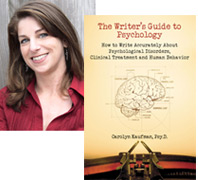

Carolyn Kaufman, PsyD's book, THE WRITER'S GUIDE TO PSYCHOLOGY: How to Write Accurately About Psychological Disorders, Clinical Treatment, and Human Behavior helps writers avoid common misconceptions and inaccuracies and "get the psych right" in their stories. You can learn more about The Writer's Guide to Psychology, check out Dr. K's blog on Psychology Today, or follow her on Facebook or Google+

Monday, September 10, 2012

Beware What You Say!


by Stina Lindenblatt @StinaLL

 ©Stina Lindenblatt

The drive to publishing success can result in the good and the ugly, and everything in between. It motives writers to dissect novels and movies, so they understand what makes for an emotionally compelling story. They attend conferences and workshops. Network and join writing organizations. Develop friends with like-minded writers who understand what they go through, and who can support them during both the high and the lows. 

But with the good comes the ugly. Here are three syndromes that can occur with success. Hopefully none have impacted your life, in one way or another.


I-have-fault-with-your-success syndrome

On the dark side is jealousy. When people you know land agents and book deals, it whispers in your ear, “Why them? Why not you?” And that’s okay, if you use that voice to help make you a better writer. Let jealousy inspire you to sign up for a writing course on emotion or stronger characterizations (or whatever weakness you struggle with). What you want to avoid is finding fault with the person’s success, no matter how small, and verbalizing your opinion. If he wins a manuscript critique from his dream agent in an auction benefiting a charity he believes in, don’t tell him he paid too much. If a small press requests a manuscript from a pitch contest he entered, don’t tell him not to send it because you don’t think much of the publisher. He obviously did if he entered the contest. And if an agent wants to talk to him, congratulate your friend, even if you have issues with the agent. Let him enjoy his moment first. 

Remember, while you’re finding fault with his successes, you can guarantee his other friends aren’t. They’re happy for him and being supportive.

It’s-only-good-if-I-succeed-at-it syndrome

Lately, we’re seeing a lot of success stories in both traditional and self publishing. We’re also hearing a lot of negative talk about both forms of publishing. The best thing to do is be careful what you say. If you are only cheering for one and constantly pointing out the negatives of the other, you’ll lose all credibility if you do an abrupt turn and go the other route. 

If you claim you don’t trust agents and you aren’t interested in querying, how is it going to look to your querying friends when an agent out of the blue offers you representation, because your self-published novel is a bestseller, and you jump at the chance of being signed? Now you're a hypocrite. You didn't trust them before, because they rejected your manuscript when you were querying. Suddenly they are trustworthy because your book is now desirable due to the sales. Really? Don't you see the irony in that? Instead of saying anything negative about agents, especially if your friends are querying, you are better off saying nothing at all.

You never know when things will change and your words and actions will come back and pie you in the face. It's best to be supportive of all opinions available, no matter where they currently fit in your goals.

Broken-record syndrome

Publishing is tough. No one will argue that. Each tiny success should be celebrated. But you know how it is when a song you like is played on the radio ad nauseam. The song goes beyond annoying. That’s what it’s like when you use social media to mention your success. It’s great the first few times, because we want to celebrate with you. But when you go on and on about the same thing, like a CD stuck in repeat mode, people will tune out. It becomes promotional spam. And when something big does happen, few people are now listening. Or worse yet, few will even care. Share your successes, but know when to say ‘thanks’ and move on. Know the difference between being excited and being self-absorbed. One is great, the other isn’t.

The writing community is a supportive place. Let’s keep it that way. Make sure your drive to success is leading you in the positive direction. 

What’s your favorite way to deal with those moments of jealous we all get? Have you ever had to deal with someone whose jealousy became toxic? 


Stina Lindenblatt @StinaLL writes young adult novels. In her spare time, she’s a photographer and blogging addict, and can be found hanging out on her blog, Seeing Creative.  

Friday, September 7, 2012

Publishing Pulse 9/7/12


Around the Internet

From io9: Great SF writers share their biggest setbacks -- and how they triumphed.

How much thought have you given your characters' names? Probably quite a bit, but have you thought about how they work together? Check out Janice Hardy's The Name Game: Do All Your Characters' Names Sound the Same?

Need some tips on revising your novel? Check out author Alex Hughes's tips on how to do it right.

Novel Rocket teaches you how to put together a pitch for your novel (one that nobody will laugh at!).

Need more tips? Write It Sideways gives you a few more to help you slam-dunk that pitch.

And fun fact: This is the QueryTracker Blog's 700th post! Thank so much for being along for the journey!

Have a great weekend and we'll see you next week!


Carolyn Kaufman, PsyD's book, THE WRITER'S GUIDE TO PSYCHOLOGY: How to Write Accurately About Psychological Disorders, Clinical Treatment, and Human Behavior helps writers avoid common misconceptions and inaccuracies and "get the psych right" in their stories. You can learn more about The Writer's Guide to Psychology, check out Dr. K's blog on Psychology Today, or follow her on Facebook or Google+

Wednesday, September 5, 2012

How to be a know-it-all

A couple of years ago, my husband approached while I was reading and sat beside me on the couch. After a few minutes, I looked up. He seemed concerned. "Is there something you want to talk to me about?"

Color me puzzled. "Why?"

He pointed to the book I was reading. The Dance of Anger: A Woman's Guide to Changing the Patterns of Intimate Relationships

Oh, that. I said, "The only problem we're having is that you're married to a writer."

The truism is to "write what you know." That means it's your job to know everything.

You must become, officially, a know-it-all. Or at least, someone who knows how to find out the things she didn't know she needed to know.

My answer? Self-help books. I've already touted self-help books to become fluent in the way other people manage their relationships, but now I'm suggesting them for everything else too. I read self-help books for helps that I either never will need or hope never to need. Why? Because at some point, one of my characters is going to need it.

Your characters probably had a childhood. If you're mean like me, they probably didn't have wonderful, glorious childhoods. On my shelf are books like Raising Adopted Children, Motherless Daughters, and a half-dozen other books about fatherless daughters, abused children, treating traumatized children, and children of divorce.

Childbirth doesn't have to be all about how your character sailed through with an epidural and push-push-push: how about adding to your character's challenges with books by Ina Mae Gaskin, and then for the meta-analysis of birth, throw in a copy of Pursuing The Birth Machine and Birth As An American Rite of Passage? You may have your own experience with having babies or raising children, but since you need to write what you know, now it's time to know every other possible experience. With more possible choices in mind, you'll know better whether your main character might prefer to give birth unassisted in a tub in her living room.

It goes on and on: Boundaries by Townsend and Cloud for when you write your pushover character. The Art Of Verbal Self Defense books for your witty character. The Sociopath Next Door? The Gift Of Fear? Check out a book about how to run your own business even though you don't own a business. One of your characters might want to.

Moreover, the greater your knowledge base, the more opportunity you have to create interesting situations for your characters. Reading a book on management will give you plenty of examples of how lousy bosses operate -- and you may find yourself filling with ideas for future stories.

Right now I'm reading a book called How Not To Marry A Jerk. (Although I admit I'm afraid I'll discover my husband married a jerk.) Not because I want to get married again, but because I want to learn another perspective on dynamics for my characters' sakes. Someday, one of them may want to marry a jerk. It'll be my job then to know why she does it.


Read. Read fiction, but also read how-to. How to live. Then you too can be a know-it-all.


---
Jane Lebak is the author of The Wrong Enemyto be released by MuseItUp on September 28th. She is also author of The Guardian (Thomas Nelson, 1994), Seven Archangels: Annihilation (Double-Edged Publishing, 2008) and The Boys Upstairs (MuseItUp, 2010). At Seven Angels, Four Kids, One Family, she blogs about what happens when a distracted daydreamer and a gamer geek attempt to raise four children. She is represented by the riveting Roseanne Wells of the Jennifer DeChiara Literary Agency. 

Monday, September 3, 2012

Villains: The Guys You Love To Hate

You might think I should be the last person to write about creating your book's villain…because sometimes, I root for the bad guy.

However, that's the precise reason I'm writing on this topic.

Before you assume I'm a bad guy myself, let me explain.

You know Mordred, the bastard son of King Arthur? He's one dark character. His parents were half-siblings, his mother being the witch who fooled Arthur into believing she was someone else the night Mordred was conceived. Raised on a steady diet of vengeance and hate, Mordred rose against his father, leading a war against Camelot that ended in the death of the Once and Future King.

Pretty much a jerk, right? Depends on your perspective but I don't think so. Mordred didn't choose his parents and he couldn't change being ruled by his mother. He grew into what she made him. He couldn't change his destiny any more than anyone else in Camelot.

How about Raistlin from the DragonLance series? Not exactly a Boy Scout Leader, not even when he still wore the red robes of the neutral mages. Elric Melnibone? Classic anti-hero--a term that simply means the villain is the protagonist of the story. Elric kills just about everybody he meets because his sword, Stormbringer, thirsts for blood and souls. (Oh, yeah. He wants to destroy the world, too.)

Why would a good person like me be rooting for these bad guys? Because they aren't flat characters.

Mordred was a child who needed to be saved--and no one was there for him. Raistlin chooses the black robes not only because he's egotistical and power-hungry but also because he wanted to usurp an even greater evil. Elric is a haunted man--desperation drove him to pick up Stormbringer and he comes so close to doing the "right" thing only to fall slave to his howling sword. The whole destroy the world thing? Elric chooses to die so that the balance between order and chaos can be restored. My heart is still broken over that.

I love the bad guys who make me root for them. How boring would stories be if we didn't love/hate each and every character?

Character flaws in a hero are wonderful because they leave room for his growth and expansion. Flaws in our hero give us another reason to sympathize with the character and root for him. Flaws humanize a hero, helping us to relate to them. We see they aren't perfect creations--which is relatable because we're not perfect, either.

But what about villains? They need love, too. Otherwise it would be too easy to hate them. Where's the fun in that?

When a villain has a character flaw, it gives us a way to relate to them without making us feel guilty for liking the bad guy.

Perfect Imperfections

A character flaw in a villain may be a surprising good trait: a talent we admire, a tender personal relationship, a reluctance to cause harm…some inkling that makes us think "there's hope for him, yet." That's what creates our emotional bond to them and further binds us to the outcome of the story. Giving the villain a likeable trait creates a delicious sort of tension in a story because we know the good guy has to win...but what will happen to the bad guy if he does?

Sometimes you can't make a villain act completely out of character--but you can make him wish he could. Give readers a chance to peer into the villains mind and see what he's feeling. It's an excellent way to add psychological and emotional depth to his character. Bad guys have backstory, too, and you can use that backstory as a backdrop for their current motives. Villains don't just hatch out of eggs--they are created by the world and the circumstances surrounding them…the same way as heroes.

Creating a Complexity

Don't let your villain fall flat--make him complex and conflicted. Let your readers teeter on a suspenseful edge, asking "will he or won't he?" It will help make your book a real page-turner.

Ask yourself a few questions:
  • Who is my villain and what is his role in the story?
  • What is his motive?
Now ask:
  • Who was he before he became the villain he is? What is the backstory?
  • What does he do/has he done that is anti-villainous?
  • Who does he sincerely love? What does he sincerely care about?
  • What would change his mind and deter his villainous course?
Have you discovered something about your villain that makes you like him a bit more? I hope so--it will make your final conflict even more interesting because you may want both sides to win. That's a book we won't be able to put down because we'll have to know what happens next.


We want our heroes to succeed and we don't want to see them hurt…but we also want an amazing story. Good vs. evil is conflict, to be sure, but when we give both heroes and villains character flaws we amp up the complexity of their relationship and we create more suspense.

More suspense means emotionally hooked readers. Flesh out your villain with the same care as your hero. Readers like me are always ready to fall for the bad guy.

And that's not a bad thing.


Ash Krafton is a speculative fiction writer who resides in the heart of the Pennsylvania coal region, where she keeps the book jacket for "Abraham Lincoln: Vampire Hunter" in a frame over her desk. Visit Ash's blog at www.ash-krafton.blogspot.com for news on her newly released urban fantasy "Bleeding Hearts: Book One of the Demimonde" (Pink Narcissus Press 2012).