QueryTracker Blog

Helping Authors Find Literary Agents

Monday, August 13, 2012

The Zen of Backstory

Backstory.

It's become an almost-taboo word. It's been associated with evil things like info dumps and terrible first chapters and near-dead pacing.

While true, those things are just half the story of backstory.

Backstory is also what gives a novel its emotional value. It explains a character's motivations and deepens conflict. Without backstory, your character is shallow. Her actions and reactions are random and meaningless.

Finding the perfect balance isn't an easy thing to master but you can learn to do it--it's all about relevance, technique, and timing.

The "What"

Backstory is an abbreviated term for "background story". When beginning a novel, the writer must first explore the character--their emotions, their motivations and any relevant history that will impact their actions and reactions.

Just as a background check examines relevant history of a job applicant, so must the writer learn to focus on the character's relevant history.

For instance, a background check for someone applying to drive a school bus will include having their driver's license inspected for driving violations. They’ll also be scanned for a history of child abuse, drug abuse, and other arrests/violations. A prospective employer isn’t going to care if they are on a bowling team or if their favorite color is chartreuse or if they won Best In Show at the recent farm fair.

Relevance is mandatory.

Sometimes it means excluding a lot of nifty stuff about your character. However, just like in the plotting, if the backstory doesn’t directly move the story forward, it doesn't belong in your novel.


The "How"

Backstory must be artfully inserted into the story. Long chunks of narrative are bad things. You think you’re doing a favor to the reader by explaining something but…it’s boring. (and it's often telling, not showing.)

There are several different ways you can handle your backstory:

Flashbacks: These are tough to write because you have to write them in past perfect tense. Use them sparingly…flashbooks look back and stories look forward. Flashbacks lose the momentum.

Monolog: An option if you’re writing in third person subjective POV.

Dialog: A great way (and one of my favorites). Questions, accusations, tones...it all can allude to a character's history.

Prologue: A prologue is still a first chapter because it gets read first. You better make it good because a bad prologue loses a reader's interest.

Memories: Another good way to use backstory. However, don’t get lost in memory lane because…it's boring. Spot memories are better. We don't need to know everything at once.

Internal dialog: Also a good option, but be careful you don’t head hop. Stay in the correct character's point of view.

Props: Why not? A novel's setting is part of the unspoken story. Keepsakes on a mantle, a collection of books, a ring on a necklace. They can all be used as backstory.

The "When"

The trick is writing your character's backstory so that they know something relevant at a time they need to know it and not one second sooner.

Get the story going before you shed light on the backstory. In most cases, you don't want a drop of it in chapter one--just strong forward moving action/story. You may add the backstory as another layer but be sure you don’t smother your story with it – rather dribble it like a succulent chocolate glaze over a buttery Bundt cake, adding flavor and depth.

Backstory should deepen a character. Use it when your character needs to show why they think and feel and act the way they do in different situations.


The Wrap

Relevance. Technique. Timing. These are the keys to finding the perfect balance of backstory.

Too much backstory and your story will stall to a sludgy stop. Too little and the reader will not develop an emotional connection to your characters. If we can't soldier through the slow spots or if we can't care about the characters, we won't finish reading a book.
Learn how to artfully work with backstory so you can find the perfect balance your story needs.
Photo credit: nazreth


Ash Krafton is a speculative fiction writer who resides in the heart of the Pennsylvania coal region, where she keeps the book jacket for "Abraham Lincoln: Vampire Hunter" in a frame over her desk. Visit Ash's blog at www.ash-krafton.blogspot.com for news on her newly released urban fantasy "Bleeding Hearts: Book One of the Demimonde" (Pink Narcissus Press 2012).

Friday, August 10, 2012

Publishing Pulse 8/10/2012

Agent Kristin Nelson discusses going through 68 queries in 60 minutes.

Author Mette Ivie Harrison has two excellent articles. The first discusses 21 different types of plot shapes for different types of stories. The second is a short checklist of things to think about when creating a magic system.

On Writing on the Ether, Porter Anderson has a great round up of links dealing with rewriting, bestsellers, and more on the DOJ statement.

Author/editor Kristine Rusch has been running a series on what she considers deal breakers in contracts (scroll down to the very bottom of the post for these) and her latest deals with the importance of understanding what you're signing in both publishing and agency contracts with respect to agency clauses.

The publishing industry tends towards a more sedentary lifestyle, and author Christina Katz has started a Facebook group to help change that. Check out Writers on the Move where you can both share and inspire others when it comes to getting exercise. (via Galleycat)

The Atlantic posits the question: Why do female authors dominate young adult fiction?

Finally, if you use an e-reader, there's a good chance that your e-book is reading you. The Wall Street Journal discusses the various ways e-book distributors can track what you're reading, how fast you're reading, and how far you get before you stop reading.

Have a great week end!


Danyelle Leafty| @danyelleleafty writes YA and MG fantasy. She is the author of The Fairy Godmother Dilemma series (CatspellFirespellApplespell, and Frogspell), and Slippers of Pearl, and can be found on her blog. She can also be found on Wattpad.

Wednesday, August 8, 2012

Psychology Q&A: Schizophrenia & Police Work?

Disclaimer: The information provided in this post is intended for writing purposes only and does not represent psychological advice.
QUESTION: I keep returning to schizophrenia as an interesting disorder. I'm wondering what exactly can someone who's schizophrenic (and on his medications) do for a living? Can they be a detective or a police officer? Or is there a better disorder for me to use that would allow them to be a detective or a police officer? I wasn't sure if schizophrenia would keep them from being employed as such. Also,  is there a positive side to the schizophrenia -- a creativity or something along those lines that could be harnessed in the right situations? Finally, what type of inner conflict would someone with schizophrenia have to overcome in order to be successful?
ANSWER: Schizophrenia is really one of the most disabling psychological disorders someone can have -- only about a third of people with the disorder are able to live independently. By definition, schizophrenia is a psychotic disorder, which means that the person who has it isn't in touch with reality as other people experience it. Symptoms of psychosis include:

  • Hallucinations: seeing, hearing, feeling, smelling, or tasting things that aren't there; the most common hallucinations in people with schizophrenia are voices
  • Delusions: believing things that aren't based in reality despite all evidence and logic to the contrary
  • Disorganization: this doesn't mean the person is messy; it means their mind is disorganized. This leads to disorganized speech (which means  means that people wander from topic to topic enough that it's noticeably weird; in extreme cases you get a "word salad," which means the words are all just jumbled up) and disorganized behavior (which may be silly, childlike, or aggressive, but is always purposeless)

People with schizophrenia can be articulate and intelligent -- John Nash, the man on which A Beautiful Mind was based, is well-spoken and obviously extremely well educated. But he does hear things (and see things, according to the movie), and he has delusions.


Nonetheless, I think it would be unusual for someone with schizophrenia to be able to be a detective or a police officer, even if he were taking medications. (Which is not to say it's not possible; as I note below, disorders always exist on a continuum, and there are always exceptions to what's "usual." Some people with schizophrenia function very well.) The meds can often suppress the psychotic symptoms, but that doesn't mean the schizophrenia goes away; sometimes symptoms can linger. And the meds tend to work better for what we call "positive" symptoms (like hallucinations, delusions, and disorganization) than they do for "negative" symptoms like catatonia, apathy, mutism, failing hygiene, and other tendencies to withdraw from society.

However, someone who has bipolar disorder (which used to be called manic depression) could be, assuming they'd never been institutionalized and they were functioning well.  Like schizophrenia, bipolar disorder can be crippling, and for some people it can also involve hallucinations and delusions, particularly during a manic phase.

I know that you can't get into the CIA or FBI if you have a history of mental illness, or have been to therapy for a psychological problem. Though I doubt the police are quite as stringent, I suspect they're still on the lookout for these kinds of disorders. So it would probably need to be something that hasn't officially been diagnosed.

Martin Riggs -- Mel Gibson's character from the Lethal Weapon movies -- comes to mind. He's a great example of a great character who went a little (ok, a lot) crazy and was still a police officer.  If you're not familiar with the movies, Riggs's wife dies, and he gets crazy suicidal, which makes him a complete loose cannon. If I had to diagnose Riggs off the top of my head in the first movie, I'd say a major depressive disorder, last (current) episode severe.

While some people have begun arguing that people on the schizotypy spectrum (of which schizophrenia is a part) are more creative than others, according to some of the research I've read, that creativity may be so different from the way other people think that it may not been seen as creativity...just as weirdness. People with bipolar disorder have more classically been seen as creative, though. They tend to be creative within the "rules" of society -- that is, their stuff looks creative, not just bizarre, to other people.

There isn't really an inner conflict someone with schizophrenia has to overcome -- it's thought to be very much a biological disorder. So is bipolar disorder, though the person with bipolar disorder may not seem quite as bizarre, and may function more within the norms of society.

Also remember that with any disorder there's a continuum from "not bad" to "really bad" versions of the disorder. So some people will have any given disorder worse than others, based on the genetics and how stressful their environment has been throughout their lives. Less severe cases may respond better to medications and therapy, and people with less severe cases (or cases that are being managed well) may function well.

Remember, if YOU have a psychology in fiction question you want to see answered here, use the Q&A form on my Archetype site or send an email using my QueryTracker email address to the right. (Please use Q&A in your Subject Line!).

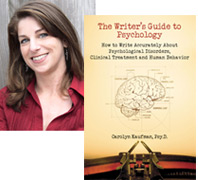
Carolyn Kaufman, PsyD's book, THE WRITER'S GUIDE TO PSYCHOLOGY: How to Write Accurately About Psychological Disorders, Clinical Treatment, and Human Behavior helps writers avoid common misconceptions and inaccuracies and "get the psych right" in their stories. You can learn more about The Writer's Guide to Psychology, check out Dr. K's blog on Psychology Today, or follow her on Facebook or Google+

Monday, August 6, 2012

Rejections: personal, form, and...what's this?


Let's talk form rejections, shall we?


We don't like rejections, but they're as much a part of the writing life as the typo. They're going to happen, but the important thing is to be able to decode what they mean. Here's my easy translation for anyone who wants to decode form rejections.


That's going to be just about every form rejection because writing is a business. Publishers need money, and agents need money, and therefore when they reject your work, it means nothing about its literary merit or your ability to write. Don't read too much into it.


Including the silent rejections. A non-response doesn't mean your work was so awful the agent couldn't even find the words to tell you its awfulness. It just means the agent deletes unwanted queries rather than hitting reply and attaching a signature with "I'm terribly sorry, but I'm afraid this doesn't meet our needs at this time."


(By spectacular coincidence, this weekend, Janet Reid also blogged on the breakdown of her responses and what they meant.)


I also interpret a form rejection this way:


On the other end we have rejections where the agent writes, "Dear Jane, thank you so much. I started it before bed and meant to read only one chapter, and instead I finished at three in the morning and will require ten cups of coffee to get through today, but it was totally worth it. Unfortunately, while I really like Blossom's narrative voice, sentient cupcakes traditionally don't sell well unless the story also has a romantic element."  


That agent has clearly read the work and is responding to specific elements of it and giving a specific reason why she's not going to represent it. (I always responded to these with a thank-you email because they took the time, and I heartily recommend not arguing with the agent. File it away and know you were close.)


But what do you do with this? "Dear Jane: I want to thank you so much for sending your book, The Big Cupcake. I have kept it so long because I didn't want to let it go. Unfortunately, I do not think I could sell this as it is, and I cannot see a way to revise this without compromising some of the elements I liked."


Receiving this, you might give up. You had an agent's attention, and s/he can't sell it. They even apologized for keeping it so long! Except it's a form rejection. 


Don't believe me? 
http://www.tumblr.com/tagged/rejections?before=1315421191
http://www.writers.net/forum/showthread.php?94281-What-s-wrong-with-this-picture
http://deepmiddle.blogspot.com/2010/12/2010-dont-let-door-hit-you-on-way-out.html
http://susanpbaker-awritingblog.blogspot.com/2010/06/rejection.html
http://www.www.absolutewrite.com/forums/showpost.php?p=5063734&postcount=138


These are all the same looks-like-a-personal-rejection. They're a form. There's a sentence in the middle that sometimes gets modified, but it's a form.


Of course agencies need to use form rejections, but I'm of the personal opinion that form rejections ought to look like forms. An agent or editor can't lovingly hand-write a four-page critique of every manuscript that comes through (and rejections aren't all that much easier when they do come that way, if you're curious.)  The agent probably wants to soften the blow with kind words, but writers are hungry for ways to improve. When a rejection hints at something, we latch onto it. 


In the case of this form rejection, a writer may try to revise blindly, hoping to hit whatever elements the agent wanted changed but never specified. Or she may conclude her work is unsellable and do exactly what the kind words were designed to prevent: give up.


I received one looks-like-a-form rejection that encouraged me to seek a small press or self-publish. This is the agent's form rejection. Agents themselves admit this is a subjective business -- and yet this one form rejection offers a blanket statement that because this particular agent doesn't like your work, no big publisher will. What if a writer gives up because of this apparently personalized advice that's anything but personal?


I've seen form rejections that would leave a writer scrambling to beef up characterization in the first five pages when in actuality characterization was fine and everyone got the same advice.


So keep in mind, forms are everywhere, even where they don't appear to be.

My takeaway: before you do anything on a doesn't-seem-to-be-form rejection, check for specific elements relating to your story. If it could refer to any story on Earth, it's probably a form. Google a sentence out of the middle. See if ninety other people received the same reply. Because the main QueryTracker site allows users to post comments, members will post the agent's standard form rejection in the comments section, so rather than revise blindly or give up, check on QT and other forums to see if anyone has posted that agent's form reply. 


And never, ever revise for vague feedback. 

---

Jane Lebak's first novel The Wrong Enemy (originally titled The Guardian) will be re-released this September by MuseItUp Publishing! She is also the author of Seven Archangels: Annihilation (Double-Edged Publishing, 2008) and The Boys Upstairs (MuseItUp, 2010). At Seven Angels, Four Kids, One Family, she blogs about what happens when a distracted daydreamer and a gamer geek attempt to raise four children. She is represented by the riveting Roseanne Wells of the Jennifer DeChiara Literary Agency.

Friday, August 3, 2012

Publishing Pulse: 8-3-12

Success Stories

Congratulations to our latest success stories, KT Hanna, Erica M. Chapman, and Stefanie Gaither!

Around the Internet

From Novel Rocket: Patty Smith Hall explains how to go From the Slush Pile to Sold!

Rachelle Gardner's recently reposted a great piece on the Top Ten Query Mistakes. If you missed it the first time around, check it out now!

I thought this was an interesting tidbit from Mind Hacks. It made me think...depending on what you search...Pinterest as a place to get story ideas? What do you think?

Margo Sorenson asks whether books for boys should be written differently than books for girls in Writing for Boys over on Market My Words.

Does this Word Count Make my Book Look Big? Michael Ehret helps you trim over at Novel Rocket.

Have a great weekend and we'll see you next week!


Carolyn Kaufman, PsyD's book, THE WRITER'S GUIDE TO PSYCHOLOGY: How to Write Accurately About Psychological Disorders, Clinical Treatment, and Human Behavior helps writers avoid common misconceptions and inaccuracies and "get the psych right" in their stories. You can learn more about The Writer's Guide to Psychology, check out Dr. K's blog on Psychology Today, or follow her on Facebook or Google+

Wednesday, August 1, 2012

Waiting on Wednesday...and Thursday...and Friday...

Your novel is complete. Your agent list is compiled. Your queries are sent.

The clock ticks. Tumbleweeds roll past your window. Your email and snail mail boxes remain empty.


So you sit. And wait.

Why are you sitting there, clicking the "send and receive" button? You have work to do!

Write your next novel. You can't pin all your hopes on one project. When your dream agent finally writes back, you want to wow them by having another book in your arsenal. Alternatively, if your current project doesn't get the response you wanted, you need to have a back up plan. Either way--keep writing!

Branch out. There are things other than novel you can be writing: poetry, short stories, articles. Anything. It will help you build a biography and it will keep your creative spark burning. You’ll also gain more practice sending out submissions (and more practice taking bad news—but don’t worry, it’ll only make you stronger.)

Work on a website. You want to have your web presence established so your future audience has a place to call home. Agents will often do a precursory search online if they are interested by your query. A website shows them you are serious about your writing and you are ready to take on a career.

Blog. Write blogs. Read blogs. Comment on blogs. You aren't just fooling around online when you do this "blog work"--you are interacting with other people and building a network. Follow some book review blogs in your genre and join the conversation. One day you'll want to do a virtual book tour...and you'll need friends to help you out. Find those friends now and help them out first by supporting their work--one day they will support yours.

Join a writers association. There is sure to be a group that fits your style. Local groups that meet at a library or a Starbucks in town once a month. State groups like Pennwriters. National groups like Romance Writers of America and Science Fiction and Fantasy Writers of America. All shapes, all sizes, all genres and focii. Join a weekend critique group. Go to a big conference and mingle with the writers and agents. Find the courage to pitch a project. It's all good exercise for any writer.

Improve your craft. Read a book on writing (I think Stephen King can help you with that). Put your manuscript through the rigors of a workbook like Donald Maass' Writing the Breakout Novel. Just because you finished a book doesn't mean you've finished growing as a writer. Get cracking on your homework.


Writing and waiting seem to go hand in hand. The submission process is 2% communicating and 98% waiting for a response--but don't waste those precious minutes waiting for cobwebs to grow on your computer.

You wanted your hobby to become a job the moment you decided to seek agent representation...so get to work. One day you'll have scant precious time between projects to do all these important and wonderful things.

Waiting time doesn't need to be wasted time.

(Photo courtesy of gunner07)


Ash Krafton is a speculative fiction writer who resides in the heart of the Pennsylvania coal region, where she keeps the book jacket for "Abraham Lincoln: Vampire Hunter" in a frame over her desk. Visit Ash's blog at www.ash-krafton.blogspot.com for news on her newly released urban fantasy "Bleeding Hearts: Book One of the Demimonde" (Pink Narcissus Press 2012).

Monday, July 30, 2012

How Long Should It Be?


                                             ©Stina Lindenblatt

By Arthur Plotnik @artplotnik
Here we go again with "size matters." Not long ago I was asked to help some writing students answer the question: "How long should a piece be?" Talk about generalizing---it's almost like asking "How good should a piece be?" (Answer: Pretty damn good.) But the length question is a common one, and, as I mused about it, my muse and I came up with some practical guidelines.
In answer to "how long?" the stock response is “as long as it needs to be.” “Needs” covers a lot of ground, however, and depends on what you mean by “it.”  Often a publication and its editors set the length limitations. Sometimes the form itself does, as with a sonnet (14 lines) or haiku (17 syllables). Time can be a factor, as with television scripts.
But if there are no set limits, writers still have to consider their purpose and the interests of an audience. You don't want to run at the mouth or come up short. What will make your communication hit home? Which elements have to be there and which are going to be a distraction?
Limits are off only when writing something out of personal need; say, to get a jumble of pressing thoughts into some kind of form. The result might be a riff or a rant as long as the Alaskan Iditarod---and just as forbidding. Or it might boil down to about 140 characters, luring you to spill your inspissated guts on Twitter.
But what determines length when addressing a wider audience? Again, form is key. In news writing you have to lay out the who, what, when, where, and sometimes why, enough to tell a story; and, in opinion pieces, enough argument to persuade---all within the attention span of the average reader. In newspapers, that might mean 200-500 words for the average piece, and some 700-2,000 words in longer-form media, like magazines. (A double-spaced manuscript page holds 250-300 words; a typical printed magazine page about 700-1,000; a page of an average published book about 350-500.)  
Poetry is mainly a form of “distillation,” where meaning is boiled down to the fewest telling words and images. Many literary journals call for poems no longer than about 40 lines, which is what fills one of their typical printed pages. Reflecting the tenor of the times, the editors suggest that if something can’t be distilled into 40 lines of poetry, then it hasn’t been worked on enough or the topic is unworkable. “Epic” poems, of course, are long verse narratives that might be book-length. They are stone out of fashion given the patience of today’s reader.
Short stories, too, are confined by journal guidelines. While quick-take stories (or “flash fiction”) run up to 1,000 words, 2,500 is the average maximum for short stories as the form has come to be developed.  Experience has shown that 2,000-3,000-words constitute a workable length for developing characters and taking them through a meaningful episode.
With multiple characters to develop and more complex episodes, or a time-span of many years, one enters the terrain of the “long story,” about 5,000-12,000 words, or up to 40 manuscript pages.  Higher counts, say 15,000-30,000 words are usually classified as “novellas,” or small novels. Like long stories they face a sheer cliff in getting published other than through the occasional contest or in a collection of the author's otherwise short stories. But here and there a bulked-up tale scales the heights.  Published novels tend to run from 80,000 words (e.g., romance novels) to 200,000 (e.g., historical sagas).    
Common nonfiction lengths include the editorial essay or op-ed of about 300-700 words; 1,000-3,000-word topical essays, and 100,000-150,000 book-length treatments of a rich topic (e.g., a biography, history of a war, or a year spent living in a tree with koalas).  
Within the general lengths mentioned, a hundred aesthetic factors make for variations. If a created character or suspenseful atmosphere is so compelling that readers are likely to want more, greater length might be justified. If the idea is to stimulate by understatement, then like the “minimalists” you’ll be writing shorter pieces. 
Often, an agent or even an editor will suggest cuts or expansions of a book manuscript without any promise of publication. And, blast them, they are usually right from a commercial publishing point of view. But not always; you'll want some second opinions. Once the book is accepted, you're still likely to face length changes from the editor---or a succession of editors during the long publishing process. You can go along with them, argue, or give back your advance. Your choice.
Crazily, the length might have to be changed at the last minute, owing to a budget change or, with print books, to fit the number of "forms" on a press (usually total book pages must be divisible by eight). You'll need to be a good sport, even if it feels like they're reconfiguring your very molecules.
But back to first things, your manuscript. The famous advice of writer Elmore Leonard still holds: I try to leave out the parts that people skip. And in the age of Internet, when words from every imaginable source flood every screen and every mobile device, people are skipping more than ever, especially self-indulgent, off-message digressions of interest only to the author and his/her unquestioning golden retriever.
And I hope I’ve left out those parts here.

Arthur Plotnik is a distinguished editor and author whose eight books include The Elements of Expression: Putting Thoughts Into Words (2012, rev. and expanded, Viva Editions) and Better Than Great: A Plenitudinous Compendium of Wallopingly Fresh Superlatives (2011, Viva). His Spunk and Bite: A Writer's Guide to Bold, Contemporary Style (Random House) has been a bestseller in its category. Website: www.artplotnik.com.
A. P., copyright ©2012