


 |
| The Skeleton: A Terrible First Draft |
Whether you’re an outliner or a pantser, things are still going to flow differently once you start writing, and insisting on having a reasonably good first draft may cause a variety of problems.
First, it’s important that every writer realize that a first draft is just that – a first draft. No matter how great it may have seemed while you were working on it, everything needs to be proofread and polished up over several more passes. One of the biggest mistakes I see beginning writers making is that they’re impatient with editing – they want their masterpiece out there, already. Often before it's ready.
But masterpieces not only require you to review the manuscript to work out the kinks, they also require feedback from others, who will let you know where the problems you can’t see are. And if you always consider your first draft terrible, you’re not going to be offended when others point out weak areas.
Second, if you’re snailing along trying to get everything right the first time, you may not notice places that the novel’s tension drops. That is, when I’m writing frantically to get all the ideas onto the page in some form, I really notice when everything sloooowwsss down, and I know that those are places that are going to need particular work (or they may even need to be cut completely).
I’ve always liked that Iris Murdoch quote, “Every book is the wreck of a perfect idea.” In other words, what ends up on the page may not capture your vision as well as you’d hoped. And if you’re spending the whole process worrying about that, you’re never going to accomplish anything.
To put this into psychological terms, if your inner critic is sitting on your shoulder tapping its pointy-nailed fingers, it’s unlikely you’re going to break into a “flow” state. Flow, as defined by psychologist Mihaly Csikszentmihalyi (yes, you can pronounce that – it’s me-high chick-sent-me-high), is a state of complete involvement, elevated mood, serenity, great inner clarity, and a sense of competence. It is, in other words, that feeling you get when you’re completely immersed in a project, time is zipping by, and the words just flow. Csikszentmihalyi argues that this occurs when we have a perfect balance between our skill level and the challenge before us. If the inner critic is worrying too much about doing things “just right” the first time, flow can’t happen.
I think of writing a book as a layered process. I see the first draft as the skeleton. It provides a framework. Next are the tendons and muscles and organs. The stuff that makes your story (forgive me for using this word) meaty. This stage takes several passes for me, each time building another layer. Finally comes the skin, the hair, the features. This is the fine-tuning, the polishing, the part that makes your manuscript truly presentable.
If I think of something important that has the potential to interrupt my single-minded creation of the Terrible First Draft, here’s what I do. Let’s say I have an idea for what I want to write tomorrow, or somewhere farther along in the story. If you have an outline, or use outlining software, you may find it easy to pop those things in with a new notecard or file. But if you don’t know where the idea goes, or you don’t want to stop long enough to go back to your plotting board, you can always write the idea right in the first draft. I usually write these pieces in ALL CAPS (I started doing that in my manuscripts before that was known as shouting) or in italics. They just go in there wherever they occurred to me, single-spaced to make them stand out, and then I plunge right back into the story.
Later I might move the idea into a writing program like yWriter so I can play with it some more, but when I’m writing, I’m writing.
So don’t be afraid to write Terrible First Drafts. I know if I didn’t, I’d miss out on a lot of great possibilities. Plus I’d be too paralyzed to get much done in the first place.
If you’ve never tried writing a Terrible First Draft, you might want to try NaNoWriMo, which starts November first. Writing 50,000 words (or more) in a month is one way to shut off the worry about producing something Good the first time. There’s no time to worry – only to write!
So how about you? Do you write Terrible First Drafts? What are the benefits you’ve discovered?
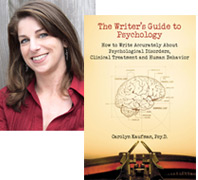 Carolyn Kaufman, PsyD's book, THE WRITER'S GUIDE TO PSYCHOLOGY: How to Write Accurately About Psychological Disorders, Clinical Treatment, and Human Behavior helps writers avoid common misconceptions and inaccuracies and "get the psych right" in their stories. You can learn more about The Writer's Guide to Psychology, check out Dr. K's blog on Psychology Today, or follow her on Facebook!


