Recently, I've taught several workshops on query letters and in studying examples of recent queries that work, I've noticed some minor changes in the trends.
Now, I can't possibly tell someone what will or won't work for sure because there are way too many variables involved and every project and agent is different. What I can say is some things remain the same. It's still essential to include book specifics like genre and word count, along with a synopsis and brief, relevant bio. It's still important to use the agent's name in a personalized salutation and to include your contact information in the letter.
Two primary things seemed to have shifted a bit in letter protocol: blog mentions/links and visual media comparisons. I'm not saying you should include these, I'm simply pointing out that many successful, agent-attracting letters include them. As recently as three years ago when I was querying, this was not the norm.
Blog links: One thing I have noticed changing is the "never include your blog if you are not gigantic" rule. From the agent-garnering letters I've read, it is common to mention your blog or at least put a link if it has a devoted (not necessarily huge) following, well-known blog co-authors, or is relevant to your project. Be careful, though, to analyze how you will look to an outside reader before you include a link. Poorly-written material riddled with grammatical and punctuation errors could do more harm than good.
Another element I've noticed becoming more prevalent is the "this meets that" comparison. It used to be a no-no to compare your work to a movie or TV shows (only literary comparisons were thought to be acceptable), but I'm seeing a lot of this in successful queries and even in publishers' book descriptions, like that of our own QT member, Cole Gibson, whose book, Katana, is described by her publisher as "Kill Bill meets Buffy." This doesn't work if you use little known or obscure references. If you look through the QT success story interviews, you will see a lot of these in recent letters.
So while the query letter remains pretty much the same, it might be of benefit to check out the recent success story interviews over on our main site and scroll to the bottom of each interview to see if the agented writer includes his/her query, so you can check out what is working right now.
Some of the letters are fantastic. You can find them by clicking HERE.
Have a fabulous week!
Mary
Monday, March 5, 2012
Friday, March 2, 2012
Publishing Pulse for March 2, 2012
New At QueryTracker:
Congratulations to our newest success story, Angela Cook, who signed with Eric Myers of The Spieler Agency!
We have one new agent this week in the QT database, Jen Linnan of Linnan Literary Management. Nine agent profiles were updated, including one who left agenting. You'll get better results if you don't query agents who have left the business, so please make sure you double-check every agent's website or Publisher's Marketplace page before querying.
If you're a QueryTracker member (membership is free) then you can be notified whenever an agent or publisher is added or updates their profile.
Cool contest:
Not ours, but it's still a cool contest regardless (and the it's also reason the ineffable Janet Reid is currently closed to queries.) Check out the Liz Norris Pay It Forward Writing Contest, where you could win registration for Backspace, travel funds, and lunch with Liz Norris's agent. Check it out!
Publishing News:
It's been an interesting week for Amazon.com, with the SFWA dropping all links to the online retailer and many authors leaving after Amazon cut ties with the Independent Publishers Group.
Digital Book World reports that publishers who are seeing print sales soften should be prepared for a steep drop, and lots of open shelf space.
Jan Berenstain, co-creator of the Berenstain Bears, has died at age 88. May perpetual light shine upon her
JK Rowling, whom you might have heard of, announced an upcoming novel geared toward adults. It is scheduled for release later this year.
Around the Blogosphere:
If you've ever thought of nudging an agent with a fake offer of representation, don't do it. As Kristin Nelson says, they can tell.
Jessica Faust gives some tips about getting a job in the publishing industry.
Literary Quote of the Week:
"Writing a novel is like driving a car at night. You can see only as far as your headlights, but you can make the whole trip that way." E.L. Doctorow
---
Jane Lebak is the author of The Guardian (Thomas Nelson, 1994), Seven Archangels: Annihilation (Double-Edged Publishing, 2008) and The Boys Upstairs (MuseItUp, 2010). At Seven Angels, Four Kids, One Family, she blogs about what happens when a distracted daydreamer and a gamer geek attempt to raise four children. She is represented by the riveting Roseanne Wells of the Marianne Strong Literary Agency.
Wednesday, February 29, 2012
The Writing Process
![]() |
| Courtesy of piovasco |
One of the things that interests me the most in writing, is how different and individual each writer's process is. Talk to enough people, and similar groupings and patters emerge, but I haven't yet met any writers that write a novel exactly the same way.
Some of the different approaches include:
- plotting vs pantsing (or free writing or writing from the hip)
- writing linearly vs writing scenes out of order and patching them together
- writing by word count vs a certain amount of time
- using a word processor vs writing software
- writing on a set schedule vs writing whenever lightning strikes
- needing music or sound vs needing silence
And a whole host of other things, most of them small, and many unique to that particular writer.
But one of the most fascinating things, to me, is the difference in the "What comes first--the character or the plot?"
While most of my writing process happens in my sub-conscious (meaning I have no idea how things happen--only that they do), I have learned certain things. Immutable laws (for me), if you will.
1) I am not a plotter. I believe there is much good in trying out different ways of writing. One of the greatest benefits to experimenting is discovering something that clicks perfectly with how your brain processes Story. I've tried a lot of things, and it's been very educational--whether or not they work for me--because doing so allows me to peel back another layer to see Story from a slightly different perspective.
I have learned that I can loosely plot a series, but if I try to plot a novel, my sub-conscious can, and will, lie to me. That's right. I can come up with some pretty awesome stuff that invariably ends up not working with the story or the characters. At all.
2) No character, no story.
It's the second one that I've been thinking a lot about right now. I've found that, for me personally, I can't sit down and write a story without having a character tackle me first. Because, for me, there is no Story without the characters.
Does that mean I write character-driven novels?
Not necessarily.
For me, character and plot aren't completely separate entities. Rather, they are two points on a continuum. Some stories will lean closer to the character side, while others will lean nearer to the plot end.
But they all start out the same way: a character looks at me from the back of my brain. Most of the time I get a sense of what the character looks like, but not always. Some are also a lot more talkative and easier to work with than others.
But they all have a problem. Sometimes that problem is on a bigger scale, driven by outside forces. And sometimes the Story happens *because* of something the character did. Or said. Or stole. And they want me to help them fix it. (Or, at the very least, escape. :p)
So, for me, the plot rises out of the characters every single time.
But I know there are people for whom this works, only in the reverse. They come up with an interesting premise that might have been sparked by a question or an idea. Only after they have the foundation laid out, are they able to people the plot.
Does that mean they write plot-driven novels?
Not necessarily.
In fact, there have been a number times I've been surprised to learn that a character-driven story had not only been plotted out, but that the plot came first.
Which opens up all kinds of delicious things to speculate both about characters and plot and how they ultimately (in the finished product) connect to the Story and each other.
How do they connect for you? Are you a character first type of writer, or can you only find the Story if you have a plot laid out. Or are you somewhere in between?
Danyelle Leafty| @danyelleleafty writes YA and MG fantasy. From March 12th-31st, she will be donating royalties from both paper and digital copies of THE FAIRY GODMOTHER DILEMMA: CATSPELL to purchase Kindle Fires for a pediatric unit in a local hospital. Click here if you'd like to learn more.
Monday, February 27, 2012
And the Winners Are . . . .
We would like to thank everyone who entered our January agent-judge contest with the wonderful Natalie Lakosil of the Bradford Literary Agency. And we would especially like to thank Natalie for taking the time to judge the entries and for the generous prizes. There were so many amazing entries, but alas, she couldn’t pick them all.
And the winners are:
Third place: 15 pg. request & critique
THE STAIRS AND THE FLY by Stacy Stokes
Genre: Young Adult
Word count: 57,000
Pitch: When high school student Taylor Anderson is struck by a car, instead of an afterlife filled with puffy clouds and hard-playing angels, she is forced to climb an endless staircase; a journey that uncovers surprising truths about her life and what happens when we die.
Anyone who saw me get hit by the car will call it an accident, and by definition I suppose it was. She didn't see me. I didn't see her. Splat. But in the deepest pit of my stomach, the part that flutters awake when I get caught doing something wrong or I see Justin Cobb walking down my high school's corridors, I know that I wished for it.
"Look who woke up on the right side of the bed for a change," my mother chirps when she sees me bound into the kitchen with a Cheshire grin plastered on my face.
Second Place: 30 page request & critique
THE GREAT CORSET REBELLION by Kerri Nelson
Genre: Historical Romance
Word count: 92,000
Pitch: Bored with the binding feminine dress code of polite society, Lady Ainsely Archibold designs her own daring new clothing line but when the object of her infatuation mistakes her for much less than a lady, Ainsely must choose between the laws of love and linen.
It was love at first gasp.
Lady Ainsely Archibold breathlessly watched the magnificent creature as he stood on the west balcony overlooking the garden below. She was absolutely woozy at the mere sight of him.
Of course, the unsteadiness of her breathing could also be contributed to the unbelievably cramped binding of her lungs courtesy of her world-class, tightlacing proficient maidservant.
Consequently, if it weren't for this blamed corset, she'd be able to achieve this moment of simple adoration without concern. As it were, she was trussed up like the feathered fowl for the fall feast on which they'd just dined.
Lady Ainsely Archibold breathlessly watched the magnificent creature as he stood on the west balcony overlooking the garden below. She was absolutely woozy at the mere sight of him.
Of course, the unsteadiness of her breathing could also be contributed to the unbelievably cramped binding of her lungs courtesy of her world-class, tightlacing proficient maidservant.
Consequently, if it weren't for this blamed corset, she'd be able to achieve this moment of simple adoration without concern. As it were, she was trussed up like the feathered fowl for the fall feast on which they'd just dined.
First place: 50 page request & critique
A PLACE TO CALL HOME by Linda Jackson
Genre: Middle Grade
Word count: 40,000
Pitch: Twelve-year-old Stacey Graham is not happy when she finds out that the only person willing to take her and her younger siblings in after the deaths of their mother and beloved "Granny" is their uncle Percy, who lives in the back of his funeral home.
It really bugged me when it rained on the day Granny was buried. Rain just came pouring down first thing that morning and kept on falling all through the funeral. The cemetery had been all muddy and messy. And it just wasn't right for a lady who kept things as neat as Granny to have to be put in the ground on such a nasty day. Her trailer might have been old and beat-up on the outside, but the inside was always good and clean. Granny's was the only trailer in town where the vinyl floor was so shiny that folks always thought it was wet.
Congratulations to all the winners! You will receive instructions via email today as to how to submit the requested material.
Friday, February 24, 2012
Publishing Pulse: February 24, 2012
The Results ARE IN!It's the moment so many of you have been anxiously anticipating—the announcement regarding the end of the Agent-Judged Contest.
But first, a celebration for all of us at Query Tracker: we've hit a major milestone.
QT just passed the 50,000 member point!
Congrats to each and every writer who joined QT in the hopes of getting their dream agent. Whether you sign with an agent or choose an indie path, you are all part of an amazing group who has taken steps to learn about the querying process, to practice and improve your writing craft, and to find courage to put your words out there for all the world to see. Be proud and take a moment for a well-deserved pat on the back.
Thank you for making Query Tracker a part of your journey to publication.
An easy way for a writer to begin building an audience is through blogging—but it won't do you any good if your blog remains the equivalent of a private journal. Robert Lee Brewer talks about the success his blog enjoys and offers 25 ways to increase your blog's traffic. If SEO isn't part of your vocabulary yet, now is the time to remedy that.
Indelibles author Susan Kaye Quinn discussed the sweat equity of book publishing with a comparison between traditional vs. indie published authors. You may be surprised to see the difference between the two routes.
Check out Ciara Ballintyne's cheeky look at the Don't List for authors who want to maintain healthy relationships with their agents and editors. (Some things just can't be stressed enough.) Bonus is the list of things that shouldn't be in your writing, assuming you want an agent or editor to take your book on in the first place. And millions of readers will rejoice to learn there is life after Harry Potter for J. K. Rowling.
The Winners of the Agent-Judged Contest
…will be announced Monday. Are you one of the lucky winners? You'll have to wait and see!
Have a wonderful weekend, everyone.
Wednesday, February 22, 2012
Writing by the Seat of Your Pants
![]() |
| Writer's block can be like trying to force rusty wheels to turn! |
I’ve been struggling a bit with writer’s block, so I’ve been reading books on
how to get unstuck. I’m noticing a pattern with them – most encourage you to
outline as you brainstorm. I love the idea of outlining, of having a rough (or
not so rough) roadmap for where you’re going, and for my last novel, I used
notecards to create one (a process I talked about with KM Weiland for her book, Outlining
Your Novel: Map Your Way to Success). The notecards were glorious, like stepping
stones along the way.
Having
had a good experience with outlining, and having read all these wonderful,
encouraging books that talk about outlining, I’d love to be able to outline to
get myself unstuck on the two WIPs I’ve got going.
Unfortunately,
it’s just…not…happening.
As much
as I’d like to be a consistent outliner, the
reality is that I’ve been a pantser most of my life. What’s a pantser, you may
ask? Why, it’s someone who flies by the seat of their pants. If the outliners
are Planners, the people who make it up as they go are Pantsers.
I’m
starting to wonder if my problem is that I'm trying to force myself to be an outliner when that isn't really my nature. After all, being a pantser has worked for me for a lot of years. And I’m kind of a pantser in life, too. I don’t like things to be too scheduled, because what if I change my mind? And when it comes to other forms of creativity, like graphic design, I like to try different visual elements together and see what inspires me most, and go from there. I probably hit more dead ends than a lot of other creative people this way, but I also have some pretty unexpected turns in my stories.
Although
forcing myself to open up that document and put words on the page when I feel
stuck and directionless is like trying to force rusty wheels to turn, I’ve
discovered that if I’m persistent about it, I can get them to turn. And when I write, I
discover things about my characters, about the story, that I’m just not sure
I’d get if I were outlining. In other words, it’s the nuances I
notice along the way that propel me from one plot point to another.
In an
example some of you have probably seen me use before, in one of my novels the
villain spontaneously shoots one of the heroes. I never had any intention of
killing off the character who was shot (after all, she was one of my heroes!),
but after she went down, I couldn’t for the life of me get her back up. I threw
medical professionals at her, and I wished along with my other characters that
she’d be okay, but in the end, she died. Another hero developed PTSD as a
result, and that PTSD not only drove the second half of that novel, but most of
the sequel. If I’d outlined, I’d never have killed her off. Yet somehow the
actual writing is different, and I realized that it was the right thing for the
story.
Of
course, you can always make changes as you work from an outline, but I think I
might have trouble flying off into these tangents that seem to bear the most
fruit if I did. It’s while I’m floundering around in the darkness, writing
anything I can think of just to get words on the page that I often seem to
stumble upon the best material. I have a wild “what if?” moment, and I go with
it because I don’t have anything better planned. And because I don’t have
anything better planned, I also feel free to just go with whatever crazy
repercussions I see as a result of that wild “what if?” moment.
So if
you’re a pantser and you find yourself getting stuck, like I have, what can you
do about it? Here are a few things that I’ve found helpful.
- Go ahead and try outlining, if you want. I really enjoyed Gene Perret’s Write Your Book Now!, and KM Weiland’s aforementioned book was also great. If you search Amazon, you’ll find at least a dozen more books to help you learn how. You can also check out the snowflake method. If outlining doesn't work for you, though, don't beat yourself up. You may just be a pantser through and through!
- Get away from the manuscript to think about what happens next. I like to sit down to my computer with some inkling of an idea for where things are going next, but I don’t always come up with those inklings while I’m at the computer. In fact, I find that going for a long walk is one of the best ways for me to find my inklings. (Of course, I have been known to talk to myself while I’m plotting, which can be a little weird for the people walking the same place I am!)
- If you normally type, try writing by hand, and vice versa. For some reason, when that blinking cursor on the screen is making me feel hopeless, I do much better on some notebook paper. For more information about why writing by hand can help us be more creative, check out my post, Thinking Outside the Computer.
- Give yourself permission to write whatever it is, even if you think it might be awful. If I had a bunch of thoughts I knew were brilliant, I’d get them down into an outline! But sometimes I get these ideas, and like I said, I don’t have anything better planned, so down they go. And sometimes they end up being the best parts of the story.
If you’re
a pantser, what are your tips? What helps you sit down at the computer, even
when you have absolutely no idea where you’re going?
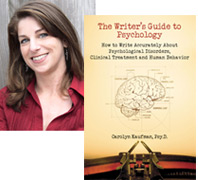
Carolyn Kaufman, PsyD's book, THE WRITER'S GUIDE TO PSYCHOLOGY: How to Write Accurately About Psychological Disorders, Clinical Treatment, and Human Behavior helps writers avoid common misconceptions and inaccuracies and "get the psych right" in their stories. You can learn more about The Writer's Guide to Psychology, check out Dr. K's blog on Psychology Today, or follow her on Facebook or Google+! Monday, February 20, 2012
The Editorial Process - My Experience vs. My Misconceptions
Well, a lot has happened in my career since I blogged here last, which is why I haven't been around (Thanks QT blog author buddies for hanging in and waiting for me to resurface).
Have a fabulous week!
Mary
Since I last posted, I sold my debut novel, Shattered Souls, to Penguin, went through four editorial rounds plus copy edits, sold another book to my publisher, freaked out when I saw my amazing cover, celebrated when the Shattered Souls ARCs came in, was blown away when I got to hold my hardcover for the first time, and have had a fantastic and fun first publishing experience. I'm jumping up and down! I'm dancing in circles! I'm... I'm...
It's great to be back on the QueryTracker Blog and I'd love to get your thoughts or questions in the comments.
I'm exhausted.
I'm also wiser.
Since this is a blog dedicated to "helping writers become authors," I've decided it would be fun to write a couple of posts about my actual experiences compared to my pre-published expectations in the hopes it will make things easier for someone else.
I'll start with a disclaimer: Everyone's experience is different. Authors are different--as are publishers, editors, agents, and projects. Nobody's path will be the same. I can only speak to mine.
One of the most frequently asked questions I get from aspiring writers is "How much revising did you have to do on Shattered Souls?"
My first reaction is to shout, "So many extensive revisions I was sure my head would explode and I thought about quitting every freaking day!" Then, I push that response back in favor of a more civilized answer: "I had major revisions. It was a lot of work, but they made my book much stronger. The process also made me a better writer."
My agent specifically chose to submit my book to my editor because she knew I wanted someone who would work closely with me and was willing to invest a great deal of time and energy in the editorial process.
I have a sick secret: I love to revise. I prefer it to original creation of the story. My agent knows this. She told my editor this. My editor took it to heart and proceeded to kick my butt.
My Reality vs. Myth/Rumor
If you've spent any time in writers' forums or real life writing groups, you've probably heard lots of great information. Chances are, you've also heard some stuff that is just plain wrong--or maybe only half wrong. Below are some of my misconceptions going into the editorial process along with what it was really like for me.
Myth/rumor: Editors only have time to fix minor grammar and punctuation errors and look for continuity errors.
My reality: Sometimes editors will spend a great deal of time studying your manuscript and analyzing ways to make it stronger. Sometimes, they will ask you to take your story apart, delete 40%, reorder it, and write new scenes to replace the deleted ones. .
My reality: Copyeditors look at punctuation, grammar and sometimes continuity.
Myth/rumor: Editors will rewrite your book or tell you what to write or say.
My reality: Editors will make suggestions and if you agree, you might opt to make changes or even rewrite scenes. My editor never rewrote anything, though she did make suggestions. All changes were made by me.
Myth/rumor: You have to do what they tell you to do.
My reality: You only have to make changes that resonate. In cases where I did not agree (and these were rare), I simply wrote an explanation of why the suggestion didn't work for me, and my editor was cool with it every time. It was always MY book.
Nuts and bolts:
Some editors do everything electronically. Some prefer hardcopy notes, like my editor. My revision notes and comments were handwritten on a printed copy of the manuscript and sent to me by FedEx. I then made the changes in a Word doc and sent the corrected manuscript electronically. My copyedits, however, were done electronically.
If you would like to read the editor's side of the process, my editor, Jill Santopolo, did a post about the Shattered Souls revision process over on Books Complete Me. She even included screen shots of the actual revision notes on the manuscript (And her handwriting was hard to read--just saying').
Summing it up:
Every experience is different. Some editorial rounds are light and consist primarily of copy edits. Some are extensive and involve multiple rounds of revisions including new scenes, new characters, new settings...anything.
Just like authors are different, editors are as well. Their preferences and styles are as distinct as those of the authors with whom they work. Notes and suggestions can be conveyed electronically, by hardcopy, and even over the phone (I received all three).
The thing I learned to keep in mind through the editorial process (even when freaking out over yet another letter requesting more changes) was that my publisher and I have the exact same goal: to turn out the best product possible.
Have a fabulous week!
Mary
Subscribe to:
Posts (Atom)


