QueryTracker Blog

Helping Authors Find Literary Agents

Wednesday, December 12, 2012

Psychology Q&A: Abusive Teen Relationships

Disclaimer: The information provided in this post is intended for writing purposes only and does not represent psychological advice.
QUESTIONS: 1. What kind of therapy would a teenage girl go through after she's been in an abusive relationship? 2. Are there any books or websites you could recommend for more information dealing with therapy post break-up? 3. Since there is a new love interest in the MC's life, would he be involved in any sessions?  4. Is there a way for him to learn how to be there for her, or is that something that is never considered? 5. From what I've read, girls who've experienced relationship abuse may have posttraumatic stress disorder after it's over. Do you have any other resources you'd recommend?
ANSWERS: For readers who aren't familiar with the signs and causes of domestic violence, you may want to drop by the HelpGuide for a comprehensive overview.

On to the questions!

1. What kind of therapy would a teenage girl go through after she's been in an abusive relationship? 

 If you're looking for the name of a therapy, I'd say a likely choice would be Interpersonal Therapy (IPT) coupled with feminist therapy.  The feminist aspect is  important for DV (domestic violence, a catchall term for relationship violence) because it does not blame the survivor (note the use of the word survivor rather than victim); in fact, it looks at how society cultivates violence against women via things like the popular media, attitudes that women should be subservient, court systems that don't provide adequate consequences for batterers, and so on.

2. Are there any books or websites you could recommend for more information dealing with therapy post break-up?

Getting a sense of the feminist theories and approaches that make therapy for DV unique will be a big help.
3. Since there is a new love interest in the MC's life, would he be involved in any sessions? 

No. Definitely not, unless, say, they're ready to get married and wanted to do some premarital counseling. Even then, I'd want them to see a separate therapist for the couples therapy. In fact, if a client asked the therapist if she could involve her new boyfriend, the therapist might want to explore what makes her want to bring him into therapy. The therapist's response would vary based on what she said, but without any extra information (as I write this), s/he might wonder about your MC's confidence in her independence and ability to function without a man.  Not in a blaming way, but s/he might want to work with her even more on autonomy, recognizing her unique strengths, and feeling (and behaving) as if she is equal in a relationship.

4. Is there a way for him to learn how to be there for her, or is that something that is never considered?

Absolutely, there are things he can do, and he'd be a keeper if he really tried to do these things!

Many people believe DV is rooted in sexism, so fighting sexism in himself and the people around him would be huge.

A man who has feminist attitudes can be a great support. I should probably clarify -- a lot of people feel like "feminist" is a bad word. Like many people, until I was exposed to feminist therapy and truly began to understand what feminism meant, I bought into the stereotype that feminists are militaristic man-haters. Though certainly some fall into that category, they are the exception rather than the norm.  All feminism is is the belief that women should have equal rights and opportunities.
The nice thing is that younger men often do have more feminist attitudes than older men. Overall a supportive man would believe that what had been done to your character was wrong and that she didn't deserve it and doesn't deserve any blame for it. He wouldn't push her around, smother her, or breathe down her neck -- he'd trust that she is a capable human being.  

Other attitudes that are much more subtle are things like avoiding assumptions of male privilege.  For example, he doesn't assume he should be the one who drives, even when they're taking his car. He can open doors and be nice, but he's not seizing control of things just because he's male. 

He wouldn't put up with sexist jokes and overt exploitation of women -- ie he's not going to endorse pornography that shows women saying "no" when they "really" mean yes. He's not going to see shoving yiour character against the wall or pinning her down as sexy.  (Don't get me wrong, perfectly healthy couples can play at things like that if they've agreed to it and have safety words in place -- but something like this would probably scare someone who's been abused.  So he'd need to be sensitive to things like that.)  

He would need to leave room for her opinions, and respect them even if he disagrees with them.  (He can disagree openly, but he doesn't try to intimidate her into anything, or blame her if, say, she chooses a movie he
doesn't like.)

I don't know how old your characters are or if they're sexually active, but if she was raped, that's definitely something to address in therapy.  He would really need to respect her boundaries and he'd want to make sure she knew it was okay to ask him to stop if she got scared or uneasy.


 5. From what I've read, girls who've experienced relationship abuse may have posttraumatic stress disorder after it's over. Do you have any other resources you'd recommend?

An absolutely fantastic book on PTSD is Aphrodite Matsakis' I Can't Get Over It: A Handbook for Trauma Survivors.


If you have a psychology in writing question, feel free to fill out my Q&A form!
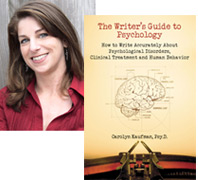
Carolyn Kaufman, PsyD's book, THE WRITER'S GUIDE TO PSYCHOLOGY: How to Write Accurately About Psychological Disorders, Clinical Treatment, and Human Behavior helps writers avoid common misconceptions and inaccuracies and "get the psych right" in their stories. You can learn more about The Writer's Guide to Psychology, check out Dr. K's blog on Psychology Today, or follow her on Facebook

Monday, December 10, 2012

The New QueryTracker - Progress Report

The new version of QueryTracker is almost ready, and should be released sometime between Christmas and New Years. With any luck, downtime should only be a few hours. When the time comes, I'll post a notice on the main site, giving everyone at least 24 hours warning before the site goes down for the upgrade.

When designing the new QueryTracker, there were a few key things I wanted to achieve:

  • Make it run faster.
  • Make it more convenient to enter query data.
  • Make it easier to work with folders and multiple projects.
  • Expand the backend making it possible to add some new (and still secret) capabilities in the future.
  • Don't change the user interface too much. (No one likes too much change.)

I hope I've achieved these goals. We'll soon find out. Watch the sneak peak video and let me know what you think.

But there are a few things that won't be included in the new version. The biggest of these are the groups. Groups, if you haven't used them, are a place where QT members can interact with each other. The idea was that they would eventually replace the old QT forum. But they never really took off, and the forum keeps growing. Obviously, people prefer the forum and I'm not one to argue, so the groups will be retired. It just doesn't make sense to keep them both.

If you're not a member of the forum, please go to QueryTracker.net/forum and sign up.

If you volunteered to be a beta tester, I'm a little behind schedule, but I'll be contacting you soon with instructions on how to access the beta system. If you haven't signed up to beta test, there's still time if you're interested. Volunteer here.


Friday, December 7, 2012

Publishing Pulse: Friday, December 7, 2012

This Week at Query Tracker

The profiles of several agents were updated this week. Please make sure you double-check every agent's website or Publisher's Marketplace page before querying.

You can see the publisher updates list here. 

Ready to write your own success story?

If you're a QueryTracker member (membership is free) you can view the database of more than 1200 agent and publisher profiles. Premium Members can be notified whenever an agent or publisher is added or updates their profile, in addition to receiving access to several other enviable features.

Self-Publishing

Simon & Schuster have joined with Author Solutions to form a new self-publishing program called Archway Publishing. Some writers wonder if it's ethical. Some writers are pretty confident it isn't.

Those writers believe that money should always flow to the writer. Speaking of which, happy holdidays from Kindle Direct Publishing-- KDP Select authors are getting a little bonus this year.

Resources

Need to rebrand yourself? Sometimes, a writer reaches a point where a change in brand is needed--perhaps when making the huge jump to published author. Here's an article that may be useful in rebranding social media profiles.

Here's a handy reference of publishing terms (so you know what the heck folks are talking about on the forum.) Read this list and you'll be talking like a pro in no time at all.

The Twitter Feed

Whenever I'm in the mood for a little research, current events or plain old diversion, Twitter.com is my resort. (Sometimes it's my last, too. I lose track of time there.) Here are some of the interesting Tweets I came across this week:

EMC Corporation@EMCcorp
How do you digitize 90,000 anncient books, documents & papyrus texts? via
 
JudithBriles@AuthorU
Top tips for to their podcast when doing TV and radio.

GalleyCat@GalleyCat
NaNoWriMo writers produced 3.2 billion words in a single month, 200 million more than last year

Tools of Change@toc
Join us for Author (R)evolution Day on 2/12 and learn how to succeed in today's shifting landscape

Have a great weekend, everyone!


Ash Krafton is a speculative fiction writer who resides in the heart of the Pennsylvania coal region, where she keeps the book jacket for "Abraham Lincoln: Vampire Hunter" in a frame over her desk. She is a tremendous fan of Jane Lebak's QTB author bio. Visit Ash's blog at www.ash-krafton.blogspot.com for news on her urban fantasy "Bleeding Hearts: Book One of the Demimonde" (Pink Narcissus Press 2012).

Wednesday, December 5, 2012

’Tis the Season for . . . Business Plans???

by Stina Lindenblatt @StinaLL

 ©Stina Lindenblatt


It’s that time of the year when we reflect on what we have or haven’t accomplished this year, and we plan for next year. No, I don’t mean the dreaded New Year’s resolutions. Most people fail to achieve those. I’m going to go one step further and have you think about your business plans. 

Now, a few of you are freaking out because we are writers. Business plans are for, well, businesses. But if you’re planning to make money with your writing, you need to start thinking of it as a business. And all successful businesses have business plans. A strong business plan will help your book achieve the level of success it deserves.

The good news is that business plans aren’t much different than the usual goal setting we do each year. Only this time, I want you to delve a little deeper. It doesn’t matter if you’re planning to self publish or traditionally publish your book—or if you’ve just written your first first draft—if you want to be taken seriously, now is the time to start planning. And it’s easier to do it now than a few weeks before your book launch. 

Step One: Brainstorm

What do you want to accomplish next year? Sorry, landing an agent or having your book become a bestseller doesn’t count. Those are dreams, not goals. You have no control over whether an agent or readers will love your book. Goals are achievable, unless you get lazy and don’t do them. For example, losing five pounds is achievable, unless you don’t exercise and don’t decrease your caloric intake.

Step Two: Dating

Figure out by what date you want to accomplish each goal. It’s not enough to say, “I want to write a novel next year.” When you do want to achieve this by? Also, this goal is not specific enough. Do you mean you want to finish the first draft by October 1st, or do you want to have a novel ready to query by then?

Step Three: Division

Break down each goal into manageable tasks and give them dates by which you want to accomplish them. For example, say you want to set up your website by April 1st

Goal: Set up website (April 1st)
  • Determine author brand (January 15th)
  • List ten authors who write similar stories to me. (January 20th)
  • List the things I like and dislike about their websites. (January 25th)
  • Research website designers (February 15th).
  • . . . .
By breaking down the larger goal into bite-size pieces, it will make the goal seem less daunting and you’ll be more likely to achieve it. 

When you create your goals, think about the following:

Product: This is your book. 

  • What do you need to do to create a query-ready book? Figure this out for each story you plan to write next year. 
 
Competition:
 
  • What’s going on in your genre?
  • Are you approaching the tail end of a trend?
  • Is your genre saturated and difficult to break into?
  • What are agents and editors saying? What are readers saying?
  • Is there a less saturated genre you love that you might want to focus on instead?
  • Of course, the only way you can answer these questions is by reading LOTS of books in your genre and following industry blogs, so . . . what are your reading goals for next year? 
 
Human Resources:
 
  • This includes books and workshops to help you improve your writing craft and knowledge related to anything dealing with publishing (e.g. creating a website, social networking for authors, creating your author brand).
  • Start researching services (editors, cover designers, book formatters, website designers, etc) early in your planning process. If you spread it over a few months, it won’t be so daunting, and it will give you time to find the right person. This applies to researching agents, too.
 
Distribution:

  • If you’re querying next year, who are you planning to query (agents or editors)? How many queries are you planning to send out with each batch, and how often will you be sending them out? When are you planning to write your query and synopsis?
 
 
  • If you’re self publishing, research what you need to know to be successful. Some great resources to check out include: Smart Self-Publishing by Zoe Winters and Self-Publishing Attack by James Scott Bell. 
 
 
Promotion/Marketing:

  • Are you planning to use Facebook? Twitter? Pinterest? Come up with goals that you can live with and that will enable you to have enough time to write. 
 
  • How’s your website working for you? Do you have one?
 
  • What are your marketing plans for before, during, and after your book launch? You might not be releasing a book next year, but it wouldn’t hurt to start brainstorming ideas for the future. Some agents and publishers want to know your marketing plans before they sign you. Make your life easier and plan ahead.
 
Finances:

  • How much have you budgeted for your business next year? By planning ahead a year or two in advance, the costs can be spread over that time period, and it will feel less intimidating. 
 
Obviously, someone who has a book launch next year (either via traditional or self publishing) will have a more extensive business plan verses someone who is writing her first novel. Also, you don’t have to write your plans for just one year. Most companies have a five-year plan. The beauty of your business plan is that it’s flexible. You can change the dates as need be, and add or delete goals as necessary.

Do you create goals every year? Have you created business plans for your writing career?


Stina Lindenblatt @StinaLL writes young adult and new adult novels. In her spare time, she’s a photographer and blogging addict, and can be found hanging out on her blog.  

Monday, December 3, 2012

Visual Editing: Color Coding Your Way to a Cleaner Manuscript

Courtesy of Caesantana

Editing.

Some people love doing it, while others loathe it.

But love it or hate it, editing is a vital part of the writing process.

I use to fall into the hate it camp, because after a while, all those words would run together and turn my brain to mush. It didn't matter how careful I tried to be, an embarrassing number of things would still slip through.

The bad news is that for 99.9% of us, things are always going to slip through. The good news is that there are ways to make life easier for your beta readers and, ultimately, you. Visual editing is one of those ways. The type of visual editing I'll be discussing in this post is color coding.

Going through your manuscript and color coding it can be time intensive, but has proven, for me, to be one of the most thorough ways of pushing small cracks and flaws out into the surface and highlighting the bigger problems with neon lights.

The first little bit of your manuscript is probably the part that will take the longest to get through, but once you fall into the rhythm, it does get faster and easier.

Now, onto the color coding.

How you go about color coding your manuscript is likely going to vary. This is how I do it. :)

First, I take an honest inventory of the areas of writing that aren't my strong suit. I make very sure to assign each of those a color. Then I look at what things I might go a little overboard on and add those to the list. Lastly, I add the things that are important structurally to the story.

Then I assign each item a color. So my list might look something like this:

Dialogue (You could even do separate colors for each main character if you wanted to.)
Description
Metaphors
Similes
Adjectives
Adverbs
To Be Verbs
Pacing
Characterization (Here, I would assign each major character and important side characters a color. If I'm running low on colors, I would assign a color and add bolding, italicizing, changing the font, or underlining.)
Inciting Incident
Clues that tie in together (I would be specific here. For example: All the clues that hint at the hero's destiny.)
World Building
Story Arcs (I'd assign each arc a different color. Again, if you're running out of colors, look at also bolding, italicizing, changing the font, or underlining to help differentiate the different things.)
Things Building Up to the Climax (I'd be specific here.)
Parts that Build/Release Tension (Might want to do a separate run through for this one.)
 Words I Overuse

This is by no means an exhaustive list, just some ideas to get you started.

Once you finish color coding your manuscript, you'll have a visual way of checking at a glance to make sure your story structure is sound, that you aren't being too heavy on, say, description, and too light on dialogue.

You can also go through and read through each character's arc, characterization, and dialogue to make sure they don't ever do anything out of character on accident.

When you go through and color code, it's important--at least to keep a little of your sanity--to go in as an impartial observer. You're not there to fix anything yet, just to observe and color exactly what's on the page. The fixing will come later. If you can't turn off your internal editor, feel free to make comments in the margins, but I would resist actually doing an edit simultaneously.

A handy tip I learned too late: If you want to save yourself a headache later on, make sure you copy your manuscript *before* you go crazy with coloring all over it. That way, when you do go in to fix things, you can have a copy of your color coded manuscript open next to a copy of your manuscript that is still one color and one font.

What about you? Do you color code? What about other types of visual editing that you've found helpful?


Danyelle Leafty| @danyelleleafty writes YA and MG fantasy. She is the author of The Fairy Godmother Dilemma series (CatspellFirespellApplespell, and Frogspell),  Slippers of Pearl, andBitten: A Novel of Faerie, and can be found on her blog. She can also be found on Wattpad.


Friday, November 30, 2012

Publishing Pulse: November 30, 2012

Success Stories

Congratulations to our latest success stories, Tristina Wright and Elizabeth Otto! Click their names to read about how they landed their agents!

Around the Internet

You know, the search for true love is a lot like the search for an agent -- you want to click with them, you want them to fight for your project, and you want them to be of good character. Sarah McCoy talks about finding your true love...er, agent in Finding True Love, Finding an Agent.

In honor of NaNoWriMo (how'd you do this year?), GalleyCat has shared a number of sites for stuck writers, including Hatch's Plot BankDial 911 for Writer's Block (warning: it talks); The Fake Name Generator (I found that one kinda creepy); and for those who don't mind lines that look like someone dropped a bunch of magnetic poetry words on the floor, Random Line Generator.

Does your story have pockets that are slow or even (heaven forbid!) boring? Author CJ Redwine teaches you how to escalate conflict in your stories!

Do you write in first person or third? How do you choose your point of view character? And how do you develop that character? Janice Hardy explains with First vs. Third: Point of View and Character Development.

Have a great weekend and we'll see you next week!


Carolyn Kaufman, PsyD's book, THE WRITER'S GUIDE TO PSYCHOLOGY: How to Write Accurately About Psychological Disorders, Clinical Treatment, and Human Behavior helps writers avoid common misconceptions and inaccuracies and "get the psych right" in their stories. You can learn more about The Writer's Guide to Psychology, check out Dr. K's blog on Psychology Today, or follow her on Facebook

Wednesday, November 28, 2012

The First-Person Query Letter


...and why you should not do it.

The advice we hear all the time is to write your query with the voice of the novel (which makes sense) but to keep it in third person even if the novel is in first person. This is eminently possible, but a little difficult, and every so often a writer has a brilliant idea: I'll write my query in the first-person voice of the first-person narrator, rather than as myself.

Every agent I've ever seen comment on this has said the same: please do not do this.

This is my understanding: when you're reading 100 queries in ninety minutes, you're used to writers beginning with this:

Dear Ms. Agent:
I've been following you on Twitter for six months, and while I can't offer you a red velvet cupcake with a spun-sugar shark on top, I'd like to offer you the next best thing: my novel To Love Again (women's fiction, 90,000 words).

Those alternate with the ones beginning like this:

Dear Ms. Agent:
When Suzie Q's world is turned upside-down by an unprecedented event, she has lots of changes to make in order to overcome her past.

(Your query, by the way, is not as awful as either of these examples. Your query is brilliant, but people who don't read this blog have less-brilliant queries, full of vagueness and obfuscation and declarification. And repetition.)

After thirty minutes of reading vague and unmemorable queries, the agent comes across this gem:

Dear Ms. Agent:
The first time I killed someone's kid, it bothered me for days, but now I've got my routine down cold, and I only do the wimpy hand-wriging stuff for an hour.

Hold the phone. At this moment, the agent is not sure if you're psychotic or whether you're actually threatening her kids or whether you're confessing... What is this?  

And then what do you (you the writer, not you the character) do when it gets time to say, "I have included the first five pages of my story..."  Well, wait, is it *your* story at that point? You've got to break voice to do it.  Do you keep talking like the character and say, "My author has included the first five pages..." Are we in memoir? A novel? What?

Any confusion as to what it is you're querying is bad. Also any confusion as to whether you're threatening the agent's life or children...very bad. Agents do get threatened on a regular basis, and we've pointed out before that writers are more likely than the general population to have emotional problems

But it's not just threats. When you think of all the situations protagonists get into, almost all of them might start off as sounding psychotic, dangerous, or even just plain whiney. 

"When my husband died, I embarked on a year-long journey of self-discovery, complicated by the revelation that he'd been supporting two children with another woman." Agent is going to think "memoir," and scan down for your platform, and when you don't have one, out it goes.

"When the President paged me into his office last week, I never dreamed he would open a Top Secret file and ask me to direct a program smuggling warheads into Belgium." Wow, treason charges, just for you! "I'm sorry, but this doesn't fit my needs at the time because I don't need to have the NSA investigating me for publishing Top Secret materials."

"When I started to hear voices in my dreams, I thought I was nuts, but then I met the guy from my dreams and he told me I was the Chosen One!"  Gee, there's a whole profession of people devoted to helping folks who have those issues -- delete.

That's why it's a problem. Don't do it.


---
Jane Lebak is the author of The Wrong Enemy. She has four kids, three cats, two books in print, and one husband. She lives in the Swamp and spends her time either writing books or ejecting stink bugs from the house. She is pretty sure no one reads these author bios. At Seven Angels, Four Kids, One Family, she blogs about what happens when a distracted daydreamer and a gamer geek attempt to raise four kids. If you want to make her rich and famous, please contact the riveting Roseanne Wells of the Jennifer DeChiara Literary Agency.