QueryTracker Blog

Helping Authors Find Literary Agents

Wednesday, March 21, 2012

Got Business Cards?

As you work to publicize your blog, website, or book, you will encounter people who want to learn more. One of the best ways to make sure they don’t forget about you (and your product) between the time they meet you and the time they reach their computers is to provide a business card. Not only are they easy to slip in a pocket, a professional-looking card will help cement your identity as someone to be taken seriously.

It's also much easier to whip out a card and suggest someone check out your book, site, or blog than to stand there and give your elevator pitch and hope they'll remember you.  Some authors who write about marketing your book suggest you tuck a business card into every envelope you send out — including your bills! You never know, they say, who might be interested.

At minimum, your business cards should have your book, blog, or site's name and a website address for more information. You can optionally add your contact information (name, email address, phone number, etc.), your book cover or site/blog logo, and a tagline or subtitle. No special credentials needed!

Do It Yourself


If you have a good photo or inkjet printer and a program you can use to design the card (I like Adobe Photoshop Elements because it’s a powerful yet affordable program), all you need are business cards on which to print. I love Avery’s Two-Side-Printable Clean Edge Business Cards for Inkjet Printers (product number 8869) because they have such a clean edge that no one will ever know you made them yourself. You can also print edge-to-edge (also known as a “full bleed”) on both sides of these cards.  This can be helpful if you want to, for example,  put your book cover on the back and your contact information and a logo on the front. I do something similar with my photography cards — full bleed with website address on one side, contact information on the other.

One of the nice things about creating and printing your own cards is that you can experiment with fonts, placement of text and graphics, and even create multiple versions of a card.

Don't Want to DIY? Getting Free Cards Online

But what if you don’t want to Do It Yourself? Maybe it sounds like too much work, or you don't have an artistic bone in your body, or you don't know how to use a graphics editing program like Photoshop Elements.Well, there are places out there on the web that will let you either get free business cards (to try the service out) or inexpensive business cards.

I’ve used Vistaprint in the past and had good experiences with them. For example, if you go with their 250 free business cards, you have 45 designs to choose from and pay only shipping and handling (which is completely reasonable). It can be a good way to get started. Other people swear by MOO Business Cards, which have great features like rounded corners and full-color front-and-back designs for extremely affordable prices.

Companies like Vistaprint also offer products like bumper stickers, pens, sticky notes, notepads, t-shirts, stickers, keychains, mousepads, and tote bags, so you can expand your brand in additional ways! (MOO offers stickers, labels, postcards, and greeting cards.)

Do you have business cards?  Do you have tips on creating them or handing them out?  What other ways do you make people aware of your book, site, or blog?

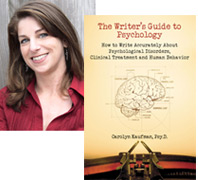
Carolyn Kaufman, PsyD's book, THE WRITER'S GUIDE TO PSYCHOLOGY: How to Write Accurately About Psychological Disorders, Clinical Treatment, and Human Behavior helps writers avoid common misconceptions and inaccuracies and "get the psych right" in their stories. You can learn more about The Writer's Guide to Psychology, check out Dr. K's blog on Psychology Today, or follow her on Facebook or Google+! 

Monday, March 19, 2012

Securing Online Reviews

In today's publishing world, more and more of the burden of publicity and marketing falls onto the shoulders of the author.

I've had quite a few newly and soon-to-be published authors ask me if I knew a way to get online reviews. More specifically, good online reviews. 

The answer is yes and no. 

First, what is a good review? To me, a good review is a thoughtful, professional, honest opinion of the book. That doesn't always mean it's a favorable review. 

How does one find reviewers? Well, it depends, in part, on the type of book you have written. I was fortunate. My publisher sent my book to the big review sites like Publishers Weekly and Booklist on my behalf. They also sent ARCs to reviewers who requested through the marketing department. But I did the grassroots campaign myself. 

Again, I was fortunate. My book is traditionally published mainstream YA. There are multiple tour sites that handle my kind of book. I researched and found a great fit with a teen book tour site. I did a 120-stop blog tour that included video interviews, written interviews, previews, live chats, character interviews, this or that lists, essays relevant to the book and, of course reviews. Lots of early reviews. 

But what if your book targets a niche audience or isn't traditionally published? 

I would recommend researching recent releases in your genre. You should be doing this anyway. Get some titles with readership similar to that of your own book. Google those titles and read the reviews. If you like the style of a reviewer, find his or her site and read the review policy. If your book fits the criteria, send a review request. 

The research is so important. Many reviewers put what they exclude on their site. It will save time and aggravation both for you and the reviewer if you research first. If reviewers state they don't review horror or BDSM or inspirational or whatever, and that's what you write, don't get offended. You do NOT want them to review it anyway as they've already stated it's not their cup of tea. Some don't review self-published books. Again, it's their blog; if they don't want to read it, that is their choice. Don't try to change their minds (you would not believe how often this happens). Go find someone who will. Approach reviewers who have written reviews for similarly published books. 

Summing up:

Accept no. For all the reasons above, if a reviewer declines to review your book, consider it a blessing. That review may not have helped you. 

Research, research, research. Sometimes blog tours are effective, other times it's better to arrange specific targeted reviews. Know your market and new releases in it, then figure out whose hands your book should be in to give it the greatest positive exposure. 

Be professional. As I said before, a good review does not always mean a favorable review. Not everyone will like your book. Not even those you provide with a free review copy. Hold your breath and your tongue (or fingers on the keyboard) and move on. 

One final observation: Big isn't always best. Many of the huge review blogs have redundant readership. In working with my tour coordinator, we made sure that we included many smaller blogs with unique readership in my target audience in addition to the larger blogs. 

Do you have tips for securing reviews? I'd love it if you'd share them in the comments.

Wishing everyone a fabulous week! 

Mary

Mary Lindsey lives in Houston, Texas, where she teaches acting to children and teens. She has one husband, two dogs, three children and dozens of hissing cockroaches.

Her debut novel, Shattered Souls, was released in December 2011. Upcoming projects include Annabel, a YA gothic based on Edgar Allan Poe's poem, "Annabel Lee" (2013), and a companion book to Shattered Souls (2014), all from Philomel/Penguin. 

For more about Mary or her books, please visit her website: www.marylindsey.com

Friday, March 16, 2012

Publishing Pulse: 3/16/2012

 QT Success Story

We'd like to congratulate our newest success story: Kimberlee Turley.

Around the Web

Porter Anderson discusses Amazon Singles and Britannica abandoning print among other stories of note on Writing on the Ether.

Author Nathan Bransford discusses the potential lawsuit the DOJ is pursing over possible collusion and the agency model.

There's been a bit of a kerfuffle over PayPal's latest policy toward obscene e-books. The Wall Street Journal discusses the latest developments and softening of this policy.

In the struggle between traditional publishing and Amazon, GalleyCat has the latest on Scott Turow (President of the Authors Guild) and authors Barry Eisler and Joe Konrath discussing the current state of publishing and looking to the future.

Editor Alan Rinzler has a great post on taking a short story and turning it into a novel.

Have a great weekend!


Danyelle Leafty| @danyelleleafty writes YA and MG fantasy. From March 12th-31st, she will be donating royalties from both paper and digital copies of THE FAIRY GODMOTHER DILEMMA: CATSPELL to purchase Kindle Fires for a pediatric unit in a local hospital. Click here if you'd like to learn more. She is also hosting a short story contest for Kindles for Kids.


Wednesday, March 14, 2012

Creating Cover Love


What makes you decide to buy a book? For most people, it comes down to the book blurb, the opening pages, and recommendations from friends. But for the reader to pick up the book in the first place, the cover has to grab her attention. 

With self-published stories, it’s vital your cover is eye-catching (in a good way) if you hope to get the sales you covet. Unlike traditionally published books, the onus is on you to nail the cover so that people will want to check the book out, and hopefully buy it. To ensure your cover shines, here are some tips from a photographer’s point of view. Even if your book is being traditionally published, some of these tips will help you if your publisher asks for your input.

Theme and Symbolism


One of the best ways to ensure the cover best represents your story is to create a list of the story’s themes (if you only have one theme, that’s fine. Just make sure you know what it is). This will help you find the perfect picture for the cover. If your themes are dark, then you’ll want to skip on the light and breezy images. Or, you might find a picture you love, that’s perfect for the story, but a slight adjustment needs to be made for it to work for the cover. For example, the above picture was originally much lighter, sweeter, but it wasn’t quite right for the story, which is about a mother’s desperate attempt to find her daughter who went missing two years ago. The image fit what the author was looking for, but the picture needed to be darkened to fit the tone of the story. 


Do you have a symbolic object in the story that might work well on the cover? Or maybe the object doesn’t exist in your story, but it is symbolic of your theme or premise. The underlying subtext might entice a potential reader to pick up the book and check out the blurb. 

Genre

Are there any expectations within the genre as to cover design? The cover of a romantic suspense will be different to that of women’s fiction. The cover of a middle grade book will not be the same as one for erotic romance. 


Visit your local bookstore and study the covers within your genre. Make a list of the ones that appeal to you, and note if there is anything you find overdone. You want your cover to standout, not be one of several dozen lookalikes. Note what you like and what turns you off. Maybe you don’t like the overall design but there’s an element in it that you love. Write this down. All this information is important for creating the final product, especially if you’re hiring someone to design the cover. 


If someone were to look at your book, would she know what to expect? When the reader looks at the above cover, she anticipates the book is for middle graders and will contain elements of magic. Also, she expects the story will involve a lighter theme. 

Composition
 
When selecting a photo for your cover, or when layering several images, keep the following composition principles in mind:

  • Keep things simple. If you try to put too much on the cover, it will become cluttered and confusing. Worse yet, the reader might assume your story has the same issue. This can easily happen when you layer too many images to make the final product. 
  • Keep things consistent. If you have a dark theme, don’t mix light- and dark-themed images on the cover. The result will be jarring, and not in a good way.
  • Allow for breathing room. This is important for the title and your name. It doesn’t mean you can’t put them over part of the image. It means you don’t want them to compete with the picture for the reader’s attention. The reader might forget the title of the story or your name because the images were too distracting.


  • Use composition techniques, such as framing, to draw attention to the subject on the cover (as in the example below). For more information on different techniques, check out this post.


Hire a Professional

Because the cover is important, consider hiring professional help.  You might have something in mind but can’t find a stock photo you love, or you want something that is unique and won’t also end up on someone else’s cover. In both cases, you can hire a photographer. Some photographers are able to create magic when producing covers (read this post and this post to see how photographer Vania created her magic with Untraceable and On the Bright Side). These photographers love to do post-production work.  Others don't enjoy that side of photography, and lack the necessary photo-editing software to produce a font that will draw the reader’s attention to the title. One author I know experienced this issue. But then she sent the photo to a graphic designer and the results were spectacular.

If you decide to work with a professional, gave the individual a list of words that describe your story (i.e. theme words), the book blurb, the titles of covers you admire, ideas you might have, things you don’t want on your cover. Basically, anything that will make the individual’s job easier. But be realistic. Unless you’re hiring someone to take the photos, you might have to compromise on your want list. And be open to her suggestions. 

When selecting a professional, ask to see her previous work and make sure you’ll be able to have input in the final product. If you love someone’s cover, ask them who designed it. Ideally, select someone who is knowledgeable of your genre. If the individual usually designs covers for romances and has never stepped into the YA section of the bookstore, she might not be your best choice. She doesn’t understand the needs of the genre, especially if your target audience are teenage males.

Know Your Budget


This goes without saying. Unless you have a fairy godmother at your disposal, you don’t want to blow your entire budget on an amazing cover and have nothing left for professional editing. It doesn’t matter how great your cover is if the story behind it is flat and filled with typos and grammatical errors. The bad reviews will haunt you and your future books (unless you change your name). 

Feedback

Get honest feedback. It’s not enough to post it on your blog or show it to you friends, and ask what they think of it. They might lie to spare your feelings and you could end up with a cover that will do more damage than good. And make sure you get feedback from your target audience. Your husband, who only reads thrillers, is not the best person to ask for feedback on your romance cover. And remember, like everything else in this industry, cover love is subjective.

Any other suggestions?

(I would like to thank the above authors for sharing their covers with me. Some of the books are now available. Others will be out in the next two months.)


Stina Lindenblatt writes young adult novels. In her spare time, she’s a photographer and blogging addict, and can be found hanging out on her blog, Seeing Creative.  

Monday, March 12, 2012

Forensics Q&A: Chain of Custody

By Kristy Lahoda | @KristyLahoda

Disclaimer: The information provided in this post should not be used for malicious intent unless it is in the form of crime writing. The author is an explosives expert, not a crime scene expert. While every attempt was made to ensure the accuracy of this information, for security purposes, some details may have been withheld.

QUESTION: In my crime novel, there are scenes involving courtroom testimony about the evidence that was collected at the crime scene. What happens to evidence at a crime scene once it’s been collected?

ANSWER: An investigator from the agency that had jurisdiction over the crime scene will take the evidence to the proper lab. Depending on the state, it could be the state crime lab, state highway patrol lab, state fire marshal’s lab, a city or regional crime lab, or even governmental labs such as the Federal Bureau of Investigation, the Drug Enforcement Agency, or the Bureau of Alcohol, Tobacco, Firearms and Explosives. It really just depends on the jurisdiction. 

So what is chain of custody?

Chain of custody provides a record of time and possession/location of the evidence. This is documentation that later becomes important if the case goes to trial. If the evidence cannot be accounted for from cradle to grave—from detection at the crime scene, to delivery to the crime lab, to analysis, and to either destruction or its return to the submitting agency—it is impossible to prove that the evidence has not been tampered with. This is often a tactic of the defense attorney and rightfully so. The evidence needs to stay secure at all times. 

How does a crime lab keep track of chain of custody?

Once the evidence is collected and packaged, the investigator secures it with evidence tape, initial and date it, and bring the packaged evidence to the lab from the crime scene. Paperwork is submitted with the evidence that provides a description of the evidence in each container along with the type of evidentiary tests that the investigator wants run on the sample. For example, if the investigator suspects that an item of evidence was used to commit arson and this item potentially has latent prints on it (such as a gas can), then there will be an indication such as checked boxes that will let the lab analysts know to analyze the evidence for arson and latent prints.

In many crime labs, each piece of evidence is received and logged into the Laboratory Information Management System (LIMS) by the evidence-receiving technician. The investigator’s name and submitting agency will be on the evidence receiving form and once the evidence is logged into the LIMS system, it will be transferred from the investigator’s possession to the evidence storage area. Once the lab analyst wants to analyze the evidence, he or she will first transfer it into his or her possession, then cut through the evidence tape, breaking the seal. After analysis, the lab analyst will place the evidence back in the original container, add another piece of evidence tape to seal the package once again and write his or her initials and possibly the date. The initials are written half on the tape and half on the package. The evidence is then transferred back into the evidence storage area. Each transfer is logged into the LIMS indicating the time and date of transfer.

What happens if the chain of custody is broken?

If proper chain of custody is not documented and maintained, there will most likely be serious repercussions for the case in court. This could lead to the perpetrator being found not guilty even if s/he was actually at fault for the crime. 


Kristy Lahoda, Ph.D., is an explosives analyst contractor in a crime lab as well as a science content editor for a major educational publishing company.  She writes Christian forensic suspense and discusses forensics on her blog called Explosive Faith.  You can follow her on Facebook and Twitter.

If you have a forensics question for Dr. Lahoda that you'd like to see answered on the QueryTracker Blog, send your question via Carolyn Kaufman using the email link under Contact Us in the right-hand column of the main QTB page.

Friday, March 9, 2012

Publishing Pulse: 3/9/12


Success Stories

QueryTracker would like to congratulate our newest success stories: Marion Browning-Baker and Abigail Schmidt!

Around the Internet

Writer Wren Emerson teaches you to build a unique paranormal world, and she gives you specific, easy-to-follow steps to do it!

The Justice Department is threatening to sue "Apple and the nation's biggest book publishers...for their alleged price-fixing of electronic books  unless the companies agree to change their business practices." Read more on The Washington Post.

Do you use Pinterest? Rachelle Gardner gives you Pinterest: 13 Things Writers Should Know, including copyright concerns you should be aware of. (And if you want more information about copyright cautions than Ms. Gardner provides, check out Business Insider's article on a lawyer who deleted all her Pinterest boards after reading the terms of service.)

Ms. Gardner followed up her Pinterest post with one on Goodreads: 8 Things Writers Should Know. She includes a link to a previous article in which she explains How Authors Can Effectively Use GoodReads.

Want to make your blog a go-to resource? Here are 5 Keys to Blog Usability. You'll notice that the article is about things like navigation and other design issues--something far too many bloggers neglect!


Carolyn Kaufman, PsyD's book, THE WRITER'S GUIDE TO PSYCHOLOGY: How to Write Accurately About Psychological Disorders, Clinical Treatment, and Human Behavior helps writers avoid common misconceptions and inaccuracies and "get the psych right" in their stories. You can learn more about The Writer's Guide to Psychology, check out Dr. K's blog on Psychology Today, or follow her on Facebook or Google+! 

Wednesday, March 7, 2012

Your Character's Language

Five minutes after meeting a guy at my daughter's winter concert, he stopped the conversation and said, "Are you an engineer?"

I laughed out loud. "No, but I'm bilingual in Geek."

I explained that I was married to a Geek, and then, as it turned out, my Beloved Geek works for the same company as the gentleman to whom I was speaking. In five minutes of talking to a senior computer engineer about music theory, I'd matched my diction and conversation style to his, and he'd pegged me for an engineer.

Why is this important? Because within five minutes of reading about your main character, we should peg him or her for what he or she is, even if he or she never mentions it. This isn't "voice" in the current usage of the word, which refers more to the feeling generated in the reader by seamless, comfortable prose. Instead I'm talking about your characters speaking as themselves.

The advice we commonly hear is "write what you know," but most of the time we're not following that to the letter. Perhaps your main character is a hair stylist, and you yourself are not a hair stylist. How do you write this character convincingly?

First, you learn to speak like your character.

In the past, I've had to become bilingual not only in Geek but in Musician, Stutterer, Police Officer, Auto Mechanic, Priest, and NASCAR Driver. The languages aren't hard to master -- but that's deceptive because every subcategory of person is going to have its own lingo and its own frames of reference. In order to convincingly write these characters, you need to immerse yourself in the way people of that category speak.

And to raise the degree of difficulty, your character most likely doesn't fit into only one category: sometimes she may be speaking like a homicide detective, but at home she may be speaking like a bereaved mother, and maybe on Sundays she's speaking like an evangelical Christian. Meaning for the duration of the book, you her writer need to be trilingual.

The way to do that is not to string a bunch of cliches together. It's to learn to speak like your character; think like your character; frame reality like your character.

"But Jane," you're saying (because I can also speak Baffled Writer), "um, how?"

The trick isn't just researching the character's background and the information your character would know. You can pick up a book and learn how police investigate a murder or how a violinist tunes a violin. In order to hear how these characters speak, you need to do the following:

1) Talk to real-life people who do these jobs or fit these classifications

(You didn't need to read a weblog to know that, so we'll move on.)

2) Pick up magazines written for and read by individuals in these jobs or classifications. You'll combine facts with lingo this way and get a basic sense of usage. (At first you will be very, very confused. Just let it all wash over you. It'll begin to make sense soon enough.) Even the ads will tell you what the target audience wants, needs, and fears. 

3) Find a support group online where people of your character's description gather. And read. Read. Read. Read. Read everything you can find. Don't pay attention to who's posting and when. Absolutely do not post there yourself. But immerse yourself until you're breathing the same air your character breathes.

Online support groups are invaluable. When I researched stuttering, I googled it thinking I'd learn a couple of things, and five hours later, I had adopted a new mindset. The gift of speaking suddenly didn't seem all that natural any longer. It was a shock. It was amazing. I'd learned a dozen acronyms I'd never thought of (PWS, SLP...) and learned the most common pitfalls, problems, and issues. And how nasty people could be to those who stutter. My character improved a thousand percent.

When writing musicians, I visited violinist.com.  Support groups for violinists? Sure, why not? And the issues they wrote about weren't the issues I'd necessarily have assumed violinists face. I learned some of their prejudices, some of their pitfalls, some situations most violinists face, and their most common questions. I got to hear high-level players giving advice to newer players, and I learned from them. I learned how deeply some of them feel for their instruments.

Did I use the specifics? No, of course not. But did I get a sense of the emotional range among musicians? And did I leverage that to create my characters? You bet.

Similarly, blogs by people dealing with what your character deals with? They're a gold mine for capturing your character's mindset, lingo, language, and situations the character will find commonplace in his or her line of work.

4) Podcasts. Listening to someone talk off-the-cuff about his profession or self-categorization will give you everything you ever need to know about how your protagonist should speak. You'll hear the usage of their everyday terminology. You'll pick up not just the lingo but how it combines with their ordinary diction.

When you speak to someone directly about his profession, he'll tell you what he thinks about his profession. But when two professionals are talking with one another, they're going to be honest about the tough parts and the surprising parts. Mine this. It's gold.

Is reading or listening like this voyeuristic? In some senses yes. But it's all been posted in public by people who knew they were posting in public. So access it without guilt.

Moreover, when you're writing a character, you will want to do a good job portraying every single aspect of that character because of respect. Your characters deserve that much. When you truly respect a group or a profession, you want to show it as it is, and that means learning as much as possible about it. 

The internet gives you a window into the unpolished lives of every kind of person there is, every profession, every subcategory of human being. Leverage it to create the truest characters you can.

---

Jane Lebak is the author of The Guardian (Thomas Nelson, 1994), Seven Archangels: Annihilation (Double-Edged Publishing, 2008) and The Boys Upstairs (MuseItUp, 2010). At Seven Angels, Four Kids, One Family, she blogs about what happens when a distracted daydreamer and a gamer geek attempt to raise four children. She is represented by the riveting Roseanne Wells of the Marianne Strong Literary Agency.