Posted 8/31/2012 09:00:00 AM by
Stina Lindenblatt
Success Stories
Want to know what the publishing process is
like from idea to final product? Check out Nathan Bransford’s hilarious look at
the publishing process in GIF form. No matter what kind of day you’re having,
it will make you smile.
Theme is a word most high school students
and fiction writers cringe at. Dr. John Yeoman wrote this brilliant post that
should help you muddle through yours.
Kobo has struck a deal to sell e-books and
its line of e-readers through independent U.S. booksellers. This sees an end to
the agreement between Google Inc and the American Booksellers Association.
If you’re
self-publishing your novel and trying to figure out your cover, traditionally publishing
it and want to know what to expect with the cover design, or are just having a
rotten day, this funny but information vlog from cover designer, Chip Kidd, is
the answer to your prays.
Have a great weekend
everyone! And to those of you living in Canada and the US, we hope you enjoy
your long weekend.
Stina
Lindenblatt @StinaLL writes young adult novels. In
her spare time, she’s a photographer and blogging addict, and can be found hanging
out on her blog, Seeing Creative.
File Under:
Posted 8/29/2012 07:00:00 AM by
Danyelle L.
One of the most interesting things about being human, is that we see the world, not necessarily as it is, but through the lenses of our own perceptions.
When we write a story, our characters do the same.
The most compelling characters are those that act as a conduit to pull the reader out of their world and into the world we've created in our story.
So how do you decide whose story you're going to tell? Imagine how different A Christmas Carol would be if it had been framed around Marley or the ghosts of Christmas instead of Scrooge.
One of the best pieces of writing advice I learned early on was to chose the POV of the character who had the most to lose when writing a scene. I agree with this 100%, since a well-rounded character will have their own perceptions and act as the focal point of understanding to their own world.
But doing this only tells us how to write it, not
who to write about.
So how do you decide who the main character will be and whose point of view you'll frame the story around?
Figure Out What You Want to Say
Stories, in general, have a kernel of truth at their core. A perception, a thought, a question, a statement. Some are written purely for entertainment, but others--my very favorite--are saying something through Story.
Whether or not you intend to speak through Story, Story will speak for itself, so it's a good idea to decide what it's going to say. Will it be the journey of a man to a miser back to a man again? The regrets of a selfish man who had precious little humanity inside him when he was alive? The story of three Christmas spirits as they work to transform people and remind them what it means to be human?
Those choices are all really different facets of one story, but which facet will you choose to focus on?
Decide Whose Story You Want to Tell
Once you've figured out what you want to say, you're going to need a voice to speak throughout the story. The character who connects the reader to the book in their hand.
For me, even though this is the second logical step, this is the first step for anything I write. The character is sometimes a whisper at the back of my head, but most of the time he or she says something that stops me in my tracks. It's usually just a single sentence, but a provocative one that instantly grabs my attention.
For my upcoming release, my main character looked at me matter-of-factly and said, "Death has bright green eyes and a wide smile."
There was so much Story in that single line (that also went on to become my opening line) that I
had to chase down the words and take them apart to see exactly what that phrase meant.
So guess whose story got told?
If you know what you want to say, then make sure you pick the voice best equipped to say it. If not, my preference is to always go with the most vibrant, dynamic, and lively character that pops out of the ether and demands their story be told. O:) If one of those types of characters isn't coming after you, don't be afraid to just sit back and listen. The right voice to tell the story isn't always the loudest.
Get Into That Character's Head, Heart, and Shoes
In order to effectively tell the story, you're going to have to slip out of your perceptions and sometimes go outside of your own experiences. Because you aren't telling the story as yourself--unless you're writing NF or a memoir, in which case, disregard this--you're telling it as someone who lives outside of the world you've carefully crafted out of your own perceptions, beliefs, and experience.
You have to learn to be able to see the world as your character does. Live it. Breathe it. Experience it--as he/she does. Otherwise, it will just be you behind the curtain.
Sometimes this can be achieved through research, but most of the time, it's just as simple as sitting back and allowing your character to speak. Learning how to listen so you can hear their voice and weave it through the story. Finding ways to see the world through a different set of eyes. Letting go of yourself so your character can get on with the telling of the Story.
Because that's what Story is all about. Story allows us to shed our own skins and try on someone else's for a time.
How do you decide whose story to tell when you sit down at write?
Danyelle Leafty| @danyelleleafty writes YA and MG fantasy. She is the author of The Fairy Godmother Dilemma series (Catspell, Firespell, Applespell, and Frogspell), and Slippers of Pearl, and can be found on her blog. She can also be found on Wattpad.
Posted 8/27/2012 09:00:00 AM by
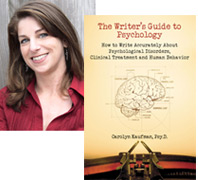
Carolyn Kaufman | @CMKaufman
One of the challenges of writing relationships is making romantic relationships realistic. A problem I see in some fiction is that there is no reason for the characters to fall for each other or be in love—other than the fact that they're both excruciatingly hot, of course.
As in real life, your characters should be attracted to the people they're attracted to for a reason beyond the superficial. (Don’t get me wrong, some people fall into passionate but superficial relationships, but they tend to burn out quickly without the other important aspects of true love: commitment and intimacy.)
In real life, finding and getting along with your “other half” long-term is difficult. The good news when it comes to fiction is that Conflict is the engine that keeps every story going, and the love relationship between your characters is one of the most important parts of that engine.
Some questions to help you generate realistic conflicts. Try to be as specific as you can when you answer.
- What drives you crazy in a relationship? What are your pet peeves?
- What drives your partner (or past partners) crazy about you?
- What kinds of life decisions and stages have created conflict in your life? That is, which things challenge your relationships? Money decisions? Family decisions? Work decisions? Something else?
- What really stresses you out (in general)? How does this impact your relationships with others?
In real life people choose the partners they do for all kinds of reasons, some of them noble and romantic, some of them less so. For example, maybe they had great "chemistry" with their partner. Maybe they had a lot in common. Maybe they need to feel needed. Maybe they wanted to get out of their parents' house. Maybe they were ready to settle down. Maybe they needed someone to help them parent a child. Regardless, there is definitely a reason other than that an author needed them together to make a particular storyline work.
Some things to think about:
- What attracted your character to the love interest in the first place?
- What needs does the love interest fulfill for your hero or heroine?
- Why is the love interest different from all the other men and women out there?
Once your characters are together, why do they stay together? Doing couples therapy was always a fascinating endeavor for me, because couples with enormous problems would come in and complain about each other and the relationship—but still want to make it work. They still loved each other. And they could usually tell you why. In other words, for all of the ways they drove each other crazy, they always had a reason that they were still together.
In my stories, relationships are usually messy. People say the wrong things, have affairs, and hurt each other—sometimes accidentally and sometimes on purpose. Ex-partners create havoc, hidden histories drive wedges, but in the end love always prevails for me. I like to pretend to be pragmatic and sensible, but the truth is that I'm a hopeless romantic, and in my stories, love really is the greatest power of all.
Ask yourself:
- What is the absolute worst thing each partner could do to the other? (Usually the "worst thing" varies by character.) Why is that the worst?
- Can you work that conflict into your story?
- Why might your characters still want or need each other in spite of this betrayal?
- Usually things are not "like new" after a betrayal—what are the lingering effects of having survived the conflict?
I'm most drawn to fictional relationships where there is a strong, identifiable reason for an attraction at the same time there are problems (internal or external to the relationship) that are trying to tear the couple apart. For me, the attraction to each other has to be stronger than the problems, but not by much. The characters have to keep coming together the way a pair of magnets will. They might push against each other, but inevitably, they snap together and hold on.
How about you? What are your secrets for making romantic plots and subplots work?
Posted 8/24/2012 09:00:00 AM by
Ash Krafton | @ashkrafton
Success Stories
Congratulations to two writers who shared their success stories with us: best wishes go out to
Marcy Kate Connolly and
Tracy Bilen.
Ready to write your own success story?
If you're a
QueryTracker member (membership is free) you can view the database of more than 1200 agent and publisher profiles. Premium Members
can be notified whenever an agent or publisher is added or updates their profile, in addition to receiving access to several other enviable features.
Publisher News
Random House Canada launches a new emag: Hazlitt, named after 19th century critic and journalist William Hazlitt. Hazlitt isn't a newspaper insert full of promotional ads; it's a "digital habitat" that is "absurdly eclectic" and "writer-centric." What does that actually mean? Two words: interesting content. Hazlitt is accompanied by an ebook line, Hazlitt Originals.
The Great Debate
People often compare traditionally-published bestsellers to unsuccessful self-published books when expressing anti-indie views…but what about the flip side: wildly successful indie books or manuscripts that never make it out of a big house's slush pile?
This article takes an interesting look at the growing trend of indie books.
Austen? Whitman? Hathorne? Dickinson? Yep. They all did it. A
new exhibit in London highlights several iconic writers who published, or paid to publish, their own work.
Self-publishing or traditional publishing? How about…both? An author explains
why doing both may be a better way to launch a successful career.
Thinking about skipping the whole traditional publishing gamut and getting your book out on your own? Self-publishing a book takes a lot
more work than simply converting a document to an epub file: it takes expertise.
Blogospherically Speaking…
In a post about non-fiction platforms and comp titles, agent Janet Reid discusses
Amazon rankings and how they can help you and your book.
One of the reasons for the growing self-published trend is time--publishing is a slow process. (It's probably why we QueryTracker users are addicted to response time stats!) Agent Rachelle Gardner has
excellent advice for dealing with impatience.
Impatience isn't the only demon that torments writers--our self-confidence is always under attack. Here's a nice piece about
regaining confidence in our writing.
Have a great weekend, everyone.
Ash Krafton is a speculative fiction writer who resides in the heart of the Pennsylvania coal region, where she keeps the book jacket for "Abraham Lincoln: Vampire Hunter" in a frame over her desk. Visit Ash's blog at www.ash-krafton.blogspot.com for news on her newly released urban fantasy "Bleeding Hearts: Book One of the Demimonde" (Pink Narcissus Press 2012).
Posted 8/22/2012 08:00:00 AM by
Jane | @janelebak
What if the most poignant parts of your story are the parts you don't say?
Beginning writers hear it dozens of times: show, don't tell. We cross out "Ted was mad" and say, "Show us how angry Ted is so we can feel it," and the intermediate writers dutifully show Ted punching walls, clenching his teeth, and stomping up the steps.
The next step is to show all your characters' feelings, not just your POV character's, so that when Jill watches Ted stomp up the steps, she knows he's feeling mad without having to tell the reader, "Wow, Ted was furious."
I've worked recently with a few newish writers on their first novels, and I'm picking up a trend from them: the need to reinforce their stories. It's not technically wrong, but it's giving their stories a feel I have to call amateurish, and I want to call attention to it, because it's standing in the way of otherwise good fiction. I'm going to call this overshowing and overtelling.
When we first start telling stories, it's difficult to prioritize what needs to be in and what needs to be left out. Back when I was in college, one of my best mentors read one of my early novels (I owe the poor woman a case of hard liquor for that service) and she told me to back off the reader. "Don't keep reminding us of things," she said. "Every time this character showed up, he had green eyes. Every time. I thought, maybe they change? No, they're always green, and eventually, whenever he showed up, I'd find myself waiting for the green eyes."
We do this because as writers we're afraid the readers are going to forget, or are going to miss something. Or, it's a more insidious problem: it's not the readers we doubt.
She continued, "You can trust us. I see you showing us something, like that he's angry, and then you tell us he's angry. But you can trust us: trust your reader that we'll get what you're doing. And more than that, trust yourself that you did it right the first time."
(When you get a chance,
check out the TED talk on designing a book cover. At 3:03, take special note of what Kidd says about the word 'apple' and the picture of an apple, how you may have one but not both.)
If Jill insults Ted, we know it's an insult because we're paying attention, and we're smart. When a writer follows it up by saying, "Jill smiled at the cleverness of her insult," we as readers feel talked-down to. No doubt what the writer wanted was to make us think Jill's insult was pretty funny, but telling us twice has the opposite effect: we back away because it reminds us we're reading a book and for that second, we're no longer experiencing it.
To be really extreme, take something like this:
Ted picked up the pottery jug, glared at Jill, and smashed it against the wall. Ceramic shattered against the concrete. "That's what I'd like to do to your head!"
Quick: what's he feeling? What's the tone of his voice?
Now imagine it if I do it this way:
Ted angrily picked up the pottery jug, glared at Jill with fury, and in a fit of wrath smashed it against the wall. Ceramic shattered against the concrete while Jill stared, wide-eyed in terror. "That's what I'd like to do to your head!" he thundered.
By the time you get to the end of that, you're pretty much snorting with laughter, like okay, I get it, he's pissed. But when a writer does that over and over, it's as if the writer is holding the reader's hand and trying to guide her toward the emotions she should be feeling in the scene, rather than relating the scene and allowing the reader to do her job and really feel it.
Okay, so now you know not to overtell and overshow. But what if you take it one step further and deliberately undershow and undertell? How would it work? I'll tell you, done right, it works beautifully.
Try framing it the way
Ivy Reisner
did to me: partner with your reader. Give two parts and let the reader fill in the third. Ted picks up that pottery jug and cocks his arm, and in the next moment, ceramic shatters against the concrete. Your reader will know he threw it at the wall without your saying so. If Jill takes a pregnancy test and shrieks when reading the result, the reader will probably know what it was.
I call this '
elision.' And it's a lot of fun: how much can you remove without losing the reader?
I didn't invent this literary technique, although as far as I know I'm the only one who applies a linguistic term to it. If you've read
Pride and Prejudice (if you haven't, go do it now) the moment of the proposal is rendered obliquely: Mr. Darcy makes it known to Elizabeth, and she gives him to understand her acceptance. We don't truly witness it, and yet we know it happened. In
Sula, Toni Morrison shows Sula swinging Chicken Little by the arms, and even though it's a pivotal moment in the novel, his slipping from her hands is rendered in a dependent clause such that we never see it happen; we never know whether it was accidental or intentional.
It's a game of Jenga with your story, only the structure gets stronger when you remove the unnecessary bracing. Readers instinctively engage when they're hungry to know and you're giving them just enough at just the right times...but not too much.
Does this require your reader to pay attention? Yes. Does it require you to place a great deal of faith in both your skills and your reader? Yes. Will some people miss a point until they've read the story twice, and therefore many will never get some of your finer details? Yes.
Is it worth it anyhow? Absolutely yes.
Sometimes the writer's most important job is to get out of the way of the story.
---
Jane Lebak is the author of The Wrong Enemy, to be released by MuseItUp this coming September. She is also author of The Guardian (Thomas Nelson, 1994), Seven Archangels: Annihilation (Double-Edged Publishing, 2008) and The Boys Upstairs (MuseItUp, 2010). At Seven Angels, Four Kids, One Family, she blogs about what happens when a distracted daydreamer and a gamer geek attempt to raise four children. She is represented by the riveting Roseanne Wells of the Jennifer DeChiara Literary Agency.
Posted 8/20/2012 09:00:00 AM by
Stina Lindenblatt
by Stina Lindenblatt @StinaLL
@Stina Lindenblatt
Last month, I attended the Romance Writers of America (RWA) national
conference in Anaheim. What were the most popular sessions? Those conducted by
screenwriters. No, writers weren’t attending the sessions because they hoped to
write an academy winning screenplay or because they want to turn their novels
into movies. They knew these individuals had the knowledge that could take the
writers’ stories to a new level, when they applied the successful techniques
employed by Hollywood.
Most novelists study their craft by reading books on writing fiction.
But don’t ignore books written for screenwriters. A popular one for both
screenwriters and novelists is Save the
Cat by Blake Synder. Not only does it provide a solid framework for
structuring your story, the publisher (Michael Wise Productions) has an
impressive list of books that will appeal to novelists, too. Topics range from
story structure, subtext, symbolism, characterization, story lines. The best part
is, they use examples from well known movies and TV shows. You don’t have to
suffer through an excerpt taken out of context or spend hours reading the novel.
You can easily watch the show or movie in a fraction of the time. Warning: after
reading these screenwriting books, you’ll never watch a movie or TV show the
same way again. And for that, I apologize.
I’ve attended a number of workshops for fiction writers. Some are by
novelists, others by screenwriters. The ones that had the most impact on me were
those conducted by screenwriters, or those involved in making movies. Why?
Because I’m a visual person. Novelists tend to read examples from their novels,
and being the ADHD person that I am, my brain tends to wander. The author’s
point is then lost on me. But with the screenwriters, they show clips from
movies to prove their point. At the RWA nationals, I attended a session on The
Six Layers of Characterization. The instructor explained the character-trait
diamond for Helen Hunt’s character in As
Good As It Gets. He then played a clip from the movie, while pointing out
how she demonstrated those traits through dialogue, action, body language. It
was a powerful example of characterization.
As writers, we need to read. A lot. We read both in and out of our
genre. We analyze stories, and figure out what we liked and didn’t like about
them. You can do the same with movies and TV shows, and apply what you learned
to your story. Fiction writers don’t have the benefit of music to create mood.
Study other techniques used in a movie, in a similar vein to your story, which
conveyed mood. Find a way to incorporate them into your writing. What kinds of
symbols were used to reveal characterization and plot? Study how the actors
portrays the characters. What kinds of physical details relating to the
character or setting does the director zoom in on that adds power to the scene?
Can you use some of those techniques in your story?
In movies, the story is revealed through action and dialogue. There are
no inner thoughts—most of the time. So how does the viewer get inside the
actor’s head? Subtext. What do readers love? Subtext. Want to know how to do
subtext well, then study movies. Analyze the difference between the great
actors and the B-grade ones, then apply it your story to make it and your
characters come to life.
Don’t just watch a movie for its entertainment value. Watch it. Study
it. Dissect it. Just like screenwriters do.
Have you read any screenwriting books you recommend? Have you attended
any screenwriting workshops even though you don’t plan to write a screenplay?
Stina
Lindenblatt @StinaLL writes young adult novels. In
her spare time, she’s a photographer and blogging addict, and can be found hanging
out on her blog, Seeing Creative.
Posted 8/17/2012 07:34:00 AM by
Jane | @janelebak
We updated nine agent profiles this week, including agents who opened or closed to queries. Please make sure you double-check every agent's website or Publisher's Marketplace page before querying.
Literary Quote of the Week:
"Every day should be unwrapped as a gift." -Harry Harrison
That's all we have for now. Until next week, keep those queries flying!
Jane Lebak is the author of The Wrong Enemy, to be released by MuseItUp this coming September. She is also author of The Guardian (Thomas Nelson, 1994), Seven Archangels: Annihilation (Double-Edged Publishing, 2008) and The Boys Upstairs (MuseItUp, 2010). At Seven Angels, Four Kids, One Family, she blogs about what happens when a distracted daydreamer and a gamer geek attempt to raise four children. She is represented by the riveting Roseanne Wells of the Jennifer DeChiara Literary Agency.
Posted 8/15/2012 07:00:00 AM by
Danyelle L.
Pursuing a career in writing and publishing can be difficult in even the best of times.
But what about when it's not the best of times?
When you're sick, when you're going through stressful events, or if you're trying to deal with chronic health conditions.
It's during these times that striving to have a big picture perspective is vital. As someone who is a bit of perfectionist and extremely driven when it comes to writing, it has been difficult finding that perspective and balance when my body fails me.
Some things I've learned along the way that have helped me cope:
Set Realistic Goals
One of the things I really have to work to remember is that realistic when my body is functioning isn't the same thing as realistic when it's not. I have to consciously pare back my goals and expectations to what my body can do during a flare-up.
It isn't easy to look at what I "should" be able to do and compare it with what I'm physically capable of accomplishing. That's why it's important to remind myself that I'm going through a flare-up and that I have an alternate plan for when that happens. I've also learned that I set more realistic goals when my health is down than when I'm healthy and postulating what I should be able to do when I'm not.
Realistic goals for me--depending on the severity of the flare-up--can vary. Sometimes it's as simple as cutting down my writing and editing load. Other times it means choosing one over the other. And on those very special occasions, it means doing things that don't really look like writing. For example, when I'm too tired to write or edit, I focus on reading or watching TV shows. I choose the book or show with care, because I'm not just reading or watching, I'm paying close attention to how the writer(s) make things work. How they portray their characters, amp up the tension, structure the narrative, etc. So even though I'm not technically writing or editing, I'm still doing something that will further my craft.
Listening to music and just allowing my mind to spin thoughts together has also proven to be very helpful.
Be Flexible--Now More Than Ever
This is a lesson that most writers have to learn. Life isn't generally well-organized and pristine. More often than not, it's messy, complicated, and has a way of intruding at the least opportune time.
But when you have illness, loss, stress, devastation, or any of life's lemons to deal with on top of everyday living, it's especially important to remember to be flexible.
Set your goals, do what you can, and let the best that you can do be good enough. Goals are just a means to an end and not the end itself. I find myself less frustrated when I manage to remember this.
Celebrate the Victories, No Matter How Small
This goes along with being flexible. As a triple A-type personality, goals are extremely important to me because they allow me to measure my progress on things that are within my control.
Because of this, it can be easy to get caught up in meeting my word count goal or editing goal, and very frustrating when I'm unable to. (Add this to being unable to do what I'm normally able to do in other facets of my life, and you have a whole lot of writerly angst.)
I've found that when I'm dealing with life's lemons, I can remove a lot of frustration by learning to see and celebrate as many victories as I can, no matter how small they may be. My usual word count goal is 2,000 words a day. On those days when I've done my best and am only able to squeak by with 100 or so, instead of looking at the 1,900 words I *didn't* get down, I try to focus on the 100 that weren't there before.
Give Yourself Permission to Take Time Off
Sometimes the lemons are so big and heavy that it isn't possible to write on top of trying to survive the citrus assault. It's during those times that it's essential to give yourself permission to take time off.
This is something that's been very difficult for me to do, but I'm finding that practice makes perfect. (I have a feeling that life is going to give me plenty of practice until I get this one down. :p)
When I'm feeling unhappy because taking time off will throw off my writing/publishing plan (I plan five years ahead) or guilty because I could do this if I just tried a little harder, I focus on my family and the people in my life that I love. As important as writing is to me, those people will always be more important. I can't spend time with them if I don't take proper care of myself. Putting it it those terms helps me squelch the disappointment and the try-a-little-harder inclination.
In the Pursuit of Publication, Don't Forget the Joy of Writing
Burnout and lemons, while not usually welcome, can be valuable in so far as they help us slow down. Help us remember why we're doing this in the first place. It can be so easy to get caught up on deadlines, projects, and where we want to be in the future that we can forget to find joy in the moment.
When I write, really write, I'm not jotting down sagas of imaginary people with the intent to be published. No, I'm writing down stories for a number of reasons, not the least of which is because writing brings me joy. Makes me feel more alive and in touch with myself.
Landing an agent, a publishing contract, and a horde of adoring fans can be wonderful, but, for me, not at the expense of the joy that comes from a thread of a thought that unwinds into a story that's larger than myself. For me, those other things are the perks, not the reason, for writing. Hitting bumps in the road and finding lemons on my doorstep helps me distill and clarify that truth (for me), bringing my perspective back to a happier, healthier place.
Danyelle Leafty| @danyelleleafty writes YA and MG fantasy. She is the author of The Fairy Godmother Dilemma series (Catspell, Firespell, Applespell, and Frogspell), and Slippers of Pearl, and can be found on her blog. She can also be found on Wattpad.